
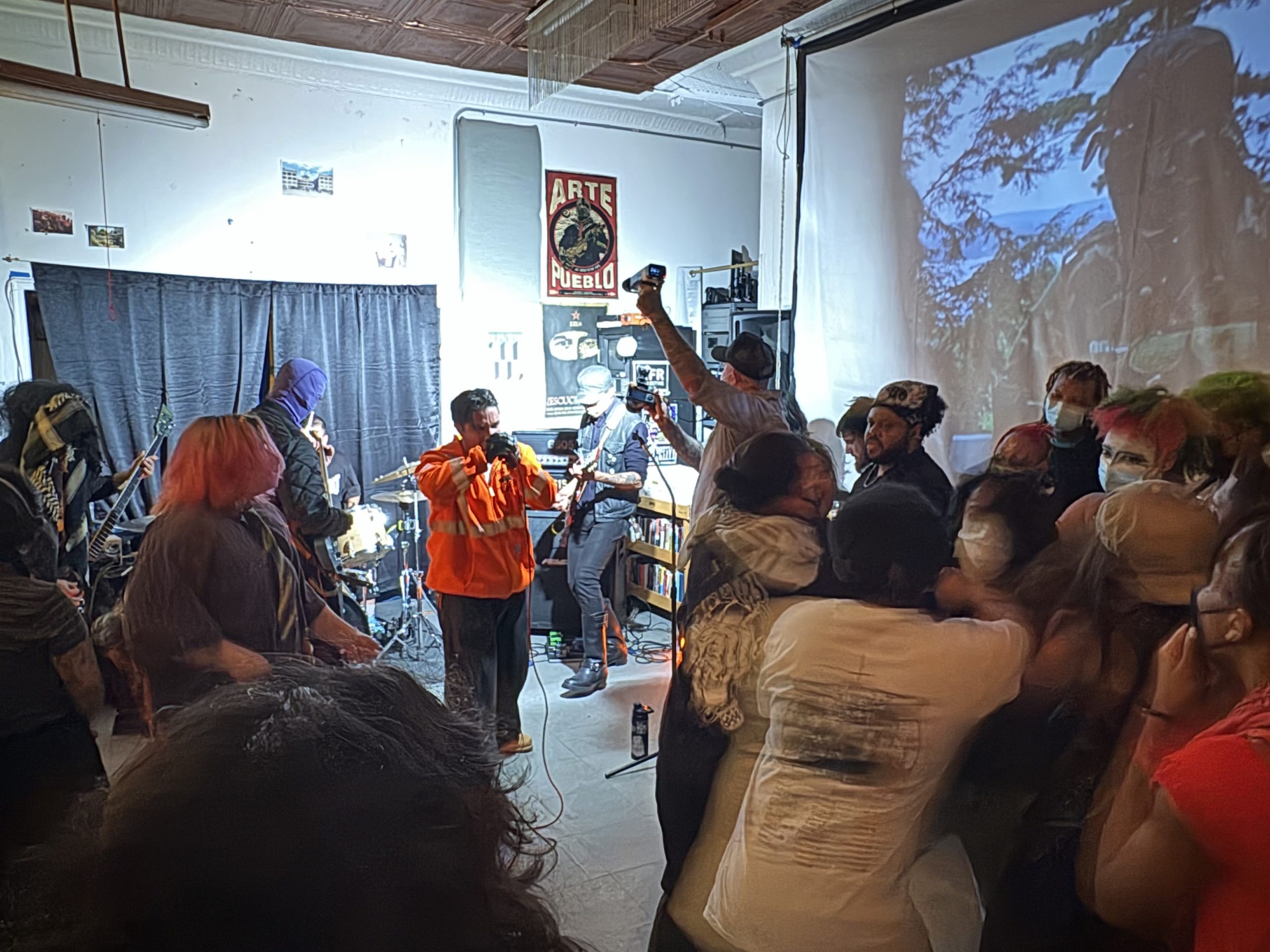
New York punk band FOCO plays a set last week at P.IT., an eclectic venue-slash-bookshop at 411 South 5th St. (Photo: Adeline Daab)
By Adeline Daab | news@queensledger.com
SOUTH WILLIAMSBURG — To the casual passerby, P.I.T. appears to be just another one of Williamsburg’s vibrant book and record shops. Memoirs of revolutionaries, collections of queer poetry, and zines about guerilla gardening overflow from the shelves. But P.I.T. — which stands for Property is Theft — primarily defines themselves as a community space, venue, and info-shop. Book and record sales merely support the reading groups, mutual aid org meetings, shows, and more that animate the corner of 5th St. and Hewes multiple nights a week.
On a recent Wednesday evening, a group spanning almost every living generation perched on an equally eclectic array of plastic folding chairs in P.I.T.. Projected onto the screen in front of us was a grainy documentary with thick subtitles that carried a distinct 2000s charm. “Soma – An Anarchist Therapy” followed the emergence of Soma, a type of group movement therapy grounded in the principles of anarchy. The film makes a point of clarifying from the outset that anarchy is not chaos. “Anarchy is the highest order,” states Soma’s creator Roberto Freire, a Brazilian writer, therapist, and torture survivor. It is “a kind of harmony where everyone knows what they need to do.”
Heavily influenced by Capoeira Angola, a communally-practiced martial art that arose with enslaved peoples’ attempt to liberate themselves from slavery in Brazil, Soma centers around the goal of liberation from what Freire sees as a new form of slavery: neurosis. Freire understands authoritarianism as “the technique that produces the disease,” and anarchy as “the minimum you must know to be healthy and free.” Soma actively works to free people from the crushing influence that authoritarianism has on our social relations. Its philosophy builds on an understanding that we bring about a liberated society by first changing ourselves and the way we connect with others. Soma isn’t for everyone — “I can’t bear it,” one participant shared, “I want my neurosis back” — but those who stuck with it appeared to achieve genuine breakthroughs. Sometimes, these were as small as a participant deciding to hug their parents more often. But each small change, Freire says, matters within the larger movement.
This event was a part of a monthly series of potluck discussions organized by the P.I.T. Care Collective, a community of health workers building a vision toward a Healing Commons beyond institutional logic and boundaries. Following the film, we sat in a circle nibbling at a meal we’d all contributed to. With piles of Yemeni rice and lentils, wedges of orange blossom cake, warmly spiced empanadas, and grapes galore balanced on our laps, attendees mirrored principles of the “hot seat” practice within Soma. Documentary interviewees had described this practice as one of reflective inquiry and response, helping them question beliefs they’d never consciously pondered before. In Wednesday’s discussion circle, people vulnerably opened up about past experiences with violence, shared their disillusionments with individualized therapy and simultaneous fears around group therapy, and wondered how Soma might help people in their lives who are struggling with addiction. Each speaker was met with active listening, deep empathy, and occasionally compassionate pushback. P.I.T.’s heavily-postered walls held space for a form of emotional safety and care that I rarely encounter in environments where most of us are strangers to each other.
One participant reflected on how they’ve often found the type of freedom-through-connection that Soma strives to cultivate at dance clubs or in mosh pits at concerts. “Not every club or show,” they clarified. “Many lack the trust necessary to create this Soma-like experience, but I’ve been to shows here and a few other places that have felt like a form of therapy.”
I returned to P.I.T. two days later for a punk show, arriving between sets. People across the spectrum of punk aesthetics bled out onto the sidewalk, adhered in small clumps by lively conversation and cigarette smoke. The first-ever punk show hosted by mutual aid group Casa Gaza, “Land Back for Land Day” attracted people from around the city to celebrate Land Day with sets from local punk bands. Our sliding-scale donations to attend the show went to sustain Casa Gaza’s nearly two-year long commitment to a monthly donation of $500 to support a family from Gaza with living and medical expenses.
Separation between the musicians of NY-based band FOCO and the audience was ephemeral; the vocalist oscillated between the mic stand and the mosh pit. Drums, electric guitar, and passionate screams moved through the crowd like a gale through wind chimes. Bodies jumped and kicked and swayed and knocked into each other in a joyful expression of liberty and connection — a refreshing willingness to extend beyond individual bubbles and genuinely share space. The intention of the show, the messaging of the lyrics, the ideas swirling through audience conversation, the modes of interaction that emerged alongside the music: it was all about envisioning a freedom that started with us but extended far beyond. This was Soma in practice.