City Council Targets Amazon with Delivery Protection Act

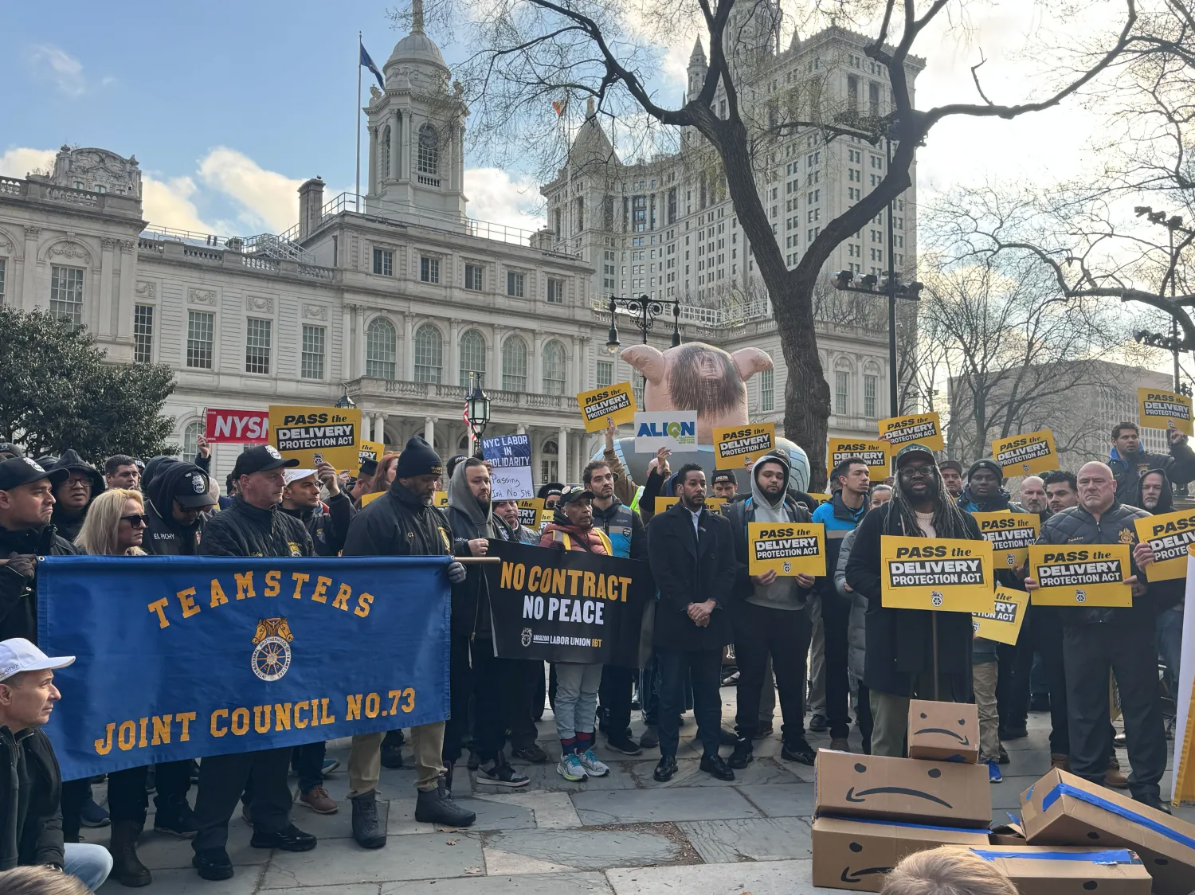
Delivery workers and members of the Teamsters union rally in support of the Delivery Protection Act. (Photo via the NYC Central Labor Council.)

By Cole Sinanian cole@queensledger.com

CITY HALL  — Amazon does not directly employ its delivery drivers, but that could be about to change thanks to a bill sponsored by Astoria City councilmember Tiffany Caban.

The New York City Council’s Committee on Consumer and Worker Protection convened Thursday to hear testimony regarding Intro 518, also known as the Delivery Protection Act. The bill, which would require last-mile delivery facilities to obtain licenses from the city, has been backed by unions and Mayor Mamdani, who’ve hailed it as a potential win for labor that would make Amazon accountable to its workers and improve street safety. Critics, however, have maintained that the bill would only cost consumers by adding unnecessary fees to the delivery process, and hurt the local “Delivery Service Partners” that Amazon contracts to complete deliveries.

Though they wear Amazon uniforms, drive Amazon vehicles, and deliver Amazon packages, Amazon delivery drivers are not technically Amazon employees. Instead, they are employed by the smaller, local companies that operate the last-mile warehouses, called Delivery Service Providers (DSP). Amazon pays workers salaries and sets their schedules and quotas, but if something goes wrong — a traffic accident, for example — it is the DSP that is liable, not Amazon.

As Caban explained in her introduction Thursday, high delivery quotas encourage drivers to move as fast as possible, increasing the risk of accidents. According to a 2025 report from the city comptroller’s office, rates of traffic accidents are on average 137% higher around last-mile facilities. In the streets around just one in Maspeth, Queens, crash rates rose by 53 percent.

“And when these accidents happen, the company who controls the van, the worker, and the route suddenly tells us that this worker is not their employee and that it’s the subcontractors who are to blame,” Caban said.

“My bill would make New Yorkers, including workers, safer,” she continued. “It would require licensing for last mile facilities, direct employment of drivers, protection against unfair termination and retaliation, real worker training, and we have an outpouring of support from workers, unions, environmental groups, and traffic safety organizations.”

If passed, the Delivery Protection Act would require DSPs to pay $500 for a city license. Carlos Ortiz, chief of staff and deputy commissioner of external affairs at the Department of Consumer and Worker Protections (DCWP), characterized the bill as necessary to holding corporations accountable for malpractice.

“This model externalizes costs as well as liabilities which can lead to labor violations and the exploitation of workers in unsafe working environments,” Ortiz said. “We can’t allow protections for New Yorkers to be held hostage to corporate threats.”

As lawmakers heard testimonies at City Hall, a group of delivery drivers convened by a coalition of trade groups called New York Delivers rallied outside against the Delivery Protection Act. Councilmember Caban, however, noted that she had received an email from a group of delivery drivers prior to the hearing which suggested that DSPs had paid their workers to show up to the hearing to protest the bill.

“Drivers were forced to attend,” Caban said in her introduction, quoting the email. “In mandatory meetings, management asked in front of everyone who was not going to go, and they made us raise our hands in front of our co-workers.”

One Amazon driver, a man named Jose Suerta who’s worked at the DBK1 warehouse in Woodside for four years, testified in support of the bill, criticizing the company’s apparent disregard for worker safety.

“I decided to focus on organizing after a particularly hot summer day when a co-worker fainted,” he said, speaking in Spanish through an interpreter. “When she called the dispatcher, this was her response: ‘Sit down, drink some water, and then continue with your work route.’”

”The following week, the same thing happened to another woman,” Suerta said. “She received the exact same response when she called the dispatcher of Amazon.”

Manhattan Chamber of President Jessica Walker, meanwhile, criticized the bill, noting that while its intentions were good, it would add needless bureaucratic hurdles and contradict Mayor Mamdani’s affordability agenda.

”I support every goal this bill claims to address,” Walker said. “I want  delivery workers to be safe. I want them paid fairly. I want our streets safer. “What I oppose is the mechanism because the mechanism doesn’t achieve any of them and it imposes serious collateral damage on small businesses and consumers in the process.”

She continued: “This is the equivalent of putting a New York City tariff on every package that is brought into our city. 2.5 million packages a day. Every one would be more expensive.”

Manhattan City councilmember Harvey Epstein, who chairs the Committee on Consumer and Worker Protection, clapped back:

“There’s an agreement that we need to deal with the issues of additional crashes that are happening in our city, so the questions are, how do you resolve those problems? Sounds like you may disagree that that will resolve those problems, but we need tools to be able to resolve these issues in our city.”

Schwartz: What Mamdani Can Learn From La Guardia (And What He Really Shouldn’t)

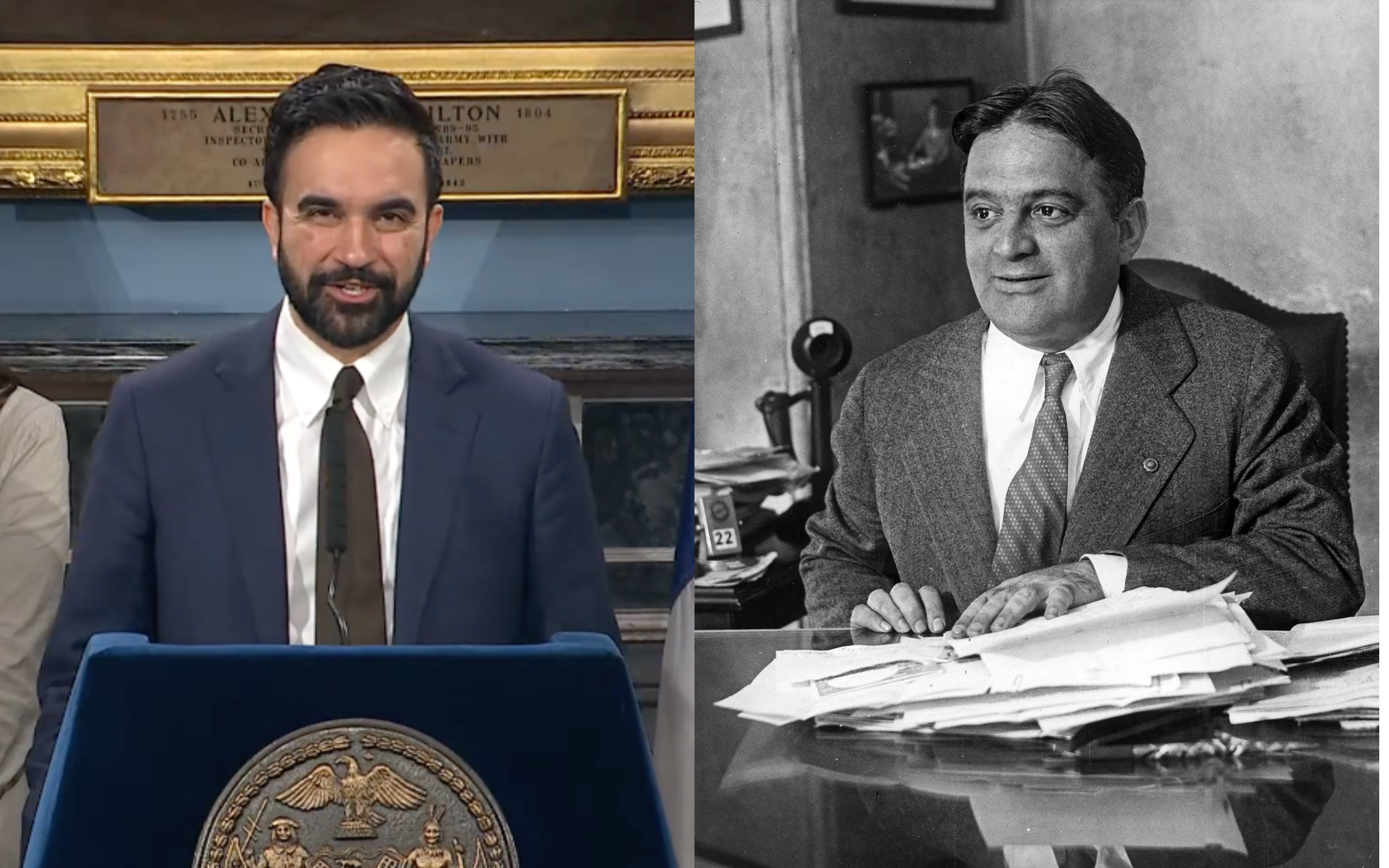
Mayor Mamdani has promised to deliver the “most ambitious agenda to tackle the cost-of-living crisis that this city has seen since the days of Fiorello La Guardia.”

By Lana Schwartzlana.schwartz925@gmail.com

From the campaign trail to his inauguration, Mayor Mamdani has promised to govern in the tradition of Mayor Fiorello LaGuardia, considered widely to be the greatest New York City mayor of all time.

Now that Mayor Mamdani has reached his 100 day mark, the question stands: So far, how does Mayor Mamdani stack up against his political inspiration and many-years-earlier predecessor?

Stuff Mayor Mamdani Has Done Like La Guardia

Making significant investments in housing

Maybe he had to use some unconventional methods to get there, but the mayor’s Sunnyside Yard plan to create 12,000 new homes — half of which would be Mitchell-Lama apartments — would be the biggest investment in housing creation the city has seen in decades.

This fits squarely in the legacy of Mayor La Guardia, the creator of the New York City Housing Authority.

Stood with striking workers

When laundry workers went on strike, Mayor La Guardia stood with them by shutting off the water to two major laundromats, forcing owners to cave to the workers’ demands. So far, no strikes in New York City have come to this, but you can find Mayor Mamdani on the picket line with striking nurses and Starbucks workers.

Fulfilling his promise of“being outside”

In his inauguration address, Mayor Mamdani promised to, in the words of Jadakiss, “be outside.” Similar to how Mayor Mamdani can be found walking from City Hall to Gracie Mansion, or making Instagram reels to promote his policies, Mayor La Guardia was also “outside.” You could find La Guardia conducting an orchestra of the police, fire, and sanitation departments at Carnegie Hall, and he famously read the comics in his weekly Sunday radio show broadcast on WNYC.

A Few Things Mayor Mamdani Can Do to Be More Like La Guardia

Finish Bushwick Inlet Park

It’s what Mayor La Guardia, whose tenure saw the creation of almost 200 new playgrounds, would do. (When in doubt, ask WWMLDWTSTCOATNPD?)

Drink a beer in Congress

Yes, La Guardia was doing it in protest of Prohibition — which means that it was his own concoction made of a “near beer” and two-thirds of a bottle of malt tonic — and yes, Prohibition has long since been repealed. Does that mean it would be any less fun if Zohran found a reason to do it? We will let you answer that for yourself.

Appoint an official magician

It was the mid-1930s, the Great Depression was roaring, and Mayor La Guardia needed a way to boost the morale of the city’s children (or New York’s Cutest, as Mayor Mamdani calls them). His solution: To appoint Abraham Hurwitz as the city’s official magician. Hurwitz, a government employee with a PhD in educational guidance, used magic to help kids learn. One more thing to keep kids off their phones!

Some Stuff La Guardia Did That He Shouldn’t

Build an airport

I think this would cause more problems than fix them.

Smash all the city’s pinball machines

While it would make for a pretty good photo op, there’s really no longer any plausible deniability that pinball is endemic to gambling and racketeering.

Appoint a Robert Moses-like figure to power, setting off a chain of events that will allow an unelected official to wield power unlike the the city has ever seen before, bending it to their will and ensuring that current and future generations suffer from his decision to prioritize cars over people, public transit, and housing

Seems self-explanatory.

Lana Schwartz, a columnist for the Star, is a writer who was born and raised in Queens and today lives in Brooklyn. Her writing has appeared on The New Yorker, The Onion, McSweeney’s, and more. She is the author of the books “Build Your Own Romantic Comedy” and “Set Piece.”

Punk and Potlucks at Williamsburg’s P.I.T.

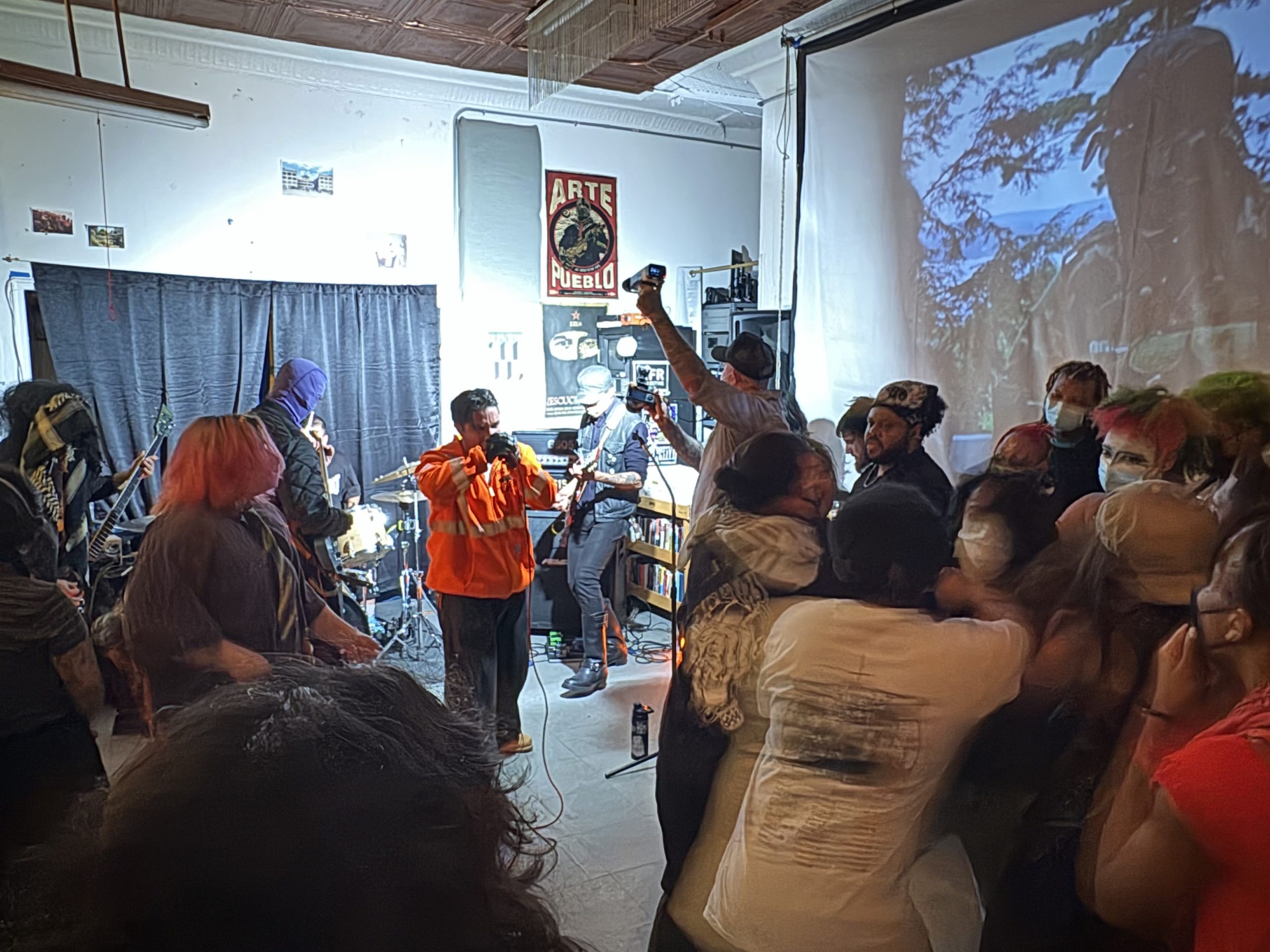
New York punk band FOCO plays a set last week at P.IT., an eclectic venue-slash-bookshop at 411 South 5th St. (Photo: Adeline Daab)

By Adeline Daabnews@queensledger.com

SOUTH WILLIAMSBURG — To the casual passerby, P.I.T. appears to be just another one of Williamsburg’s vibrant book and record shops. Memoirs of revolutionaries, collections of queer poetry, and zines about guerilla gardening overflow from the shelves. But P.I.T. — which stands for Property is Theft — primarily defines themselves as a community space, venue, and info-shop. Book and record sales merely support the reading groups, mutual aid org meetings, shows, and more that animate the corner of 5th St. and Hewes multiple nights a week.

On a recent Wednesday evening, a group spanning almost every living generation perched on an equally eclectic array of plastic folding chairs in P.I.T.. Projected onto the screen in front of us was a grainy documentary with thick subtitles that carried a distinct 2000s charm. “Soma – An Anarchist Therapy” followed the emergence of Soma, a type of group movement therapy grounded in the principles of anarchy. The film makes a point of clarifying from the outset that anarchy is not chaos. “Anarchy is the highest order,” states Soma’s creator Roberto Freire, a Brazilian writer, therapist, and torture survivor. It is “a kind of harmony where everyone knows what they need to do.”

Heavily influenced by Capoeira Angola, a communally-practiced martial art that arose with enslaved peoples’ attempt to liberate themselves from slavery in Brazil, Soma centers around the goal of liberation from what Freire sees as a new form of slavery: neurosis. Freire understands authoritarianism as “the technique that produces the disease,” and anarchy as “the minimum you must know to be healthy and free.” Soma actively works to free people from the crushing influence that authoritarianism has on our social relations. Its philosophy builds on an understanding that we bring about a liberated society by first changing ourselves and the way we connect with others. Soma isn’t for everyone — “I can’t bear it,” one participant shared, “I want my neurosis back” — but those who stuck with it appeared to achieve genuine breakthroughs. Sometimes, these were as small as a participant deciding to hug their parents more often. But each small change, Freire says, matters within the larger movement.

This event was a part of a monthly series of potluck discussions organized by the P.I.T. Care Collective, a community of health workers building a vision toward a Healing Commons beyond institutional logic and boundaries. Following the film, we sat in a circle nibbling at a meal we’d all contributed to. With piles of Yemeni rice and lentils, wedges of orange blossom cake, warmly spiced empanadas, and grapes galore balanced on our laps, attendees mirrored principles of the “hot seat” practice within Soma. Documentary interviewees had described this practice as one of reflective inquiry and response, helping them question beliefs they’d never consciously pondered before. In Wednesday’s discussion circle, people vulnerably opened up about past experiences with violence, shared their disillusionments with individualized therapy and simultaneous fears around group therapy, and wondered how Soma might help people in their lives who are struggling with addiction. Each speaker was met with active listening, deep empathy, and occasionally compassionate pushback. P.I.T.’s heavily-postered walls held space for a form of emotional safety and care that I rarely encounter in environments where most of us are strangers to each other.

One participant reflected on how they’ve often found the type of freedom-through-connection that Soma strives to cultivate at dance clubs or in mosh pits at concerts. “Not every club or show,” they clarified. “Many lack the trust necessary to create this Soma-like experience, but I’ve been to shows here and a few other places that have felt like a form of therapy.”

I returned to P.I.T. two days later for a punk show, arriving between sets. People across the spectrum of punk aesthetics bled out onto the sidewalk, adhered in small clumps by lively conversation and cigarette smoke. The first-ever punk show hosted by mutual aid group Casa Gaza, “Land Back for Land Day” attracted people from around the city to celebrate Land Day with sets from local punk bands. Our sliding-scale donations to attend the show went to sustain Casa Gaza’s nearly two-year long commitment to a monthly donation of $500 to support a family from Gaza with living and medical expenses.

Separation between the musicians of NY-based band FOCO and the audience was ephemeral; the vocalist oscillated between the mic stand and the mosh pit. Drums, electric guitar, and passionate screams moved through the crowd like a gale through wind chimes. Bodies jumped and kicked and swayed and knocked into each other in a joyful expression of liberty and connection — a refreshing willingness to extend beyond individual bubbles and genuinely share space. The intention of the show, the messaging of the lyrics, the ideas swirling through audience conversation, the modes of interaction that emerged alongside the music: it was all about envisioning a freedom that started with us but extended far beyond. This was Soma in practice.

Fill the Form for Events, Advertisement or Business Listing