
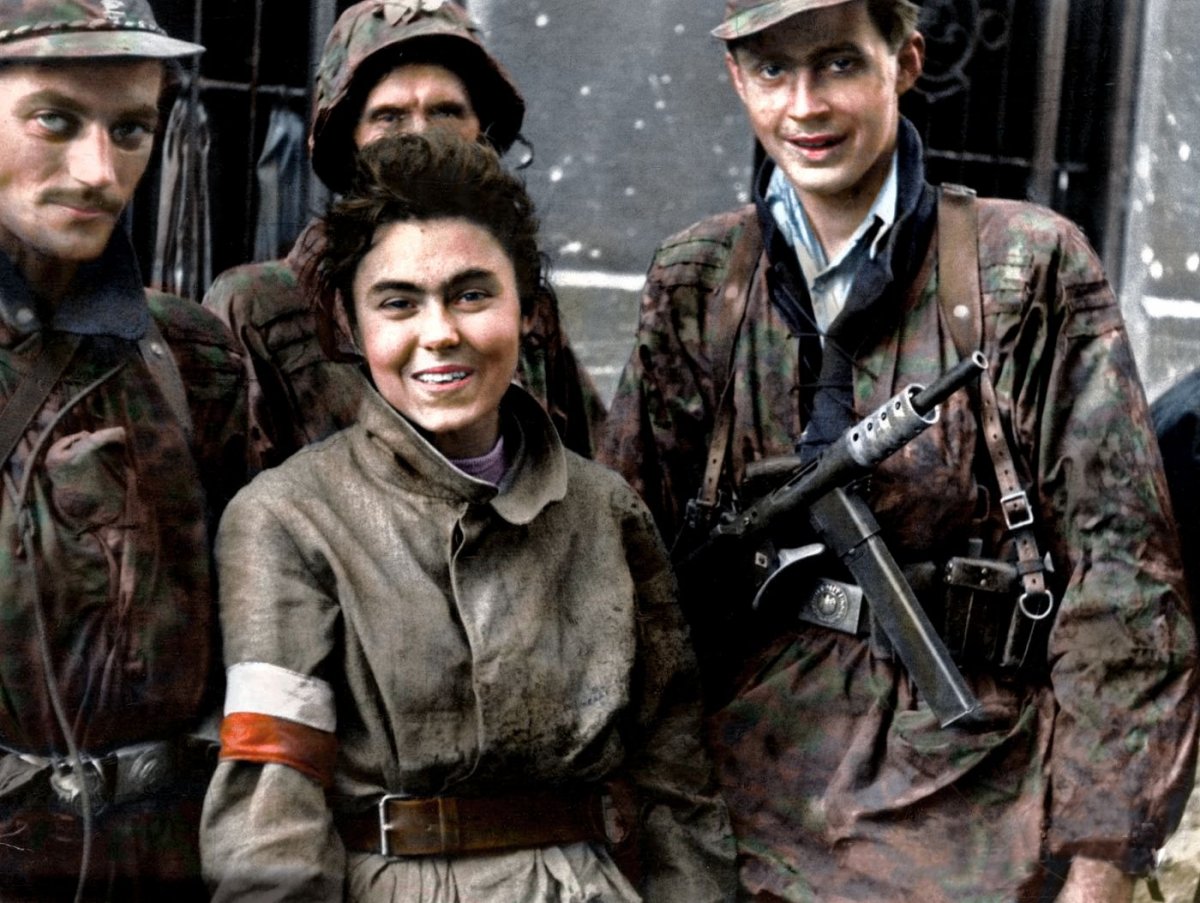
A colorized photo from the Warsaw Uprising. (Photo: Intitute of National Remembrance).
GEOFFREY COBB | gcobb91839@Aol.com
Author, “Greenpoint Brooklyn’s Forgotten Past
A mural on the wall of the Polish National Home, better known as Club Warsaw, on Driggs Avenue honors the Warsaw uprising of 1944 during World War II. To help people better understand the significance of the mural, and what it means to the Polish community in Greenpoint, I visited the Warsaw Uprising Museum in the Polish capital. I lived through September 11th in New York City when 2,753 people were killed in the attacks on the World Trade Center. New York was traumatized, so you can imagine how much more traumatic the failed Warsaw Uprising during World War II was to Poland because between 150,000 and 200,000 people died as a result of it, including some 40,000 civilians who were murdered by the Nazis in the Wola district in just three days from August 5th to 7th 1944.
World War II began on September 1, 1939, when the German Wehrmacht invaded the country. By the summer of 1944, Poland had suffered under brutal Nazi rule for five years, but the occupation had not extinguished the Polish spirit of defiance or the people’s longing for freedom and independence. The Polish underground decided on a desperate gamble, a dangerous uprising against their well-armed German oppressors.
The Museum is located in the Wola district of the Polish capital, the scene of the worst Nazi massacres. Today Wola with its many skyscrapers and modern buildings feels more like Los Angeles than a European capital. The museum housed in one of the few pre-war buildings in the area stands out. We waited in line moving by the black granite slabs inscribed with the names of the approximately 18,000 insurgents who died.
Visiting the museum is a moving experience. It’s hard to fathom the brutality of the Nazi regime in crushing the uprising. Infuriated by the Polish attempt to gain their freedom, following Heinrich Himmler’s orders, Nazi forces systematically destroyed the city and committed massive war crimes against the civilian population. The Germans systematically destroyed 80-90% of the Polish capital, including the Royal Palace and the splendid Baroque Old Town. One of the most moving parts of visiting the museum is a film in three dimensions shot from a plane flying over the destroyed city in 1945, revealing acres and acres of destruction. Before the war, Warsaw was a city of 1.3 million people. After the war its population had been reduced by 400, 000 people. A mere thousand people lived in the ruined city when the Nazis finally retreated.
The Polish resistance decided to rise up against Nazi rule as the Soviet Army approached from the East, but Stalin had no intention of helping the Polish resistance fighters. He wanted a prostrate Poland that the Soviet Union could dominate. Although Soviet forces had reached the other bank of the Vistula River just across from the center of Warsaw where the uprising occurred, Soviet forces stopped and did nothing to help the doomed Polish resistance. The Polish government in exile pleaded with the Soviets, Americans and British to air drop supplies to the encircled Polish fighters, but Stalin refused to let allied planes land on Soviet controlled ground to refuel. Stalin was quite happy to see the Nazis finish off Free Polish forces who would resist Soviet domination of a post-war Poland. The Soviet Union’s halt at the Vistula allowed Germany to heavily concentrate forces, enabling them to destroy the city and crush the uprising over 63 days.
Visiting the museum left me deeply upset. It was even more upsetting for my Polish wife. The Poles had almost no weapons yet confronted the far better armed Nazis with unbelievable valor, ready to die to free their country. Despite being short of food, ammunition and medicine, the Poles fought valiantly. but tragically in vain. One of the most moving aspects of the museum is the youth of the fighters in the rising. Many were still children or adolescents, yet ready to sacrifice their young lives for their beleaguered land.
After 63 days of bloody fighting, the brave Poles had little choice but surrender. After Many fighters were deported to German prisoner-of-war camps (POW camps) or concentration camps. On January 19, 1945, General Leopold Okulicki ordered the dissolution of the AK to prevent direct armed conflict with the incoming Red Army and to save remaining personnel. Many soldiers, however, refused to stop fighting, continuing a losing battle against the new communist authorities as independent underground units, often known as “cursed soldiers.” Although disbanded, AK members were hunted, arrested, and often executed by the Soviet-backed Polish security services, particularly in the 1950s and 60s, which slandered the AK as a reactionary force.
Some Army Krajowa veterans managed to make it to the United States where they settled in Greenpoint. Friends of mine can remember Army Krajowa veterans tattooed with numbers from Nazi concentration camp who often spent Sundays at the Polish National Home on Driggs Avenue, which has been a thriving Polish cultural center for over a century.
Today, Poland is independent and thriving, but Poles will never allow the heroes of the uprising to be forgotten. Go and see the mural and remember the heroic Poles who fought and died in a valiant attempt to free their country.