
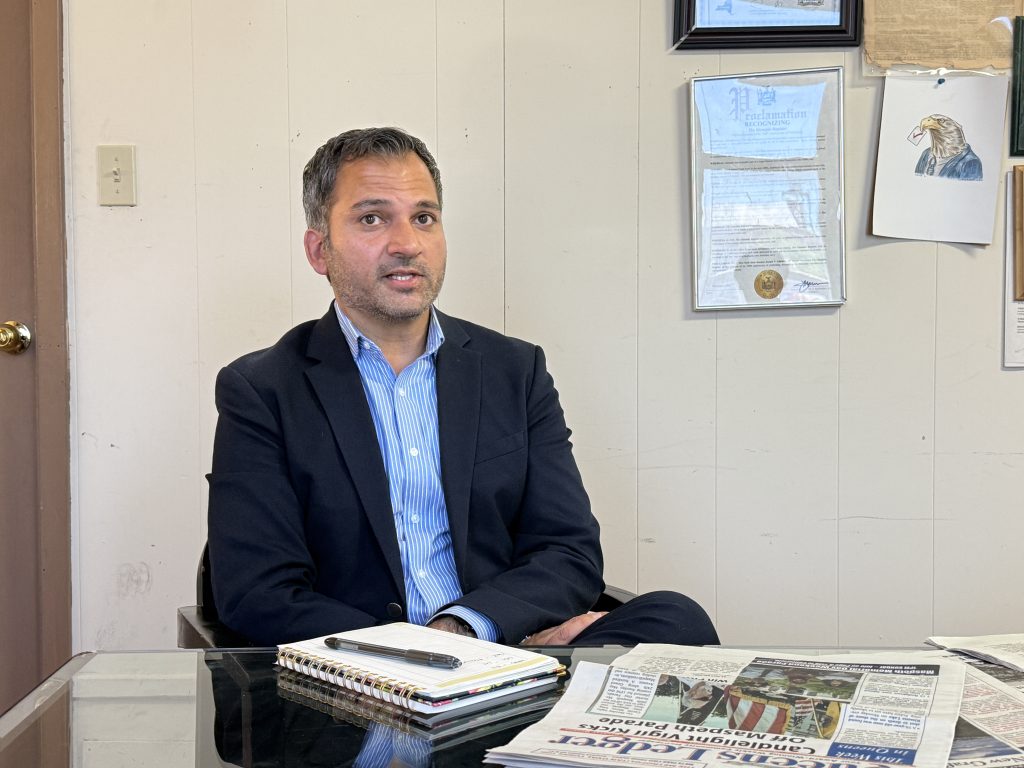
Vichal Kumar, a public defender from Brooklyn with over two decades of experience, is hoping to mount an upset win in NY-7 on June 23.
BY JACK DELANEY | jdelaney@queensledger.com
The June 23 primary is only weeks away, and one of the most closely-watched races in the city — New York’s 7th Congressional District, which forms a rough triangle between Downtown Brooklyn, Astoria, and Glendale — is being viewed by many as a referendum on the balance of power in the local progressive movement.
The Democratic contest is packed with three prominent politicians, pitting Mamdani’s endorsement against an older guard of Brooklyn and Queens representatives. But a fourth candidate stands out: Vichal Kumar, a 46-year-old public interest lawyer who has cast his relative lack of political connections as an asset.
“Their experience is being politicians, with allegiances to their ideologies and machines,” Kumar told the Queens Ledger at a recent round-table. “Our experience is actually working to protect community members that have needed it the most.”
Kumar’s platform advocates for abolishing ICE, establishing universal healthcare, and ending military aid to Israel. Yet it also includes a detailed plan to help small businesses thrive by facilitating better access to loans, informed by his own family’s experience of owning a convenience store.
Kumar was born in Manhattan, but grew up in the working-class New Jersey town of Kearney. His interest in law started early: When he was eight years old, a customer sued his parents, pushing their home to the brink of foreclosure. Kumar remembers the sense of injustice he felt — his parents had taught him that “if somebody needs something, you always have to give it to them,” and would regularly extend thousands of dollars worth of credit to their customers. Now legal fees were preventing them from paying for heat and electricity.
“It didn’t leave me in a position where I was like, ‘Oh, I should go do something really lucrative,’” said Kumar. “I was like, ‘I want to be a lawyer, and I want to be a lawyer that helps people that can’t afford it.’”
Kumar attended Rutgers University before pursuing a law degree at Hofstra, attending night classes while working at The Bronx Defenders, which provides pro-bono legal services to thousands of low-income residents each year.
Since then, Kumar has occupied a range of roles spanning private practice, federal government — working to appeal a capital punishment conviction — and nonprofits, such as the Immigrant Defense Project and the Neighborhood Defender Service of Harlem.
A former president of the South Asian Bar Association (SABA) of North America, Kumar currently serves as the managing director of Partners for Justice, a network that supports public defender offices across the country.
Kumar argues that the job, which required him to navigate districts that were sometimes politically hostile, has prepared him for Congress. “Being the Brown lawyer from New York walking into spaces where the legislatures are all MAGA Republicans could potentially be jarring,” he said. “But [I was focused on] coming out with the result we needed, which was the resources to create hubs that were invested in the community.”
Last year’s mayoral election largely revolved around discussions of affordability, an issue that continues to dominate in this campaign cycle. Kumar’s approach draws from a career-long interest in the intersection of criminal justice and social services.
“We know that if somebody has stable, affordable, long-term housing, they’re 85% less likely to interact with the criminal legal system,” said Kumar. “So instead of us always focusing on how to punish and ‘rehabilitate’ people, because that’s a terrible word, why don’t we focus on providing the front-end services that community members need?”
To that end, Kumar promised to push for two interventions: fully funding Section 8 housing and NYCHA’s backlog of capital investments, which could collectively cost about $200 billion — pricy, he acknowledged, but meager compared with federal defense spending.
Kumar also wants to tackle affordability through his small business plan, hoping to “deepen and continue” the work of outgoing Rep. Nydia Velazquez, whose retirement announcement triggered this summer’s four-way succession scramble. The proposal calls for a no-interest federal startup program to help small business owners get off the ground, coupled with a crackdown on corporate mergers like the impending $29 billion takeover of Restaurant Depot — a wholesale provider that supplies 725,000 businesses — by the distribution giant Sysco.
Kumar also outlined a proactive framework for regulating AI, including banning federal agents from using facial recognition software and placing a 3-year moratorium on new data centers in New York. But the public defender, who describes himself as a “prison abolitionist,” balked at being pigeonholed as a progressive.
“Am I a progressive? A moderate? A corporate Democrat? A socialist?” said Kumar. “I spent 20 years fighting establishment institutions that have failed our people, so I think that’s something voters can make judgments about themselves.”
Kumar has lived in Clinton Hill, Brooklyn, since the early 2000s, attending courthouses throughout New York City and holding posts in both the Bronx and Manhattan. Why run for Congress, then, rather than a city-level position?
Kumar argues that sweeping change has to come from the top down. “Eventually you recognize that you can build new institutions, you can build new nonprofits, you can bang your head against the wall in court every single day — and no matter how successful you are, there’s a cap,” he said. “Our system must be realigned to serve people, not squeeze them.”