
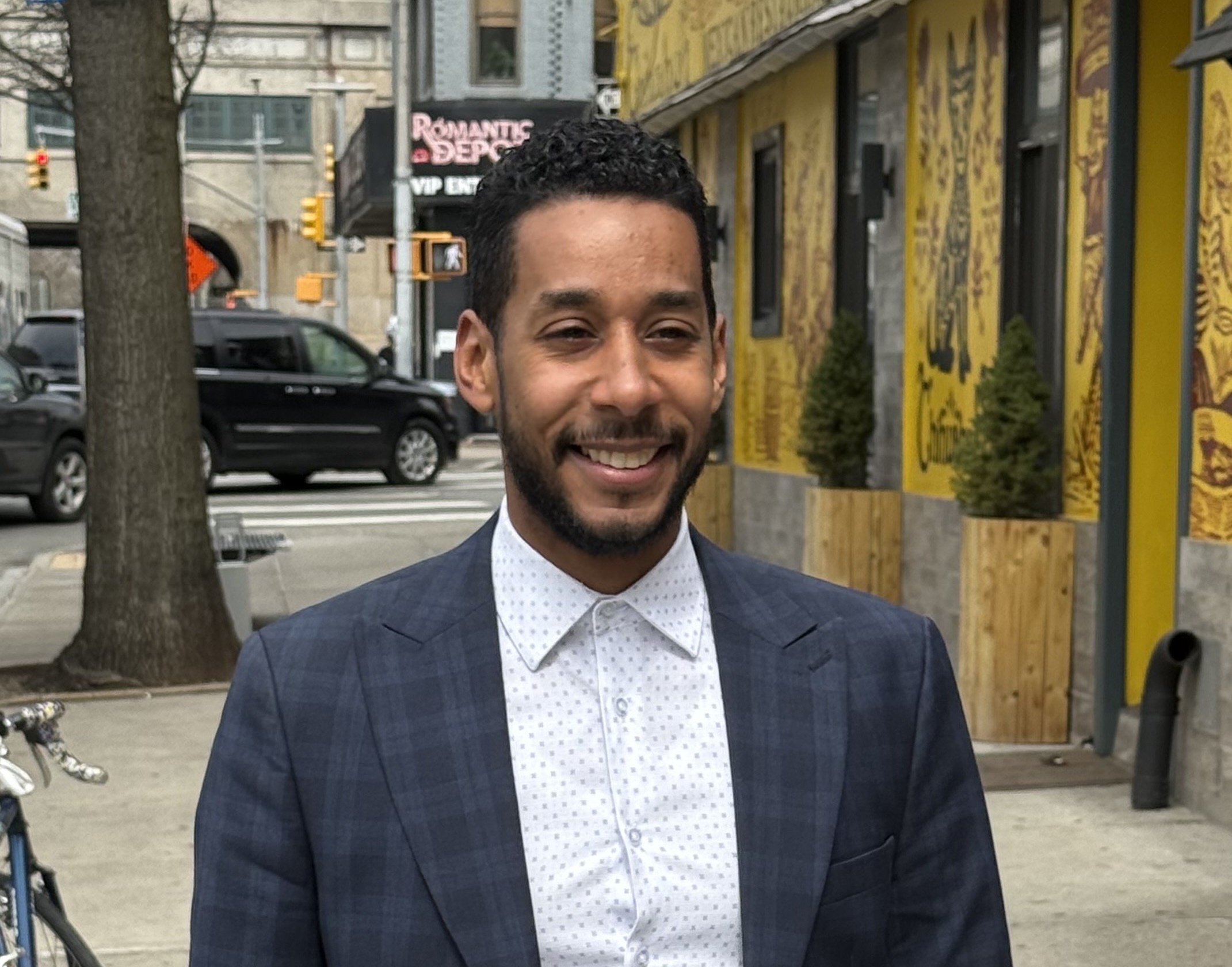
Borough President Antonio Reynoso is looking to replace his mentor, Rep. Nydia Velazquez, in New York’s seventh congressional district on June 23. (Photo: Walter Sanchez)
BY JACK DELANEY | jdelaney@queensledger.com
Antonio Reynoso has an infectious smile, the kind of easy warmth that’s invaluable for a borough president. But as countless political power players have learned over his nearly two decades in city government, he’s more than willing to ruffle some feathers to get the job done.
Back in 2017, Reynoso — then a City Council member representing Bushwick, Ridgewood, and Williamsburg — spearheaded the Right to Know Act, which required NYPD officers to inform New Yorkers of their right to refuse certain searches. At the time, that kind of police reform seemed dead on arrival: Brad Lander and Jumaane Williams had pushed through sweeping changes to stop and frisk only four years earlier, and Mayor Bill de Blasio wasn’t eager to rein in the department further.
“It was a disaster,” the 42-year-old recalled during a recent roundtable with the Ledger. “I mean, everyone told me my career would be dead if I passed that legislation.”
But Reynoso, undaunted, threatened to force the bill to a vote anyway. He remembers de Blasio calling him into his office in a panic, creating the leverage needed to negotiate the bill across the finish line.
“I fought against my own friends to make it happen,” said Reynoso. “I don’t care if you’re my ally, I’m willing to push if it means that we could effect change in the progressive movement.”
Now, nine years later, Reynoso finds himself in familiar territory as he runs to replace his mentor Nydia Velazquez in the House of Representatives. Once again, there’s a mayor in his path — one of his opponents, the first-term state Assembly Member Claire Valdez, is backed by Zohran Mamdani and the ascendant local chapter of the Democratic Socialists of America (DSA).
Yet like before, Reynoso isn’t blinking, positioning himself as the most battle-tested candidate for the roughly triangular 7th Congressional District, which spans from Downtown Brooklyn in the west, to Glendale in the east and Astoria up north.
Touting endorsements from the Working Families Party, Queens Democratic Party, and Velazquez, among others, Reynoso’s campaign is unabashedly progressive, promising to “abolish ICE, tax the rich, end the genocide in Gaza, and fund healthcare, housing, and education.”
Reynoso was born in Brooklyn to parents from the Dominican Republic and grew up in the Los Sures section of Williamsburg, not far from where he still lives with his wife and two sons. After attending P.S. 19, he commuted to La Salle in Manhattan for high school, before graduating with a degree in political science from Le Moyne College in upstate New York.
Reynoso broke into the scene as an organizer for NYC’s branch of the Association of Community Organizations for Reform Now (ACORN), a left-leaning nonprofit that later reincarnated as New York Communities for Change (NYCC). In 2006, he founded the New Kings Democrats, and in 2009 he was appointed chief of staff to Diana Reyna; when she termed out in 2013, Reynoso ran himself, besting the infamous Brooklyn Democratic Party head Vito Lopez. In 2021, following eight years in the City Council, he was elected to his current post as Brooklyn’s borough president.
For some, the pivot from council member to borough president might risk whiplash, since the latter can’t pass laws, instead doling out discretionary funds and overseeing community boards. But for Reynoso, the job has offered the chance to find a more universal brand of politics.
“People from Bushwick think a lot differently than people from Sheepshead Bay, and I wanted to be the borough president that represented everyone,” he said. “I wanted to make sure people felt they were heard, so I changed my politics to one of common denomination.”
Building on his time as a lawmaker — where he crafted the original outdoor dining bill during the pandemic, and reduced the disproportionate share of the city’s trash (at one point 40%) being processed in Williamsburg — Reynoso has used his new pulpit to highlight borough-wide inequality, earmarking $45 million for maternal health facilities and converting underused space into a legal hub for 6,000 immigrants seeking work papers.
Yet Reynoso’s signature issue may just be the one he’s shifted his stance on the most over his career: housing.
In 2019, Reynoso proposed creating historic districts in Bushwick to limit development amid his district’s rapid gentrification, and in 2021 reiterated his support for community boards’ say over the pace of construction.
But by 2023, he had changed tack, arguing that the root cause of skyrocketing rents isn’t that there are too many apartments going up, but not enough and only in select neighborhoods. While stressing the need for tenant protections, he has since boosted a range of major housing projects, including the $3.5 million redevelopment of the Brooklyn Marine Terminal in Red Hook.
“When I was an organizer, I thought that housing was an introduction to gentrification and there was no way around it,” explained Reynoso. “But I ended up learning that scarcity is the introduction to gentrification. Minneapolis did it. Austin did it. They’ve lowered rents. What did they do? They built a ton of housing, and they oversaturated the market.”
Reynoso’s campaign for Congress rests upon a broader and longer-lasting vision of affordability, however, something more durable than momentary relief from rising costs.
“The Democrats should be the party of rebuilding the American dream and the middle class,” he noted, proposing an affordable home ownership program for those making less than $250,000 annually, and an expansion of public housing in New York City that’s matched by a sustainable maintenance budget. (It may be a moonshot, he acknowledges, but if he’s able to build a new NYCHA building in North Brooklyn or Western Queens, he would name it after Ruth Bader Ginsberg.)
To achieve these goals, Reynoso recognizes that his party needs to rethink its approach. “People are angry, and they want to see [their representatives] fight. They want a reaction to the crisis that is similar to it,” he said. “Right now, what we see from our elected officials is that everything is out of whack, and they’re just moving through life like everything is business as usual.”
As Reynoso gears up for the primary on June 23, he faces a conundrum that’s becoming increasingly common in NYC in the wake of Mamdani’s win: When the leading candidates are all progressives with similar platforms, such as Valdez and the Astoria-based City Council Member Julie Won, what sets them apart for voters?
Reynoso’s answer is clear. “Democrats don’t get anything done — that’s how they describe us,” he said. “I get things done.”