
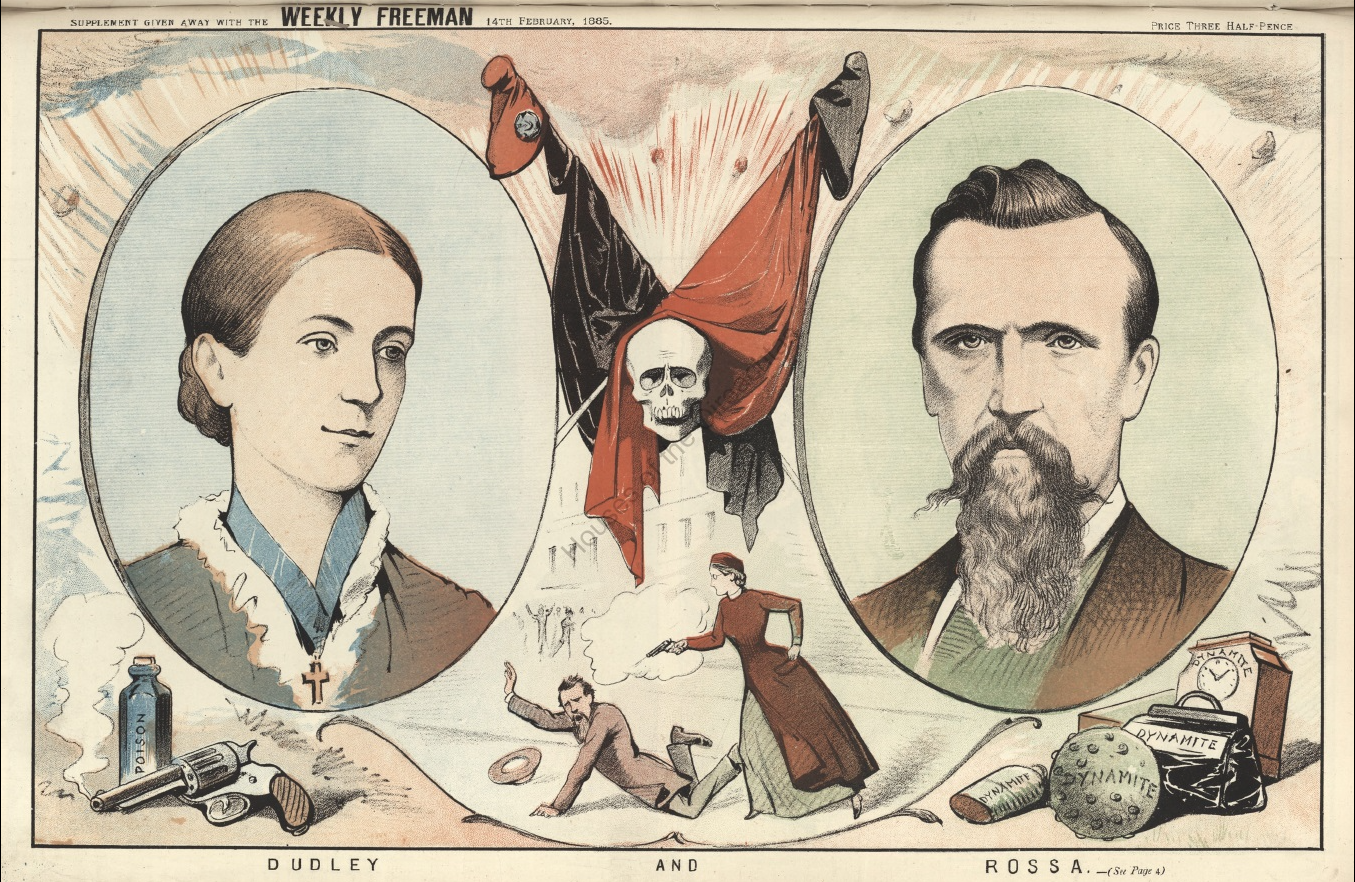
An 1885 cartoon depicting an assassination attempt against Jeremiah “O’Donovan” Rossa. Photo via Wikimedia.
GEOFFREY COBB | gcobb91839@Aol.com
Author, “Greenpoint Brooklyn’s Forgotten Past
A friend considering opening an Irish bar in Greenpoint asked me for help naming it.
I suggested, “The Dynamiters Inn,” which relates to a sensational, but long forgotten, local story from the 1880s involving Irish patriots called Fenians, who were ready to use violence to free Ireland from British rule. A group of locals formed a terrorist cell with the intention of attacking many of the landmarks of the British capital of London in 1883.
A frequent speaker in Greenpoint was the exiled Irish revolutionary O’Donovan Rossa, who published a newspaper called The United Irishman. Rossa, who had seen people starving with his own eyes during the famine, became a revolutionary, was arrested, tried for treason and sentenced to life before he was allowed to seek permanent exile in New York. Burning with hatred of the British government, Rossa encouraged Greenpoint’s many Irish exiles to use terror in their struggle to free their homeland. In 1866, Alfred Nobel invented dynamite and the invention appealed to Rossa and other Irish revolutionaries as a means to strike back at the British. Teams of dynamiters, Rossa argued, could strike Britain, and bring the war home. Cheap and easily made, dynamite bombs held the potential to arm thousands of Fenians, thus removing past dependency on foreign powers for the provision of weapons.
The Fenians set up a dynamite school in Greenpoint, a development that was closely observed by British spies working in New York and reporting back to London. The dynamite school was almost entirely financed by subscriptions collected by Rossa’s United Irishman paper. By the end of 1882, it amounted to the considerable sum of $3,401 and 67 cents.
A group of local Fenians learned how to make, transport and detonate dynamite. The Fenians decided to begin a bombing campaign of Britain, choosing Doctor Thomas Gallagher of 420 Manhattan Avenue to mastermind the attacks. Gallagher, born in Glasgow, Scotland to Irish parents, yearned for vengeance against the British government. On the death of his father, his family migrated to the United States. Settling in Greenpoint in 1868, he had started as an ironworker but went on to complete medical school and had developed a thriving Greenpoint practice.
Thomas Clarke, another local Fenian, was the son of a British Army sergeant from Dungannon, Co. Tyrone in Ireland before he emigrated to America. He lived on Russell Street and met Gallagher, who convinced him to become part of the dynamite team. Gallagher also persuaded two other Irish Americans to join the plot.
Unfortunately for the dynamiters, a fifth member of the cell, William Lynch, turned out to be a British double agent, who was informing the authorities in London of the group’s activities. Gallagher and his team sailed for London, where they had arranged to begin their campaign of bombings. Joined by Gallagher’s brother Bernard, they set about establishing a bomb-manufacturing factory in Birmingham, disguised as a paint and decoration shop. Nitroglycerine was manufactured in the Birmingham shop and transported to London by means of rubber bags and fish stockings enclosed in large boxes. Attacks against was major iconic buildings of the
British Empire were set for some time in late April 1883, but the British, thanks to Lynch, followed their every movement. The Gallagher team was arrested in April 1883 as a result of an intense surveillance operation in Birmingham, involving entering the premises at night to survey the materials. They were indicted for “feloniously and unlawfully composing, imagining, and devising and intending to depose the Queen from the Imperial Crown of Great Britain and Ireland” and for “intending to levy war upon the Queen.” Lynch testified against the conspirators who were all found guilty except for Bernard Gallagher. The dynamiters were sent to Chatham and Portland prisons, where they were treated as ‘special men.’ This title, reserved specifically for the dynamiters, was terrifying given that it meant they had to endure a system of persistent harassment morning, noon and night, including a ‘no sleep’ torture and other tortures. This system was specially designed to destroy them mentally or physically – to kill or drive them insane.
Dr. Gallagher collapsed under the mental strain. He was released thirteen years later, completely broken mentally and physically. Locals who had turned out en masse to greet Gallagher upon his return to New York City were horrified by the doctor’s physical and metal deterioration. Clarke survived the torture, returned to Greenpoint and in 1916 returned to Ireland where he took part in the Easter Rising that eventually led to Irish independence. Clarke was shot by the British for his role in the rising and today is considered a national hero in the Republic of Ireland.