
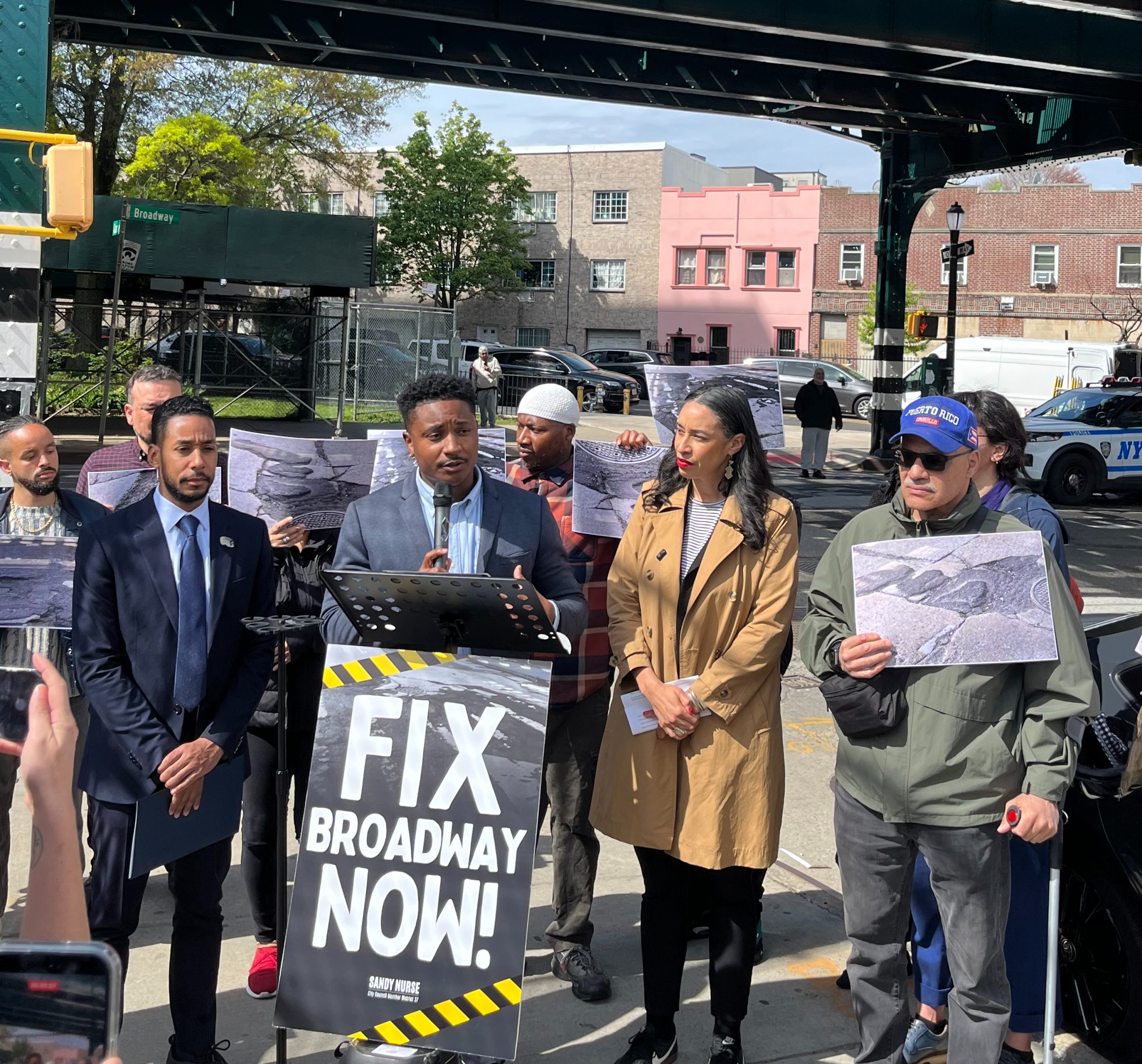
Local elected Chi Osse (center), Sandy Nurse (right) and Antonio Reynoso (left) spoke at a rally by Thomas Boyland Park on Wednesday, April 29. Photo by Cole Sinanian.
Lawmakers and residents alike are fed up with the ragged roadway that runs through Bed-Stuy and Bushwick. Can they finally repair it?
BY COLE SINANIAN
cole@queensledger.com
BED-STUY— Brooklyn’s Broadway corridor has always been bumpy. Up until the 1950s, what is now the shadowy underside of the elevated J Train was a cobblestone thoroughfare traversed by the Broadway Line streetcar.
Now of course, the streetcar is long gone and the cobblestones have been paved over, leaving pedestrians and motorists alike to contend with a minefield of potholes and cracked asphalt that can turn a simple car ride into a torturous affair.
“If you know anything about Broadway, you get in the car and you’re going to be slapped back and forth,” said Brooklyn Borough President Antonio Reynoso at a recent press conference on the corner of Broadway and Granite St. “You might need a neck brace by the time you make it down six blocks.”
Straddling Bushwick and Bed-Stuy and stretching roughly from Howard Ave to the east and Flushing Ave to the West, the Broadway Corridor has long been a source of ire for local residents, who’ve urged elected officials for years to address both the poor state of the roadway and rampant crime and drug use that’s plagued the poorly lit space below the tracks. During the historic blackouts in the summer of 1977, it was the site of major rioting and looting that at one point left two full blocks of Broadway on fire. Nowadays, the Department of Transportation has identified the corridor as among the top 10% most dangerous in Brooklyn, with an average of 14.8 people killed or severely injured (KSI) per mile.
It’s no help that Broadway forms the border of several different political districts, allowing local electeds to defer responsibility for its repairs to their neighboring representatives. The north side of the Broadway Corridor spans City Council District 34, State Assembly District 53, State Senate District 18, and Congressional District 7, while the south side — or the Bed-Stuy portion — encompasses City Council District 36, State Assembly District 56, State Senate District 25, and Congressional District 8.
But now, as the Mamdani Administration doubles down on its commitment to “pothole politics” — or the idea that trust in government can be cultivated by addressing small, everyday issues that affect New Yorkers’ qualities of life — a coalition of Brooklyn elected officials whose districts touch the corridor are renewing calls to fund its total repavement.
At the press conference, held Wednesday, April 29th next to Thomas Boyland Park, Reynoso, alongside City Councilmembers Chi Ossé and Sandy Nurse as well as several local community board leaders, spoke passionately about the state of the roadway as the J train rumbled overhead. A group of community members from the surrounding Bed-Stuy, Bushwick and Ocean Hill neighborhoods stood behind the speakers, holding up photos of some of the road’s ugliest blemishes.
“It’s disgusting, it’s unsafe for both drivers and cyclists and pedestrians,” Ossé said. “This is the wealthiest city and wealthiest country in the world, and this corridor does not speak to that.”
Ossé and Reynoso both pledged to contribute $1 million to funding the corridor’s repavement, a far cry from the estimated $110 million that Nurse a total restructuring of the corridor would likely cost. They also highlighted the necessity of the elevated train to the area’s residents and the relative lack of investment in road infrastructure in comparison to other parts of the city.
“This elevated train was deeply important to Brooklyn and getting us around,” Reynoso said. “But what happens is they built that infrastructure and then forgot about it, they just built it and left us alone. They abandoned this community. They neglected this community. They don’t make long-term investments.”
Ossé also evoked the famous Myrtle/Broadway intersection, which has become an internet meme in recent years for its disorienting and contradictory atmosphere. The intersection is perhaps most famous for its trio of oddly placed fast food joints — the Popeyes, Checkers and Dunkin Donuts nestled side by side.
Ossé jokingly referred to the intersection as a “cultural heritage site,” before taking a more serious tone.
“As much as it has become a joke within meme culture, it speaks to the broader need for investment within this entire corridor,” the second-term City Councilmember said.
Speaking at the press conference, Brooklyn Community Board 4 and longtime Bushwick resident Roberto Camacho drew attention to the costs incurred by drivers whose cars are damaged by Broadway’s potholes.
“How much money do you think people pay when their cars get damaged and their insurance goes up with no fault of their own?” Camacho said. “Or some senior trips and breaks their ankle and gets hurt and they have no health coverage? It’s an investment that helps everyone.”
Community Board 16 District Manager Sydone Thompson, meanwhile, called out the city’s inaction in fixing the Broadway corridor and urged all Brooklynites who use the road to support the initiative.
“The Broadway corridor, the entire span affects all of our districts— Bed-Stuy, Bushwick, all of it,” she said. “So we all need to fight. We need every elected from every level of government to put the money where your mouth is, because I’m tired of my car breaking an axle on Broadway.”
She continued: “I think the city needs to understand [that] for the amount of money you would pay out in lawsuits, you can fix this.”