
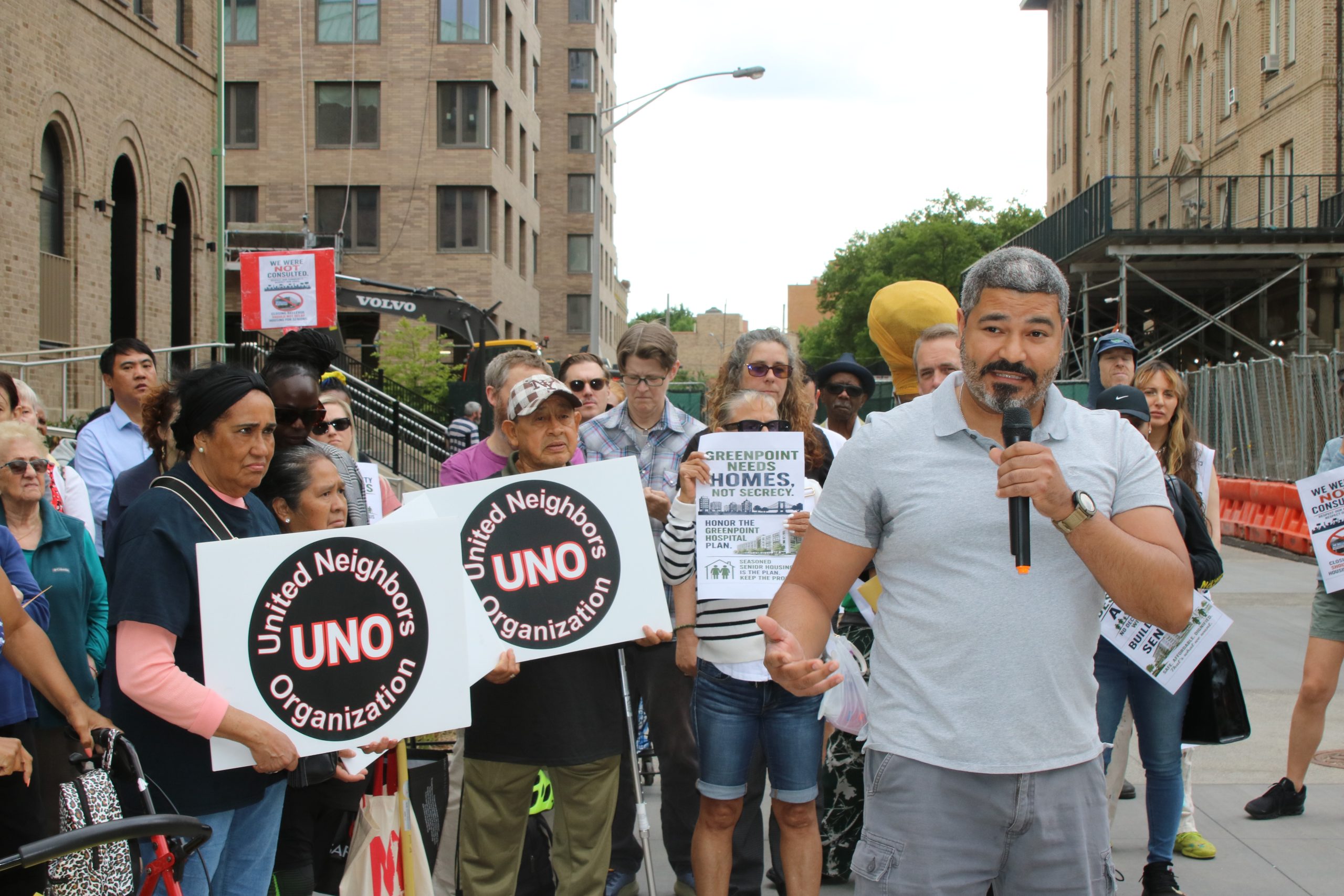
Joseph Yano speaks to the crowd outside the Greenpoint Hospital site — now called Kingsland Commons — last Friday. (Photos: Jack Delaney)
By Jack Delaney | jdelaney@queensledger.com
GREENPOINT — Halfway into the rally outside the old Greenpoint Hospital complex, a man from a shelter in one of its three buildings wandered over to see what all the commotion was about. “Hey,” he said loudly, interrupting a speaker from a tenants’ union. “This is my home!”
An organizer pulled him aside, offering to explain. For the roughly 50 people who had assembled here on Friday, June 29, it was important that the nuance wasn’t lost — they weren’t against having homeless shelters in the neighborhood, necessarily. Instead, they had come to protest what they called a broken promise from the city, one that can be traced back nearly 40 years.
“I want to be very clear, this is not an anti-homeless shelter rally,” said Brooklyn Borough President Antonio Reynoso. “Community Board 1 consistently approves shelters in this district. We support that, and we always will. But let us finish the supportive housing that is going to allow us to move families into a permanent space instead of continuing to have them move around.”
Greenpoint Hospital served residents from 1914 to 1982, when it was deemed too dilapidated to remain open. The next year, the local advocacy group Neighborhood Women drafted a plan to convert the outer buildings into senior housing, with the central hub becoming a nursing home.
That proposal fell on deaf ears. In August of 1983, the city moved more than 1000 men into the central hub of the former hospital, launching a decades-long legal battle with the neighborhood that continues to this day.
“Neighbors were universal with their civil disobedience, because the city closed the hospital overnight and created a men’s shelter with no resources,” explained William Vega, who chairs CB1’s cannabis review and environmental committees, at last week’s rally.
“It’s a history of us not being able to trust the city,” said Vega. “All of us here do things out of love — we try to help each other, and that’s why I’m here.”
After decades of activism, community organizations like Neighborhood Women and the nonprofit St. Nick’s Alliance persuaded the city to reduce the shelter’s number of beds from 1100 to 200, while redeveloping the entire site as a mixed-use campus called Kingsland Commons that is projected to create 557 affordable units.
Many Greenpointers viewed the project as a major milestone, a fresh chapter in a bitter saga. But in late April, an employee at St. Nick’s noticed a mention in the news that the 30th Street Shelter and Intake Center in Manhattan — originally built as the Bellevue Psychiatric Hospital — was being closed for repairs by the Mamdani administration, and that some of its beds would be transferred to one of the outer buildings of the unfinished Kingsland Commons.
The revelation triggered an immediate, and visceral, response. Some residents who had supported the four-phase construction of Kingsland Commons, vouching for the plan to skeptical neighbors, said they felt burned, such as Sarah Sheffield, co-leader of Friends of Cooper Park.
Vega was more pointed. “We all bought it,” he said. “It’s a slap in the face. It’s a slap in the face for decades, and decades, and decades.”
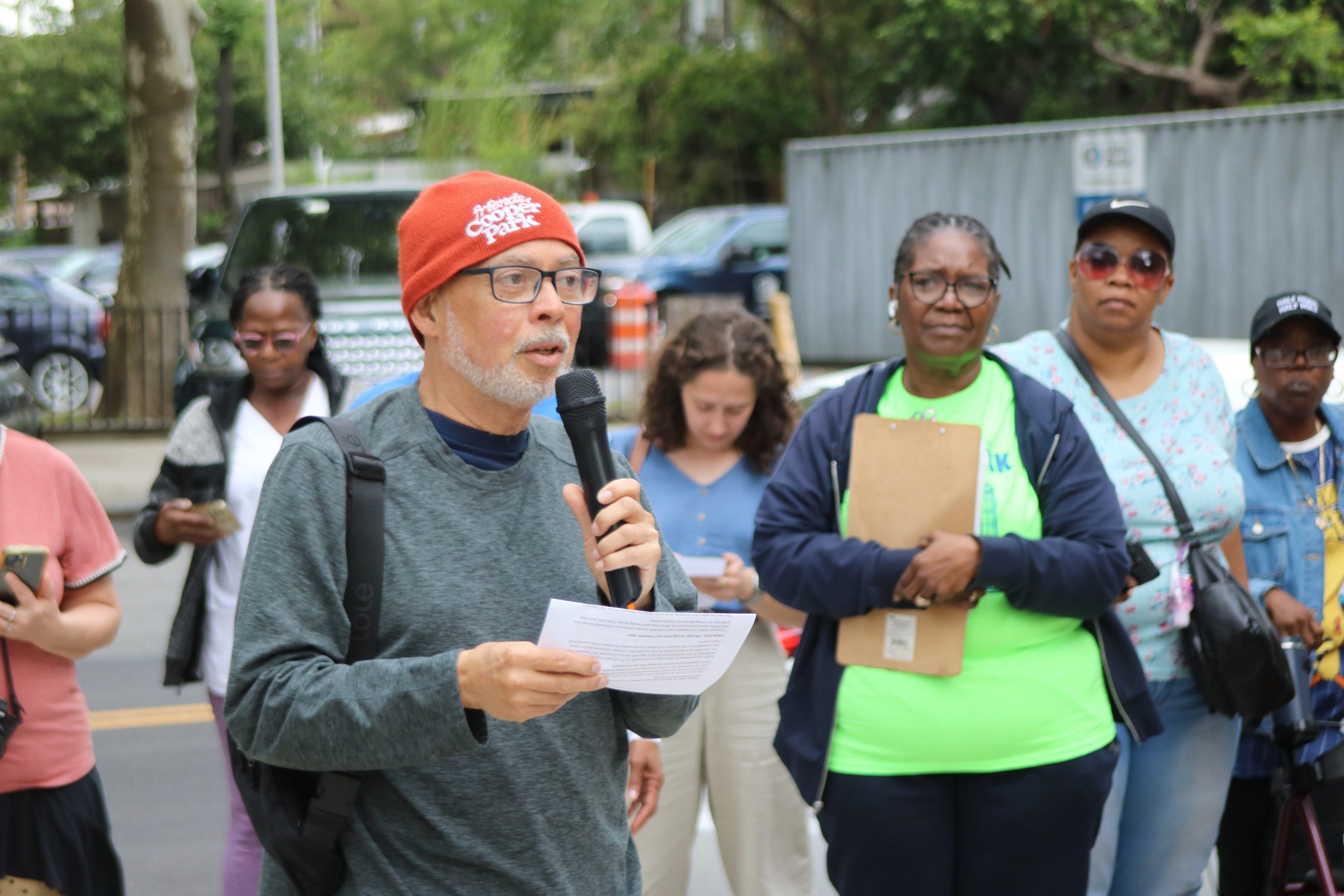
William Vega, who chairs two committees on Community Board 1, said the city’s change-up was “a slap in the face.”
Representatives from the Department of Homeless Services (DHS) presented at a CB1 meeting in mid-May, saying the curveball setup was “temporary.” When Frank Lang, director of housing for St. Nick’s, pressed for a specific timeline, he said they told him that “temporary” for the DHS can sometimes mean five years. (The Star has contacted the DHS for comment, and will amend this article when it responds.)
Back in March, a DHS release noted that it would be “working with partner agencies and City Hall on a long-term redevelopment plan for the [Bellevue shelter],” adding that the new administration had “inherited several shelter sites that had been neglected for years.”
NYC’s shelter population increased rapidly from 2022 to 2024, and has since plateaued at approximately 90,000 New Yorkers sleeping in shelter beds each night. The proportion of single adults in the system has grown at a much faster rate than families, and Mamdani has said he will “double down on protecting the safety, continuity and quality of services — because every New Yorker deserves a secure place to rest, to recover and to rebuild their life with dignity.”
But the speakers at the rally — a lineup that included leaders from local nonprofits and housing advocacy groups, alongside star power in the form of Reynoso — argued that the city hasn’t properly funded the makeshift shelter, and emphasized that the community’s vision for the site should not be deferred any longer.
“We’ve fought for over 20 years for this development to be constructed for people who are low income,” said Luz Esperanza Rosero, the president of the United Neighbors Organization (UNO), a tenant rights outfit based in North Brooklyn.
“We need the affordable housing units now,” said Rosero, “and we cannot wait.”