

The Case Against Monitor Point, According to Greenpointers

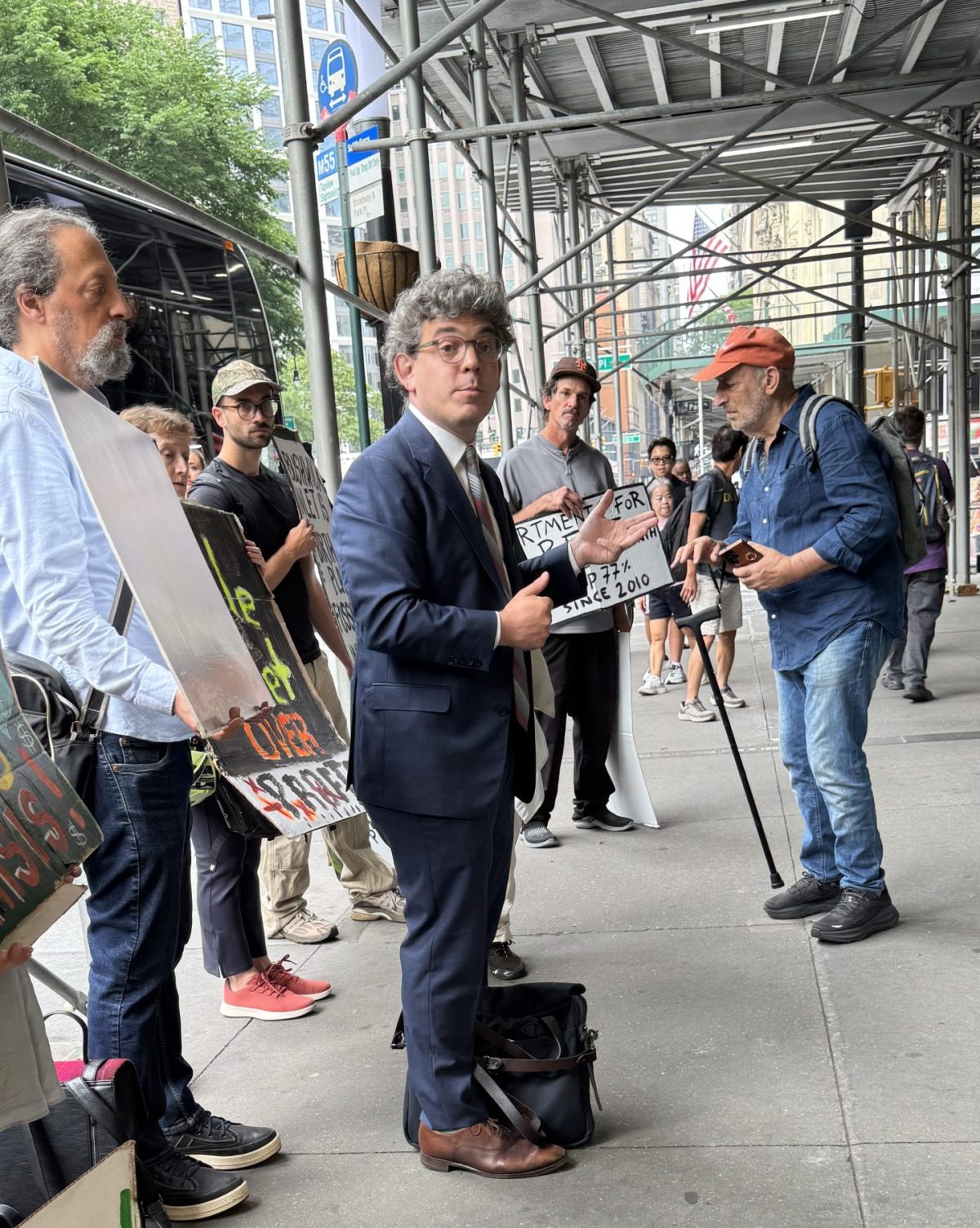
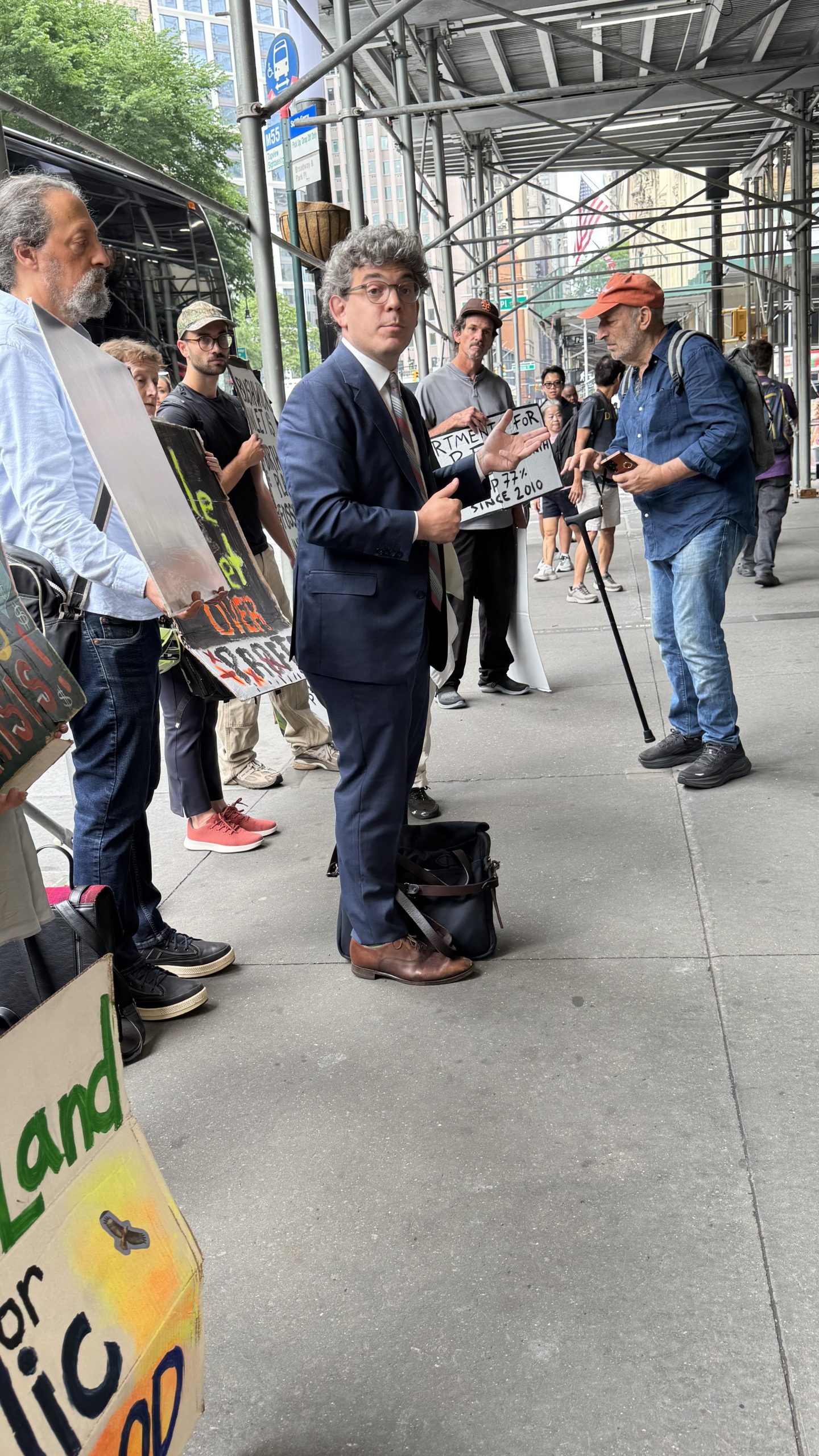
Greenpoint City councilmember Lincoln Restler spoke out against Monitor Point at a rally outside City Hall May 27. Photo via Sarah Roberts.
Opponents and supporters of the Monitor Point development fell across familiar battle lines at a City Council hearing last week, while Greenpoint’s representative ripped into the project team.
EDITOR”S NOTE: This is part of a series on Greenpoint’s Monitor Point development. Find our previous reporting here, here, and here.
BY COLE SINANIAN
CITY HALL — “Who wants to take their lumps first— The MTA or Gotham?”
City councilmember Lincoln Restler’s question hung in the air. Ultimately, it was MTA Deputy Chief of Staff Sean Fitzpatrick who’d first face the wrath of Restler, who’d come to the Council’s Subcommittee on Zoning and Franchises hearing on May 27 with more than half an hours-worth of questions for Fitzpatrick and the rest of the Monitor Point development team.
The nearly five-hour hearing marked the fiery culmination of a review process that began earlier this year, during which developers tried to convince the Greenpoint community that the mixed–use Monitor Point project — which would see three high-rise residential towers, retail space and a museum built next to Bushwick Inlet — is the best possible use for Greenpoint’s last undeveloped waterfront property. Restler and a vocal group of Greenpoint activists, however, have called the plan a bad deal, arguing that it expropriates public land for private benefit and that a project of such size on a publicly owned site must primarily serve the public good.
“There are some individuals here today that think we should take whatever crumbs this developer was willing to offer, and say thank you,” Restler said. “I’m not one of them. We can stand up and say we’re not willing to sell out our extremely valuable public land for primarily luxury housing.
The hearing preceded the Council’s final vote on the project, now set for June 25th. Among the 90 members of the public who signed up to testify, supporters included Open New York, the SEIU 32BJ building maintenance workers’ union, the Local 79 construction workers’ union, and the North Brooklyn-based St. Nick’s Alliance. Environmental activists with a group called Save the Inlet, several longtime Greenpointers and a duo of fifth grade girls from PS 34, meanwhile, came out against Monitor Point. The tension lies in the question of whether the project’s housing component — 460 affordable units and 690 market rate units — should exist at all, given Monitor Point’s location in a flood plain highly vulnerable to sea-level rise, and if it does, whether it makes sense for the City to allow most of that housing to be market rate on MTA-owned land, especially in a neighborhood where two-bedroom apartments routinely rent for $14,000 per month or more.
There’s also the question of Bushwick Inlet Park. The City had promised to build the final terminus of the sprawling, 27.8-acre Bushwick Inlet Park 21 years ago on what is now the upper portion of the Monitor Point property as a sweetener of the consequential 2005 Williamsburg/Greenpoint rezoning. Today, most of the promised park remains a debris-littered brownfield — with a few notable exceptions — while Gotham is trying to upzone its original footprint to make way for luxury towers.
“To earn my support,” Restler said, “any proposal for this publicly owned land would have to guarantee true affordability in a clear majority of the housing units and an ironclad commitment with crisp timeline and full funding for the completion of the long promised Bushwick Inland Park.”
The project’s financing and logistics are complex, involving a public-private partnership between the MTA and the Gotham Organization to fund the relocation of a disused MTA-owned mobile wash facility that currently occupies the site. Developers have argued that because of these major upfront expenses, it is not like other projects on public land and therefore requires the luxury housing as a revenue generator, which will in turn provide funding to the MTA. To increase the affordable housing percentage and keep the project financially viable, developers would need help from the City, they said.
“Council member, you’ve got our commitment to spend the next three to four weeks to try and tick that number upward,” said Gotham President of Development Bryan Kelly. “But to be clear, from our perspective, developers are executing upon a business plan. If we can move the needle, we’ll move the needle.”
Restler Holds Court
In his fierce cross-examination of Kelly and his team, Restler broke down several of the project’s supposed public benefits, characterizing them as far from the good deal for the community developers have made them out to be.
The MTA funding, for example. Once the towers are complete, Gotham will pay ground rents to the MTA over the course of a 99-year lease — broken into four, 25-year chunks — which the MTA has said will go towards funding capital projects.
But Gotham’s estimated 25-year payment to the MTA would amount to a measly $39 million— a tiny fraction of its $68 billion capital plan.
“$39 million— that is the equivalent of MTA’s operating expenses for about one half hour of one day out of those 25 years,” Restler told Fitzapatrick.
Restler then turned to Kelly, questioning Gotham’s failure to collaborate with elected officials to ensure the deal was in the Greenpoint community’s best interests. According to Restler, Kelly had approached him in December with Gotham’s plans to move forward on Monitor Point, to which the councilmember urged him to wait until a meeting with the incoming Mamdani administration could be arranged.
“What I suggested was that you wait two weeks to talk to the new mayor, who was about to take office, so that we could see if there was an alternative proposal that might work for all of the parties involved, and you said no.”
Kelly, for his part, highlighted the community support the project received — with both the local community board and Brooklyn Borough President Antonio Reynoso expressing support, albeit with conditions — and the urgency of the housing crisis.
“We’ve been at this for six years now, obviously received a lot of feedback from you as well,” Kelly said. “We have deadlines in our agreements with the MTA. We’ve made substantial investments to undertake this.”
Next, Restler grilled developers on their flood resiliency plan. Monitor Point is located in a coastal flood plain with elevated chances of flooding and storm surges, making it one of New York City’s most vulnerable areas to sea-level rise.
“The infrastructure proposed contemplates that flood zone and considers it to ensure the protection of the residents,” said Gotham Vice President of Development Simeon Maleh. “There’ll be no critical infrastructure in the basements of any of the buildings.”
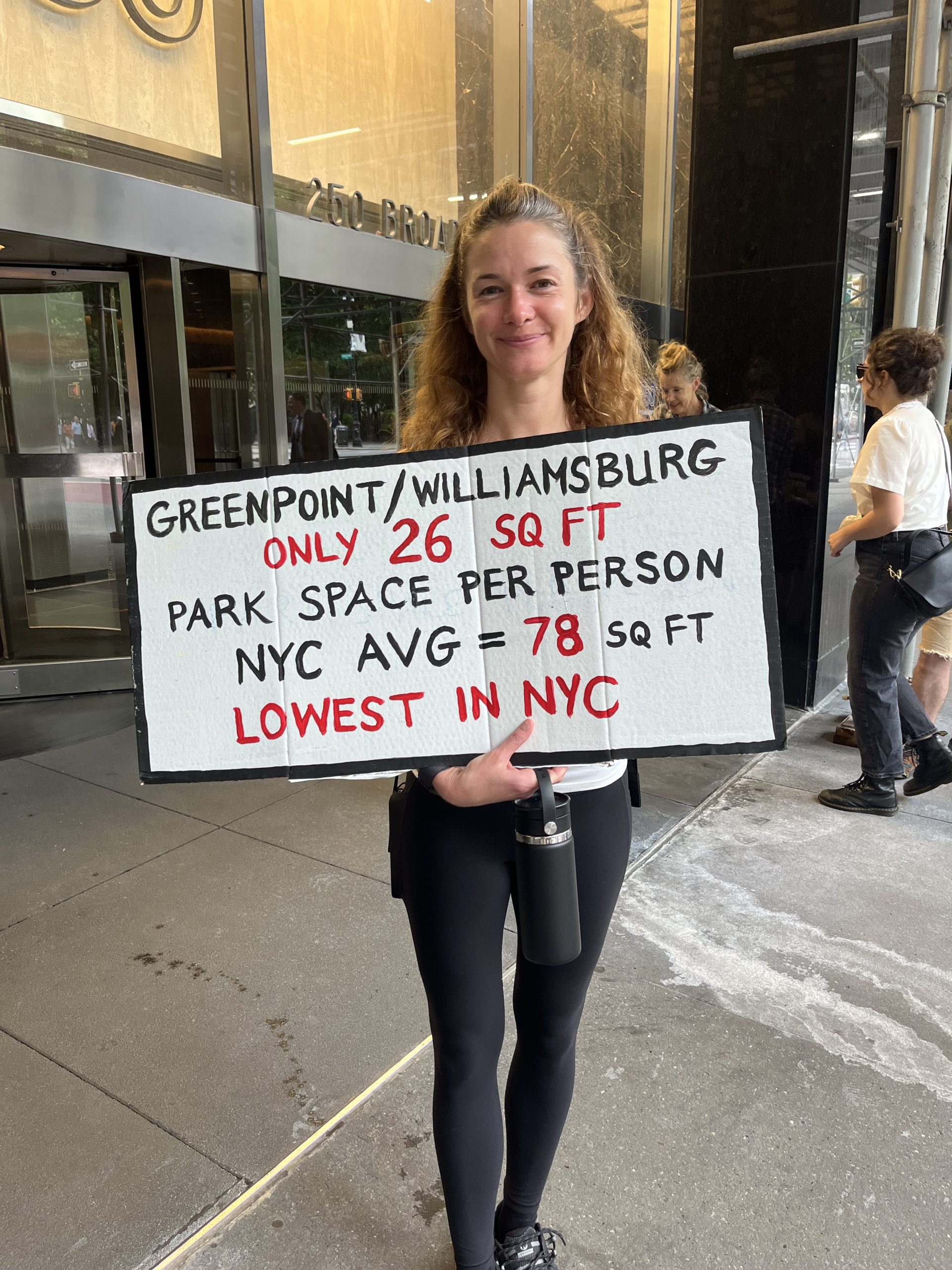
Greenpointer Veronica Zapasnik at Wednesday’s rally. Photo by Cole Sinanian.
Greenpointers Weigh In
But despite the development team’s assurances, Save the Inlet activists were unconvinced, with some citing the widely circulated “Sponge City” New Yorker article that posited green space as the best defense against sea-level rise.
“Our stormwater system is built to handle 1.75 inches of rain per hour,” said Williamsburg resident Debra Funkhouser in her testimony. “Hurricane Ida saw 3.5 inches of rain per hour. Basements are flooding and our subway systems and our streets are compromised.”
“So why at this moment would we choose to put our affordable housing in such a vulnerable place? she continued. “It seems irresponsible.”
Others testified Wednesday to voice not their opposition to development in general, but their criticism of a housing market largely controlled by developers for whom profit is the bottom line and public benefit is an afterthought. Several questioned the thesis that any kind of housing is good housing, and accused profit-seeking developers of manufacturing the housing crisis. As Restler and Monitor Point opponents have reiterated at hearings throughout the winter and spring, nearly 30,000 thousand units of housing have been built in Greenpoint and Williamsburg since the consequential 2005 rezoning, and yet the area’s average rents have only climbed since.
“Homebuilding monopolies are the reason for the housing crisis, not the residents who live here” said Marissa Bohk, an artist and lifelong North Brooklynite.
By rejecting Gotham’s proposal, the project’s critics argued, the City can show developers that it is local government — not the real estate industry — that calls the shots about what kind of development takes place on public land.
“We’ve been told that this is a debate between NIMBY and YIMBY,” said Victoria Alexander, a Red Hook-based activist and founder of Realty Collective, an alternative, preservation-focused brokerage firm.
“It’s a false choice engineered by an industry that’s spent decades creating the very housing crisis it now claims to be solving.”
Save the Inlet activists held a rally against Monitor Point on the sidewalk outside 250 Broadway in the Financial District before Wednesday’s hearing. Among them was Veronica Zapasnik, a Greenpointer and mental health coach and former financial analyst who told the Star she was not a NIMBY and had supported other housing projects in Greenpoint and Williamsburg, but that the public green space around Bushwick Inlet was not worth sacrificing for primarily luxury towers.
“The reality is, that when you bring in luxury towers, it does shift the benchmark, it moves it higher for the entire neighborhood,” Zapasnik said. “So all the smaller landlords see what’s possible, right? They see the precedents and then raise rents.”
“It’s not just about saving the birds” Zapasnik continued. “It’s a magical natural refuge for people to go for their mental health. We have a lot of stressed out people with anxiety. This park serves a purpose.”