
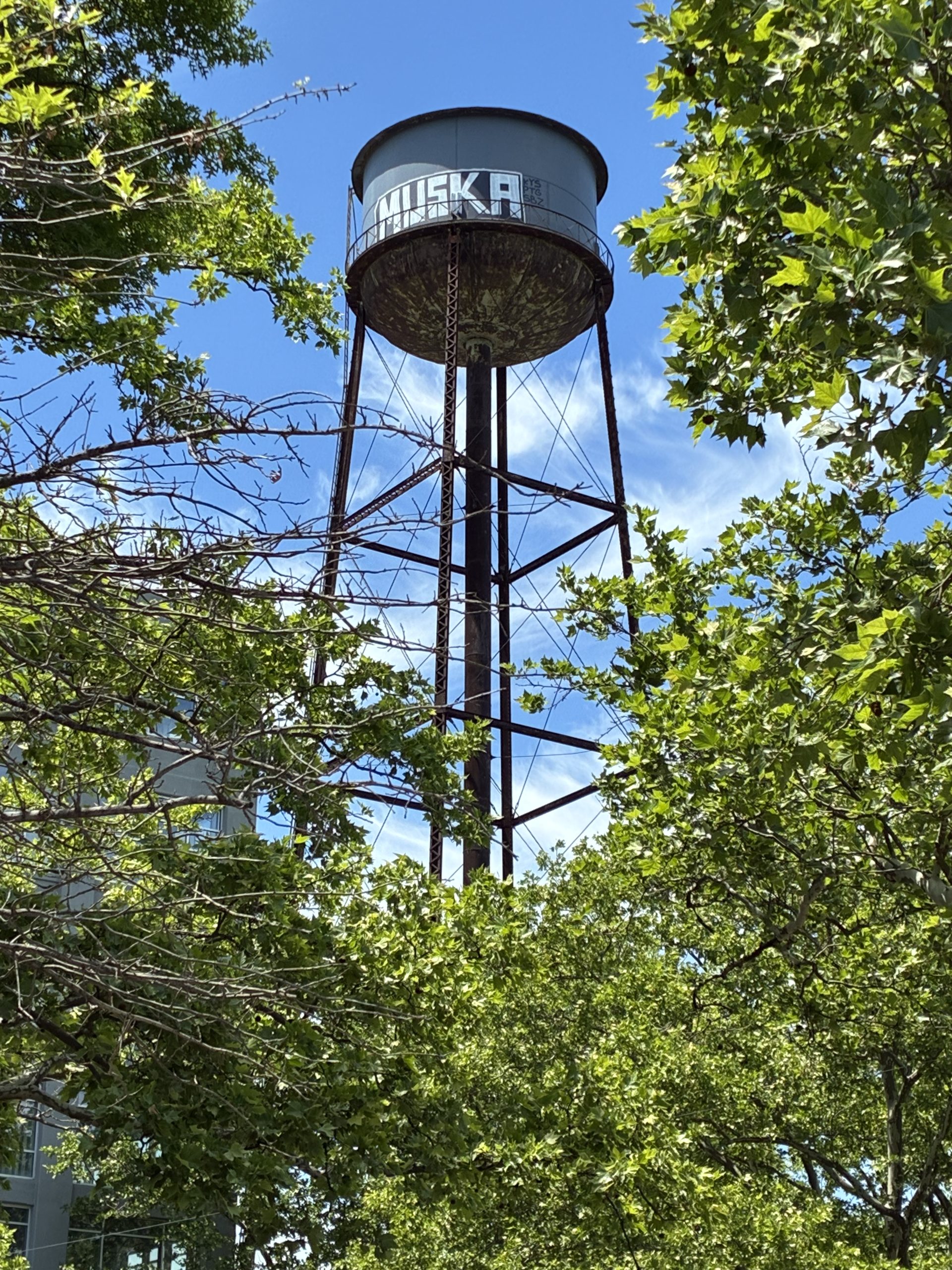
Photo via Geoffrey Cobb.
The industrial icon at Milton and West Street will soon be demolished to make way for housing. To some, it’s a symbol of Greenpoint itself.
GEOFFREY COBB
Author, “Greenpoint Brooklyn’s Forgotten Past”
gcobb91839@Aol.com
Greenpoint is about to lose one of its most iconic structures, the huge water tower that has lurked for decades above the neighborhood at Milton and West Street. Since I began to live in the area in the early 1990s, the hulking steel structure, towering over the neighborhood, has been the most defining feature of the waterfront and a visible connection to its industrial past.
Whenever I was taking the ferry on the East River or crossing the Williamsburg Bridge I would search for the water tower as a symbol of home, and I cannot think of any structure that better evokes Greenpoint for me more than the tower.
When I wrote my history of the area, “Greenpoint’s Forgotten Past,” I asked my talented friend Monte Antrim to create a sketch for the book’s cover that featured the water tower because no other structure better reflects the area’s rich manufacturing heritage.
I just read with great sadness that a developer has purchased the property and plans to build a ninety-nine-unit residential building at 72 West Street, on the corner of Milton Street where the tower rises. Constructing the building will likely doom the iconic water tower. The tower has been such a defining feature of our area for so long that I simply cannot imagine Greenpoint without it, but gentrification and property development have little regard for history and sense of place, so sadly the tower seems doomed.
The tower once supplied water to the American Hemp Rope manufacturing Company, whose home was a massive area on the waterfront that included sixteen buildings. The company employed over 2,500 largely female workers and was once the fourth largest industrial employer in New York City. The factory employed generations of immigrant women including Poles, Lithuanians, Sicilians and Puerto Ricans.
In 1910, a fierce street battle broke out under the shadow of the tower as a striking Polish and Lithuanian women were blocked from occupying the rope works by police who were pelted by the enraged strikers with rocks, bottles and even bricks.
During World War I, the rope works provided some fifteen thousand miles of rope for the American Navy and Merchant Marine. The plant also produced bags that were used in the American south to pick cotton.
Robert Bruce Brown, superintendent of the rope plant, fathered Margaret Wise Brown, the celebrated children’s writer and author of Goodnight Moon, whose childhood was spent on Milton Street, just up the street from the tower.
The rope factory went out of business sometime in the 1970s, but the tower survived, bearing mute witness for decades to the area’s manufacturing days. Sometime in the 1980s, a group of Polish men scaled the huge tower in the night and painted a massive Polish flag on the tower. The red and white flag stood for many years as a symbol of Polish Greenpoint. Later, someone painted “Save Palestine” on the tower, a reminder of the suffering of the Palestinian people.
In 2005, the city changed the zoning laws transforming the area from an industrial zone to a mixed-use zone, allowing for the construction of luxury towers that have quickly transformed the waterfront into a kind of Dubai on the East River. The tower’s days were numbered.
I wish there was some way to save the tower, but it seems like a futile struggle. Gentrification has no pity. I will be sad to see the tower gone because for me it has always been a powerful and evocative symbol of the area I call home.