
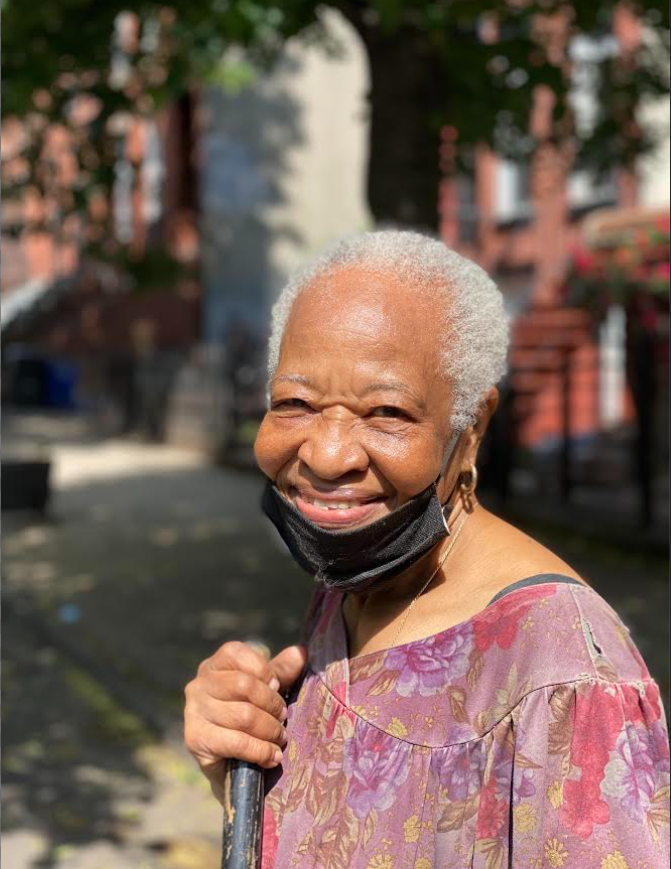
Jamaica-born Hyacinth Williams was Monroe Street Block 500’s unofficial caretaker for years. Photo via Owa Brandstein.
A new film documents the history of one Bed-Stuy block, as told by its elder residents.
BY COLE SINANIAN
cole@queensledger.com
It’s no accident Monroe Street was so clean.
For years, the entirety of Block 500 in the heart of brownstone Bed-Stuy was swept daily by Mrs. Hyacinth Williams, who took it upon herself to ensure her neighbors had a clean and clutter-free sidewalk.
Originally from Kingston, Jamaica, Mrs. Williams emigrated to Brooklyn in 1954 and spent much of her life among the presumably hundreds of Brooklynites who appoint themselves as their block’s unofficial caretakers, looking out for their communities and taking great pride in the beauty of their street.
“Many days she was out there by herself,” said neighbor Owa Brandstein. “We would leave for work and come home, and she would be finishing up. It really was her job.”
Mrs. Williams no longer lives on Monroe Street, but her local legacy and that of several of her neighbors is immortalized in the film “On Monroe Street: An Oral History of One Bed-Stuy Block.” Directed by Brandstein, the film — screened at a special community event at the Von King Cultural Center on March 28th — paints a vivid portrait of the sidewalk-sweepers, snow-shovelers, stoop-sitters and everyday working people who’ve called Monroe Street home for years. It’s both a hyperlocal homage to one particular tree-lined block and a broader testament to the elders of inner-Brooklyn, who recall a time when children ran carefree through the streets and the word “neighborhood” meant more than just a place to sleep.
The 500 Monroe Block Association produced the film with the support of the North Brooklyn Democratic Socialists of America and the Brooklyn Movement Center, and its screening was organized with the help of the office of Bed-Stuy City councilmember Chi Osse. The film sought to capture the stories and legacies of the block’s residents for posterity and ensure their preservation for Monroe Street’s next generation.
“Obviously there’s going to come a day when Mrs. Williams will not be there, and people are going to move into the neighborhood and not know who Mrs. Williams was and what she did,” Brandstein said. “And that just felt like such a tragedy.”
One of the film’s subjects is Mrs. Denise Feaster, a born-and-raised Brooklynite who grew up in public housing and later built a career in it, working for the New York City Housing Authority. She married an MTA bus driver and raised three sons in her Monroe Street home. Mrs. Feaster explained that having a nice home to raise a family was a non-negotiable for her husband, who passed away in 2005.
“He grew up in a home, and that’s what he wanted for his children,” she said. “So we stayed, and we bought this house on Monroe Street, which was the best thing we ever did.”
For Ronald Alston, among the best parts of living on Monroe Street is access to the endless wisdom of the community’s elders. Mr. Alston, recalled one Mrs. Bernice, an old woman that used to live a few doors down who spent her golden years sitting in her yard, slowly sipping a can of beer. When Mr. Alston came home from work, Mrs. Bernice would hold up her beer can to greet him.
“This lady was in her 80s, her late 80s, she would sit in her yard every day and her enjoyment was her can of beer,” he said.
Mrs. Feaster remembered the elders on the block when she first arrived, a couple called Mr. and Mrs. Mayes. They drove a yellow Cadillac, and Mrs. Feaster’s husband made sure the couple never had to shovel snow.
“My husband would have the boys shovel,” she said. “He would not allow the Mayes to come out and shovel.
Over the years, people came and went. Nowadays, a lot of the young people moving in are renters rather than homeowners. At least one attended the screening, a woman named Scout.
“We rent on this block,” Scout said. “I love it, the people, the conversations you hear. I wouldn’t want to live anywhere else.”
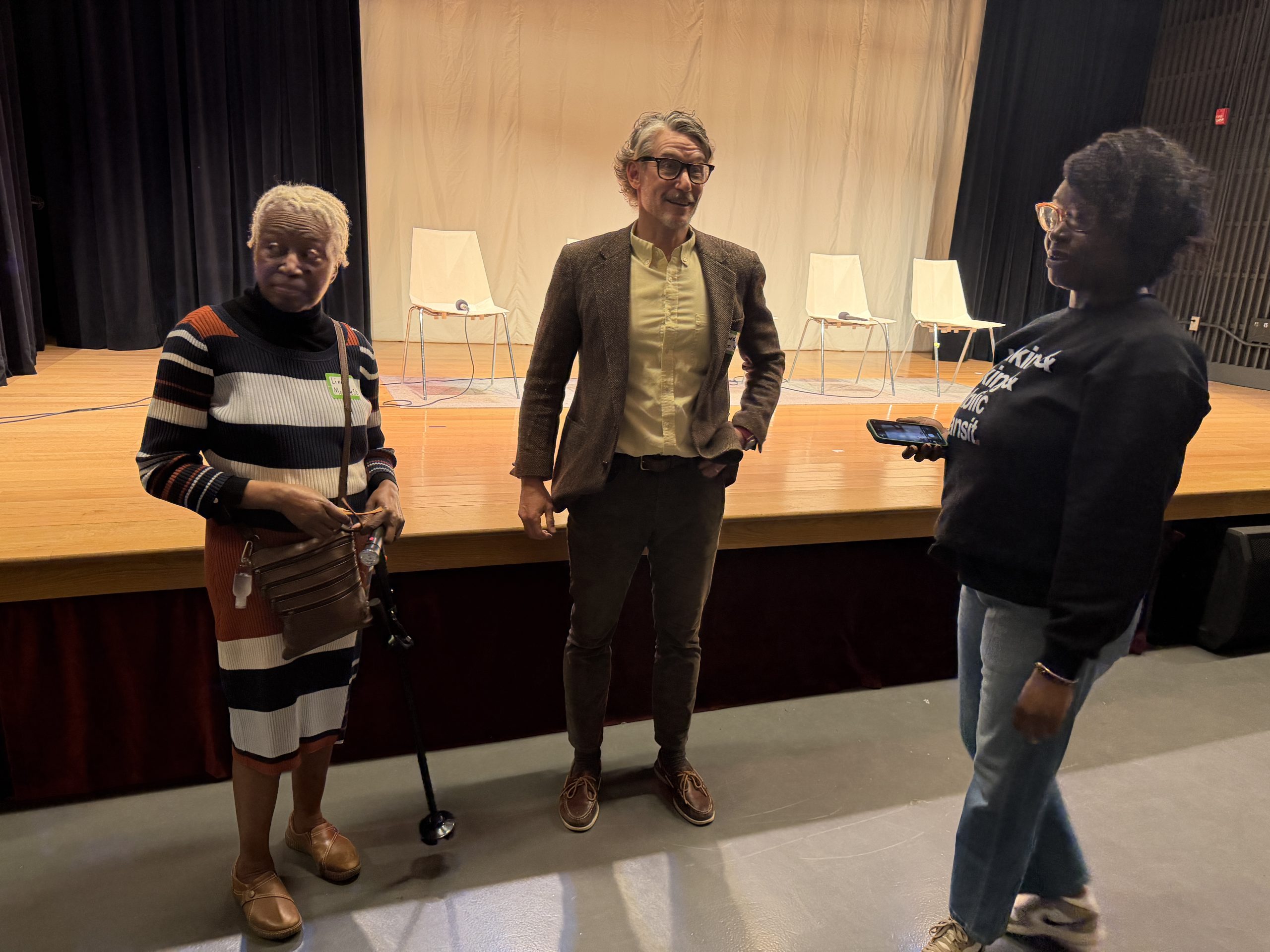
Filmmaker Owa Brandstein (center) with Linda Ferguson (left) and CM Chi Osse’s Chief of Staff, Arlean Gillin at the Von King Cultural Center on March 28. Photo via Owa Brandstein.
But not all of the new arrivals are friendly. In the film. Mr. Alston recalled neighbors who were scammed out of their homes in shady cash-for-house schemes or manipulative real estate tactics.
“A group of young people comes through these areas and they put out a front person to act like they’re helping you,” Mr. Alston said. “Reverse Mortgages, balloon mortgages, all of the things that they know that these people in these areas are uneducated about and unfamiliar, and they just steal their homes.”
In the film Janine Tolbert, the former housemate of Mrs. Williams, described cleaning some new neighbors’ yard.
“They’re new people, it’s four young girls,” said Mrs. Tolbert, who passed away in 2024. “And we go up in the yard, cleaning up to the door, and they come right out and see us cleaning, they say, ‘good morning.’ You’d think they would help us.”
During a Q&A discussion after the film, Ayinde Robinson, who’s lived on nearby Block 200 since 1980, explained how the sense of community in his neighborhood has degraded over the years, with many former neighbors selling their homes and moving on, while fewer and fewer people seem interested in building community.
“There was growing up, a spirit to the block personified by children playing,” Robinson said. “There is way fewer children in their yards from day to day. We haven’t had a block party the last two summers.”
Mrs. Linda Ferguson, who appeared in the film and also attended the screening, described what being a truly good neighbor meant to her.
“It’s a home, it’s a family atmosphere,” she said. “We love one another and we care for one another. If a neighbor has a problem on our block and someone sees them, we contact other family members.”
Rosemarie Borington, who’s lived on Stuyvesant Avenue between Monroe and Madison Streets her entire life, also sat on the panel. A home, she said, is more than just a house to sell.
“It’s hard sometimes when people call you night and day and want to buy a house out from underneath you,” she said. “You try to tell them, ‘this is my home.’ But they don’t understand.”
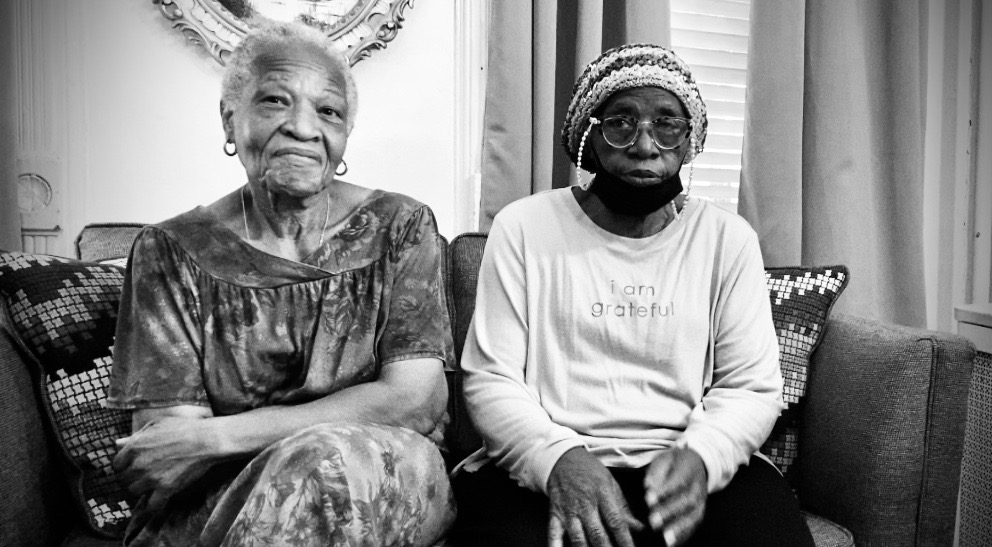
Hyacinth Williams (left) at home with her former housemate, Janine Tolbert, who passed away in 2024. Photo via Owa Brandstein.
But there’s hope. This part of Bed-Stuy still supports several active block associations. During the Q&A, Celeste Douglas, president of the nearby Gates Avenue Block Association, stood up, thanked Brandstein for making the film and requested that he show it to her neighbors. Then, speaking directly to Mrs. Borington, plead for help:
“Do you have any suggestions to help promote stronger communities, stronger block associations? Because it’s really hard. It’s really hard getting people out. Give me some tips!”
Borington suggested organizing block parties or community events that would encourage unity among neighbors. Scout then stood up and looked over at Mrs. Douglas, who as it turns out, was a former neighbor.
“I used to live at 904 Gates,” Scout said. “I’m sorry I didn’t socialize more and get to know my neighbors.”
To close out the speech, Scout recalled a neighbor who responded to a greeting of “It’s good to see you” by saying “It’s good to be seen.”
“I think that’s a beautiful thing,” Scout said. “Because to be seen, you’ve got to get outside.”
Any block associations interested in screening the film can reach out to Brandstein at obrandst@gmail.com.