
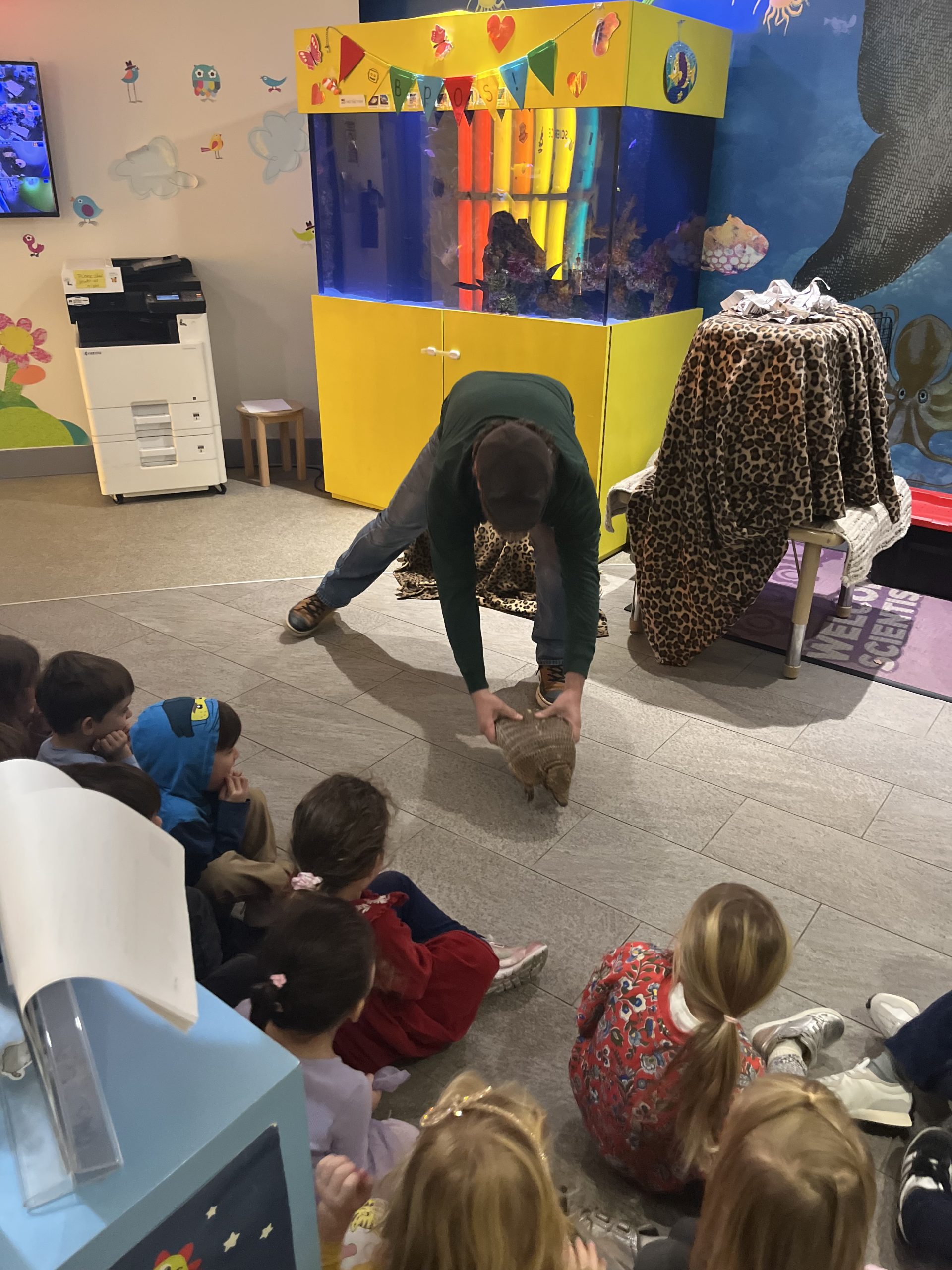
Travis Gale of Eyes of the Wild releases Dillon the Armadillo into a room of screaming pre-schoolers during an exhibition on December 2.
By Cole Sinanian
news@queensledger.com
“This is a full-grown elephant.”
Travis Gale pauses for effect, holding up the back of the leopard-print blanket that covers the cage, its mysterious contents visible only to him.
“BBRRRRRAAA!” His elephant trill is impressive. The dozen or so four-year-old Brooklyn Preschool of Science students seated criss-cross apple sauce around him scream and giggle in delight.
Gale pulls out one strip of newspaper, then another, relishing the suspense.
“WE WANT TO SEE THE AMINAL!” shrieks a little blonde boy named Henry.
Finally, out of the cage comes Dillon the six-banded armadillo. Gale takes care to explain to the children the difference between Dillon and other kinds of armadillos. There’s giant armadillos, nine-banded armadillos, and of course, the pink fairy armadillo of Argentina. Dillon, who Gale rescued from the exotic pet trade, is tortoise-sized with a hard, ridged shell covered in wispy long hairs.
“Imagine your whole back is covered in toenails,” Gale said.
“BE CAREFUL WITH THE AMINAL!” responded Henry.
It’s clear Gale spends much of his time speaking in the register of children. “Good morning, toys and swirls,” he tells the kids before unveiling Dillon. He addresses them as “baby goats,” a kind of animal also known as a “kid.” As founder of Eyes of the Wild — an exotic animal rescue center based on a farm in Hunterdon County, New Jersey — Gale has been coming to Brooklyn Preschool of Science for the past eight years, bringing a different cast of creatures each time. Last year, he brought a wallaby. A few years before he brought a sugar glider, a kind of gliding possum native to southeastern Australia, and launched it at Miranda DeMartin, the school’s educational director.
“As a science school, we’re always trying to figure out ways to incorporate different kinds of sciences,” DeMartin said. “And children at this age, they have no fear of worms or snakes or animals.”
A visit from Gale and his furry friends fits nicely into the school’s educational programming. With locations in Cobble Hill, Park Slope, and Boerum Hill, Brooklyn Preschool of Science offers an interactive, activity-based curriculum where children’s innate curiosity is cultivated as a precursor to scientific inquiry. As DeMartin explained, interaction with the natural world is crucial to BPS’ curriculum. Pet guinea pigs, hermit crabs and frogs are kept in classrooms. In the Cobble Hill location’s entrance hallway, where Gale’s presentation took place, a giant sperm whale is painted on the wall. Each year, children hatch a cohort of classroom chickens and care for the young chicks, part of a study of the life cycle. In January, DeMartin says, the school will host a “bubble show” as part of its unit on states of matter.