
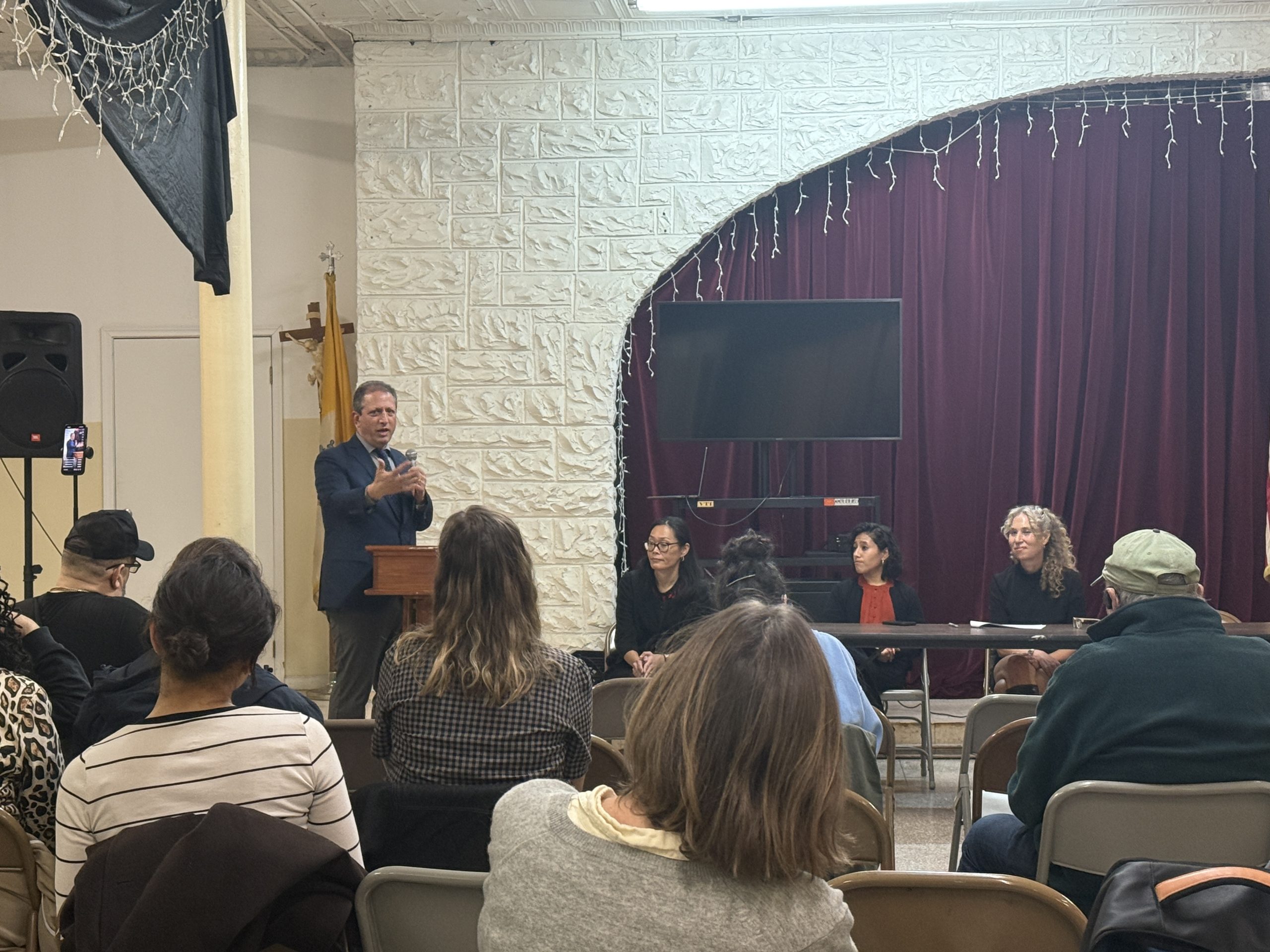
Brad Lander, the former city comptroller and now congressional candidate, speaks last week at a forum on the planned redevelopment of the Brooklyn Marine Terminal (BMT) in Red Hook.
By Jack Delaney | jdelaney@queensledger.com
CARROLL GARDENS — Red Hook residents may have gained a powerful ally in their fight against the Brooklyn Marine Terminal (BMT) redevelopment — but he’s not making any promises yet.
On Wednesday, March 11, nearly 100 locals gathered in the bowels of Sacred Hearts & Saint Stephen Church by the BQE trench. The meeting was ostensibly an info session about the BMT’s environmental review process, and kicked off with a presentation by Hilary Semel, director of the Mayor’s Office of Environmental Coordination (MOEC).
Once the Q&A arrived, however, attendees went on the offensive. Axel from the Columbia Waterfront District posed the essential question: Could the environmental review lead to any meaningful changes to the existing plan, which would see approximately 6000 homes built along the decrepit piers south of Brooklyn Bridge Park?
Semel’s answer — that the review’s findings were non-binding — triggered a muffled outcry. Local activist John Leyva argued that the process was simply meant to appease residents, while the New York Economic Development Corporation moved ahead without alterations to its original proposal. (“This is BS. Quote me on that,” Leyva would say after the meeting.)
A Red Hooker named Lou agreed: “The preamble makes it seem like the mostly-port alternative has no legs,” he noted, referencing a master document called the draft Scope of Work. “It’s a foregone conclusion that there will be housing.”
Other residents raised what they view as fundamental issues with constructing high-rises on the waterfront. Maria LaRocca pressed officials about a recent study published in Nature, which found that scientists have been severely underestimating sea level rise. Lisa Baustead, a veteran business owner from Carroll Gardens, added that buses were already gridlocked at the intersection of Atlantic Ave and Columbia St — what would happen with thousands of additional cars? And Pablo Garcia highlighted the 10 tons of waste that would need to be removed daily, to which an EDC rep replied that they were in contact with DSNY.
As part of the review process, known as CEQR, the MOEC is required to study the environmental impacts of alternative plans. Yet despite soliciting applications from potential port operators, the city has thus far signaled it is unlikely to tweak the core proposal.
These are familiar concerns, ones which failed to scuttle the BMT project when it passed a task force vote last fall. But a new face was in the crowd on Wednesday: former Comptroller Brad Lander, who joined the line to ask his own question.
“Why are we moving forward with one fleshed out plan, and a vague sense of another?” said Lander, pressing Semel. “Sometimes there’s urgency. Here it just seems like — hit pause, and let the alternatives develop.”
Semel replied that the city “had to start somewhere,” leading to a brief back-and-forth. The meeting wound to a close, and locals chatted with Lander, who said he was still researching and considering his position on the BMT. But even that was significant — Though the forum was a reminder of residents’ frustrations with the engagement process, it also introduced a curveball into an already tumultuous contest over the future of Red Hook.