
Record Snowstorm Recalls Brooklyn’s Blizzard of 1888

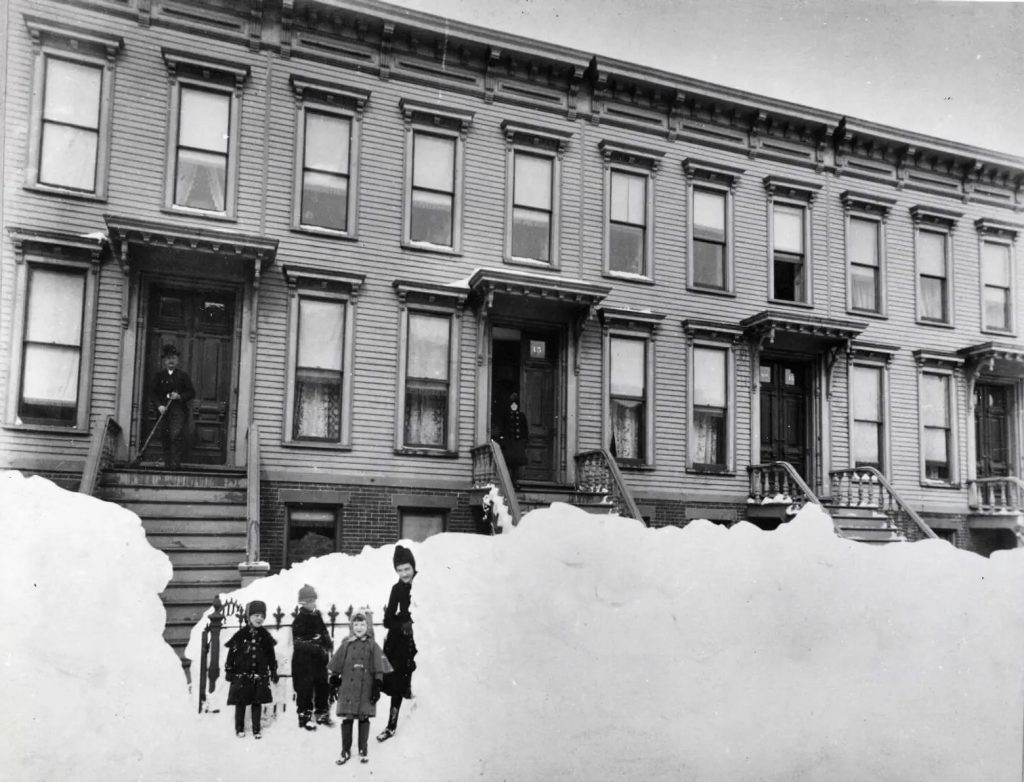
A family of Brooklynites peers out from the massive snowdrifts dumped by the Great Blizzard of 1888 — one of which was said to be over 50 feet tall. (Photo: Brooklyn Public Library)
By Jack Delaneyjdelaney@queensledger.com  

On Monday morning, as Brooklyn began to dig itself out of several feet of snowfall dropped by a bomb cyclone the night before, kids — basking in their day off — gathered in Prospect Park to sled and romp through the winter wonderland.

Numerically, it was an all-time blizzard: Crown Heights saw the peak for this corner of the borough with 21 inches of snow, comparable only to a handful of other storms in NYC’s history. In descending order, there was January 2016 (27.5 inches); February 2006 (27 inches); December 1947 (26 inches); February 2010 (21) inches; and March 1888 (also 21 inches).

But in many ways, nothing can compare to the Blizzard of 1888. Forget the icy palisades that will tower on our sidewalks for the next few days; that year, a snowdrift in Gravesend supposedly measured 52 feet tall.

Then consider the lack of forecasting technology. On March 10, the day before the blizzard, temperatures hovered in the mid-50s. No impending storm made the headlines of the ten-cent dailies, and the city was plunged unawares into 80-mile gales and a flurry of white.

Some accounts could have been written today. “By Monday morning the great blizzard had arrived!” the Brooklyn Eagle trumpeted, in a retrospective forty years after the fact. “For almost a week the city remained snowbound! There was no attempt to shovel sidewalks. Little canyons began to appear only after several days.”

Other vignettes evoke a forgotten world. “Children were seen tied together for safety’s sake with a rope, alpine fashion,” the article recounts. “Nothing was a surprise.” Brooklynites tossed snow into bonfires, barely making a dent. At 365 Fulton St, once a vaudeville theater called Hyde & Behman’s, a “unique intimacy sprang up” between the performers and the meager band of enthusiasts who had risked their lives to see the show.

Transportation was tricky in the age before motorized plows. “The dead were taken away in sleighs—the hearse was a sleigh,” but even that was iffy: bystanders found an undertaker helplessly stuck in a snowdrift on Court Street with a coffin. “Long Island trains left Brooklyn and were not heard from for hours, caught, snowbound,” lost somewhere down Atlantic Avenue in the haze. For those without rubber boots, the most popular alternative was to wrap your feet in newspapers. An older brother, memorialized as an “expert in snow shoes,” braved the arctic blasts to pull his sister to school at Packer.

The most moving details that reach us more than a century later, however, are the ones that gesture at a spirit of New York — and of Brooklyn — that’s still alive today. “Everybody tried to see the humor in the situation wherever that was possible,” the Eagle observed. “Funny signs, ‘Keep off the grass,’ were planted in drifts eight feet high.” A judge delayed a tenant’s eviction; residents joked that the steeple of a church on Monroe Street, bent out of whack by the wind, looked like the Leaning Tower of Pisa. Neighbors mobilized to help each other, and only two deaths were reported.

Anyone who lived through Hurricane Sandy knows what happens when disaster strikes in Brooklyn, whatever the millennium: “Throughout the storm people remained good-natured and helpful, the common experience binding them together.”

Leave a Reply

A family of Brooklynites peers out from the massive snowdrifts dumped by the Great Blizzard of 1888 — one of which was said to be over 50 feet tall. (Photo: Brooklyn Public Library)
By Jack Delaneyjdelaney@queensledger.com  

On Monday morning, as Brooklyn began to dig itself out of several feet of snowfall dropped by a bomb cyclone the night before, kids — basking in their day off — gathered in Prospect Park to sled and romp through the winter wonderland.

Numerically, it was an all-time blizzard: Crown Heights saw the peak for this corner of the borough with 21 inches of snow, comparable only to a handful of other storms in NYC’s history. In descending order, there was January 2016 (27.5 inches); February 2006 (27 inches); December 1947 (26 inches); February 2010 (21) inches; and March 1888 (also 21 inches).

But in many ways, nothing can compare to the Blizzard of 1888. Forget the icy palisades that will tower on our sidewalks for the next few days; that year, a snowdrift in Gravesend supposedly measured 52 feet tall.

Then consider the lack of forecasting technology. On March 10, the day before the blizzard, temperatures hovered in the mid-50s. No impending storm made the headlines of the ten-cent dailies, and the city was plunged unawares into 80-mile gales and a flurry of white.

Some accounts could have been written today. “By Monday morning the great blizzard had arrived!” the Brooklyn Eagle trumpeted, in a retrospective forty years after the fact. “For almost a week the city remained snowbound! There was no attempt to shovel sidewalks. Little canyons began to appear only after several days.”

Other vignettes evoke a forgotten world. “Children were seen tied together for safety’s sake with a rope, alpine fashion,” the article recounts. “Nothing was a surprise.” Brooklynites tossed snow into bonfires, barely making a dent. At 365 Fulton St, once a vaudeville theater called Hyde & Behman’s, a “unique intimacy sprang up” between the performers and the meager band of enthusiasts who had risked their lives to see the show.

Transportation was tricky in the age before motorized plows. “The dead were taken away in sleighs—the hearse was a sleigh,” but even that was iffy: bystanders found an undertaker helplessly stuck in a snowdrift on Court Street with a coffin. “Long Island trains left Brooklyn and were not heard from for hours, caught, snowbound,” lost somewhere down Atlantic Avenue in the haze. For those without rubber boots, the most popular alternative was to wrap your feet in newspapers. An older brother, memorialized as an “expert in snow shoes,” braved the arctic blasts to pull his sister to school at Packer.

The most moving details that reach us more than a century later, however, are the ones that gesture at a spirit of New York — and of Brooklyn — that’s still alive today. “Everybody tried to see the humor in the situation wherever that was possible,” the Eagle observed. “Funny signs, ‘Keep off the grass,’ were planted in drifts eight feet high.” A judge delayed a tenant’s eviction; residents joked that the steeple of a church on Monroe Street, bent out of whack by the wind, looked like the Leaning Tower of Pisa. Neighbors mobilized to help each other, and only two deaths were reported.

Anyone who lived through Hurricane Sandy knows what happens when disaster strikes in Brooklyn, whatever the millennium: “Throughout the storm people remained good-natured and helpful, the common experience binding them together.”

Leave a Reply

Fill the Form for Events, Advertisement or Business Listing