
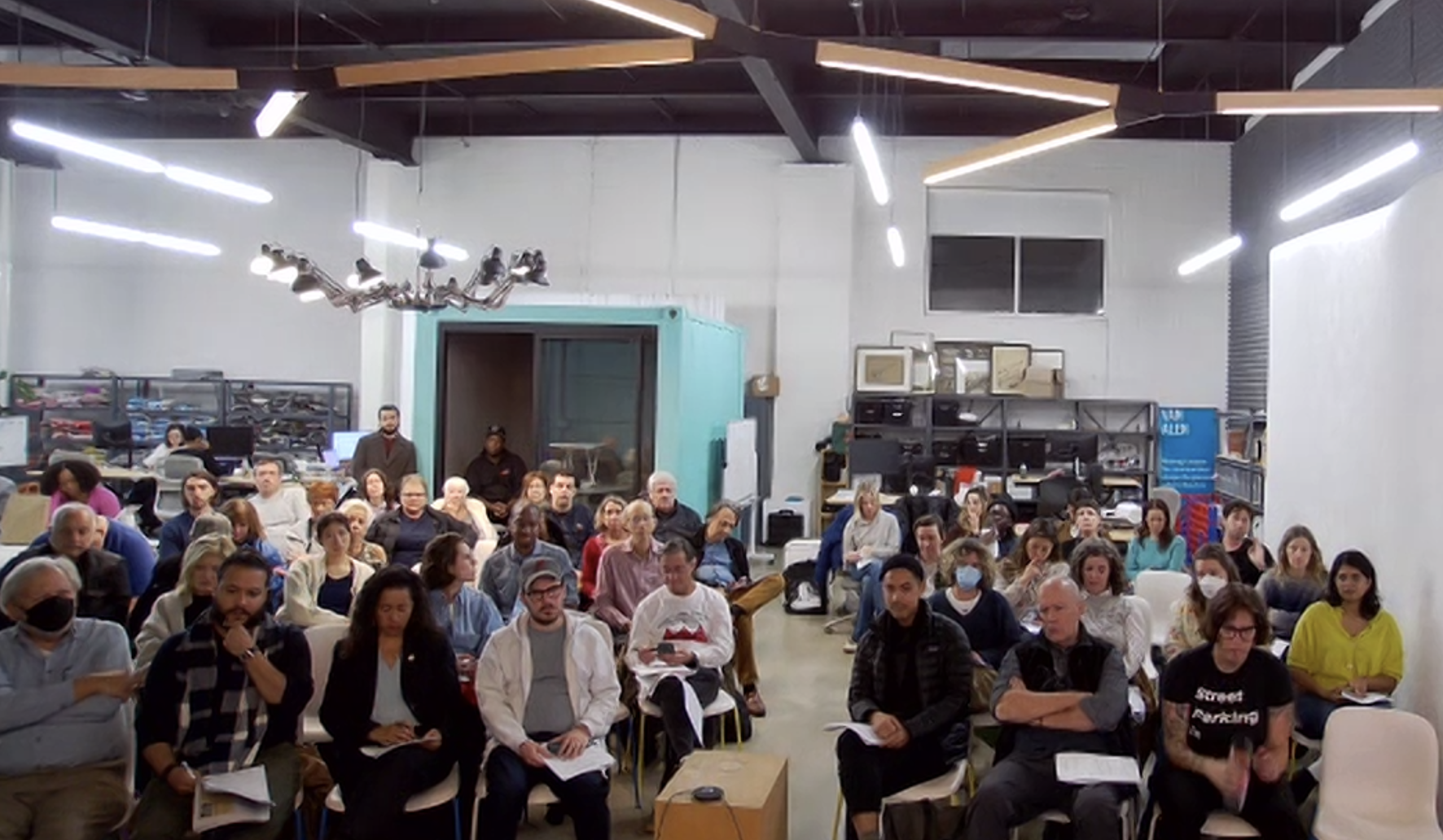
Brooklyn Community Board 6 covers parts of Red Hook, Cobble Hill, Carroll Gardens, Gowanus, and Park Slope.
By JACK DELANEY | jdelaney@queensledger.com
At its latest full meeting on November 12, the rift between older and newer residents in Community Board 6 was laid bare by one of its fiercest controversies since the rezoning of Gowanus: the creation of a protected bike lane on Court Street, a major business artery in Carroll Gardens.
The event started out innocently enough. Local Council Member Alexa Aviles opened with a report on the increasing presence of ICE in New York City, sharing that the City Council’s immigration committee will be holding a hearing on December 8 to consider a docket of legislation that includes shoring up sanctuary city policies.
“There are many neighbors who are vulnerable at this time,” noted Aviles. “Extend a hand, which can be everything from helping a neighbor walk their kids to school if they are not feeling secure, or checking in with folks to make sure they have food.”
Aviles also highlighted efforts to curb pollution in Red Hook, another hot-button issue. The neighborhood hosts an Amazon warehouse and a cruise terminal, both of which give rise to emissions that reduce local air quality, and lawmakers are pushing for a law that would require NYC’s ports to go carbon-neutral.
“One idling cruise boat is equivalent to 30,000 traffic-trailers idling,” said Aviles. “So when you have boats at berth that are not plugged in and are sitting there idling, it really is a noxious situation for our community.”
Next came a brief speech from the district manager, Mike Racciopo, who recapped the results from Election Day. He praised the area’s high turnout, and presented graphics showing that CB6 voted at higher rates than the city as a whole for ballot proposals two through five, while snubbing proposal one (which ultimately passed).
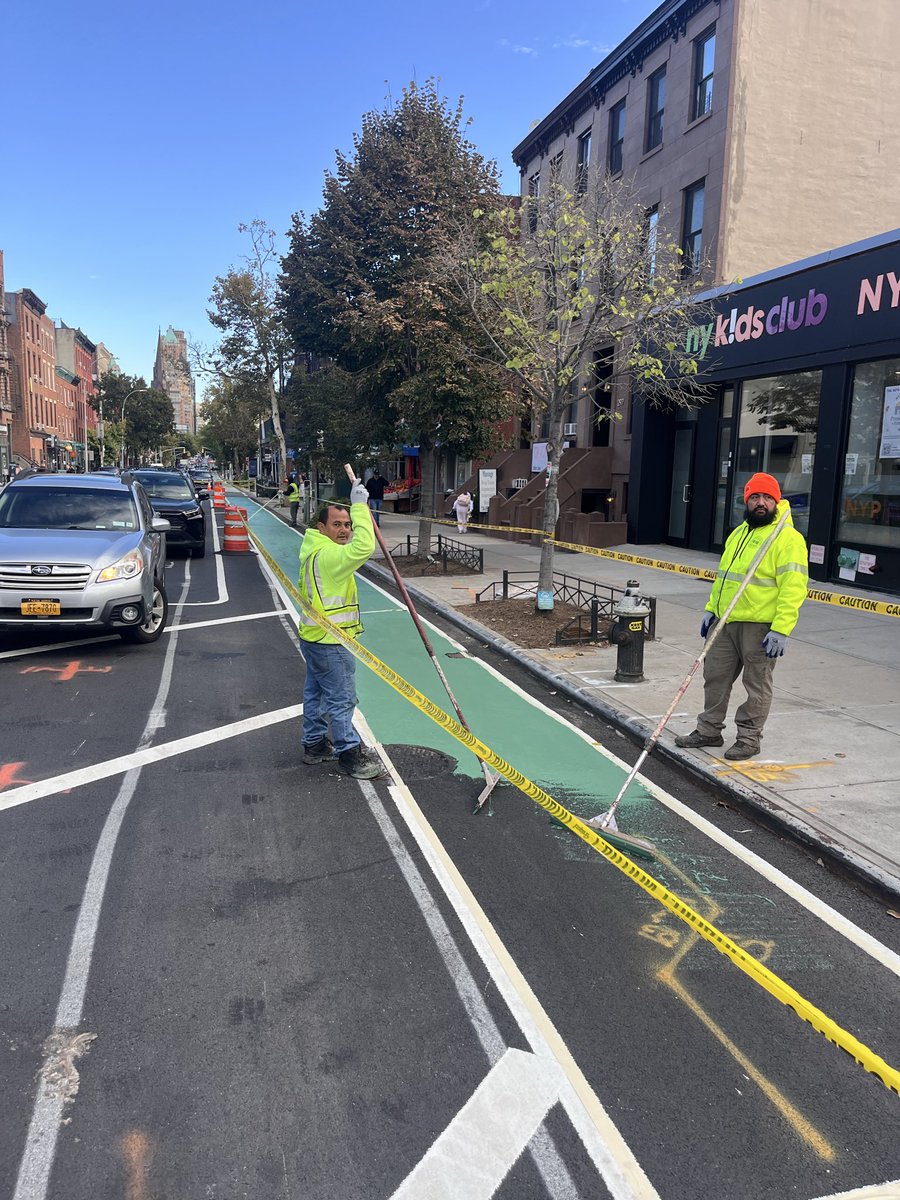
The Court Street bike lane, pictured during installation, has stoked tensions between local business owners and the community board.
The headline item at last week’s meeting was the annual District Needs Assessment, essentially a wish list that each community board sends to Borough Hall.
The top asks were the same as last year — housing, resilience, and transportation — but Treasurer Dillon Shen-Cruz stressed the urgency of building new homes, citing a recent study by fellow CB6 member Rebecca Kobert which found that for every three units the jurisdiction added over the past 15 years, it lost one to renovations as many brownstones were converted to single-family housing.
In raw numbers, 1,500 units were lost between 2010 and 2024, giving CB6’s bundle of neighborhoods the dubious honor of having the highest rate of unit loss in Brooklyn.
Yet one of the community board’s proposed solutions to the housing shortage, a plan to construct over 6000 units at the Brooklyn Marine Terminal in Red Hook, has stoked tensions with locals on the waterfront, many of whom claim their views are not being represented by CB6’s leadership.
A seemingly small motion at the latest meeting ignited similar concerns.
Earlier in October, the community board’s transportation committee unanimously voted to support a Low Traffic Neighborhood (LTN) designation in Gowanus, a proposal presented by the nonprofit Open Plans. Studies show that most car traffic in any given neighborhood comes from drivers who live elsewhere. In theory, LTN schemes limit this cut-through traffic by diverting some streets to prioritize slower, safer, and more localized driving — a practice that has seen success, and backlash, in cities like London.
Out-of-neighborhood cars account for 80% of traffic in Gowanus, CB6 board members explained, while only 8% of Gowanusians drive to work every day. An example diagram showed Hoyt Street cut off at Atlantic Avenue and Third Street by plazas, with another blocking the route over the Union St bridge.
The motion at hand for the full meeting was whether to ask the Department of Transportation to study a possible LTN in the area, not a binding vote to implement one. “It’s purely a concept,” asserted CB6 Board Chair Eric McClure, who is also the executive director of the street safety advocacy group StreetsPAC.
But several residents quickly protested, arguing that the proposal could have major ramifications for drivers in nearby Carroll Gardens, most of whom likely weren’t aware the idea was being floated.
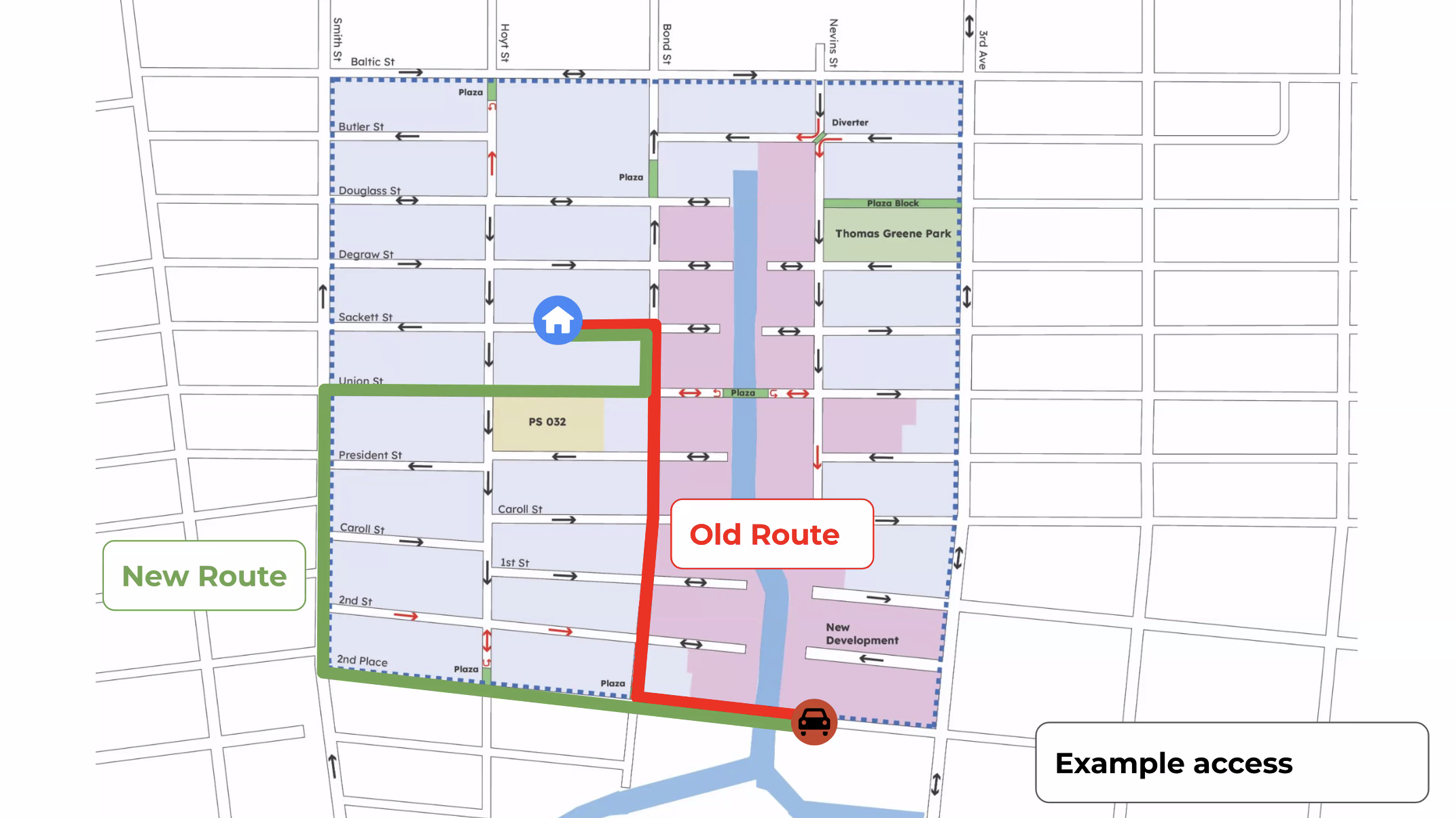
CB6 also discussed a potential Low Traffic Neighborhood designation for Gowanus (and, as the diagram shows, much of Carroll Gardens).
“I agree that we’re just asking for this to be studied,” said CB6 member John Heyer. “But when you do that, it’s also kind of seen as approval. And before you know it, you have a situation like we have on Court Street.”
That was the elephant in the room. McClure called the LTN motion to a vote, where it passed 15 to 12. Yet the underlying battle lines — loosely organized along drivers and bikers, old-guard Italian American residents of Carroll Gardens and the more recent arrivals in Gowanus and Cobble Hill — became entrenched again during the open mic portion of the meeting, when the issue of Court Street came to the fore.
For years, Court Street was a two-lane, one-way street with unclear markings. Cyclists were left to weave through car traffic; per city data, 155 people were injured on the street over the past four years, two fatally.
But an uproar began in October, when the DOT acted on safety concerns and removed one lane, installing a 1.3-mile protected bike lane in its stead. Business owners revolted, with legendary coffee roasters D’Amico’s protesting that their sales were down by almost 20% because cars could no longer park next to the store. Some residents said the area was actually less safe, posting videos of ambulances backed up by a snarl.
Many of the complainants are long-time fixtures in the neighborhood. “Court Street Bike Lane Has Church Parishioners Praying for Answers,” announced the Tablet, the official newspaper of the Catholic Diocese of Brooklyn, relaying the complaints of St. Mary Star of the Sea Church, a local mainstay. Another article quoted a funeral director who was now forced to unload cadavers around the block.
The proposal was first presented to CB6 in June, and McClure asserted that the community board had reached out to businesses on Court Street before approving the redesign.
The Court Street Merchants Association, a coalition of small business owners, maintains otherwise. It sued the city earlier this month, asking for a temporary injunction and claiming that the community board did not involve its members in deliberations over the bike lane. A judge opted not to halt work, saying it was “moot at this point,” but will hear arguments on November 24 and will make a final decision by the end of the year.
Jonathan Romero, who has lived in Carroll Gardens for 38 years, said he believed the intentions behind the redesign were good, but that the street was more dangerous due to congestion.
“It is a completely different street,” agreed Andrea Romeo, who opened a home decor shop called Painted Swan on Court Street in 2017. “I was told that we were going to lose two and a half parking spots per block. Obviously, that’s not the case — there are many, many more spots that are not accessible to my clients.”
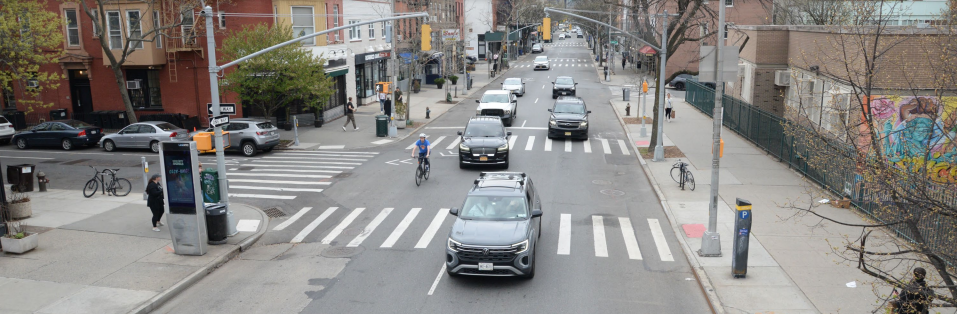
Court Street before the protected bike lane was installed earlier this fall.
Frank Cuomo testified that driving his granddaughters to school currently takes double the time it used to. He summed up the opposition concisely: “I have been in this neighborhood for 67 years,” he said. “I have seen the good, the bad… now this is becoming ugly.”
“I’ve been sitting here for two hours, listening to things I don’t agree with,” said Cuomo.”But respectfully, I listen. You guys need to up your game and basically represent everybody in this community.”
Cuomo wasn’t the only speaker claiming to have the community’s backing, however. “I get excited when I’m on Court Street now, and I see kids and cyclists,” said Boerum Hill resident Diane Martin, an organizer with Transportation Alternatives, who pointed to the DOT’s safety studies. “Change is hard, but you have to adapt for the greater good of everyone.”
If you’re interested in getting more involved, the community board will be staging its next full meeting on December 10. You can also apply to become a board member of CB6 from now until February at brooklyncb6.cityofnewyork.us.