42 Hotel opens in Williamsburg

By BK Star Staff

news@queensledger.com

42 Hotel, a new luxury lodging in Williamsburg officially opened its doors to the public earlier this week. 

Located on 426 S 5th Street, the 60-room building features amenities like floor-to-ceiling windows, lounge chairs, JBL Bluetooth speakers and high speed internet access.

The hotel offers six different room packages, ranging from 240 to 320 square feet and handicap accessibility options.

Designed by architect Lucas Lee and interior designer Andres Escobar, the new hotel sports a self-described “rustic but modern” design, with Edison style bulbs adorning the lobby.

The hotel also features a beer and wine lounge, called the Community Lounge, where both local and international craft beers, and “Americana-inspired small plates” will be on the menu. Additionally, 42 Hotel has partnered with Brooklyn Speed Coffee to run their cafe, offering breakfast burritos and “third wave” coffee.

The lobby of 42 Hotel

“42 Hotel is excited to serve the residents and tourists of Williamsburg. Our hotel is all about ‘community,’ and we will be partnering with local businesses to provide hotel guests with a unique Williamsburg experience,” the management team said in a statement.

“We hope that guests will enjoy all of the details that our team has spent years on crafting.”

42 Hotel also offers perks like same-day laundry, access to a fitness center and conference room options for patrons. 

Reservations can be made directly on their website: https://42hotel.com/


5 Rules For Small Business Grant Funding Applications in NY

Starting a business is expensive.  You have to test new products, secure inventory, research market trends, etc.  There’s no shortage of costs for a startup business. But if you haven’t even started selling yet, where does the money come from?

Seasoned small business owners might have a network of financiers, but for entrepreneur rookies, securing funding before you’ve had a chance to prove yourself can be tricky.

Every new business can do with a bit more cash, but the application process for government issued small business grants involves more than putting your name on a list and waiting for a deposit. Not every grant is right for every business and understanding how grant-issuing organizations evaluate applicants is imperative to securing the financial assistance you need.

If you plan on investing the time and energy into applying to a small business grant program, it’s important to understand the options available and pick the grant that’s right for your business.

Small business grants are offered by all kinds of organizations, to all types of businesses, with a wide range of values, missions, and functions.

There’s no single set of criteria that can be applied to all grant opportunities, but generally, grant-lenders are looking for small businesses that embody their organization’s stated purpose and add value to a particular community or industry.

Small business grants are not loans, so lenders aren’t expecting to be paid back. They’re not investment capital, either so issuers aren’t expecting to own assets of your business. But that doesn’t mean that small business grants don’t come with expectations and incentives.  Issuers still expect a return on their investment, just not a monetary one. Instead, organizations that provide small business owners with grants want to feel confident that your business idea contributes to their organization’s mission⁠—whether it be a common good, innovation in a particular industry, or economic growth in a specific community.

A small business grant isn’t necessarily “free money” either. Grant issuers often have stipulations about how the money can be spent, sometimes even spending the money themselves on specific resources they believe will help your business grow.

If you’re to fund a small business and looking to apply for a business grant, here are some key points to keep in mind:

  1.  Look for grants within your industry:  A lot of small business grants are industry specific, so it can help narrow down your search if you focus on organizations and research institutions within your specific industry.  Focusing on one industry also builds buzz around your business and can help build connections with industry figures who may be able to offer guidance and investment opportunities.
  2. Read the eligibility requirements carefully:  Read the requirements carefully and evaluate whether you qualify for the grant. If you’re unsure whether you qualify, contact someone from the organization and ask.
  3. Make sure your business aligns with the organization’s mission:  Organizations that provide small business grants do so in the hopes of achieving a specific goal they are deeply invested in. Ask yourself how your business model helps contribute to achieving this goal. If the answer is hard to find, you might want to consider applying for grants with another organization.
  4. Know what you’ll be spending the grant money on:  Have your business plan ready and know how the money will be spent.  This will make the organization understand more clearly how your business aligns with their mission.

Focus your pitch on innovation and expansion:  Organizations that issue small business grants typically favor business that they see as innovative, forward thinking, and on a path to growth. Focus your pitch on new technologies you might be developing, and what your business can do to help the organization with its mission.

Common Estate Planning Mistakes By A Brooklyn Lawyer

Estate planning is meant to provide peace of mind to you and your loved ones in the event of your passing. There are some easily avoidable mistakes which can cause unnecessary time and cost. This article will try to list just a few in an attempt to help people avoid them. All specific matters should be discussed with a competent Brooklyn estate planning attorney.

One mistake we sometimes see is a parent transferring appreciated assets like stocks or real estate to their children directly. This causes the children to lose an important tax benefit called the step up in basis, costing the children unnecessary taxes in the future. We have an in-depth article about this topic linked here. In addition, the parent loses certain tax benefits such as the primary residence capital gains tax exclusion, and STAR benefits. Instead, the parent should consider placing the property or assets into a living trust to avoid probate while keeping the step up in basis and other tax benefits.

Another lost opportunity is failing to list beneficiaries on accounts or failing to properly fund a trust. Probate can be avoided entirely simply by listing beneficiaries on bank accounts, investment accounts on life insurance policies. Forgetting to list your beneficiaries on even one account will cause an estate to have to be opened after you pass away for that account. Similarly, we have seen clients set up living trusts to avoid probate but then forget to properly fund the trust, thereby avoiding much of the benefit of a trust.

When planning an estate, it is important to have advance directives set up as well. These documents, which include a health care proxy, power of attorney are important tools to be used when someone can’t make their own medical or financial decisions. We often see clients who need help transferring their home or assets in order to qualify for Medicaid, but are unable to do so themselves because of a lack of mental capacity. For these clients, a power of attorney makes it possible to have their agent(s) make decisions for them, but the key is that the power of attorney and health care proxy has to be set up while you are of sound mind. Missing the opportunity to do it early on may mean the difference between getting the help you need quickly and going through a long and expensive Article 81 Guardianship proceeding.


Contributed by Roman Aminov, an award winning attorney in Brooklyn, NY located at 600 Avenue M, Brooklyn, NY 11230. Schedule A Consultation today by calling (347) 766-2682 or visiting https://www.aminovlaw.com/.

Queens, NY Location:

2022 Elections Profile: Senate Candidate Elizabeth Crowley

By Matthew Fischetti

mfischetti@queensledger.com

Elizabeth Crowley wants to represent Queens again. And Brooklyn. Oh, And Manhattan too.

Crowley, a former city councilwoman from Glendale, is running in the newly redrawn Senate 26, which straddles Western Queens, Northern Brooklyn, and Eastern Manhattan. Crowley is no newcomer to politics, coming from a large political family (her cousin was former Congressman Joseph Crowley, who AOC upset in 2018)  and has run for a slew of offices over the years.

While the district originally encompassed her home of Glendale, Crowley said that her vision and platform apply to a greater swath of New Yorkers.

“I went to college at FIT, I went to grad school in Brooklyn. I identify with the city as a whole,” Crowley said in an interview.  Crowley said that while she represented different neighborhoods back in the council, she pushed for policies that benefit New Yorkers across the board.

Crowley pushed against firehouse closures, fought to close Rikers, and advocated for increased greenway and transit options during her time on the city council. She lost re-election against Councilman Robert Holden in 2020.

“Most of them [inmates] have some level of anxiety, depression and a significant amount of the population as a serious mental health diagnosis, such as schizophrenia, or bipolar disorder. And many of them have no family and no support system,” Crowley said of her decision to support bail reform, even though she noted that the legislation went too far in offering bail to alleged violent offenders.”So either way, they’re going to cycle in and out, in and out.”

Crowley said that affordability issues, child care, and education would be among her top issues if elected. In order to tackle the affordability issue, she says that New York needs to build a massive amount of affordable housing with transit to support the development.

“I have constituents in this district, over $3 million houses, in Greenpoint, pay less than property tax, then a modest, 1,000 square-foot homeowner in the district – or even, let’s say, a homeowner in southeast Queens. It’s a city-wide issue that needs to be addressed,” Crowley said, highlighting her desire for broad-based property tax reform. Earlier this year, a group of bipartisan legislators from Albany to the city council called for the issue to be addressed in the next legislative session.

While Crowley said that she wasn’t a fan of 421(a), the city’s now expired affordable housing tax break that critics said didn’t invest enough in actually affordable units, she said there still is a role for the government to subsidize construction.

She also said that she would explore options to reduce construction by “working with unions and project labor agreements to bring down wages, or to get some guarantees or give back to them for the cost of the project.” Crowley has received the most amount of support from labor unions thus far in the race.

The other candidates in the race are Kristen Gonzalez, Mike Corbett, and Nomiki Konst. The election is on Aug. 23, with early voting occurring from Aug. 13 to the 21st.

2022 Elections Profile: Senate Candidate Elizabeth Crowley

By Matthew Fischetti

mfischetti@queensledger.com

Elizabeth Crowley wants to represent Queens again. And Brooklyn. Oh, And Manhattan too.

Crowley, a former city councilwoman from Glendale, is running in the newly redrawn Senate 26, which straddles Western Queens, Northern Brooklyn, and Eastern Manhattan. Crowley is no newcomer to politics, coming from a large political family (her cousin was former Congressman Joseph Crowley, who AOC upset in 2018)  and has run for a slew of offices over the years.

While the district originally encompassed her home of Glendale, Crowley said that her vision and platform apply to a greater swath of New Yorkers.

“I went to college at FIT, I went to grad school in Brooklyn. I identify with the city as a whole,” Crowley said in an interview.  Crowley said that while she represented different neighborhoods back in the council, she pushed for policies that benefit New Yorkers across the board.

Crowley pushed against firehouse closures, fought to close Rikers, and advocated for increased greenway and transit options during her time on the city council. She lost re-election against Councilman Robert Holden in 2020.

“Most of them [inmates] have some level of anxiety, depression and a significant amount of the population as a serious mental health diagnosis, such as schizophrenia, or bipolar disorder. And many of them have no family and no support system,” Crowley said of her decision to support bail reform, even though she noted that the legislation went too far in offering bail to alleged violent offenders.”So either way, they’re going to cycle in and out, in and out.”

Crowley said that affordability issues, child care, and education would be among her top issues if elected. In order to tackle the affordability issue, she says that New York needs to build a massive amount of affordable housing with transit to support the development.

“I have constituents in this district, over $3 million houses, in Greenpoint, pay less than property tax, then a modest, 1,000 square-foot homeowner in the district – or even, let’s say, a homeowner in southeast Queens. It’s a city-wide issue that needs to be addressed,” Crowley said, highlighting her desire for broad-based property tax reform. Earlier this year, a group of bipartisan legislators from Albany to the city council called for the issue to be addressed in the next legislative session.

While Crowley said that she wasn’t a fan of 421(a), the city’s now expired affordable housing tax break that critics said didn’t invest enough in actually affordable units, she said there still is a role for the government to subsidize construction.

She also said that she would explore options to reduce construction by “working with unions and project labor agreements to bring down wages, or to get some guarantees or give back to them for the cost of the project.” Crowley has received the most amount of support from labor unions thus far in the race.

The other candidates in the race are Kristen Gonzalez, Mike Corbett, and Nomiki Konst. The election is on Aug. 23, with early voting occurring from Aug. 13 to the 21st.

Park Slope church robbed of ‘priceless’ tabernacle

St. Augustine Church in Park Slope was robbed of their tabernacle late Thursday night.

A tabernacle is an ornate encasing that holds the consecrated eucharist, which in the Catholic religion represents the literal body of christ.

The church along 6th Avenue was broken into on Friday evening according to police. The surrounding architecture was destroyed as well. The angels surrounding the tabernacle were decapitated and the eucharist was strewn across the room.

Cops say the 18 karat gold tabernacle decorated with jewels is approximately worth $2 million. But to the parishioners, a lot more was stolen.

Diane Montemarano, 68, has attended the parish for 39 years. Her father, born in 1918, was an altar boy at the church in his youth.

“I always loved coming here because, you know, he was an altar boy, and he grew up in this parish. So, personally, it’s like, a relic of my dad was taken,” Montemarano said in an interview.

The stolen tabernacle dates back to the 1890s, from when the church was built, and is described as irreplaceable by the church due to its historical and artistic significance. Burglars cut through a steel encasing with power tools. Father Tumino said that when he walked in Saturday morning he saw the door was ajar. After he walked in and saw the destruction, he could still smell the metal shavings from the tools used to break through.

Tumino also stated that the DVR that recorded the security footage within the church was stolen as well. The Father said that the parish is working with police to see if neighboring schools or businesses caught any footage of the suspects.

Tumino also speculated that due to the construction in the neighborhood, the burglars were able to break through the steel encasing without raising suspicion.

Tumino shot down the idea of an inside job at a Sunday morning press conference.

“I know it’s easy for people to say it was an inside job. But the reality is, these are also very public buildings. And so even online, there’s a history of this church,” Tumino said. “And even the history of the church does say that there is a tabernacle and that information is accessible. And because churches are available for weddings and funerals and for mass, people do come in and out.”

“This was a place where you come to gather yourself things are going wrong. You can come here and calm down and sort of get a second boost so to speak,” Michael Okebey, 58, who has been attending services at St. Augustine’s for 35 years, said. “I feel like somebody has interrupted my relationship with God in some way.

After being asked about how he felt about the crime, knowing that the approximate value of the tabernacle is $2 million, Okebey got more stern.

“Now i’m really angry,” he said, explaining that the church is currently raising funds for other projects and that this would put them further behind.

Lest We Forget: Black Veterans on Memorial Day

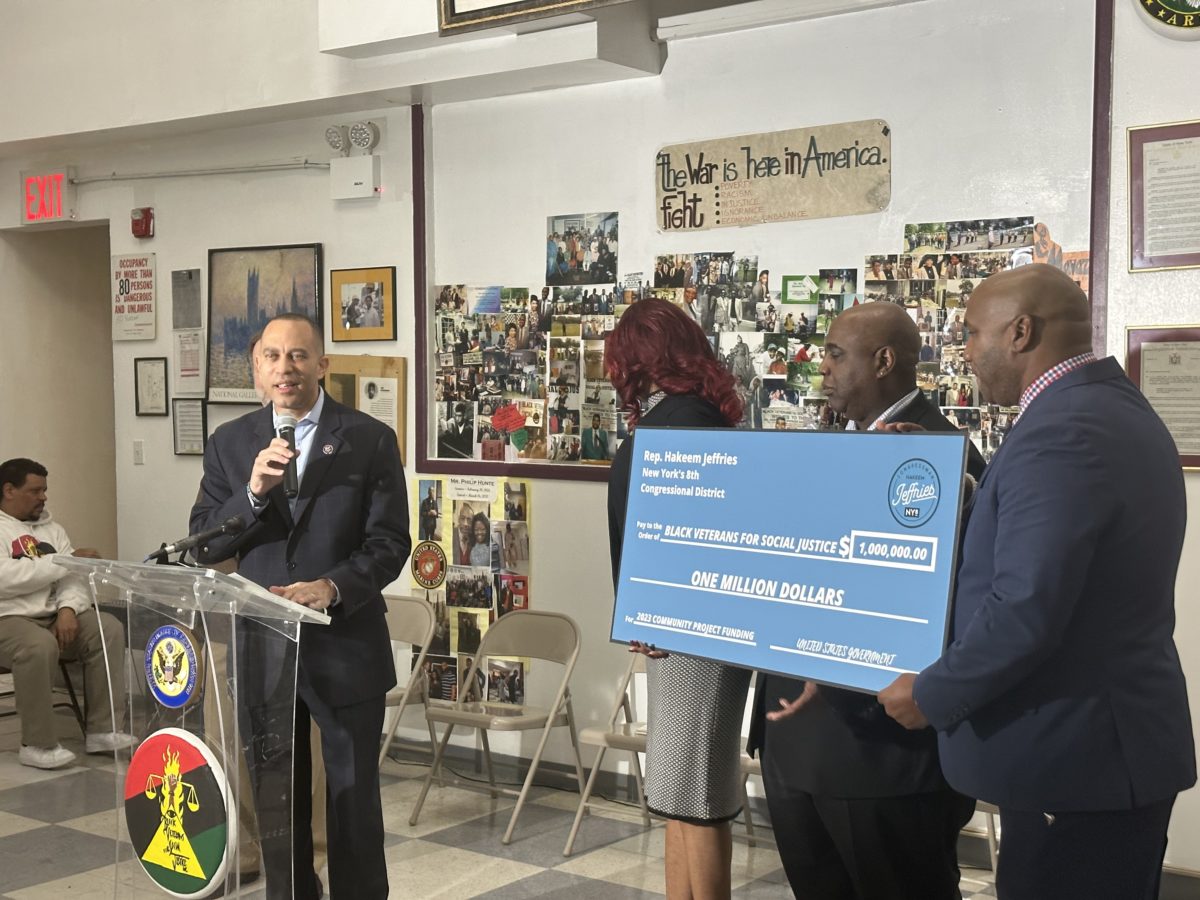
Black Veterans for Social Justice, founded in 1979, is a veterans service and community-based nonprofit organization headquartered in Bed-Stuy. Every year veterans can be seen marching along the little stretch of pavement between Throop Avenue and Marcus Garvey Boulevard on Willoughby Avenue in honor of those who gave the ultimate sacrifice.

The annual parade, now in its 11th year, has the usual fanfare: a hot sizzling grill pumping out burgers and hot dogs, the big banners and an even bigger line of marchers, as well as refreshments to stay cool in the first sweat of summer.

Attendees at Black Veterans for Social Justice Memorial Day rally in Bed-Stuy.

“This traditionally is the start of summer. And I’ve had so many people text me saying Happy Memorial Day. And although I say thank you, or sometimes I just give a thumbs up emoji. But Memorial Day is to commemorate those who have fallen, primarily on active duty, but we want to remember those who are soldiers for life, and who did not get a chance to enjoy the fruits of their retirement,” Walter Gist, a veterans outreach coordinator with the Services for the Underserved, said.

Gist is manning one of the many different types of services tables Black Veterans for Social Justice hosts to connect veterans with different kinds of support services ranging from job training and interview preparation to helping people apply for social services like ERAP funding, a pandemic-era rent relief program.

William Lugo has been attending the Black Veterans for Social Justice parade since its inception. It’s the easiest for him to get to at 73-years-old, as a local resident of Bed-Stuy. Lugo said the parade has helped him in the past get connected with all his benefits.

“Remember the men and women died defending this country,” Lugo said in an interview. “That’s why there will always be a Memorial Day.”

While thanking a veteran for their service may seem customary in today’s America, Vietnam Veteran Errol Vanmooden said that Americans have still failed to recognize the service of his fellow Vietnam service members.

“I remember my fallen brother in Vietnam. I remember the good times and the bad. I remember the holidays. Christmas, Birthdays. I remember the disrespectful welcome that I received back from Vietnam. I remember one person saying ‘are you part of the baby killers?’,” Vanmooden said.

While Vanmooden says he wants the day to be about celebrating the contributions of fallen soldiers, he couldn’t shake the bad memories that come with the day.

He remembers when he was injured on the battlefield, his buddies coming to help him. He was the only Black member of his unit, but that didn’t matter. Army green was the only color that mattered, he said.

He remembers his 22nd birthday. He was awoken by a barrage of heavy artillery fire early one morning in the jungles of Vietnam. Rockets would land and get stuck in the thick mud. He was sure he was going to die.

“I remember my brothers were always there for me,” Vanmooden said solemnly.

Exclusive: Kellogg’s added to historic registry

Kellogg’s, the famous 24-hour Williamsburg Diner, was added to the Historic Business Preservation Registry on Saturday.

The Historic Business Preservation Registry was created with the goal of providing educational and promotional assistance to businesses that have been located in a neighborhood for over 50 years. The program, administered by the New York State Office of Parks, Recreation & Historic Preservation, can receive nominations from local legislators and are decided on a rolling basis.

Elected officials and restaurant workers inside Kellogg’s Diner with the historical designation award.

Since around 1973, Kellogg’s has served Williamsburg residents morning, noon, and night. Despite the pressures the COVID-19 placed on local businesses, the Metropolitan Avenue-based eatery was able to continue serving families during the pandemic.

Navigating a business throughout a pandemic is difficult, but Irene Siderakis was able to pull it off – without any restaurant experience at all.

Before the pandemic, Irene was a stay-at-home mother for her four boys. She inherited the restaurant after her husband passed away unexpectedly in 2019.

“The worst things in life can hate you. But it doesn’t mean you can’t move forward in a positive direction, as long as you believe in yourself,” Siderakis said about what this moment meant to her. “As a woman I want to say that I’m proud of myself. I know I put my heart into it. I put all my strength into it. Just because my husband died there is the excuse to say we can’t. I’ve got four children in this world I’m responsible for. There is no can’t”.

Before her husband passed she didn’t know anything about the business—who the vendors were, how to handle payroll, or the day-to-day responsibilities. Now, she says she feels closer to him, knowing everything he did to help provide a life for her and her kids.

“It is just a fantastic, fantastic testimony to the community that this place holds that Kellogg’s fought through COVID and rose again, and reopened and kept their staff and kept everyone safe,” State Assemblywoman Emily Gallagher, who nominated the business for the registry, said while presenting the award. “They closed for two months during COVID, during which the owner became very, very ill, but still made sure that she was feeding the community. And I just think this is a beautiful example of what small businesses can do for our city and our states.

Siderakis has an emotional moment after being presented with the award

The 15 or so patrons got excited by the unexpected announcement, taking out their phones to capture the moment they got to be a part of.

“One of my first memories in about 1950 was that this [referring to her booth] was a caboose you know, like real diners used to be like train cars,” longtime patron Lorraine Franzese Scorsone, 68, said.

And she’s kept the tradition alive for the latest generation, regularly taking her two grandchildren to Kellogg’s.

“Kellogs has always been probably one of the biggest staples of this community,” 13-year-old Dahlia Prettr said. She said that she can’t even remember the first time going as it’s always been a piece of her life.“ So this community, no matter how much it’s changed, it’s always still been like that. Not a close-knit family by any means. But it’s still a family.”

“If you’re born and raised here, you know everything about Kellogg’s. You know how important it is early in the morning or very, very late at night,” South Williamsburg native and Brooklyn Borough President Reynoso said to some laughs. “And I just want to thank you again for being here for 50 years, when no one wanted to be in Williamsburg 30 years ago, you were here 50 years ago, and you guys maintained it and stood strong.”

And while much was made about the history of Kellogg’s on Saturday, Siderakis is even more excited for the future.

Siderakis receives Historical Business Award

Siderakis recently held their first comedy show at the diner the previous week, where Brooklyn Magazine reported over 75 people attended. She’s also been looking at expanding their takeout options, working to supply the food for ghost kitchens. She’s even gotten a request for someone to hold their wedding reception there.

But some things are going to stay the same. The friendly service the staff at Kellogg’s are known for will continue. The menu will be just as long. And, of course, it will stay open 24 hours a day.

“They believed in me, which was the biggest thing for me,” Siderakis said about how none of this would be possible without her staff. ”I didn’t know nothing. But they believed in me. And they stuck by me. And we got it together and we made it happen. And we supported one another with the customers that believed in us. I’m so grateful for everyone that kept coming back.

Brooklyn Debate League raises $1.3M after viral post

Conyers with his debate coach DiCo (Credit: Gabriel Taliaferrow)

By Matthew Fischetti

mfischetti@queensledger.com

“Those who have a ‘why’ to live, can bear with almost any ‘how’.”

This quote is how coach K.M. DiColandrea would begin almost every debate team practice at Frederick Douglass Academy.  He would urge his students to figure out their ‘why’.

At 15, Jonathan Conyers couldn’t answer the question.

Conyers, now 27, has figured out the answer. When he was selected to tell his life story with Humans of New York, he opted to talk about his teacher, nicknamed DiCo, instead. And that’s when over $1.2 million started rolling in.

Through 12 different posts on the account, Conyers shared his life story, overcoming ‘hows’ like drug-addicted parents, getting evicted numerous times, and seeing his friend locked up at 14.

Conyers enrolled in Frederick Douglass Academy in Harlem after avoiding charges for breaking into a home in middle school. The principal made him enroll in an extracurricular program. After sitting silently in the back of the debate room, Conyers finally participated when the topic of drug addiction was brought up.

“But one day they were discussing drug addiction, which is a topic I know a lot about,” Conyers said in the Humans of New York post. “So I stood up and shared my story. Afterwards Ms. DiCo asked me to stay behind. Mainly she just wanted to make sure I was OK. She was like: ‘Do you need anything?’ But after that, she was like: ‘You should join debate.’”

In hindsight, Conyers wishes he paid more attention to DiColandrea.

“She was white, from Manhattan. She’d gone to Yale. I just assumed she didn’t have any problems,” Dico said in the Humans of New York post.

But that wasn’t the case. DiColandrea revealed to his students that he was in the process of transitioning.

“They waited until I was ready to tell them,” DiColandrea said in an interview, explaining that some students had suspicions when Dico would bring his “friend” to school events. “And then it was just unconditional love.”

“DiCo could have told me he was a dinosaur, and I’d be like: ‘That’s cool. Just stay DiCo,’” Conyers said in the Humans of New York Post.

DiColandrea and Conyers knew the biggest tournament of the year was a real shot when the topic was announced: “Should juvenile offenders be tried as adults?”

While Conyers recalled feeling out of place at the tournament, he found his home on the dais.  Conyers recalled in the post that there was nothing special about his opening speeches, but on cross-examination, he destroyed his opponents asking his predominantly white and affluent opponents whether they should be the person making this argument if they don’t know anyone. 

“Jonathan needs to stick to the facts. His life story gives him an unfair advantage,” Conyers recalled a judge saying, in the Humans of New York post. 

DiColandrea taught all his students to be calm and collected. But that’s when she snapped.

“You will not do this to him. These rich kids have access to every resource. But you’re penalizing Jonathan because his life is f***ed up?” Conyers recalled DiColandrea saying, in the Humans of New York Post.

Ever since that tournament, DiColandrea has been working hard to break down those barriers in debate. A few years later, DiColandrea founded the Brooklyn Debate League – a group that seeks to eliminate the gatekeeping in debate by expanding programs and teams to urban areas.

“But it’s not always just about personal anecdotes, it’s a more fundamental, personal confidence,” DiColandrea said about teaching students a more personal and unconventional debate style. “It’s helping students understand at a really visceral and deep level, that regardless of what neighborhood they live in, or how much money their parents make, or what school they go to, or what color their skin is, or who they’re attracted to, or how they identify. Regardless of any of those identity markers, they belong in a space where the only weapon is words, because their words matter”

“And that’s priceless. Knowing your voice matters,” Conyers said. “Especially as a young Black man, presentation and how you articulate yourself are important.”

And although it’s priceless, it still costs.

DiColandrea started the GoFundMe to cover the $6,000 he personally invested to cover payroll for the small mostly volunteer staff. It was covered in 10 minutes. After two days, it already hit a million. Now over a week later, it has raised over $1.3 million.

“It feels like a mix of the day I got married, all of my birthdays combined, and the day that my student won Harvard,” DiColandrea said about the newfound attention and funds. “It feels like everybody in the world is just reaching out with this abundant outpouring of love and kindness.”

The Brooklyn Debate league operated on a small and scrappy budget, reaching around 250 people on their mailing list and about 100 students coming to tournaments.

“That’s chump change now. We can change our whole mission now,” DiColandrea said with excitement in his voice. DiCo said that he’s looking to reach every person, school and program he can throughout Brooklyn and other urban areas.

“You don’t need to look any further than the New York State Championship that was held two weekends ago, right? There were over 60 schools there. And there were five of them that were public schools in New York City. And three of those were specialized schools. And we are the biggest school district In the country, we have, what, 1.1 million students? They weren’t in those spaces. And they’re not in the speech and debate circuit,” DiColandrea said, explaining the still urgent need for something like Brooklyn Debate League.

While Conyers credits a lot of how he got by in life due to his coach’s help, DiColandrea disagrees.

“I don’t know how to express it. You know, that kind of selflessness is what’s always made him so special; he’s a very humble person,” DiColandrea said. “And he wanted me to have this moment. And man, am I having it?”

Conyers now says he has figured out his why. 

“I learned that giving back and being selfless can change lives. And what he [DiColandrea] did to me has allowed me to help so many people,” Conyers said. He has been on the front lines of COVID working as a respiratory therapist. He also started a home for children who had been orphaned during the pandemic and owns juvenile rehabilitation centers in Virginia to give kids like him the resources and opportunities he didn’t.

For DiColandrea, it’s a wish come true. 

DiColandrea originally gravitated to the quote when he was 16. His high school was only a few blocks from the World Trade Center on September 11. In the weeks after, she asked for book recommendations for helping to understand and process her trauma. The teacher recommended Frankel’s Man’s Search for Meaning. 

“As someone who experienced this firsthand, we then had an obligation to speak up about it, to make sure that it wasn’t forgotten to make sure that people understood what happened,” DiColandrea said.

And that became DiColandrea’s reason. Helping his own students to process their trauma and make sure they know that their voice matters.

“We’re talking about racism. We’re talking about, people who are undocumented. We’re talking about people who come from low-income communities. There are traumas that kids are carrying from those communities as well. I  want them to feel empowered to speak up about what is meaningful to them and what is their lived experience. To teach them about what matters and for them to feel empowered to share that on whatever level they want. That might be just in front of a friend or a classmate or it might be on a national stage at the Speech and Debate championship,” DiColandrea said.

“But that voice belongs to them. And that power belongs to them to use it, to speak up about what they think matters.”

Even though Conyers said he never had a good answer to what his “why” was – he always knew a bit of the answer. 

“All I knew was that I wanted to be like Ms. DiCo,” Conyers said in the Humans of New York post.

“I just want the world to know that there is so much more to Jonathon Conyers, there’s so much more to DiCo,” Conyers said in an interview. “We pray that we can continue to share our story and continue to share the things we have been through in much more detail, and we hope the world is supportive.”

Donziger celebrates freedom in Williamsburg

By Matthew Fischetti

mfischetti@queensledger.com

Steve Donziger is doing all right.

After 993 days under detention, Steve Donziger can celebrate freedom. Donziger, an environmental lawyer, was part of the team that won a multi-billion dollar settlement against Chevron for polluting millions of gallons of contaminants into the Amazon over decades. Later, Chevron lawyers claimed that Donzigers team tried to solicit a bribe in the case; the judge who made the original accusation later admitted in court that it was a lie and that he had been prepped over 50 times by Chevron lawyers, as Vice has reported.

A group of U.S. Representatives including Alexandria Ocasio-Cortez, have called on President Biden to pardon Donziger.

The first-day Donziger was able to unstrap his ankle monitoring unit, he was welcomed by dozens of his Upper West Side neighbors at a block party. 

“It was complete exhilaration. Made me a little sad, thinking of the lost opportunity I’ve had with my wife and son over the last three years. But it was really really awesome to know we stood up to what they threw at us when we came out the other side intact, happy and stronger” Donziger said in an interview about the moment he first experienced a slice of liberty and walked outside his apartment. 

But on Thursday Night, Donziger took his newfound freedom to Baby’s All Right in Williamsburg. Advertised as a “Donziger Release Party”, the event first hosted a panel discussion between Donziger and Amazon Labor Union founder Chris Smalls and was moderated by socialist podcast host Will Menaker of Chapo Trap House before musical performances. Tickets to the event supported the Donziger Legal Defense fund.

“[Donziger is] battling the real Amazon, I’m battling the retail Amazon. So there’s always a commonality with that – just beating up on billionaires and their lawyers,” Smalls, the fired Amazon worker who beat the odds to form the first independent Amazon Labor union in Staten Island, said in an interview. Both Amazon and Chevron have retained the law practices of Gibson Dunn to fight against Donziger and Smalls.

“I would say it’s important to know about because I think primarily because it’s not really being talked about in the corporate media very much,” Olivia Riggio, 25, a critic with progressive media watchdog FAIR who attended the party said. FAIR has released numerous reports highlighting much of the mainstream media’s lack of coverage concerning the case.  “I think it says a lot about corporate influencing corporate greed. And I think it’s important because it kind of is it sits at the intersection of corporate greed, of environmental rights, of human rights, of indigenous rights.”

The moderator of the panel, Will Menaker, said that the discussion was important to have at a moment when politics seemed stagnant and the future seems doomed.

“I don’t know about you guys, but the last two, three years now, it’s felt pretty f*cking grim out there,” Menaker said to kick off the panel. “It’s my pleasure to be on stage tonight with two men who have caused more stress and billable hours for America’s top corporate law firms.”

In an interview, Menaker said that both Donziger and Smalls’s stories were important as they are people taking up the seemingly unwinnable fights against the “worst people in the world” – and securing victories.

“It’s because I think, we as a society, have quite rationally given up on the future. Because it’s been decided for us. We have no voice or agency, in our political process, and even our culture; just like the dignity in our day-to-day lives to varying degrees. And I think the solution to that is embodied by these two guys, because they’re two individuals but they couldn’t have done it without a movement supporting them,” Menaker said. “I think that is what I take inspiration from. That’s what I was happy to try to highlight.”

Donziger said that one of the first Brooklyn spots he was going to hit would be Vinegar Hill in DUMBO. He still plans on fighting to get his law license back.But, for now, he’s just enjoying his freedom and the first beer he’s had in a bar for years.

“I’m giving myself away like I’m some fancy guy. I love good food.”

Fill the Form for Events, Advertisement or Business Listing