NYC Banned These Broker Fees in June. Why Are So Many Brooklynites Still Paying Them?

An apartment building in Williamsburg.

By COLE SINANIAN and JACK DELANEYnews@queensledger.com

Brokers working for landlords who say they’ve never heard of them. Unlisted apartments with sketchy caveats. Scribbled-in “processing” charges worth hundreds of dollars.

It’s been a month since the FARE Act eliminated forced broker fees. But amid a tight housing market and confusion among tenants about what is and isn’t legal, it appears that many brokers and landlords are finding ways around this new legislation.

“Nothing’s really changed since the law went into effect,” said Michael Corley, a Brooklyn-based broker — though he believes it’s necessary, and that it could benefit both brokers and tenants if thoroughly enforced.

The bill, which sought to prevent prospective tenants from being forced to pay a fee for a broker they didn’t hire, was introduced in February 2024 and took effect on June 11, 2025, leaving plenty of time for speculation: many brokers and landlords, particularly the Real Estate Board of New York (REBNY), warned — or, from tenant organizers’ perspective, threatened— that the new law would lead to higher rents. It would encourage landlords to add the cost of hiring a broker to monthly rent, they said, and reduce the number of listings on platforms like StreetEasy as landlords stopped hiring brokers to market their properties.

In response, lawmakers and tenant advocates argued that even if landlords baked hired broker fees into monthly rent, it would improve housing accessibility, as it would reduce the high cost of signing a lease that was often a barrier to entry for low-income tenants. Many renters pay upwards of $10,000 in fees and deposits to move into a new apartment.

The upfront nature of these costs matters: at a City Council hearing last year, dozens of tenants testified that high broker fees were locking them into subpar or outright dangerous housing situations, and in some cases pushing them out of the city altogether. Annie Abreu, a law student, said that it would be difficult for her and her mother “to leave our current insecure living situation and find an apartment in my neighborhood as soon as I start working, because having to pay [these] fees in one go is basically impossible.” Others, like Augustina Velez and Logan Ferris, said they accepted poor conditions because their landlords knew they would not be able to move out. The FARE Act, they hoped, would even the playing field.

So what’s the reality? Early signs suggest that rents haven’t skyrocketed, despite an initial spike. But while there have been success stories of tenants gaining more mobility, costs haven’t plunged, either, thanks to a “wild west” of scams and workarounds. The Brooklyn Star spoke to more than a dozen tenants and brokers about their experiences since the FARE Act went into effect, and identified a series of recurring practices — some new, some old — that, in effect, continue forcing tenants to pay for brokers despite the new regulations.

Below, you’ll find (1) a guide to the broad categories of violations, and (2) an explanation of what you can do if you believe you’ve fallen into one of these traps.

1. What To Look Out For

Gatekeeping

Almileno Situmorang, a financial analyst originally from Indonesia, found a unit near McCarren Park, listed by the Brooklyn-based rental agency Rentopia, that seemed to fit his needs. In the end, the price wasn’t right, but the agent claimed to have a different unit that might interest Situmorang — a rent-stabilized apartment at 58 Bushwick Ave in Williamsburg that was unlisted on StreetEasy. After Situmorang toured the apartment, the agent told him that if he wanted to apply, Situmorang would have to sign an agreement with Rentopia, hire the agent as his broker and pay the broker fee himself.

But while he was touring the unit, Situmorang found the phone number for the property management company, Secured Management NY, which owns the building under the holding company “Bushwick Realty II LLC.” He called, inquired about available units at 58 Bushwick, and was promptly told to contact Rentopia. When Situmorang questioned the legality of forcing a tenant to pay for a broker that appeared to have been hired by the owner, the receptionist at Secured Management NY doubled down and told him to “just give Rentopia a call.”

Not wanting to pass up a rent-stabilized, off-market unit in a desirable area, Situmorang and his fiance applied for the apartment through Rentopia. After they applied, his fiance called Secured Management NY as a test, and was told there were no units available.

“That’s probably because we had already applied for the unit,” Situmorang said. “So they are working with Rentopia.” To Situmorang, it seemed clear that Secured Management NY did not want to pay the Rentopia agents who were marketing its properties, and hoped to get tenants to pay the agents by forcing them to apply through Rentopia.

“It’s a desirable place to live,” he said, “so they know they can probably get away with finding someone who’s desperate enough to pay the fee and do it under the table illegally.”

A number of ads can be found on Craigslist that seem to utilize a similar strategy. One, posted on June 29, advertises a “MASSIVE — RENT STABILIZED — ONE BEDROOM APARTMENT IN AMAZING LOCATION in SUNSET PARK.”

But at the bottom of the page is the following: “I have access to many rent-stabilized apartments across NYC! Due to the FARE Act, this ad is not for a specific unit — but if you’d like to hire me as your tenant agent, I can help you find great options. A broker fee of 8–15% of annual rent applies.”

On Streeteasy, a unit on 276 Suydam Street in Bushwick listed by a company called Bohemia Realty Group included an image with the message, “Think you’ve seen it all? You haven’t. We’ve got access to thousands of listings that are not advertised anywhere due to the FARE Act. Hire one of our savvy, friendly agents as your tenant rep and unlock every option that fits your budget, location and vibe.” The message has since been taken down, although the listing remains.

This strategy isn’t always out-and-out malicious — as reported by Hell Gate, many brokers are unsure of the legal landscape themselves and believe that advertising without specific addresses is allowed. “Everyone is a little on edge,” Curbed concurred. And Anna Klenkar, a broker who has been an outspoken advocate of the FARE Act, told the Star that there could be a niche for agents who assist tenants in a more holistic way.

But under the new law, brokers are not permitted to make hiring them a condition for closing on an apartment, which anecdotal evidence suggests is happening frequently. Broadly, if a landlord is relying on a broker to market their property and tenants cannot access it without going through them, the law indicates that the landlord should foot the bill.

“If a landlord gives a broker permission to show their unit, that generally counts as hiring and the landlord is legally required to pay the fee,” confirmed Fox, who helped architect the FARE Act.

The “Bait-and-Switch”

Situmorang’s story was similar to those of other tenants the Star interviewed, which follow an old playbook. Another prospective tenant, who has asked to be kept anonymous, showed up for a tour at the address of a Jackson Heights apartment they had encountered on Zillow, only to find what appeared to be a family of four living there. They called the agent, who worked for a company called Contact Realty, and was told that the actual address was a few blocks away. The address was completely different from the one listed on Zillow, although the photos from the listing matched the second apartment. After the tour, the agent told them that they wouldn’t have to pay the broker’s fee until they signed the lease, although they should pay it quickly to “take the unit off the market.”

“We felt pressured to send them the broker’s fee as soon as possible to ‘take it off the market,’ even though the thing they would be taking off the market was already off market,” the prospective tenant said.

They continued: “We got the bait-and-switch of being shown a place, then being brought to a different place and that’s how they justified the broker’s fee.”

To an even greater degree than the previous examples of gatekeeping, this is clearly illegal — twice over, in fact. The Federal Trade Commission (FTC) has consistently cracked down on the practice as false advertising, and it would also violate the FARE Act if the tenant is being forced to hire a broker.

Mystery Fees and Double Listings

Other tenants reported misleading practices of nebulous legality that were more difficult to categorize. Another StreetEasy post listed by the company SERHANT for a unit at 350 East 62nd Street in Manhattan includes more than $1,000 in fees, including a $500 “annual lease fee,” a $575 “processing fee,” and a $65 “digital submission fee.”

These fees were illegal even before the FARE Act passed: in 2019, a state law mandated that landlords cannot charge tenants more than $20 for application fees.

A newer development is the phenomenon of double listings.

Allia Mohamed, founder of the listing platform openigloo, shared a typical example in a reel on Instagram: “$5,495 with Broker Fee,” the screenshot reads, “OR $6,400 & NO BROKER FEE — BRAND NEW APARTMENT.”

Commenting below Mohamed’s video, user @katesatthebeach highlighted a variant of this that she experienced during the initial week after the FARE Act’s implementation. In her telling, she replied to a listing on Zillow and was told that the unit was taken, but that there was a similar unit available. The only catch? The going rent was $3600, but if she agreed to hire the broker they claimed they could reduce it to $3300. (She declined.)

Ghost Brokers, Rogue Agents

Another issue is that open listings — a system in which any interested broker can pick up keys to show an apartment, without dealing closely with the management company — create legal grey areas at best, and at worst allow landlords to claim plausible deniability if a broker pushes tenants to pay their fee.

Ruth Windberg was browsing StreetEasy when an almost-too-good-to-be-true listing appeared. The apartment was at 307 Eastern Parkway in Crown Heights, and the broker, who was from a virtual brokerage firm called eRealty Advisors, emailed her just moments later and they agreed to meet for a tour. The listing included no information about fees, and when Windberg asked the broker directly he dodged her question.

But after the tour concluded, Windberg told the broker she wanted to apply, at which point he informed her she must pay him a 15% broker fee, claiming he had not been directly hired by the landlord, a Brooklyn-based management company called AH Realty. Frustrated, Windberg walked out and called the management company. The woman who answered told her there were currently no vacant units at 307 Eastern Parkway and that she had never heard of the broker. An argument ensued and ended when Windeberg threatened to report the company to the DCWP as a FARE Act violation. Later she texted the same thing to the broker, who quickly backtracked: “that is unnecessary this property is a no fee,” he texted her. On the phone, he told her that a friend had given him access to the apartment and he did not know it was no fee.

“He did a complete 180,” Windberg said.

Technically, the law includes a “rebuttable presumption” — guilty until proven innocent, essentially — that if a broker lists a unit online, the landlord is liable for their fee.

Other stories shared with the Star confirm that this is not an isolated instance. For example, a licensed real estate broker named Raymund Ramirez Sykes told the Star he found a broker on Facebook who was advertising his services for a rental property that Sykes had already been hired for.

“I asked, ‘Why are you presenting a tenant agreement?’” Sykes said. “‘They’re already signed off to me. Who are you’?”

These tactics have existed for years, noted Klenkar, but increased scrutiny under the FARE Act has brought them out into the open.

2. What You Can Do

Once you’ve identified that a broker or landlord is likely violating the FARE Act — or other laws, such as the cap on application fees — the next step is filing an official complaint. There are two channels to go through, the first being the city.

The NYC Department of Consumer and Worker Protection (DCWP) is responsible for enforcing the FARE Act, which lays out fines for offending brokers: $750 for the first violation, $1,800 for the second, and $2,000 for every additional violation within a two-year period.

You can report potential violations online at nyc.gov/site/dca/consumers/file-complaint.page, or by calling 311, though that can be convoluted.

As of July 7, DCWP had received 562 complaints from tenants related to the FARE Act, spokesperson Michael Lanza said. The agency is still assessing the claims, however, and has yet to impose any fines.

Lanza stressed that many of the complaints they’ve received thus far are incomplete, and that the tenants often don’t respond when his colleagues attempt to follow up. “We ask any New Yorker who is submitting a complaint about the FARE Act to provide as much evidence as possible (text messages, screenshots, receipts, contact information),” he said, “and to please include the name and contact information of the broker if available.”

But the agency has roughly 20 staff members on its consumer services team that review all complaints DCWP receives, which to Klenkar seemed meager: “This law needed to have a clear enforcement mechanism,” she said, “and it does — but it’s just not being staffed the way that it needs to.”

With that in mind, Corley recommends filing a second complaint at the state level. (To do so, visit dos.ny.gov/preliminary-statement-complaint-0).

“Unlike local enforcement, the state looks at this in clear black and white,” he said. “If a law passed and you are failing your public duty as a fiduciary by obfuscating disclosure that impacts the consumers’ rights, your license can be taken, and if there’s a pattern of abuse, it can be revoked. [Agents] are afraid of that, because it can happen.”

A final course of action could be a lawsuit: the FARE Act creates a private cause of action, which allows individuals to sue in civil court over alleged violations.

JJ: “Welcome to New York, Mike Brown”

It’s Now NBA Finals Or Bust…

By John Jastremski

Last week, the Knicks finally concluded their head coaching search and decided former Sacramento Kings head coach Mike Brown will be their guy.

My first reaction to the news was that as a Knicks fan, I felt uninspired.

Look, Mike Brown on paper fits the bill of the sort of coach you’d want leading your team.

There’s no sense of the unknown for a franchise that will have sky high expectations going into next season.

You know what you’re getting with Mike Brown.

He ran a tremendous offense in Sacramento that was as modern as it gets.

He’s taken a team to the NBA Finals before, albeit a team that had LeBron James, but an accomplishment none the less.

In addition, he seems like a tremendous guy. I expect he will do a fantastic job in handling the NY media and what comes with that.

So, you might ask. After what I just detailed, why is the hire uninspiring.

Well, it’s pretty simple to me.

After the Knicks fired Tom Thibodeau, I was expecting the sort of hire that would put me in a position where I feel the team clearly upgraded with their head coach.

No disrespect to Mike Brown, but I for one am not convinced the Knicks hired a better head coach than Thibs.

Thats why I cant share a feeling of elation and excitement when it comes to the hire.

However, the goal is pretty simple for Mike Brown next season.

It’s time to get the Knicks back to the NBA Finals for the first time since 1999.

Are those unfair expectations to a first year head coach?

In most circumstances, yes. Not with this current Knicks group.

The roster is there, the East is weak and if not now, then when.

Talk about walking into a pressure cooker!

You can listen to my podcast New York, New York on The Ringer Podcast Network every Tuesday & Friday on Spotify/Apple Podcasts. You can watch me nightly on Honda Sports Nite following Mets postgame on SNY.

Matt Freese Returns to NYC After Gold Cup Final Start

Noah Zimmerman

noah@queensledger.com

Matt Freese is making his return to New York City FC as they look ahead to their playoff push. (Photo: Noah Zimmerman, @n.z.media)

New York City FC goalkeeper Matt Freese is finally returning to the club following an impressive showing at the 2025 Gold Cup. The American shotstopper dazzled despite a loss to Mexico in the final, playing a big role in their path to the cup-deciding match.

In the quarterfinals, the tournament hosts were unable to fend off Costa Rica in regulation, conceding a 71st minute equalizer. In the resulting penalty shootout, it was Freese making a statement to send the Americans through to the semis.

The only penalty he didn’t get a hand to against Costa Rica came from his NYC teammate Alonso Martinez. The top scorer for the Boys in Blue winked at his ally-turned-foe before sending his shot down the middle.

Freese made stops on the second and fifth shots, getting a hand to the third and fourth. Legendary goalkeeper Keylor Navas answered with a save of his own on John Tolkin to extend the match.

By this point, Freese was in the zone. The whole stadium knew what was coming and sure enough he made a definitive stop with Damion Downs converting the winning kick for the US.

Against Gold Cup semifinal debutants Guatemala, Freese was able to see out an early 2-goal cushion. He made four saves, only allowing a goal in the 80th minute against an enthused opponent.

Freese was busy between the posts in the Cup Final against Mexico. He was able to stop 6 of the 8 shots on target, but couldnít do much on the two goals from Raul Jimenez and Edson Alvarez.

NYC’s goalkeeper will return for a pivotal stretch of the season. With 14 matches and the Leagues Cup remaining, Freese will look to help the Boys in Blue clinch a postseason berth and earn more silverware.

Liberty Open July With Win Over Los Angeles

Storm pick up 2nd win vs New York

The New York Liberty defeated the Los Angeles Sparks 89-79 at Barclays Center (Photo NY Liberty, Brandon Todd)

By Noah Zimmerman

noah@queensledger.com

The New York Liberty opened up their 8-game July homestand with a thriller against the LA Sparks. They picked up a  win to slow a troublesome skid that’s lasted since their first defeat of the season. Since their 9-0 start, New York lost five of seven and have been lackluster on both ends of the court without star center Jonquel Jones.

Making a long-awaited return to the Liberty bench was Leonie Fiebich. The German made her return from the EuroBasket tournament, providing immediate relief for a thin-stretched Liberty lineup. Fiebich put up strong numbers in Germany’s quarterfinal finish, and while she didn’t fill the stat sheet too much in her return she impacted both sides of the floor.

Leonie Fiebich made her return to the Liberty lineup after international duty with Germany. (Photo: Brandon Todd, NY Liberty)

For LA, former Liberty nemesis Kelsey Plum dazzled in her first game at the Barclays Center as a member of the Sparks. Plum previously won a ring on the Brooklyn floor with the Las Vegas Aces two seasons ago. The three-time All-star scored 7 of her 13 points in the opening quarter. 

There were a number of head-turning plays in the opening half, including a clutch one-footed three-pointer by Marine Johannes amid an expiring shot clock. New York’s French guard helped ensure a razor-thin 21-20 advantage after the 1st.

Johannes continued to impress in the second quarter with one of New York’s most impressive plays of the year. In transition Johannes queued up a perfect behind-the-back pass to Breanna Stewart, who scored a layup through contact and hit the resulting foul shot.

Kennedy Burke and Natasha Cloud helped add to the first half scoring with a pair of clutch threes, but LA remained on their heels. On the following possession, Stewart eyed a pull-up jumper that rimmed out. Had the shot gone down, the arena would have exploded. Instead, the visitors were able to fend off New York through one half, leading 41-37.

In what’s often been a troubling quarter for them, New York flipped a switch in the 3rd. The Liberty’s 11-0 run continued as they seized control, pumping up the sold-out crowd. After a tough bucket, Isabelle Harrison knocked down a free throw to knot the game at 53, and the Barclays Center finally erupted.

The hosts shot an impressive 63% in the quarter, hitting five of their seven threes. They outscored the Sparks by 14 to seize a 69-59 edge entering the final stretch. Cloud led the charge with 11 points, with Ionescu adding 10. Both would finish with impressive 17-point second halves.

LA kept the game close near the end, but the Liberty ultimately picked up a much-needed 10-point win. Given the recent troubles and with Atlanta right on their heels, head coach Sandy Brondello identified Thursday’s matchup as a must-win.

New York couldn’t keep their momentum as they fell to the Seattle Storm for the second time this year. (Photo: Brandon Todd, NY Liberty)

Unfortunately the Liberty weren’t able to carry over their success for Sunday’s matchup with the Seattle Storm. While they were finally able to out-rebound their opponents in back-to-back games, the shots just weren’t falling for New York.

After leading at the break, the Liberty only scored 6 points in the 3rd quarter. They were outscored by 16, creating a deficit they wouldn’t be able to overcome in the final period.

“They came out and executed and we didn’t,” head coach Sandy Brondello said after the loss. “We had to get a little bit tougher and have more urgency.”

To make matters worse, Isabelle Harrison went down with a knee injury, making her questionable for Tuesday night’s matchup against the Aces. With the Liberty already missing Jones, a lack of frontcourt bodies could make matters even more difficult after a 3-6 span.

After Tuesday the Liberty have five more games in their homestand. On Sunday the 13 they take on the Atlanta Dream in a pivotal matchup for Eastern Conference positioning at 3pm. Then on Wednesday night, New York hosts the Indiana Fever at 7:30pm.

The stretch of games in Brooklyn concludes with another matchup with Indiana on July 22, the Mercury on Friday the 25, and a rematch with Los Angeles on July 26.

Red Hook Rez March After BMT Vote Postponed Again

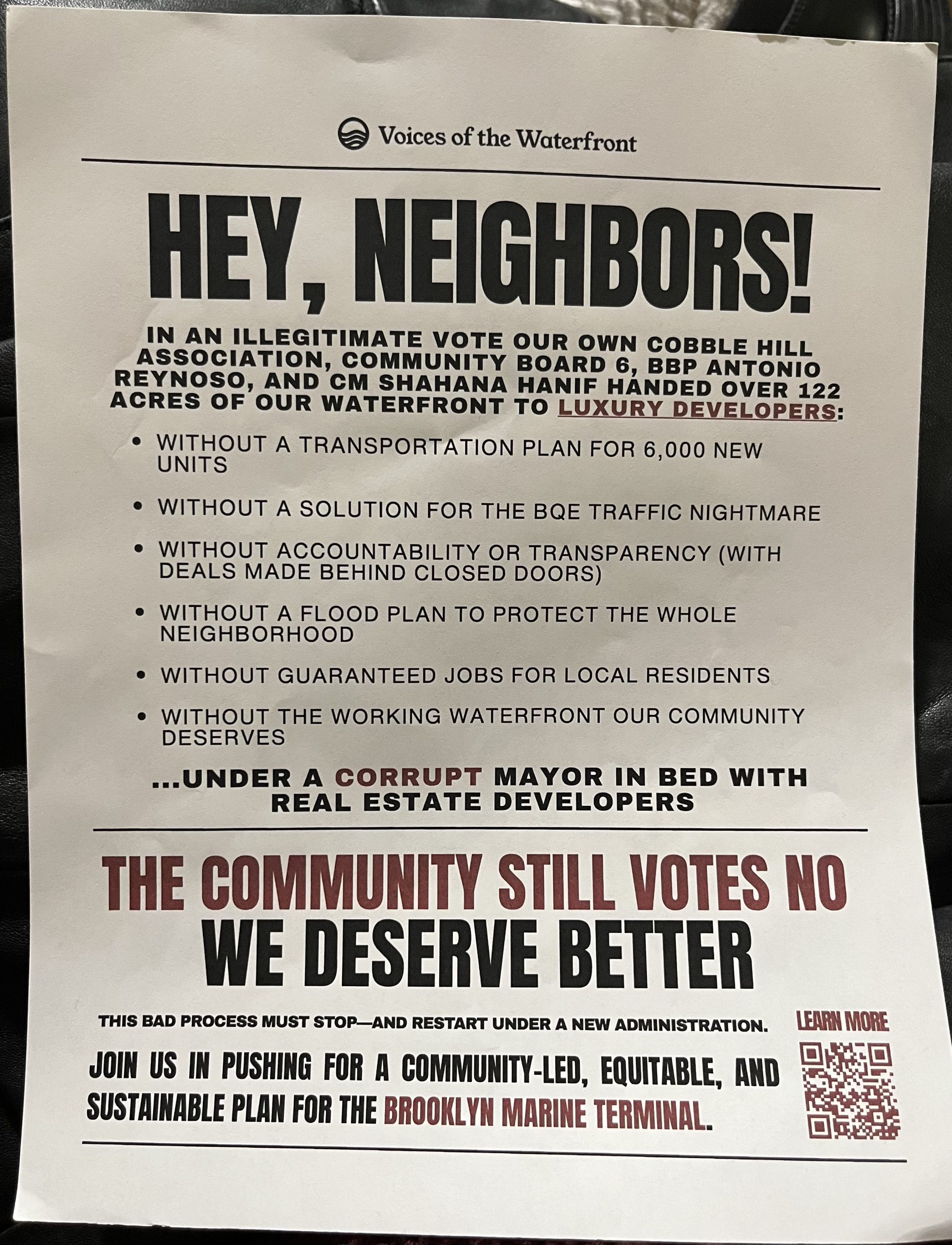
Dozens of community members gathered by the Harold Ickes skate park to protest the BMT plan’s go-ahead vote — only for it to be postponed at the eleventh hour.

By COLE SINANIAN | news@queensledger.com

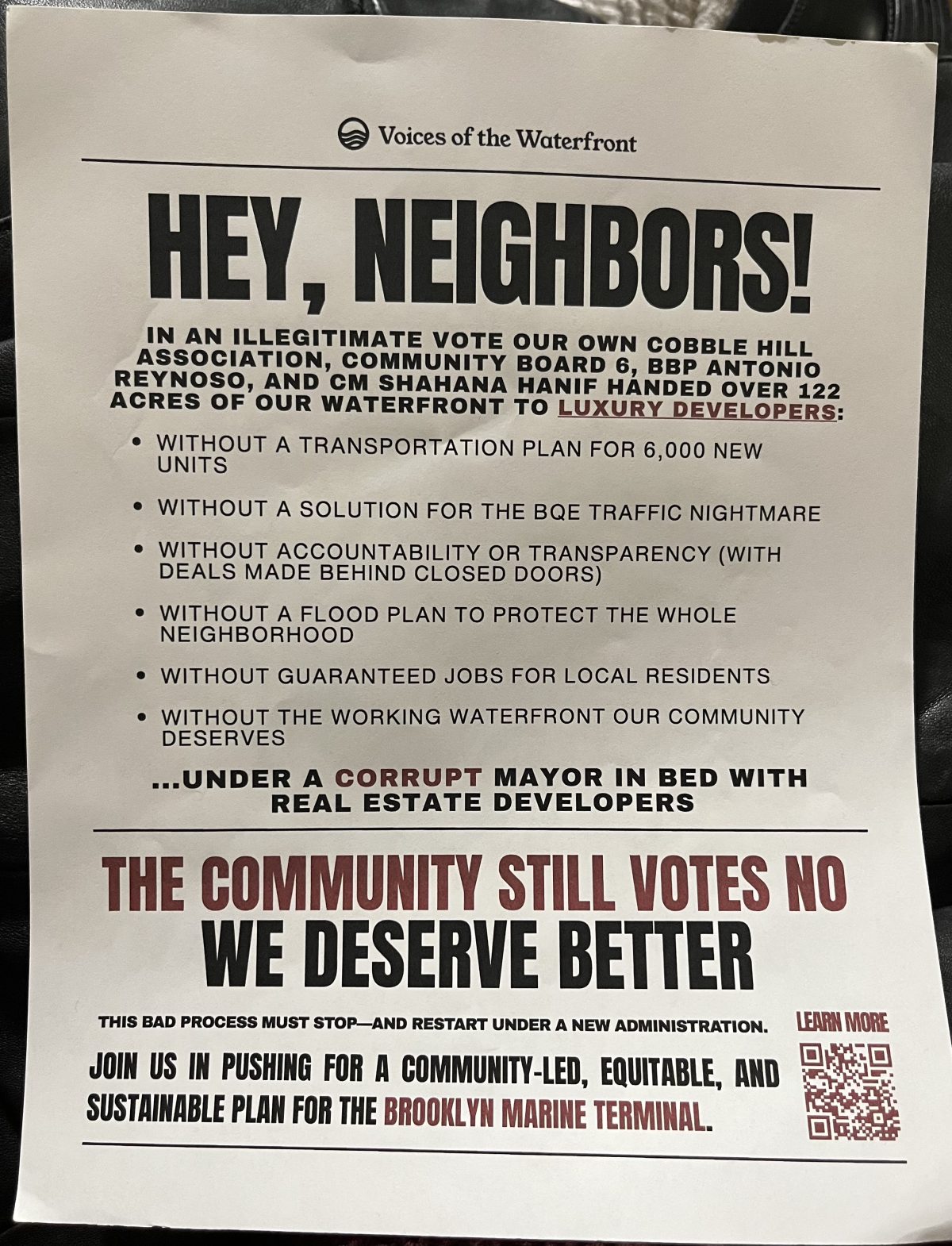
Under overcast skies and braving the gusty harbor winds blowing off upper New York Bay, dozens of Red Hook, Columbia Street and Carroll Gardens residents gathered at the corner of Hamilton Ave and Van Brunt Street in the early afternoon on Friday, June 27 to oppose the Economic Development Corporation’s (EDC) redevelopment of the Brooklyn Marine Terminal (BMT) at the Columbia Street Waterfront. 

By some estimates, the project could double the neighborhood’s population. The 122-acre swath of waterfront land between the Red Hook Peninsula and the Brooklyn Bridge Park would see improvements to the working port, as well as luxury condo towers, public parks, restaurants, and some price-controlled housing. Part of Mayor Adams’ wider “Harbor of the Future” initiative to revitalize waterfront properties throughout New York, the City first announced the BMT redevelopment in May 2024 and has since invested tens of millions of public dollars. 

An EDC-appointed task force chaired by congressman Dan Goldman was set to vote on the plan on Friday, before the EDC abruptly postponed the vote until July 17 or 18 — the third such delay. A two-thirds majority is required for it to pass. 

Criticism of the EDC plan has largely centered on its rapid approval and lack of transparency, with community members calling the process undemocratic. Some residents fear that such a sudden population bump of mostly wealthy transplants would permanently alter the neighborhood’s character and price out long-term residents and local businesses. Others worry that Red Hook — which notably sits in a transit desert — lacks the infrastructure to support such a quick expansion, as the redevelopment would put the neighborhood under significant mobility stress both during and after construction. 

The march wended its way through four neighborhoods — Red Hook, Carroll Gardens, Gowanus, and finally Park Slope — as onlookers cheered or simply watched, perplexed.

”The abject lack of community input that EDC is allowing during this process is shameful,” said Kashif Hussain, Deputy Public Advocate for Infrastructure and Environmental Justice, addressing the crowd of protesters. Many wore red and carried signs with slogans like “Ports R 4 boats” and “Public land for public good! Not for developer profits!” 

“The resulting proposal does not prioritize affordable housing, the viability of the marine terminal, or protect the working class residents who call the surrounding area home,” Hussain continued. Once the speech concluded, the group set off on a winding route through Red Hook, Carroll Gardens and Gowanus to the rhythm of the local Hungry March Band’s lively brass music. Passing cars honked while pedestrians cheered along as the activists chanted “This is what democracy looks like!” and “Save our waterfront!”

The EDC is pursuing the plan under the state’s General Project Plan (GPP) procedure, which facilitates quick approval and minimal oversight by bypassing the City Council. One activist carried a cardboard sign reading “Rather slurp a ULURP than a GPP”— referring to the Uniform Land Use Review Procedure (ULURP), a standardized public review process mandated by the City Charter for major land use decisions. Were the BMT development pursued under the ULURP, approval from community boards, the Borough President’s office, and the City Council would be required for the project to proceed. 

Jana Weill has lived in the Columbia Street neighborhood for 22 years, and attributes her love for the area to its tight-knit community and maritime character. “It feels like a really special, unique part of the city that you can’t find anywhere else,” she said. 

The terminus was state Senator Gounardes’ office. Though he was away in Albany, the band picked up the slack.

But Weill worries that if the EDC’s current plan is approved, the neighborhood will become congested and face population stress she fears its already lacking infrastructure is unprepared to accommodate. “We don’t have roads for all these people, we don’t have buses for all these people,” she said. “It would destroy the neighborhood.”

For its part, the EDC proposes several mobility upgrades around the BMT site in its Vision Plan, such as a commitment to a $25 million investment in shuttle services between the waterfront area and MTA stations during construction, and improved pedestrian access through expanded bike parking and bike lanes along the waterfront. Also discussed are improvements to the B61 bus route, which serves Red Hook, but the plan does not outline a concrete proposal.

Also proposed are 6,000 new homes concentrated along the waterfront, 2,400 of which will be affordable to families earning 60% Area Median Income (AMI), which in New York City amounts to $87,480 for a family of three. A 2025 study from maritime nonprofit PortSide NewYork put the median household income in Red Hook and the Columbia Street Waterfront District at just $56,164, with nearly a third of all households earning less than $25,000. 

“I want Red Hook to stay Red Hook,” said Jose Julian, who’s lived in the neighborhood for the past three years. He works as an art handler, and worries that a rapid influx of high-income residents will drive up rents. “We’re a co-op, we’re owners of the company,” he says. “The moment they start building that thing, rent is just gonna spike up, and our business is right here, so that’s not gonna be good for us.”  


The Nuclear Power Revolution Reaches New York

Politcal Whisperer

By Robert Hornak

You know an important election is approaching when elected representatives abandon the long-standing political ideology of their party and actually take actions that many people consider long overdue. 

That very thing just happened. Gov. Kathy Hochul, despite generally strong opposition from democrats, just announced that she has directed The New York Power Authority, the utility owned by the state, to build a new nuclear reactor in upstate NY. This new facility will provide approximately half the energy that the 2.0 GW Indian Point facility provided before it was closed.

The closing of Indian Point is considered by most people to be the perfect storm of policy failure. It was ordered by the Cuomo-Hochul administration with no plan to make up for the loss of 25% of the supply being provided by Indian Point to NYC. The fallout was the loss of 1,000 good-paying jobs at the facility and economic activity at surrounding local businesses. 

Ultimately, three new natural gas fired power plants were built that replaced 1.8 GW of the energy lost. Nevertheless, energy costs in NY have been skyrocketing as demand grows. Rolling blackouts have become a constant summer concern as we just witnessed in south Queens where 300,000 homes lost power during a summer heatwave. 

Meanwhile, other states have embraced the new nuclear revolution and the new technologies that have been created in recent decades that are far superior to the tech used when most of our current nuclear facilities were built over 50 years ago. Just as we’ve witnessed with the space program, nobody is looking to use the old 1950’s tech that Indian Point was created with.

Hochul made sure to drive that point home in her announcement, proclaiming, “This is not your grandparents’ nuclear reactor. You’re not going to see this in a movie starring Jane Fonda,” in a reference to Fonda’s 1970’s movie The China Syndrome that nearly killed the nuclear power industry by fantastically fictionalizing the worst case scenario of a nuclear reactor meltdown. This was in spite of the reality that we never had a nuclear plant failure or a single death associated with nuclear energy in the U.S.

In recent years many states have realized the insanity of denying the potential of nuclear power to meet future energy needs and have overturned bans on new nuclear plants. Texas, struggling with its recent self-inflicted energy shortfall from a reliance on new, unreliable wind and solar plants, has just approved a $350 million fund to build new nuclear plants. 

Some of our largest tech companies, including Amazon and Google, who have incredible energy needs to power server farms have also begun investing in nuclear energy to power their operations.

And, of course, there were the recent Executive Orders signed by President Trump to speed up the process for the Nuclear Regulatory Agency to approve new permits and generally make building new nuclear reactors much faster. 

All this is welcome news to most New Yorkers who have been hit with massive electricity bills in recent years that are making living in NY unaffordable for many people. Crushingly high energy bills are just one more reason that there has been an exodus of people from New York to lower cost of living, low tax states like Florida.

But while welcome news, this just scratches the surface of the problem and the need. Many areas upstate are anxious to be the site for this new plant and the many good paying jobs and economic activity it will bring. Unemployment upstate has been abysmal and the exodus out of NY has hit upstate the hardest. 

This, however, should be a first step to making NY a leader in building a nuclear powered future. Communities all across upstate would be thrilled to get a reactor that would revive their local economy while providing desperately needed, reliable and affordable energy for downstate. 

This would be a win-win for everyone. Will Hochul embrace this long overdue win for New Yorkers and build on it or will this just be a one-time election season stunt? Maybe the pressure of reelection will make this more than just a gimmick. Time will tell.

Robert Hornak is a professional political consultant who has previously served as the Deputy Director of the Republican Assembly Leader’s NYC office and as Executive Director of the Queens Republican Party. He can be reached at rahornak@gmail.com and @roberthornak on X.

Smith Street Stage Celebrates 15 Years of Shakespeare in Carroll Park

Photos courtesy of Smith Street Stage

By JACK DELANEY | jdelaney@queensledger.com

It’s summertime in Carroll Park, and all the signs are there: the heat, the sunshine streaming through the leafy canopy above the WWI memorial; parents maneuvering strollers through the circle as fifth graders whizz by on scooters. The shouts from the basketball courts, apart from the one that was never repaired after Hurricane Sandy; a line forming for the water fountain. But the clearest tell is the clump of actors rehearsing by the playgrounds — it must be summer, because Smith Street Stage is back. 

This season’s production of “Henry V” is particularly special, however, because it marks the beloved theater group’s fifteenth year of providing the community with masterful and engaging renditions of Shakespeare’s plays, free of charge. 

“Our mission, plainly spoken,” said Jonathan Hopkins, the troupe’s co-founder and artistic director, “is the idea that on any given night anyone — anyone — can walk into this park, find a seat, and see themselves reflected on our stage.”

And Smith Street Stage has delivered on that promise, judging by the crowds of Carroll Gardeners who gather in the park year after year to watch its shows. But how did it become such a local mainstay? 

For one thing, the quality is high. “Henry V” has already garnered rave reviews: Stephanie Pietros of Thinking Theater declared it “one of the best ways to spend a summer evening in New York City,” and Blog Critics’ Jon Sobel praised lead McLean Peterson’s performance as the “most stirring portrayal I can remember” of the titular king. And when Manhattanites are waiting in line for hours to secure their tickets to Shakespeare in the Park, the ease of simply wandering into Carroll Park can lend the luster of the Brooklyn-based company’s top-notch acting an extra sheen. 

The other obvious answer is that community theater can serve as a neighborhood’s glue. Yet here’s where the story takes a turn: Smith Street Stage was actually conceived in New Jersey. Hopkins and his wife, Beth Ann Leone, met in Jersey City while developing a small-cast “Romeo and Juliet,” which they planned to produce there. When their theater company nixed the show due to budgetary constraints, they looked elsewhere; Leone was living in Carroll Gardens at the time, and suggested her local park as the venue. 

The rest is history — except for the downpour that rained out the first show in 2010. (“There was, like, no audience there,” Hopkins recalled, laughing.) The next night, a boy lobbed a water balloon at the actors in the middle of the climactic fight between Romeo and Tybalt, and Hopkins snapped at him. But after the co-founder apologized, explaining that the scene involved chaotic blocking and he was worried about safety, the boy’s stance on the play shifted. Slowly, over the course of an hour, he and his friends inched their way closer and closer to the stage, their interest piqued.

A cozy scene at the company’s first show in 2010.

“There’s swords, there’s music, and that spectacle is attractive,” mused Hopkins, fifteen years after that exchange, “but when kids stay and watch, it’s because they can sense that there’s a conflict. They can sense that if there are two people arguing on stage, they’re actually arguing about something, that if there are two people who are in love on stage, that we feel that they’re actually in love.”

Hopkins still routinely meets audience members who remember those initial performances. The group is now old enough that college graduates will come up to him, reminiscing about attending plays when they were children. (Growing up nearby, I assumed it was normal to have swashbuckling and soliloquies in the park every summer.) 

Now, Smith Street Stage is instilling a love for theater in the next generation: the night before our interview, for example, Hopkins had spoken with a nine-year-old boy named Avery, who had been getting into photography with his friend and was excited to document the show.

“I’ve worked with a lot of other companies and it’s rare to have this kind of experience, where you get to know members of the community so well,” said Will Sarratt, who has acted in seven of the group’s productions, including its latest as part of the ensemble. “I truly believe it’s only possible by making theater as accessible as Smith Street Stage makes it.”

Since “Romeo and Juliet,” which the company staged for a second time in 2019, offerings have included virtually all the classics — ”Macbeth,” “A Midsummer Night’s Dream,” “The Tempest” —  alongside innovative adaptations such as a “King Lear” told through the eyes of a girl who finds a musty version of the play in an attic, only for its characters to spring from the pages. (Smith Street Stage has also held indoor shows at the Mark O’Donnell Theater.)

In deciding what to perform on a given season, the company often looks for connections to current events. “Is there a germ in this play,” said Hopkins, “that feels like it could speak to something that we’re experiencing as a people, as individuals, or as a neighborhood?”

Why pick “Henry V,” then, the final installment in a four-part sequence that includes “Richard II,” “Henry IV, Part 1,” and “Henry IV, Part 2”?  It’s not an obvious candidate for modern audiences, as an old play about events that are even older — written around 1599, it follows the lead-up and aftermath to a clash between England and France in 1415. 

For Hopkins, much of the story’s enduring appeal is that it captures personality types that still resonate today. “Henry the Fifth, there’s a lot of charisma in that character,” he noted. “A lot of charm and a lot of power, but also a lot of drive. So perhaps it’s someone we might be reminded of, someone who we’ve worked for, or known —  a dominant voice in our friend group, who always seemed to get their way. You couldn’t stay mad at them, but sometimes it could feel like it was a little much.”

Amara James Aja and Angel Lu in “Henry V.”

As New York prepares to elect its next mayor, theatergoers might also see parallels to politics. “I wish there were a leader like Henry who represented my policy preferences, so I could vote for him and he would win,” Hopkins added. “But the way that he gets to victory is compromised. I hope that in watching this production, some people feel heartened by the thought that a Henry will come along to articulate our national values and restore them. But I think many people will also watch the play and say, this is part of the problem — that there’s no way to achieve a national or political victory without compromising.”

Shakespeare productions abound in Brooklyn. Bike downtown for sweeping, high-budget interpretations at the Theater for a New Audience; if that’s not your speed, head to Prospect Park this weekend for the Public’s “Much Ado About Nothing.” 

But there’s a rare magic that’s borne of being hyperlocal. “So many of my favorite memories from Shakespeare in Carroll Park,” said longtime collaborator Katie Willmorth, “are the moments in between—warming up before a performance and having the neighborhood kids join in or sit and watch or ask questions, passersby sitting and watching us rehearse before we’re performance-ready, [and] walking around the block between scenes because the temperature has finally started to drop on those hot summer nights.”

Earlier this month, I stopped to admire the actors rehearsing a battle scene. Suddenly, a pre-teen darted out to blurt a curse word, before retreating to the safety of his chuckling friends. Little did they know — if Smith Street Stage’s storied past is any guide, they’ll probably be groupies by July.

You can find more information about Smith Street Stage at smithstreetstage.org. Make sure to catch the last few performances of “Henry V” at 7:30 p.m. in Carroll Park before it closes on Sunday, June 29!

My Local Heroes: Julia Lichtblau

Photo courtesy of Julia Lichtblau

By ELEANOR TRAUBMAN | news@queensledger.com

Eleanor Traubman is the founder of My Local Heroes, which lives on both Facebook and Instagram. Now in its fifth year, MLH is a celebration of activists, artists, athletes and entrepreneurs from Brooklyn and beyond who are working to make their communities better places to live.

Launched during the pandemic, the project was featured in News12 and The Patch, and received a Covid-19 Heroes Award from the former Brooklyn Borough President.

This article is part of a series of posts Eleanor is writing about community leaders and their take on local community involvement. This week, we’re featuring her conversation with Julia Lichtblau, the organizer of the Secret Garden, a green haven located at 253 DeGraw St.

My Local Heroes:  How did you become the organizer of this garden?

Julia Lichtblau: I live next door to the garden and directly across from the house of the two gentlemen, Nat LaMar and Christopher Adlington, who owned and created the garden. When Christopher died and Nat (who had never been a gardener) needed help, I was the closest person, and also an avid gardener in my own right. So it became sort of natural to take on the project of building a community to keep the garden up.

MLH: In what ways has this garden brought members of the local community together?

JL: It’s so beautiful and was originally designed to be seen from the gate, but not entered, Christopher being an extremely private person.

When Nat began to allow people to come in and garden for him, there was the allure of being admitted to the inner sanctum. And the desire to preserve this exceptionally beautiful garden, which we were lucky enough to have in our neighborhood, drew people.

Then COVID hit just as we were getting going, and it became one of the few safe, healthy, enjoyable, and constructive social activities around, especially for families with kids.

At the time, it wasn’t clear whether Nat had made formal plans for the garden’s preservation, though we knew he wanted it to go to the Brooklyn Queens Land Trust.

There was a lot of uncertainty about its future when Nat accepted a guardian to look after him as his health declined. We wanted his guardian to see that we were looking after his property for him, following his wishes, so there would be no question of the garden not being worth preserving from sale or development.

As it turned out, he had left it to the BQLT in his will. So there wasn’t any conflict about that, just a long wait for the probate process to work through the courts.

A view of the Secret Garden by day, dappled with sunlight.

MLH: Why are community gardens important in these times?

JL: For one thing, children aren’t exposed to lore about the natural world that you pick up from playing in the woods and running around unsupervised—the way I did, for one, in the Maryland suburbs of Washington. Kids knew a lot about plants and bugs, not to eat pretty but poison berries that looked like blueberries (pokeweed) and strawberries (snakeberries), for example.

We, the garden friends, always encourage—enthusiastically urge—children of all ages from babies on up—to help when they stop in, they always want to help—dig, pick up sticks, plant, rake, build stuff, and to teach each other. A lot of parents don’t know much about plants. So it’s a chance to encourage them to learn and not mind getting dirty. We don’t use toxic chemicals and there are no dogs, so it’s about as clean a space as you’ll find in Brooklyn.

There are young kids who are very interested in plants and nature and we take them seriously and talk to them like adults. Their parents tell us that they look forward to coming back all week.

MLH: What are some of your daily tasks as the Gardens organizer?

JL: Thinking ahead to what has to be done—planning our Solstice concert (June 21!), following up on suggestions and proposals that gardeners have in mind—pot lucks, movie night, planting this or that. Sending out the weekly email.

MLH: What do you love about being in this garden?

For Brooklyn, it’s a pretty big garden, but it’s not expandable. There is something quite miraculous about the endlessly bounteous and self-perpetuating cycle of flowering plants and trees, which Christopher chose and tended. At the same time, we always seem to find room for new plants, and they look indispensable once they take hold.

It’s also become the center of a self-perpetuating community, continuously open to newcomers, but stable. A wonderfully genial and kind and fascinating crew, full of new ideas. I look forward to seeing us together every time.

Brooklyn FC Wraps up Inaugural Regular Season with a 0-0 Draw Against Top-ranked Carolina Ascent, Comes up Short on Playoff Bid

Brooklyn FC’s starting eleven at their home field, Maimonides Park in Coney Island, before their match against Carolina Ascent FC on May 24. The team is holding a jersey to honor their equipment manager, Frank, who has been struggling with health issues recently. Photo: Michael F. McLaughlin

By NICHOLAS GORDON | news@queensledger.com

In what has been a tale of two seasons, the Brooklyn Football Club (10-9-9) earned a 0-0 draw against top-ranked Carolina Ascent FC (13-5-9) in a match that was a tale of two halves, on Saturday, May 24, at Maimonides Park in Coney Island. Approximately 1,500 fans were in attendance.

After weathering the storm of Carolina’s high-pressure first half, Brooklyn dominated the second half, racking up thirteen corner kicks and creating a flurry of goal-scoring chances. Though they were unable to convert a goal for their efforts, Brooklyn’s second half performance evinced the kind of talent and grit that had them as league leaders for the first half of the season.

Brooklyn defender Leah Scarpelli said that coming into the match the team’s confidence was as high as it’s ever been. “Yes, Carolina is on top of the table numbers-wise, but we know we’re just as good as them at every position,” Scarpelli said in the post-match press conference. “We didn’t get the result that we wanted, but I think we showed up today, and we were the better team today.”

Despite Carolina’s overall edge in possession of the ball, Brooklyn created the best scoring opportunities. In the 36th minute, defender Kelsey Hill headed a strong shot on goal from a cross on a free kick by midfielder Jessica Garziano. Carolina’s keeper Samantha Murphy made a diving stop on the goal line to keep the match scoreless. 

Two minutes later on a heads up play in a quick transition Brooklyn midfielder Samantha Kroeger launched a shot from forty yards out that sailed over the deep-playing Murphy’s head but just missed the mark, landing on the top netting.  

At the start of the second half, Brooklyn forward Mackenzie Pluck cracked a shot from thirty yards out that bounced off the crossbar, setting the tone for the mostly one-sided Brooklyn attack that would last for the duration of the match. 

Brooklyn forward Mackenzie George was ubiquitous in that attack, giving Carolina’s defenders fits with her quickness as she zipped around the box on the hunt for a goal that proved elusive. George finished the season with four goals and five assists, among the league leaders.

Brooklyn goalkeeper Alexa Goldberg made her professional debut with a performance marked by poise and promise. Throughout the hectic first half, Goldberg deftly handled numerous backpasses in traffic, smoothly distributing balls to her backline as they recentered with possession.

“Those exact scenarios are what I think of myself as a specialist in,” Goldberg said. “I love being able to get a ball at my feet and find an open player. It’s something I work on a lot. Fortunately, I have the personnel on this team to help me make those plays.”

Currently sitting in sixth place in a league of eight teams with their playoff hopes dashed, Brooklyn FC has had an up-and-down season on par with the Coney Island roller coasters whirling around just beyond their home field.

Brooklyn forward Mackenzie George was ubiquitous in the second half attack. Photo: Michael F. McLaughlin

Before the season started last September, the team learned that due to turf issues on their pitch at Maimonides Park they would instead be playing their home matches at Rocco B. Commisso Soccer Stadium in Upper Manhattan for the remainder of the calendar year. Despite this last-minute shift, Brooklyn FC delivered a terrific first half of the season, finishing in first place with a comfortable six-point lead on the table.

Returning to their home pitch in Coney Island after the lengthy winter break, Brooklyn FC – the borough’s first professional women’s soccer club – appeared poised to continue their stellar play with the support of their Brooklyn fan base.

The whys and the wherefores for what happened next are anyone’s guess: Brooklyn went winless in its next eleven matches, slipping through the league standings, and “parting ways” with their head coach Jessica Silva along the way. Suddenly, goals were hard to come by, while many were conceded.

But if it’s been a mercurial ride for Brooklyn FC in the USL Super League’s inaugural season, resilience and togetherness have been the squad’s calling card throughout.

“I wouldn’t say it’s been one thing specifically, it’s just the name of the game sometimes,” Scarpelli said, reflecting on their less successful second half of the season. “Seasons can go one way, and then go another way a few games later. But I think what’s most important is that no matter the score of the game at the end, we stick together. Just knowing that as a team, win, lose, or draw, we are one.”

Heading into the offseason, another important thing for Brooklyn will be finding their new head coach. The club’s sporting director, Kevin Tenjo, has been filling in that role since Silva’s departure.

“We’re looking for a coach that represents Brooklyn FC in the best way possible,” Tenjo said.  “We’re looking for a coach that feeds our identity, our philosophy, and our culture.”

It’s a community-first team philosophy that includes the tagline, “Grow the game, uplift Brooklyn, and inspire a brighter future through soccer excellence.”

Goldberg believes that with the team’s culture and foundation in place, Brooklyn will come out strong at the start of next season.

“I think this season the team laid the groundwork for the culture of the club and what it means to be part of a startup,” Goldberg said. “All the girls fought tirelessly for each other this year, and going forward that’s going to be the standard.”

New York City FC Extinguish the Fire, Move to 6th in East

New York City FC are starting to put it together. They now hold the 4th best defensive record in MLS as they climb the Eastern Conference standings. (Photo: Noah Zimmerman, @n.z.media)

By Noah Zimmerman

Noah@queensledger.com

Three goals and two red cards gave New York City FC a comfortable win at Yankee Stadium over Memorial Day Weekend. After conceding an opening goal to the visiting Chicago Fire, NYC found the net three times in the second half for a second straight win.

Chicago’s goal came in the 19th minute, a strike by Philip Zinckernagel with an assist by Jonathan Dean. New York left too much open space around the top of the box, allowing for a long-distance shot to settle in the bottom left corner. At the half-hour mark Chicago nearly doubled the lead, but the play was ruled offside.

The defensive task was made easier by a reckless move by Chicago’s Brian Gutierrez. The central midfielder seemed to jump into the body of NYC midfielder Aiden O’Neill, catching him in the face with his elbow. Gutierrez was given a straight red card and Chicago was sent down to 10 men.

NYC capitalized in the second half with a goal by Monsef Bakrar and a wonderful strike by Hannes Wolf. After a controversial second red for the Fire, Alonso Martinez sealed a 3-1 win from the penalty spot. 

The Boys in Blue entered the week 6th in the East. After their midweek match vs Houston they head to Nashville on Saturday before hosting Atlanta on June 12th.

Fill the Form for Events, Advertisement or Business Listing