
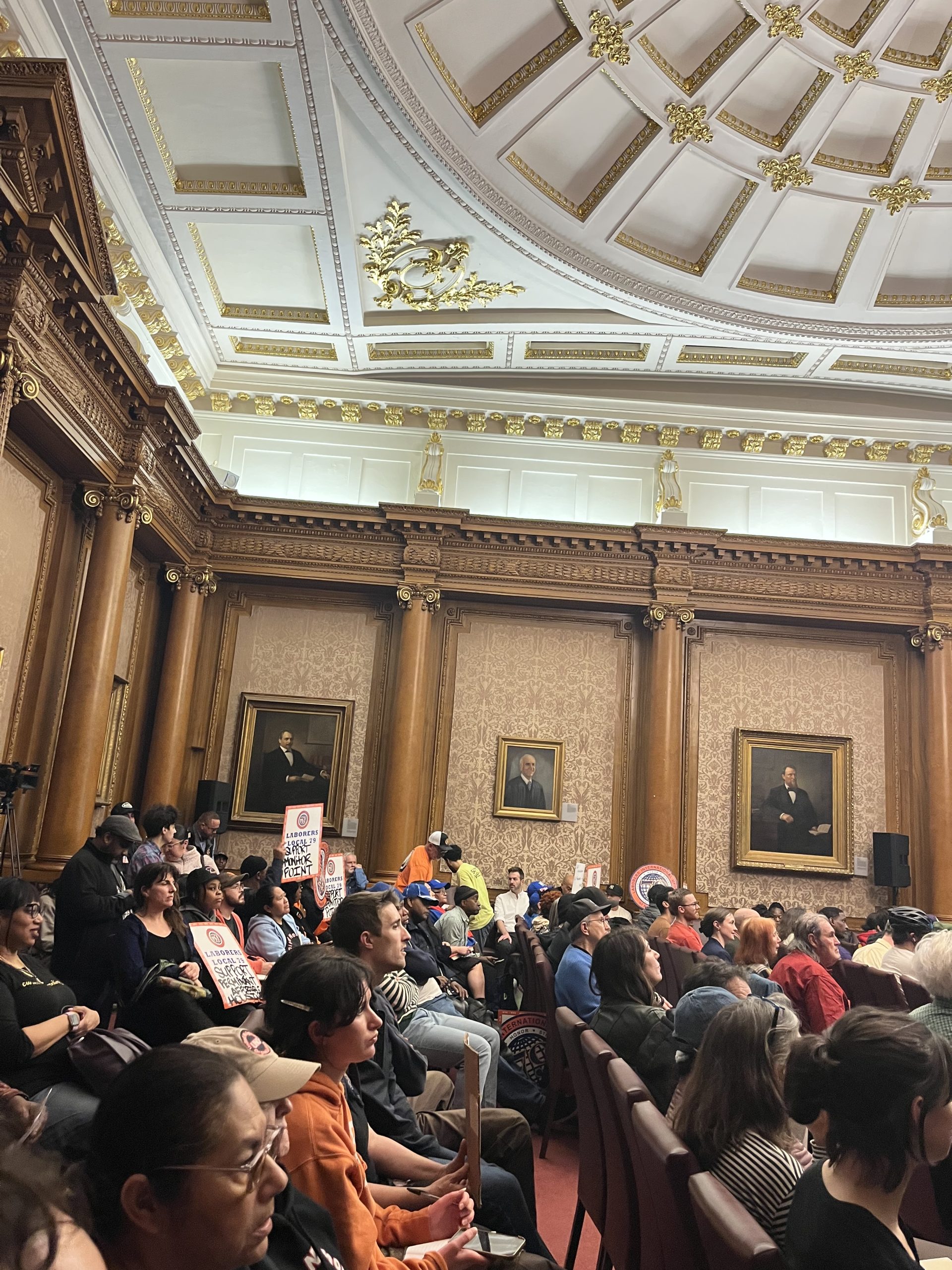
Union members hold signs in support of Monitor Point at a public hearing at Brooklyn Borough Hall on March 11.
BY COLE SINANIAN
cole@queensledger.com
This is part of a series on the Monitor Point development. Read our previous coverage here and here.
A controversial plan to build three mixed-use towers, new open space, and a museum on the Greenpoint waterfront has earned the Borough President’s support.
In a 23-page letter, Brooklyn Borough President Antonio Reynoso recommended the approval of the Monitor Point development, though urged developers to boost affordable housing and called for the full funding of the unfinished Bushwick Inlet Park, which sits adjacent to the site of the proposed towers.
The Monitor Point development — set to be located at 40 Quay Street and 56 Quay Street next to Bushwick Inlet — would transform Greenpoint’s last undeveloped waterfront property with its completion in the 2030s.
But since its Uniform Land Use Review Procedure (ULURP) began earlier this year, Monitor Point has pitted several highly vocal community groups against each other in what has brought bitterness and spectacle to each public meeting. Activists both for and against the development show up armed with signs, while “boos,” cheers and catcalls have regularly rung out during public testimony. Critics of the plan — which includes City councilmember Lincoln Restler and local groups Save the Inlet and Friends of Bushwick Inlet Park — have raised environmental concerns and called it a land grab that would take what was once designated park land and turn it into a playground for the wealthy.
Meanwhile, building maintenance and construction workers with the Local 79 and SEIU-32BJ unions have supported the project, arguing it would bring good jobs and much-needed affordable housing to the already gentrified neighborhood, and have accused “no” activists of being gentrifiers more concerned with saving wildlife and greenspace than housing working class people.
“The quality and quantity of testimony, engagement, and public participation speak to the fact that the implications of this land use application reach deeper and stretch wider than the Project Area’s literal boundaries,” Reynoso’s recommendation reads.
The towers, set to be developed by the Gotham organization in partnership with the MTA, would rise 21, 41 and 56 storeys. The development would add some 3,000 residents to the area, as well as a museum to showcase the history of the famous Monitor battleship, public plazas, retail space, and a network of meandering public walkways that developers say would finally connect the Williamsburg and Greenpoint waterfronts for pedestrian access. Twenty-five percent of the towers’ 1,150 units would be permanently affordable at 40-80% Area Median Income (AMI), while the developers have applied for City subsidies that would fund additional affordable apartments, raising the total percentage to 40%.
The West Building — to be located in the western half of 40 Quay St. — would include the two taller towers, while the East Building would sit on the eastern portion of the same property and rise to 21 stories. Both buildings would front Quay Street, with the West Building set to be separated from the street by a 60-foot wall. An old MTA mobile wash facility currently occupies the property, which developers would relocate to somewhere within the North Brooklyn Industrial Business Zone (IBZ).
The adjacent property — 56 Quay Street — would house the Greenpoint Monitor Museum. The project would require both an upzoning for the 40 Quay St. property from medium to high-density and a demapping of 56 Quay St., which is currently designated park land on the City Map, though it is owned by the Greenpoint Monitor Museum.

A Gotham rendering of the proposed “portal” to Bushwick Inlet Park.
To critics, Monitor Point represents a betrayal on the City’s part. The park land at 56 Quay was set aside by the City as part of the 2005 Williamsburg-Greenpoint rezoning for the future Bushwick Inlet Park, though in 2026, only a small portion of the promised park is open.
“This was the central jewel of the Greenpoint Williamsburg rezoning,” Restler said at a January public hearing. “And 20 years later, we do not have a fully funded park.”
In his recommendation, Borough President Reynoso took care to recognize the significance and historical context of the project. He described the application as a “proxy for the continued outcomes of the 2005 Greenpoint-Williamsburg rezoning.”
“The Borough President recognizes the frustration of Greenpoint and Williamsburg residents who bristle at the prospect of a separate, adjacent project breaking ground before the park is finished, particularly considering the housing development that has taken place in North Brooklyn since 2005,” the recommendation reads.
Reynoso’s recommendation proposes several modifications to the developers’ plan, including that City planners “identify a parks and open space acquisition and development strategy for Community District 1” in order to fully fund the completion of Bushwick Inlet Park.
Regarding affordable housing, Reynoso suggests that developers “maximize affordable housing” via multiple strategies, like increasing the floor area of the East Building to accommodate more affordable units, and to increase the range of affordability to allow access to moderate income households making 90-120% AMI.
In line with recommendations from both Councilmember Restler and Community Board 1, Reynoso’s recommendation also suggests upping the total percentage of affordable units from 40% to “at least 50%.”
In February Community Board 1’s Land Use Committee voted unanimously to reject the project unless developers could guarantee 75% of units are affordable. The full board, however, contradicted its Land Use Committee the following week and recommended the project’s approval, albeit on the condition of at least 50% affordable housing units.

Developers and architects with the Brooklyn-based FX Collaborative Architects presented the proposal at the March 11 hearing.
At a public hearing at Brooklyn Borough Hall on Wednesday, March 11, union workers, environmentalists, and pro-housing advocates fell along familiar battle lines over the fate of Monitor Point.
During their presentation, developers argued that 40% affordable housing is the best they can do while preserving financial viability, and that the 2005 park designation is outdated.
In response to questioning from Reynoso’s representatives, Kelly said that affordable housing developments around the city with 50% or more affordability are often developed on land given to the developer at no cost. As Gotham will be paying rents to both the MTA and the NYC Parks Department, anything higher than 40% affordability could compromise the economic viability of the project, Kelly said.
“We’re open and receptive to ideas on how to increase affordability,” he said. “But that can’t be done at the expense of the viability of the development. We want to do more affordable housing if it’s feasible, but we won’t commit to doing things that we can’t deliver.”
David Lopez, a North Brooklyn local whose family emigrated from Puerto Rico in the 1950s, testified in support of Monitor Point, cited the importance of permanently affordable housing for keeping working class New Yorkers in the neighborhood.
“The area has changed drastically over the last 25 years,” Lopez said. “Bodegas have been replaced by cafes, mom and pop businesses have been replaced by high-priced bars, boutique hotels, and Michelin-rated restaurants. A major way to keep families in the neighborhood is to create permanently affordable housing, and this project is offering that. Turning down 460 affordable apartments is a privilege that many working class New Yorkers don’t have.”
Greenpointer Laura Treciokas, meanwhile, spoke out against the Monitor Point towers, raising concerns that they could “turn what should be shared public space into an amenity for luxury tenants,” and significantly boost the neighborhood’s population without adding infrastructure to accommodate.
“In exchange, the community receives very little, essentially a narrow walkway and a street extension, while nearly 3,000 additional residents are added,” Treciokas said.
Stephen Chesler, who sits on Community Board 1 and has been a vocal critic of the project since the outset, criticized developers for neglecting to show detailed renderings of the towers.
“The community board specifically requested that from them, and they refused to provide it,” Chesler said. “Which is very telling that they know that there is huge community opposition, because of the density and impact this project will have on Bushwick Inlet Park.”
A petition against the Monitor Point development launched by Save the Inlet has 5,460 signatures.
The public hearing and Reyonoso’s recommendation marked step two of the project’s Uniform Land Use Review Procedure (ULURP), which guides development in New York City.
Developers presented the application before the City Planning Commission (CPC) on Wednesday, March 18, before Reynoso’s recommendation was made public. The CPC now has 60 days to review the application before making its recommendation.