
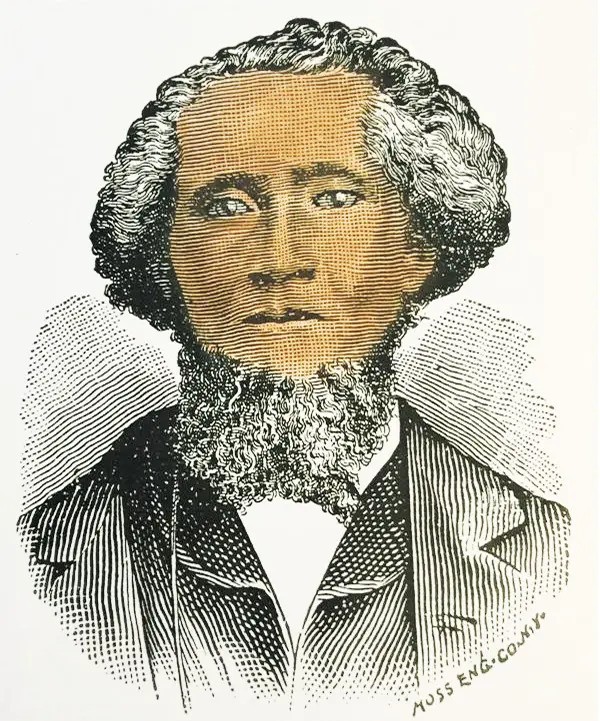
Willis Hodges dies in Williamsburg in 1890, but his legacy lives on. Photo via NJG.
Willis Hodges, the founder of America’s first Black-owned newspaper, was a prominent figure in Williamsburg.
GEOFFREY COBB | gcobb91839@Aol.com
Author, “Greenpoint Brooklyn’s Forgotten Past
When people think about African American communities in Brooklyn, people might think about East New York, Brownsville or Flatbush, not Williamsburg, but the area was once home to a thriving Black community founded by an amazing, but forgotten Brooklynite, Willis Hodges. Though Hodges’ name is largely forgotten today, his life story and achievements deserve to be recalled, especially during Black History Month.
His life had so many adventures, it seems as if it came straight from a film script. Although Willis Hodges’ life may seem contrived, it is not. Born free to unenslaved African American parents in Virginia in 1815, Hodges learned to read and write at a time when many whites were illiterate and only a handful of African Americans could articulate their stories. Nat Turner’s rebellion cast a shadow over the Hodges family when his older brother was falsely accused of abetting Tuner in his slave revolt and was imprisoned. Hodges’ older brother escaped the jail and headed to New York. Incensed whites took vengeance on Hodges’ family, nearly blinding his mother and killing all the family livestock.
Willis arrived in Williamsburg in 1836, where he soon bought land and became a deacon in a local black church. He also became one of the founders of Colored School #2 in Williamsburg, where black children learned to read and write. Willis also quickly joined the local abolitionist movement and became a stationmaster on the Underground Railroad. Angered by a pro-slavery editorial in a New York newspaper, Hodges paid to print a rebuttal, but his article was stuck in the back of the paper where no one would see it. When he confronted the publisher, the man told him to start his own newspaper which he did, starting the weekly Ram’s Horn in 1840. His paper featured articles by Fredrick Douglass and John Brown, the leader of the unsuccessful attack on the Harper’s Ferry arsenal. The Ram’s Horn became the first newspaper ever in America published by an African American.
Douglass urged Hodges to “blow away” on his horn, predicting that its “wild, rough, uncultivated notes may grate on the ear of the refined,” but would “be pleasurable to the slave, and terrible to the slaveholder.”
Hodges and Brown became good friends, and it is entirely likely that Hodges knew about Brown’s plans to foment a slave rebellion before the attack on Harper’s Ferry. It’s also possible that Brown pleaded with Hodges to join him in the raid, but we will never know because as soon as Brown was arrested Hodges burned all of his correspondence with Brown.
During the Civil War Hodges disappeared from Brooklyn and there is speculation that he served the Union Army as a scout. At the end of the war, Hodges returned to his birthplace and was chosen to represent Virginia at the constitutional convention of 1867-1868, which marked the first time ever blacks sat alongside whites as lawmakers. Hodges’ leading role at the convention singled him out for attacks in the pro-confederate Southern press, which was openly hostile to African Americans taking part in Reconstruction. Aligning himself with the Radical Republicans, Hodges supported the enfranchisement of blacks, demanded the disenfranchisement of former Confederates, and sought the racial integration of schools. When Democrats returned to power in Virginia at the end of Reconstruction, Hodges returned to Williamsburg where he lived until his death in 1890.
Hodges published his autobiography chronicling his unique African American story, which he dedicated to the free Blacks of the South. Hodges home and store on South Fifth Street were demolished to construct the Williamsburg Bridge, so the physical evidence of his time in Williamsburg is gone, but his important legacy as a writer and abolitionist lives on and should be remembered during Black History Month.