
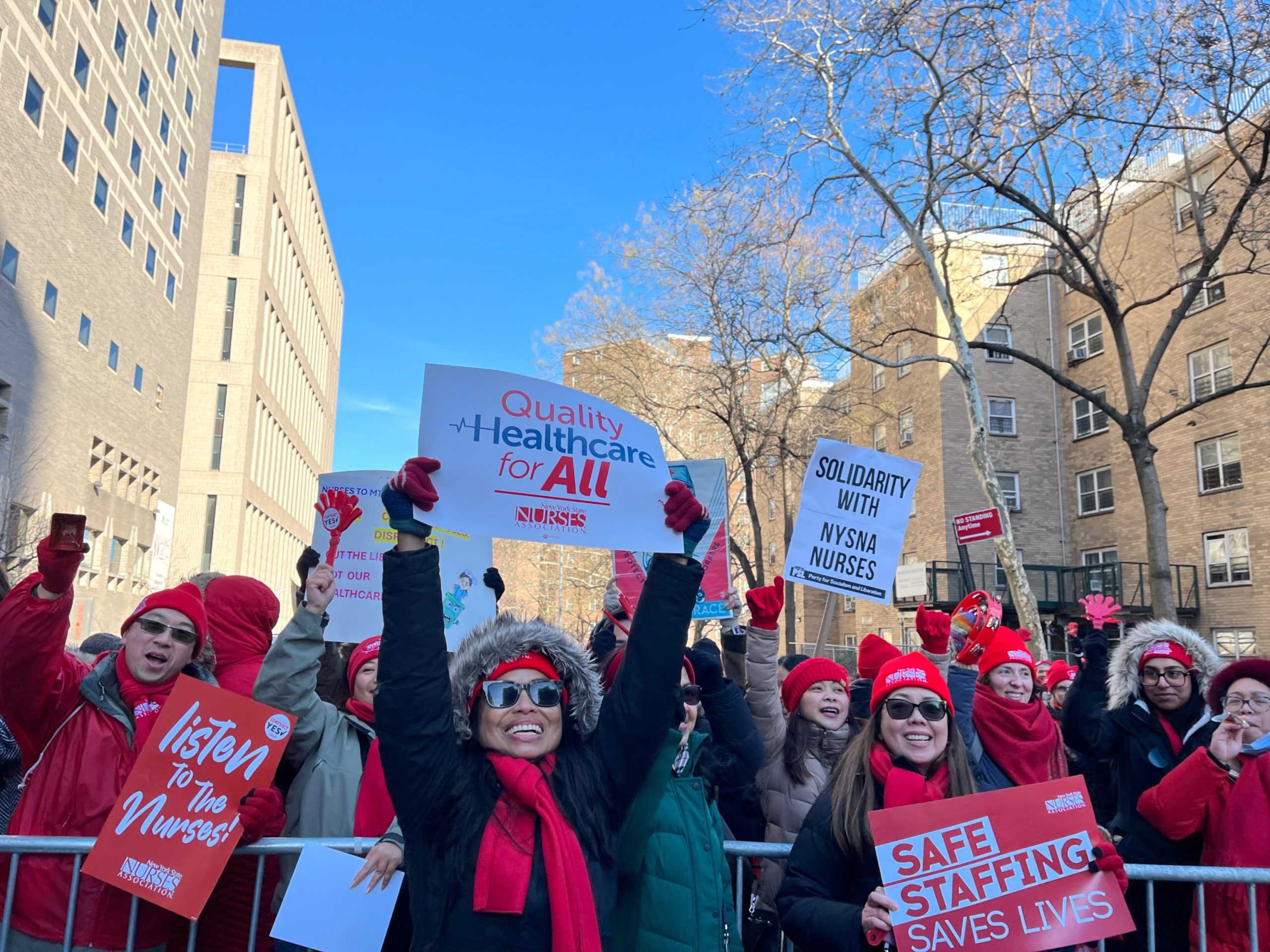
Photo via @nynurses on Instagram.
By COLE SINANIAN
news@queensledger.com
Nearly 15,000 nurses went on strike Monday morning at three of New York City’s wealthiest private hospitals in the largest nurse strike in city history.
The nurses have accused management at Montefiore and NewYork-Presbyterian hospitals and multiple Mount Sinai hospital branches of threatening to cut nurses’ health benefits plan, failing to address workplace violence, keeping dangerously low nurse-patient ratios, and rampant union busting amid a surging flu outbreak and increasing instances of violent confrontations at hospitals around the city. Nurses are also asking hospitals to ensure that patients always have access to a real human at their bedsides at a time when some hospitals have moved to implement AI tools in patient care.
Some 16,700 nurses at 15 hospitals throughout New York City and Long Island unionized under New York State Nurses Association (NYSNA) gave strike notices on January 2. Since then, 4,000 of those have withdrawn their strike notices after management at eight safety-net hospitals — which accept Medicaid and generally serve the city’s poorest communities — came to a tentative agreement with nurses. One of these, Maimonides Medical Center in Brooklyn, is in the midst of a merger with NYC Health and Hospitals after years of financial hardship.
Mount Sinai fired several nurses on Monday morning just hours before the picket was said to begin, in what a NYSNA press release described as illegal terminations. According to NYSNA president and veteran Maimonides nurse Nancy Hagans, the fact that the city’s most cash-strapped hospitals are willing to negotiate when its wealthiest are not illustrates the greed and disregard for nurse and patient safety at New York City’s largest private hospitals.
“If the poorest hospitals in the city of New York could come to the table, negotiate a fair contract in order to protect our communities, in order to protect our patients, the rich hospitals should do the same,” Hagans said at a press conference on January 8.
Along with Maimonides, The Brooklyn Hospital Center, Wyckoff Heights Medical Center, Bronxcare, Flushing Hospital Medical Center, and several other safety-net hospitals have come to tentative agreements with NYSNA nurses. Striking nurses are picketing at 10 locations, including the Montefiore Hutchinson Medical Center and Jack D. Weiler Montefiore campuses in the Bronx, and the Columbia University NewYork-Presbyterian Hospital, the Morgan Stanley Children’s Hospital of New York-Presbyterian, Mount Sinai Hospital and Mount Sinai Morningside in Manhattan.
In a statement to the Ledger, Marketing and Communications Vice President for Maimonides Sam Miller expressed management’s willingness to continue negotiations with NYSNA:
“We have resolved many of the key contract issues, and will continue negotiations toward a final agreement that rewards nurses for their important work while recognizing the increasingly difficult financial challenges that we and other safety net hospitals face,” he wrote. “We are grateful for our partnership with NYSNA, now and always, and look forward to finalizing a new contract soon.”
This is not the first time New York nurses have gone on strike for better staffing and work conditions. In January 2023, 7,000 nurses at Montefiore in the Bronx and Mount Sinai in Manhattan went on a three-day strike that resulted in a tentative contract that in theory would guarantee better staffing and wages. But three years later, nurses say that the for-profit hospitals have not honored their agreement and allowed conditions to slide.
“We went on strike then, and we won what hospitals said we couldn’t: enforceable safe staffing ratios throughout our hospitals,” Hagans said. “Now the same hospitals are trying to undo the progress we’ve made on safe staffing for our patients. They want to take back everything we accomplished three years ago.”
Many hospitals lack any kind of metal detectors or security infrastructure, Hagans said, which has allowed violent incidents to occur that put the lives of staff and patients at risk.
Last week, a mentally disturbed patient at the NewYork-Presbyterian Methodist Hospital in Park Slope cut himself with a piece of broken toilet seat and threatened an elderly patient and hospital staff member before being fatally shot by police. And in November, a 20-year-old man entered Mount Sinai Medical Center with a gun and threatened to shoot the staff inside, before police apprehended him and shot him dead. Nurses at the hospital — who had attempted to save the shooter’s life after police shot him — rallied outside the hospital after the incident to demand increased security measures, and were subsequently issued disciplinary write-ups by management in what union reps alleged was an illegal disciplinary action.
Meanwhile, the New York State Department of Health announced January 2nd that the state was experiencing its highest recorded number of flu hospitalizations in a single week, pushing nurses to the brink as they endure long shifts and high patient loads while struggling to maintain their own health amidst cuts to healthcare benefits.
NYSNA nurses are also seeking to prohibit hospitals from relying on artificial intelligence for patient care. As part of their tentative agreements, safety net hospitals have already agreed to this, while Mount Sinai, NewYork Presbyterian, and Montefiore have refused to negotiate.
“Every patient deserves a nurse at the bedside to take care of them, not artificially,” Hagans said. Patients need human touch. Every patient is a VIP, regardless of your zip code, regardless of your immigration status.”
In a recorded press update, Mount Sinai Health System Chief Executive Officer Brendan G. Carr urged nurses to come back to work.
“Nurses want to be back at the bedside even though the unions have instructed them to stay home,” Carr said. “In fact, we had about 20% of our nurses show up for work today. I’m grateful to those of you who chose to stay at the bedside, and I welcome those of you who’d like to come back to work, to come back. And I commit to all of you, no matter what your decision, that we will work tirelessly to come to an agreement that balances the incredible value you bring to our teams, with the financial crisis that’s facing healthcare today.”
On Friday, Governor Kathy Hochul announced that she would issue an executive order to ensure striking hospitals stay operational.
“This could jeopardize the lives of thousands of New Yorkers and patients, and I’m strongly encouraging everyone to stay at the table, both sides, management and the nurses, until this is resolved,” Hochul said in a recorded statement posted on social media.
Mayor Mamdani, for his part, voiced his support during a picket in Morningside Heights on Monday.
“New Yorkers have a right to quality healthcare, as do the nurses who provide that care,” he said. “My job as mayor is to protect both of those rights.”
According to a Monday NYSNA press release, NewYork-Presbyterian, Montefiore and Mount Sinai had spent more than $100 million on replacement nurses bussed in from elsewhere around the state, money that Hagans says could have been spent meeting the nurses demands. Mount Sinai had an annual revenue of $11.9 billion in 2024, while NewYork-Presbyterian CEO Steve Corwin earned a salary of $26.3 million, or about $72,000 per day.
“They are spending millions of dollars to bring in out of town nurse replacements that are not as highly qualified as our nurses,” Hagans said. “We are asking them to take the money and invest them into our communities, invest them into our patient care, and invest them into reducing workplace violence.”