
In her first State of the District address, North Brooklyn senator Kristen Gonzalez recaps a year’s worth of legislative work.

Kristen Gonzalez speaking at he State of the District address on November 17. Photo by Alexandra Chan via @sengonzalezny on Instagram.
By COLE SINANIAN
news@queensledger.com
In a wide-ranging State of the District address on November 17 at CUNY Law School in Long Island City, New York State Senator Kristen Gonzalez urged cooperation and unity in the struggle against the Trump Administration, and vowed to protect and improve quality of life for her constituents in her unique, three-borough senate district.
Hailing from Elmhurst, Queens and representing New York’s 59th District — which includes Astoria, Long Island City, Greenpoint, Williamsburg, Stuyvesant Town, and Manhattan’s Kips Bay and Murray Hill — Gonzalez, a Democrat and Working Families Party member, was the youngest woman ever elected to the New York State Senate when sworn in on January 1, 2023 at 28-years old. Raised by a single mother, the former tech-worker and community organizer now chairs both the Senate’s Internet and Technology and Elections Committees. She sits among New York City’s progressive-socialist core, her district overlapping with those of other prominent, Democratic Socialists of America (DSA)-endorsed politicians like City councilmember Tiffany Cabán, Assemblymembers Emily Gallagher and Claire Valdez, and Mayor-elect Zohran Mamdani.
After a brief introduction from Valdez, Gonzalez launched into an explanation of her role as a state senator, followed by a review of her legislative achievements in 2025 and a discussion of her goals for the year ahead.
Budgeting and bargaining
Gonzalez presented the state legislature as a tool for standing up to what she called an “openly hostile federal government.” But if this tool is to be effective, state lawmakers must coordinate with each other and with constituents across both legislative chambers, Gonzalez said. She explained how laws are passed— bills are introduced in both the Senate and the Assembly and must pass by a majority in both chambers. At this point the governor signs off, and the bill becomes a law.
For the 2025 legislative session, Gonzalez passed 19 bills, co-sponsored 209 and introduced 49 to be passed in future sessions. As chair of the Elections Committee, many of Gonzalez’s legislative wins dealt with voting rights, digital transparency and regulations on the AI industry.
Some of the bills Gonzalez has sponsored this year includes legislation to designate a statewide “chief artificial intelligence officer” to help guide policy decisions relating to AI, the “secure our data act,” which would protect data stored by the state from external individuals and organizations, protections for gender-affirming care, and a bill to establish cost-accountability in the construction of AI data centers.
Besides passing bills, Gonzalez and her colleagues in the state legislature work to allocate the state’s $254 billion budget, $115 billion of which went to the New York City Council in 2025. A draft budget is proposed by the governor, then the Senate and Assembly respond with their own version of the budget, negotiating with the governor until an agreement is reached.
For the 2025 fiscal year, Gonzalez’s office helped secure $1.3 billion for affordable housing in New York City through housing voucher access programs. Securing funding for the MTA, which is controlled by the State, is another major part of Gonzalez’s and her fellow New York City senators’ work. This year saw $60 billion secured for the transit authority, much of which went to improvements to the city’s subways stations, such as at Queens Plaza and Queensboro Plaza stations, which got elevator upgrades this year as a result of this funding.
This year’s budget also included funding for the State’s Hunger Prevention and Nutrition Assistance Program (HPNAP), and $2.2 billion for childcare programs. Gonzalez’s office also holds a pot of state money designated for local organizations and nonprofits in her district. This year, the youth development program at Variety Boys and Girls Club of Queens received funding from her office for afterschool programming and to triple the number of students it serves.
“If you are someone who has an organization, a nonprofit, that needs either operational funding — that’s the programming – – or capital — and that’s more the physical space,” she said, “you can absolutely reach out to our office.” Local organizations can call her district office at (718) 765-6674, or apply for funding through a form on her website, although applications must be submitted by June in order to meet this year’s budget deadline.
A dignified life
Gonzalez emphasized that her legislative work is focused around three main issue areas: affordability, quality of life and democracy. Echoing the populist message propagated by mayor-elect and fellow Democratic Socialist Zohran Mamdani, Gonzalez made it clear that her vision for New York is one that puts working-class New Yorkers first. She described the city she envisioned, where affordable housing is accessible to all in the neighborhoods where they work, public infrastructure is safe and efficient, and every New Yorker, regardless of salary, can enjoy a high quality of life.
“Quality of life,” as Gonzalez explained it, includes protection from natural disasters, pedestrian-friendly infrastructure, and easy access to public parks and open space.
“We’re looking at safe streets and street redesigns that make sure that we’re protecting pedestrians because across our district, we’ve had an incredible number of deaths due to traffic violence,” Gonzalez said. “It also means having open spaces in clean spaces that we can enjoy, that when you leave your house, you don’t have to assume you’re paying at least $20 to $50 to enjoy something, that you can go somewhere that is free, that is publicly owned and publicly funded.”
She called out stewards of some of these public spaces who were present in the audience, including the Friends of Bushwick Inlet Park and the Hunters Point Park Conservancy. Community members at Bushwick Inlet Park are organizing to prevent the construction of the Monitor Point towers, a proposed group of mixed-use high-rises just to the park’s north that activists say would crowd the neighborhood, cast shadows and threaten the delicate coastal ecosystem.
Air quality and pollution in the district are also part of this quality of life. In northern Brooklyn and Queens, “peaker” plants — power plants that run during the summer to boost electricity generation at peak hours — have historically brought dirty air to the neighborhoods where they operate. Though many have closed over the past few years, some, like the massive Ravenswood Generating Station in Long Island City, remain operational, and represent an opportunity for the state’s transition to renewable energy, Gonzalez said. A bill that she co-sponsored in 2023, the Build Public Renewables Act, allows the state power authority to build public wind and solar facilities.
Gonzalez also took aim at the area’s noise pollution, referencing her bill to impose a tax on non-essential helicopter and seaplane flights in major cities. She mentioned the constituents who had complained to her office about how the noisy helicopters flying over the East River detract from quality of life in the district, characterizing them as symptomatic of the wealthy classes’ entitlement to indulge in their luxuries at the expense of everyone else.
“It is a clear example of how the city serves millionaires and billionaires that are able to travel by helicopter and plane over protecting our quality of life and the majority of the public,” she said.
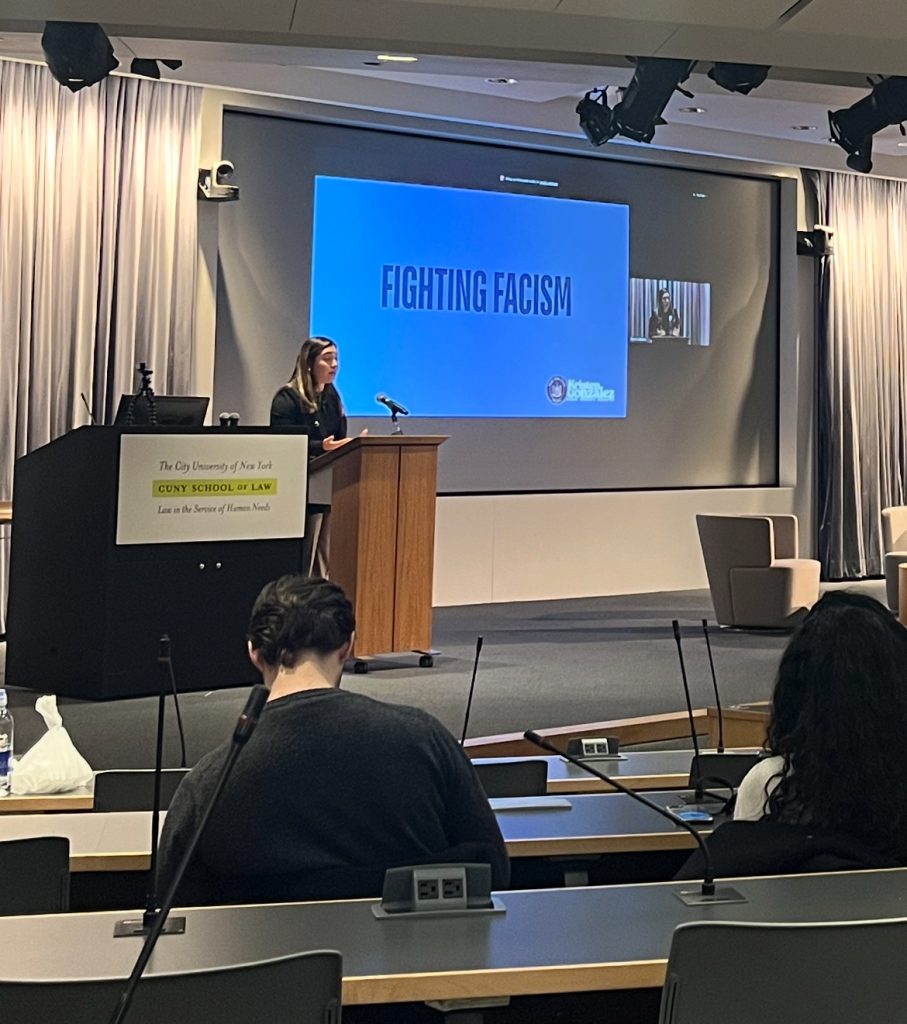
Senator Gonzalez discusses what she called the Trump Administration’s “openly hostile federal government.” Photo by Cole Sinanian.
…and a functioning democracy
Crucial to Gonzalez’s vision for a high quality of life in her district is robust participation in the democratic process and a government that protects the people who elect its members. This is perhaps more important now than ever, Gonzalez urged, as the Trump Administration has deployed troops to cities controlled by the Left and detained immigrants at Manhattan’s 26 Federal Plaza without due process. She praised the Mandating End of Lawless Tactics (MELT) Act, introduced by Senator Patricia Fahy, which would require federal immigration agents to reveal their names and faces while operating in New York.
Much of her upcoming legislative work deals with data transparency and protecting the democratic process from threats posed by deepfakes and generative artificial intelligence. As chair of the Internet and Technology Committee, Gonzalez promised to ensure that campaign finance data remains public, and to put guardrails on AI development, characterizing the technology as an “existential threat” to her district’s workforce.
But most importantly, as Gonzalez reiterated, democracy begins in communities, and the top priority of elected officials must be to serve the best interest of the people they represent.
“I have heard from so many of you that you have had moments or interactions with either politicians or offices from any level of government that have not actually helped you,” Gonzalez said. “And I really want to be clear that with this office, with what we’re doing and how we’re working, we are trying to change that. And by proving we can change that, by proving that we can have a functional government, it sends a signal to the rest of the city that not only organizing works, but from the bottom up, we can actually win big things together.”