
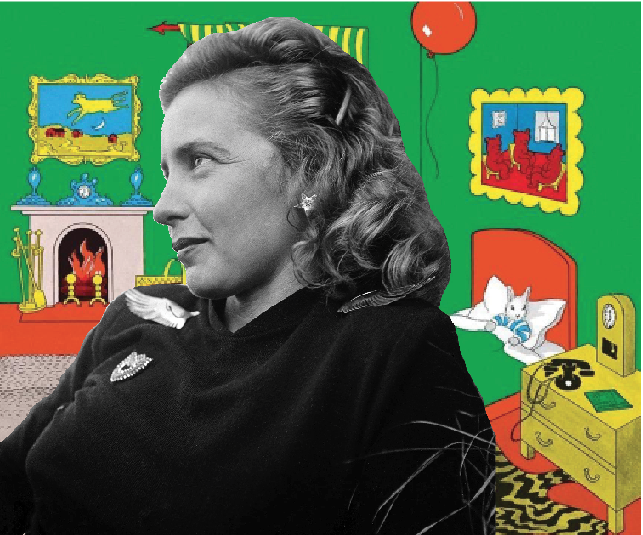
Margaret Wise Brown grew up on Milton Street before moving to Long Island. Photo via the New Yorker.
Born in Greenpoint, the author of “Goodnight Moon” spent hundreds of hours interviewing children before publishing her global bestseller.
GEOFFREY COBB | gcobb91839@Aol.com
Author, “Greenpoint Brooklyn’s Forgotten Past
In terms of book sales, no Brooklyn-born author can compare to Margaret Wise Brown’s classic children’s book Goodnight Moon, which has sold an unbelievable 50 million copies worldwide. Almost fifty years after its 1947 publication, Brown’s beloved tale still sells some 800,000 copies annually and has been translated into at least 25 different world languages. The Library of Congress named it as one of its 88 “Books that Shaped America” for reflecting the nation’s unique literary heritage, yet, amazingly, the New York Public Library almost torpedoed this beloved children’s classic.
Wise, who was born at number 118 Milton Street, is often referred to as the “laureate of the nursery,” and the “queen” of children’s literature, who transformed the picture book into a modern art form. A literary genius with an insight into how toddlers perceive the world and used language, Brown revolutionized children’s books by focusing on the “here and now” of daily life, rather than fantasy. The author of a slew of other successful children’s books, Life Magazine hailed her in 1946 as the “World’s Most Prolific Picture-Book Writer,” yet powerful adults almost kept her books from the hands of children.
Before discussing Brown’s fight with censorship, let’s get some background on her Greenpoint roots. She was born and lived the first seven years of her life in a landmark house on Milton Street. Her father, who was an executive with the American Hemp Rope Manufacturing Company on West Street, often fought with Margaret’s mother, creating an unhappy family home. The sensitive, highly perceptive Margaret, sensing from an early age the unhappiness in her parents’ marriage, retreated into language, composing. even as a young girl, her own songs, rhymes and poems. The family moved to Long Island, but when Margaret graduated from high school, her father refused to pay for her college education, which sparked many heated arguments between Margaret’s parents. Thankfully, her mother prevailed and in 1935 Brown enrolled in Bank Street Teacher’s College children’s writing workshop under the direction of Lucy Sprague Mitchell, an educator interested in the new field of literature for very young children. Brown spent hundreds of hours interviewing young children, swapping stories with them and learning what they wanted to hear. She developed an uncanny sense of how children communicate and she echoed children’s language in her own works. Her books were unique and a complete departure from traditional children’s books.
In 1947, Brown conceived and wrote her classic, Goodnight Moon, all in one morning. Her book soon reached the desk of Anne Carroll Moore, the stuffy and conservative, but highly influential head of the New York Public Library’s children’s department. Moore, who also disliked other classics, including Stuart Little and Charlotte’s Web, read it with disdain and dismissed the book as “unbearably sentimental” and a “bowl full of mush.” She objected to the absence of a moral in the work and refused to add it to the shelves of the NYPL, which led other libraries around the country to reject the book as well. In large part because of Moore’s rejection, Goodnight Moon wasn’t an immediate commercial success; by 1951 sales had dropped low enough that the publisher considered taking it out of print.
The book, though, was saved by the word of mouth of parents, who were amazed by their children’s positive reaction to it. In March 1953, the book featured in Child Behavior, a nationally syndicated parental advice column. “It captures the two-year-old so completely,” the authors wrote, “that it seems almost unlawful that you can hypnotize a child off to sleep as easily as you can by reading this small classic.”
The book’s popularity continued to grow throughout the 50s and 60s as bookstores stocked it. By 1972, the book’s 25th anniversary, Goodnight Moon was selling almost 100,000 copies sold a year. That same year, the New York Public Library finally added it to its shelves.
Brown was a charming total eccentric. She would use entire royalty checks to buy an entire flower stand. She was part of a group that could proclaim any day of the year Christmas. Although wealthy, she chose to vacation in a house in Maine without running water or electricity. Her romances were volatile: she was engaged to two men but never married, and she had a decade-long affair with a woman. At the age of forty-two, she died suddenly, in the South of France, after a clot cut off the blood supply to her brain.
Brown’s sudden, untimely death shocked the world of children’s books. Her output during her brief career was prodigious, writing more than a hundred children’s books, many of which are still in print six decades after her death. No author before or since Brown has managed to write books that reflect a natural impulse to amuse, delight and comfort small children. Thank goodness a stodgy librarian wasn’t able to censor her.