
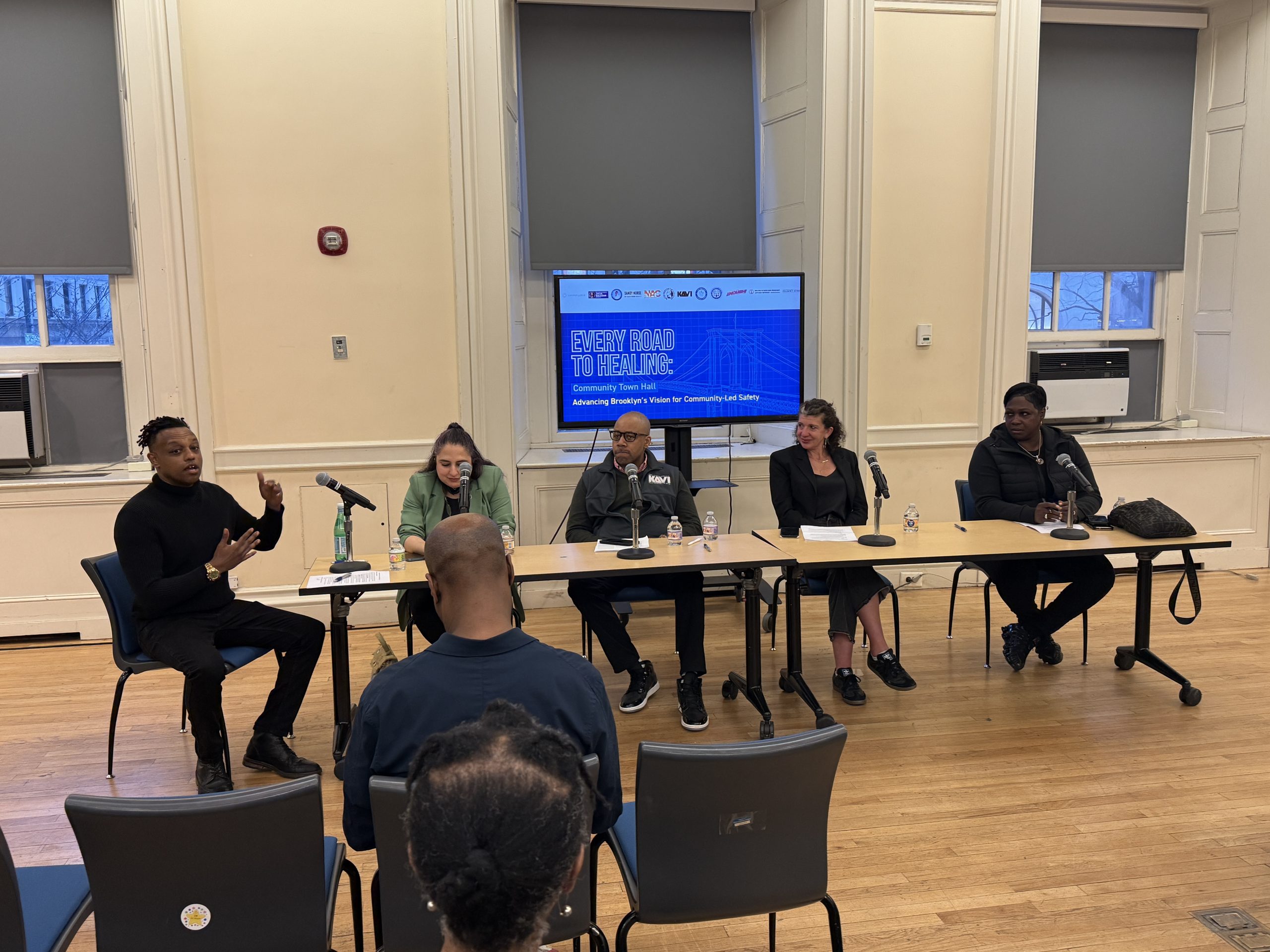
From left: Abraham Paulos, Rama Issa-Ibrahim, Ramik Williams, Danielle Sered, and Shneaqua Purvis. (Photo: Jack Delaney)
By Jack Delaney | jdelaney@queensledger.com
Last month, Mayor Mamdani made good on one of his central campaign promises by establishing a new Office of Community Safety, aiming to overhaul the city’s approach to mental health-related 911 calls by sending social workers instead of police officers.
But as the Mamdani administration moves to adopt alternate models for public safety, local nonprofits in Brooklyn are banding together to send a clear message: They’ve already ready been doing the work, and just need more — and more consistent — funding.
On March 24, the citywide outfit Common Justice joined leaders from other violence prevention organizations at Borough Hall for a forum called “Every Road to Healing: Building Safety Rooted in Community,” drawing an audience of more than fifty Brooklynites who were eager to hear what the freshly-created office might mean for their neighborhoods.
Before the panel discussion, Common Justice played a clip from its recent documentary short featuring the decorated judge L. Priscilla Hall, whose commentary framed the conversation to come.
“The courts by themselves can’t make you safe. Police cannot make you safe. The only people who can really make you safe is your community,” said Hall. “What seems to me to be a real problem right now is the lack of attention that’s being paid to people with mental and emotional issues. When you put people in ghettos and you mistreat them, there’s always trauma to that person. If that trauma is not addressed, it flourishes.”
Each of the panelists was someone who had dedicated their career to healing or preventing such trauma, in many cases because gun violence had impacted them or their loved ones.
Shneaqua “Coco” Purvis, executive director of the Bed-Stuy-based outfit Both Sides of the Violence, said that she was driven to start the organization not simply after her sister was murdered, but 18 years later, when she finally spoke to the person who killed her and decided to mentor him.
Since then, Purvis has expanded her youth outreach initiatives from Brooklyn to the Bronx and Manhattan, with the mission to “create long-lasting solutions and resources to cure all types of violence for victims and perpetrators in our most vulnerable communities.”
“I work really hard with zero to no funding to do this work authentically,” said Purvis. “Because these kids know when you’re a fraud, and you have to look into yourself and see who you are in that mirror before you go tell somebody else what to do in their mirror.”
Ramik Williams, co-director of Kings Against Violence Initiative (KAVI) in Central Brooklyn, emphasized structural solutions to support community safety efforts.
“We have a trillion dollars coming into the city. How is there not enough money?” Williams asked the crowd. “It all comes back to capitalism and holding these entities responsible, just paying their share, giving back what they take.”
Daneille Sered, founder and executive director of Common Justice, seconded his sentiments.
“Neighbors are working, community-based organizations are working. We are keeping each other safe,” she said. “But Ramik is right. We’re not resourced, and it’s not for lack of money, right?”
Moderator Abraham Paulos, who helms the Black Alliance for Just Immigration (BAJI), posed the hot-button question: Will the Office of Community Safety alleviate those woes?
Williams noted that the administration had contacted nonprofits shortly before the announcement to share that their programs would be overseen by the new body.
“The budgetary shift has happened. The money that was being allocated for all types of programs under DYCD is now going here, but there’s no talk about replacing it,” mused Williams. “The potential’s there, but we have to be mindful of the shiny object.”
“There is a good intention, and we shouldn’t disregard that,” added Rama Issa-Ibrahim, a Brooklynite who leads the Center for Anti Violence Education. “But there’s no money that’s been baselined for this office. The work that we’re all doing is still continuing to happen. It’s just going to be moved from one place to the other.”
The overall atmosphere of the event was a cautious — very cautious — optimism. “The NYPD still gets $6 billion every single year and increasing, but we haven’t been promised any additional money to do violence interruption or violence prevention,” said Issa-Ibrahim. “So until we see that, I don’t think that we can celebrate.”
For Purvis, the greatest barrier to effecting change is not only the lack of funding, but the fact that it’s often erratic. She recounted seeing tangible results from building relationships with young people on a particular block, until she was forced to stop when the money dried up.
“As bad as I want to serve these guys, I can’t if there’s no funding,” said Purvis. “Consistency — it’s so important. With that consistency comes trust. If we have consistent money, or we come together with other organizations that do the same work as an agency, then maybe we can have permanent funds. And if we can have this consistency, we can do the work that we’re meant to do.”