
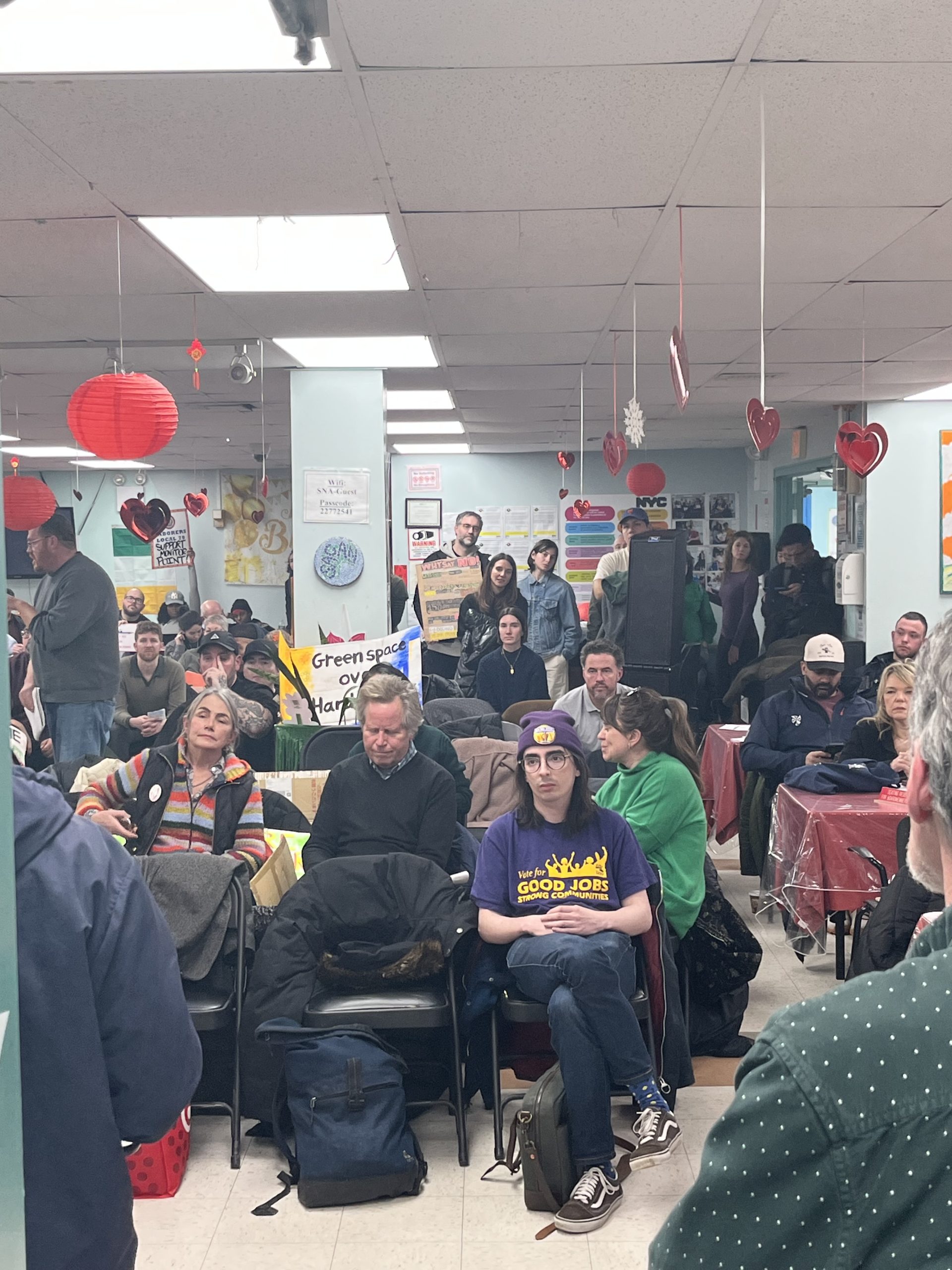
The vote came at the end of a chaotic meeting that pitted local environmentalist against unions and housing advocates over the fate of Greenpoint’s last undeveloped waterfront land.
By COLE SINANIAN | news@queensledger.com
GREENPOINT — Brooklyn Community Board 1 voted Tuesday night to recommend the approval of Monitor Point, the proposed mixed-use development immediately north of Bushwick Inlet that’s stirred controversy over its scale and proximity to the half-built Bushwick Inlet Park.
The proposal — a partnership between the Gotham Organization and the MTA — would add 3,000 new residents in three high-rise residential towers, the tallest of which would stand over 600ft. Most residents would be paying market-rate rent, while Gotham has committed to 40% of the 1,150 units being affordable at 40-80% Area Media Income, an income bracket of about $45,000 to $90,000. Of these 460 affordable units, 200 will be concentrated in the east building, which will be 100% affordable.
CB1’s recommendation marks the beginning of the project’s Uniform Land Use Review Procedure (ULURP), a standardized process that guides development throughout the city. The recommendation includes conditions, like increasing the amount of parks funding from $300,000 to $600,000 annually, and that a “healthy majority” of the project’s apartments are affordable.
The board’s vote is a break from its land use committee, which voted unanimously last week to reject the project unless developers committed to at least 75% affordable housing. Community board recommendations are not binding, but the borough president, to whom the project goes next, is expected to follow the board’s recommendation.
“The board kind of sets the stage,” said Stephen Chesler, who sits on CB1 and is the Vice President of Friends of Bushwick Inlet Park. “The borough president, and especially our city council member, have to answer to the people.”
Gotham’s plans for the project — located at 40 and 56 Quay Street — also include museum, retail, and public waterfront space, and would require a rezoning from medium to high-density.
The project has garnered criticism from local environmentalists and open space advocates who’ve argued that the towers would privatize Bushwick Inlet for the buildings’ mostly high-earning residents and wreak environmental havoc on a rare and sensitive ecosystem that’s the last of Brooklyn’s undeveloped waterfront land. Critics have also raised concerns that the population bump could contribute to the area’s ongoing gentrification.
Labor unions and several housing organizations, however, have supported the project on the grounds that it would bring necessary affordable housing to the neighborhood.
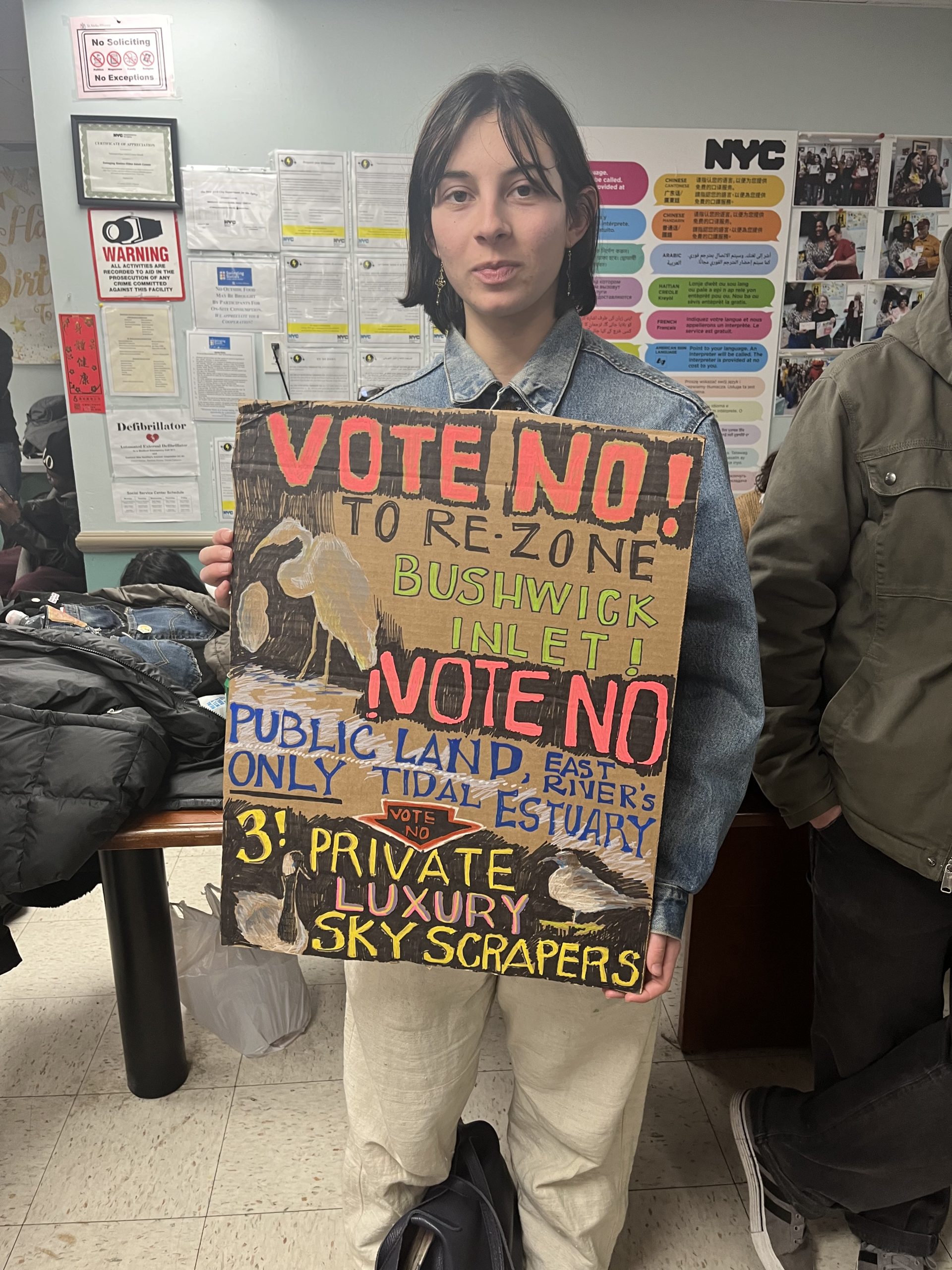
Marissa Bohk holds a sign she made advocating against the Monitor Point development at Tuesday’s meeting.
Tuesday’s meeting took place at the Swinging Sixties Center on Ainslie Street. Among the room’s “no” crowd — many of whom held signs and sat together in the center of the room — rumors circulated that the project’s supporters were not from the neighborhood and had come to stir the pot on Gotham’s behalf.
During the meeting, City councilmember Lincoln Restler held firm on his opposition to the Monitor Point towers unless developers could guarantee a “healthy majority” of their apartments would be affordable, a position he had previously stated at a January 20 hearing at the Polish Slavic Center. He also urged that Bushwick Inlet Park must be completed before any new towers can be built.
“I am grateful to the members of our land use community for voting unanimously for more affordable housing, and for getting us on a path to fully funding Bushwick Inlet Park,” Restler said
He continued: “If, if, if this administration is able to actually put us on a pathway to building Bushwick Inlet Park, which has been promised to us for 20 years, then I think we have to have a real conversation. But until then, my position for four years has been that I’m not there on this project.”
Union members from Local 79 and the SEIU 32BJ building maintenance workers union sat together, booing those who spoke against the project, and cheering those who supported it.
“You don’t build anything union!” yelled a man seated towards the back as Restler spoke.
Both Local 79 — which represents construction workers — and the SEIU 32BJ building maintenance workers union have partnerships with the Gotham Organization. In a prior written statement to the Brooklyn Star, a Gotham spokesperson clarified that “all Gotham-owned buildings are staffed by 32BJ members.”
During the meeting’s public testimony portion right before the vote, Local 79 union member and North Brooklyn resident Eddie Burgos said he supported the project for the waterfront access , affordable housing, and jobs it provided.
“Not only is it providing affordable housing, it’s providing union jobs for local residents like myself,” Burgos said.
At a table in between the union members and environmental activists, several women wearing matching black t-shirts chatted in Spanish before the meeting. They had come with the United Neighbors organization (UNO), a tenant group supported by the housing organization, St. Nick’s Alliance.
One, an older woman named Luz, explained in Spanish that this was her fourth meeting, and that she supported Monitor Point because the development would bring housing to her and her neighbors. Another woman, who held a bright green sign that read “Support affordable housing! Vote yes on Monitor Point,” said her friends had invited her to the meeting, nodding towards Luz.
Ronaldo Guzman, the Deputy Director of Community Preservation at St. Nick’s, brought three of the women, including Luz, up to the podium during the public testimony portion of the meeting.
“For the people of Greenpoint, please meet your neighbors,” Guzman said. “This is one of the few projects that is going to secure 40%, low income housing for our community,” he continued. “What is the use of a park if our community cannot even enjoy it?’
It was close to 9pm by the time the vote took place, by which point Guzman and the group from UNO had already left, as well as many of the Local 79 and SEIU 32BJ members.
Several members of the public who spoke at the meeting began by stating their connections to the neighborhood. Scot Fraser, a longtime Greenpoint resident who also sits on Friends of Bushwick Inlet Park’s Board of Directors, evoked the displacement brought by the area’s 2005 rezoning in his testimony.
“At our rallies in the 80s and 90s, we were a community united, locked away from our waterfront by fences, by pollution, by closed factories, by dumps and by parking lots,” Fraser said. “Now, after our rezoning, we are being walled-off by the golden handcuffs of high-rise towers.”