
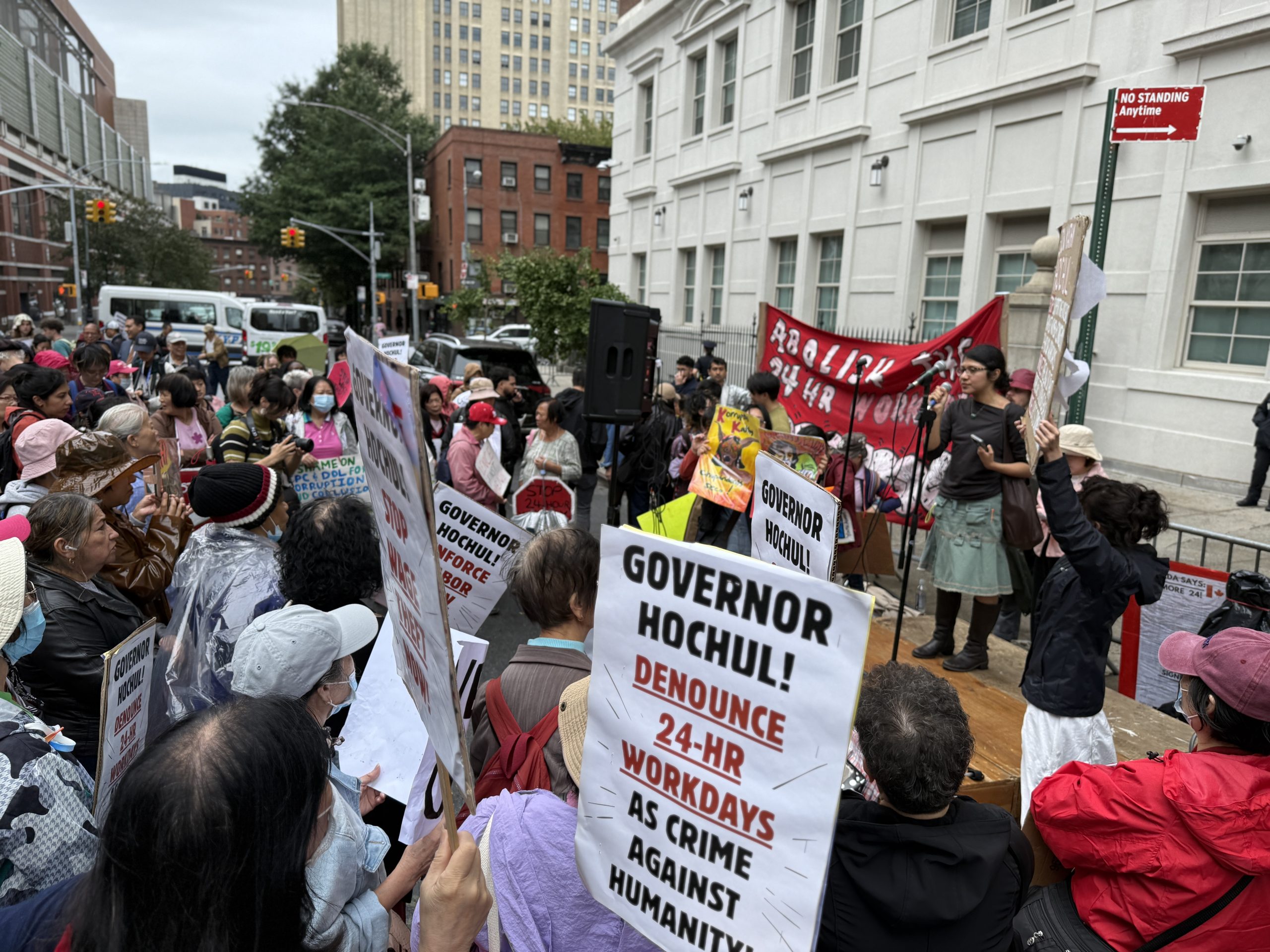
Home care workers rally outside the Department of Labor’s offices in Downtown Brooklyn, calling for an end to 24-hour shifts and accountability for wage theft.
By Jack Delaney | jdelaney@queensledger.com
For five years, Velkis Cid barely slept at all.
Cid was making ends meet as a home care worker with Royal Care, one of the largest agencies in the New York area. “I used to sleep like two hours,” she said, “but I had to be ready, because the patient would call me and I would wake up. So I never slept eight hours straight.”
Under a state law called the “13-Hour Rule,” home care companies are allowed to pay live-in aides for only 13 hours of a 24-hour shift, provided they receive at least eight hours of sleep and three hours for meals. If those conditions aren’t met, however, the employer is required to compensate them for the entire shift.
Yet despite enduring what they describe as sweat-shop conditions, Cid and thousands of her fellow home care workers — most of whom are immigrant women of color — allege not only that they were never paid for those long hours, but that the state’s Department of Labor (DOL) has been actively trying to kill investigations into stolen wages that likely total over $6 billion.
They’ve had enough. On Wednesday, October 8, Cid joined over a hundred home care workers and an intergenerational coalition of allies called the Ain’t I a Woman?! campaign at a rally outside the DOL’s offices in Downtown Brooklyn, demanding that it both reopen probes into widespread wage theft and end the 24-hour workday for good, by splitting shifts in half.
“Like many of us, my health is destroyed,” said Mireya Silva, who often worked consecutive 24-hour shifts during her 12 years with the United Jewish Council of the East Side, as she looked out on a sea of posters with messages in Chinese, Spanish, and English. “I have had three operations — one on my spine, one on my arm, and one for my hand. Plus, I was robbed of almost half of my pay from those 24-hour shifts. No more! Pay us now, not tomorrow or later!”
A System on the Brink
This is a precarious moment for the future of home care in New York. Since the 1990s, the state has offered patients and their families more flexibility through a popular Medicaid program called CDPAP. In 2023, the state announced that it would be transitioning from a system in which those customers could choose from over six hundred companies for help with payroll and benefits, to one with a single fiscal intermediary — an embattled company called Public Partnerships LLC, or PPL.
Soon after the switch, all hell broke loose. Many caregivers reported incomplete or severely delayed paychecks, and were unable to contact PPL amid a raft of technical and communications failures. It didn’t help that when state lawmakers hauled the commissioner of the Department of Health in for answers last month, they were told that nothing was amiss.
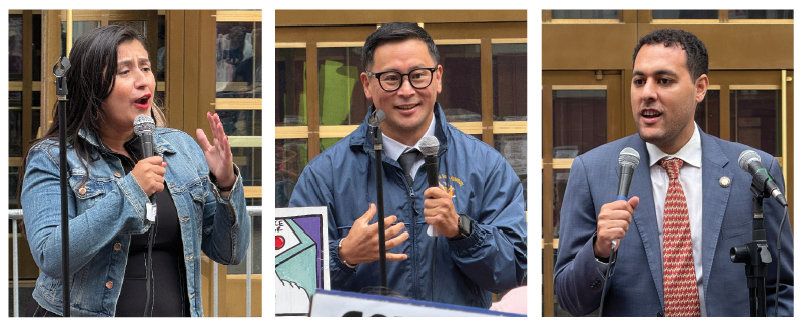
From left, state Senator Jessica Ramos; Assemblymember Ron King; and City Councilmember Chris Marte.
The stakes are particularly high, given that New York is sitting on a demographic time bomb. As of 2024, home care work was already by far the largest job category in the state at 623,000 positions, almost triple those of retail sales, the runner-up. (New York also has more home care workers per 1000 older adults than any other state.) Nonetheless, officials have been sounding the alarm on a looming crisis: according to a 2023 report from the Fiscal Policy Institute, more than 4.6 million New Yorkers will be over age 65 by 2035, and the state will be 1.5 million home care workers short of its needs.
Policymakers agree on one cause of the shortage: the job is physically and emotionally challenging, and vastly underpaid. Some fixes are more popular than others. In 2023, Governor Kathy Hochul approved a $1 minimum wage hike for home care workers. The next year, however, she awarded another multimillion-dollar bundle of grants to the Chinese American Planning Council (CPC), a home care juggernaut that has been accused by Assemblymember Ron Kim of stealing over $90 million from its employees.
Who Watches the Watchmen?
A recurring theme at the rally was the sentiment that the home attendants had been abandoned by the very entities that are supposed to protect them.
Since 2017, the New York Department of Labor (DOL) has ordered home care companies to return more than $5 million in back pay, making the sector the third-worst offender after restaurants and construction contractors. But that number doesn’t include active cases, nor claims — like Cid’s — that the DOL has dropped or ignored.
For those seeking a better sense of just how ingrained wage theft is in the home care industry, a more accurate ballpark was revealed by a lawyer for 1199SEIU, the dominant healthcare union in New York, during a closed-door meeting with home care workers in 2019. Needless to say, it’s much, much more than $5 million.
“We estimate that if everybody got paid what they were owed from missing meal breaks and rest breaks, we’d be talking somewhere between 5 and 6 billion dollars,” the lawyer explains in a leaked recording, urging the workers to content themselves with a $30 million payout the union brokered that year — equivalent to about half a cent of wages for each unpaid hour. “There isn’t enough money in the industry to pay back every dollar of what everyone is owed for missing meal breaks and rest breaks. And if the employers were pushed to pay back every penny, they would all go out of business.”
Paradoxically, several home attendants at the rally had come to view their union as a barrier to achieving better labor conditions.
“Home care workers’ organizing in the last two years has actually gained traction to the extent that now they are changing industry practice,” said Kiran Chaudhuri, a longtime volunteer with the Lower East Side-based organization National Mobilization Against Sweatshops (NMAS). “Many agencies are phasing out 24-hour shifts and splitting them, many are paying back the workers — but not the unionized agencies.”
A blockbuster report released by Assemblymember Kim’s office in 2022 pointed the finger squarely at 1199SEIU. In 2015, fearing that proliferating lawsuits could eventually bankrupt the industry, the union signed an agreement with the CPC that laid out a safety mechanism: its members would be required to let the union negotiate any claims for them, forfeiting their own ability to sue their agencies, in a process known as mandatory arbitration.
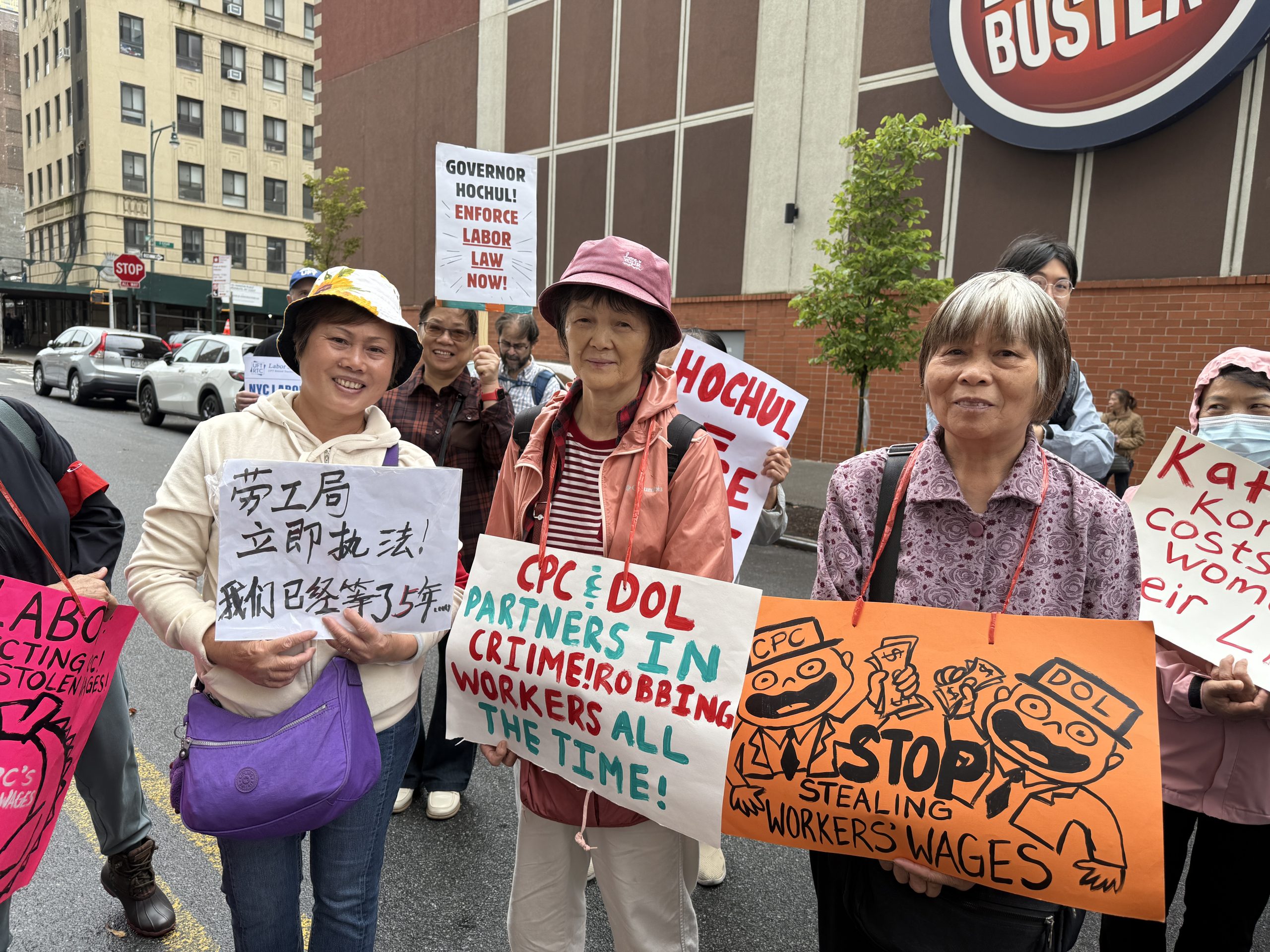
The event focused on the Chinese-American Planning Council, which faces the most severe wage theft claims by dollar amount of any NYC-based agency.
But when the union moved to ratify this change the next year, many home care workers didn’t realize what they were signing away — in part because the announcements they were sent in the mail made no mention of mandatory arbitration, leading Kim’s report to argue that it was “orchestrated without the knowledge and consent of the workers by the leadership of CPC and 1199SEIU.”
“This arbitration award is a great insult to me,” said Azucena Deras, a retired First Chinese Presbyterian home attendant and former member of 1199SEIU. “I worked so hard for 20 years, 24 hour shifts, and paid membership dues to 1199 for them to treat me this way. Now, in my retirement I get this little check and no dignity.”
The changes passed, and in 2019 the union bundled together the claims against 42 agencies from its nearly 100,000 home workers in NYC, arranging for each to be paid roughly $200. From 1199SEIU’s vantage, a compromise had been struck; from Kim’s, it was a sign of “total subservience to industry stability above all… even if the rights and material dignity of workers are categorically neglected.”
Since then, attendants have been fighting to regain their ability to sue. In 2023, five home care workers sued the DOL itself, alleging that it had improperly closed investigations into wage theft by two companies, the United Jewish Council of the East Side and the CPC. By their account, a DOL report in 2019 had found “overwhelmingly corroborative” evidence of wrongdoing, only for the department to abruptly terminate the cases in 2023.
The DOL asserted that it was following a policy of not investigating claims filed by aides whose unions had entered into mandatory arbitration agreements with agencies on their behalf, since the five petitioners named in the lawsuit were part of 1199SEIU’s $30 million deal. For their part, the workers countered that this new rule seemed to have been created arbitrarily.
The state’s Supreme Court thought they had a point. In 2024, the justices denied a motion filed by the DOL to dismiss the case, finding that it had adopted a rule without observing the usual protocol. The case is ongoing.
A parallel case, filed last September, is playing out in a federal circuit court for New York’s southern district. Rather than targeting the agencies, like the CPC, or the regulator, the DOL, the aides who brought this class-action suit singled out an insurer called GreatCare, as well as a raft of other companies that cover home care through Medicaid. (Insurers provide much of the revenue for agencies, and ostensibly decide whether a patient should receive coverage for 24-hour care.)
As lawsuits against the many actors of the home care industry crawl through the court system, lawmakers like Kim — who catapulted into the spotlight during the pandemic after confronting former Governor Andrew Cuomo over his handling of nursing homes — are laying the blame for delays at the feet of Governor Hochul.
“Hochul is telling everybody that she cares about the care economy, about home care, about our seniors,” Kim told the crowd on Wednesday, under an overcast sky. “All we’re asking her is, do your job. That’s it. Enforce the law, and do your job.”
“This Affects Us All”
The home care workers’ fight isn’t new, but it’s been gaining ground since the pandemic as young people join its already diverse ranks. Organizers noted that the universality arises from their emphasis on time, rather than wages, as their rallying cry.
Chaudhuri started organizing with the Ain’t I a Woman?! campaign in 1996. She was a high school teacher at the time, and was frustrated by the fact that she needed to work through the night to give her students’ assignments the attention they deserved. When she heard about a group of garment workers protesting wage theft and 24-hour shifts, she saw a through-line.
“There’s so many reasons why this is my struggle,” said Chaudhuri. “I guess I connect on a whole new level, many levels, with every passing year.”
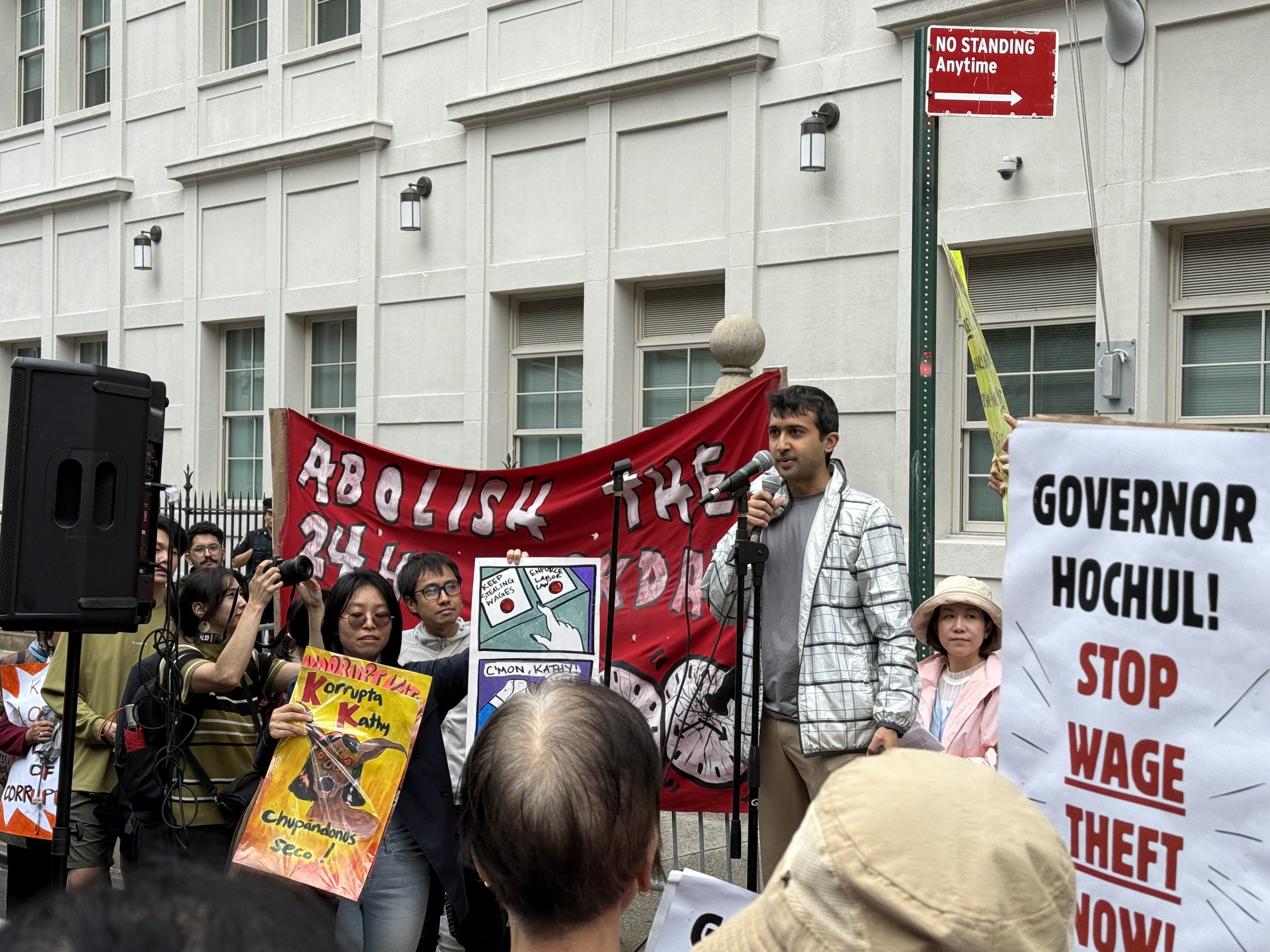
Young tech grads noted that, like home care workers, their hours are unsustainable.
The campaign eventually secured a legal precedent that allowed clothing labels to be held liable for labor abuses by their contractors. When New York’s textile jobs were outsourced to Georgia and then Bangladesh in the early aughts, many of the former garment workers found jobs in home care — but the abuses continued, and so did their campaign.
In testimonial after testimonial, home care workers framed their struggle as a fight to make things easier for their children and grandchildren. But the Ain’t I a Woman?! campaign has recently drawn Gen Z tech workers like Zeke Luger, who say the protests resonate.
“Home attendants say they want to fight to end the 24-hour workday for the next generation,” said Luger, a data science major who helped found Youth Against Sweatshops in 2020. “That inspired us to see, like — sure, maybe we get paid a little more. Maybe we’re able to work as an artist. Maybe society recognizes us in a different way, but we’re still working. Work still controls our entire life, is destroying our health, and we’re also stuck in this race to the bottom.”