
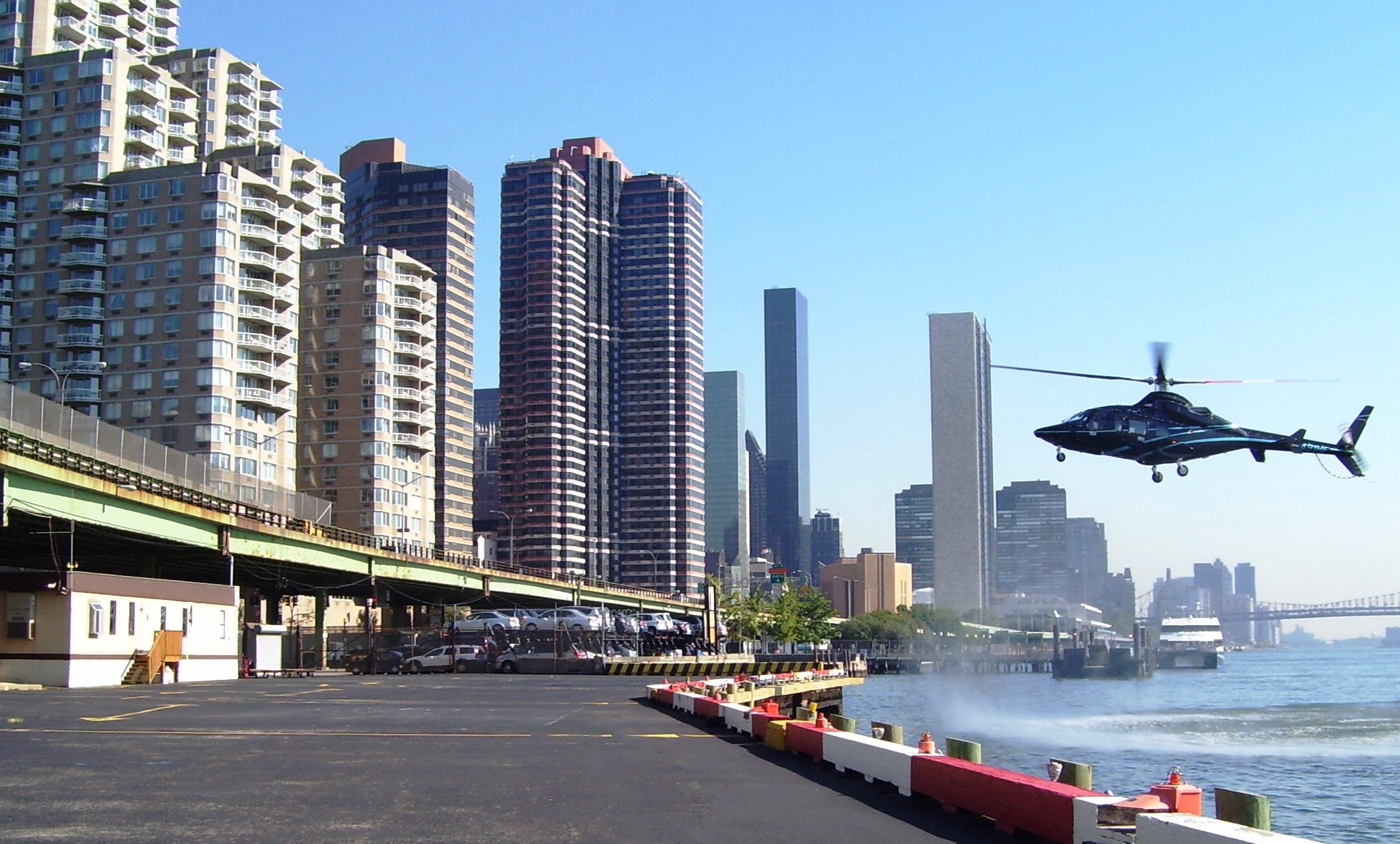
Residents across the city have complained about the proliferation of “unnecessary” trips. (Photo: Wikimedia)
By Jaysa Dold | news@queensledger.com
Tina Allen, a Park Sloper, was speaking with a friend recently about a wedding they’d attended in the neighborhood. It hadn’t gone well.
“The vows were completely ruined because of the helicopter traffic,” Allen explained. “The wedding was kind of a bust and you couldn’t hear the vows. When it’s a problem, it’s such a big problem.”
Backlash in Brooklyn against noise pollution from helicopters has been growing since last year. But local lawmakers and residents have now escalated their fight — advocating for an all-out ban on commuter and tourist helicopter flights over the city, as the helicopter industry pushes back against legislative attempts to regulate its activity.
New York City has three heliports that are available for public use: one apiece on East 34th Street, West 30th Street, and in Downtown Manhattan. Privately owned companies can use these heliports to transport those who can afford their services. One of the most prolific of these companies is BLADE, which offers commuter flights — as cheap as $195 and lasting as little as five minutes — from helipads to JFK Airport, six days a week.
Another major source of helicopter noise comes from sightseeing. Within the city, sightseeing flights can only take off from the Downtown Manhattan heliport and are prohibited from flying over land, but tours operated out of New Jersey and elsewhere in New York State do not have that restriction.
Neighborhoods in the flight paths between heliports and popular destinations like JFK have the highest numbers of helicopter noise complaints in the city, according to the New York City Council and NYC Open Data.
But for many in Northwest Brooklyn, a surge in helicopter traffic last year during the Ryder Cup, a weekend-long men’s golf tournament hosted in Farmingdale, New York, was the straw that broke the camel’s back. Residents described a constant din throughout the weekend as helicopters ferried spectators over Brooklyn en route to the competition.
In response to community outrage, Assemblymember Jo Ann Simon, Rep. Dan Goldman, State Sen. Andrew Gourdanes, and Council Members Lincoln Restler and Shahana Hanif wrote a letter to the Hudson River Park Trust and New York City Economic Development Corporation, urging it to ban nonessential flights from city heliports.
“The helicopters were flying so low that community members could see the passengers taking selfies, with some hovering for 20+ minutes above residential buildings, making a quick commuter trip into a tourist flight,” the lawmakers wrote. “The companies are breaking the rules, and catering to a small number of ultra-rich people at the expense of everyone else’s health and quality of life.”
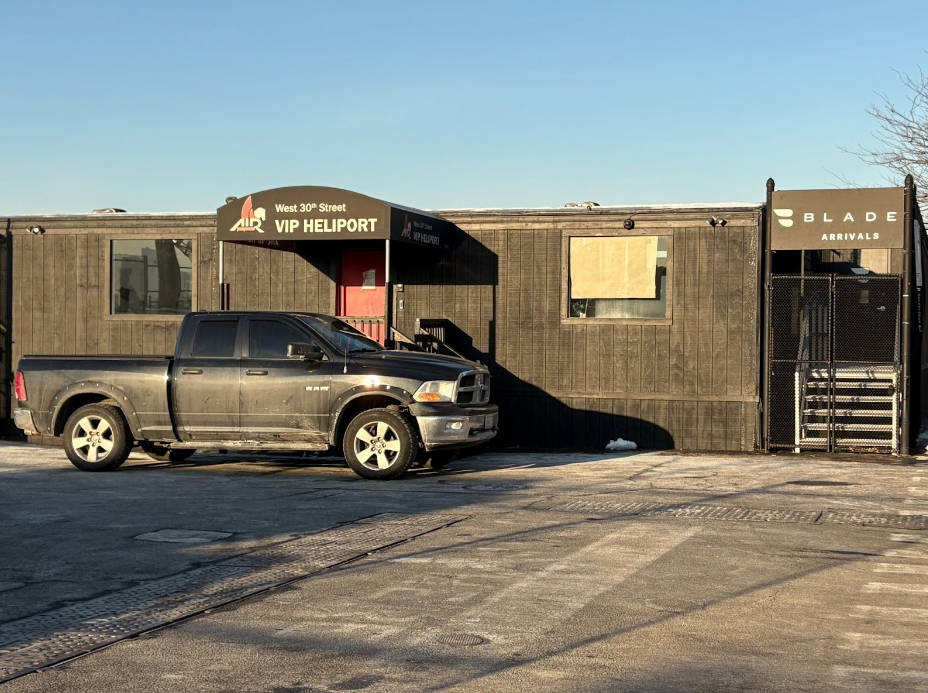
The entrance to the W 30th St heliport. The City Council passed a partial ban on helicopter flights last year, but it faces a fierce legal challenge from the industry. (Photo: Jaysa Dold)
The City Council passed a bill in April that would ban flights exceeding a certain noise threshold, but the law is already being met with a lawsuit that claims the legislation infringes upon federal authority.
Jed Dunlap, 49, has been piloting commercial helicopters for ten years, four of which have been in the New York City Metro area. He currently flies sightseeing tours out of New Jersey. Dunlap says those in the industry are not oblivious to the noise problem, and that they attempt to limit the impact on residents.
“We are aware of it and we do try to mitigate it to the greatest extent possible,” said Dunlap. “We are bound by certain constraints like altitude and route, but within that we do try to be good neighbors.”
Dunlap says that while the Federal Aviation Administration provides suggested routes and regulations, he works within the framework provided by the FAA to cause as little disruption as possible to the people below. This includes flying at a higher altitude whenever feasible and taking different routes in and out of the city to avoid traveling over the same neighborhood multiple times in one flight.
The FAA categorizes helicopter noise into three stages, with stage one the loudest and stage three the quietest. The City Council’s measure, which takes effect in late 2029, would restrict any helicopters with noise emissions above a certain level from using heliports. The bill comes alongside resolutions supporting a nationwide transition to electric helicopters and calling for greater transparency around helicopter operations and emissions.
Yet residents and lawmakers alike say they feel anything short of a complete ban of nonessential helicopter activity is insufficient.
In addition to disruption from noise pollution, residents have growing safety concerns following a fatal helicopter crash in April 2025, when a sightseeing helicopter broke apart mid-flight and crashed into the Hudson River, killing the pilot and five tourists on board.
“We’re increasingly hearing a lot of people in Brooklyn saying, ‘I’m really freaked out,’” said Kenneth Lay, a board member with the anti-helicopter advocacy organization, Stop the Chop.“‘These helicopters – the same kind of helicopter as the one that crashed – are going right over my house, super low. What if one crashed?’”
Lay, 39, travels to community board meetings throughout the city to educate residents about helicopter noise. He became involved with Stop the Chop after experiencing disruption firsthand at his home in Carroll Gardens. Stop the Chop is a grassroots organization that advocates for a ban of all nonessential flights over the city and works alongside lawmakers to push for change.
“Tourism helicopter flights and jaunts to JFK or the Hamptons for the top 0.1% wealthiest New Yorkers create needless pollution and negatively impacts the quality of life of neighborhoods across New York City,” said Council Member Restler, who sponsored a bill that would ban all non-essential flights. “We will keep pushing for its adoption in the new year.”
For some, the issue is urgent. Boerum Hill resident Gina Briggs suffers from mild hyperacusis, an auditory disorder that can cause even everyday sounds to be extremely uncomfortable. Briggs lives in a common flight path and says she feels that banning all nonessential flights is the only real and fair solution.
“They’re not flying a heart so somebody can live,” says Briggs. “It’s basically for someone’s ego. So this guy can feel like he’s important, just like the other hundreds of people who were on the helicopters. That’s the thing that’s so offensive.”