
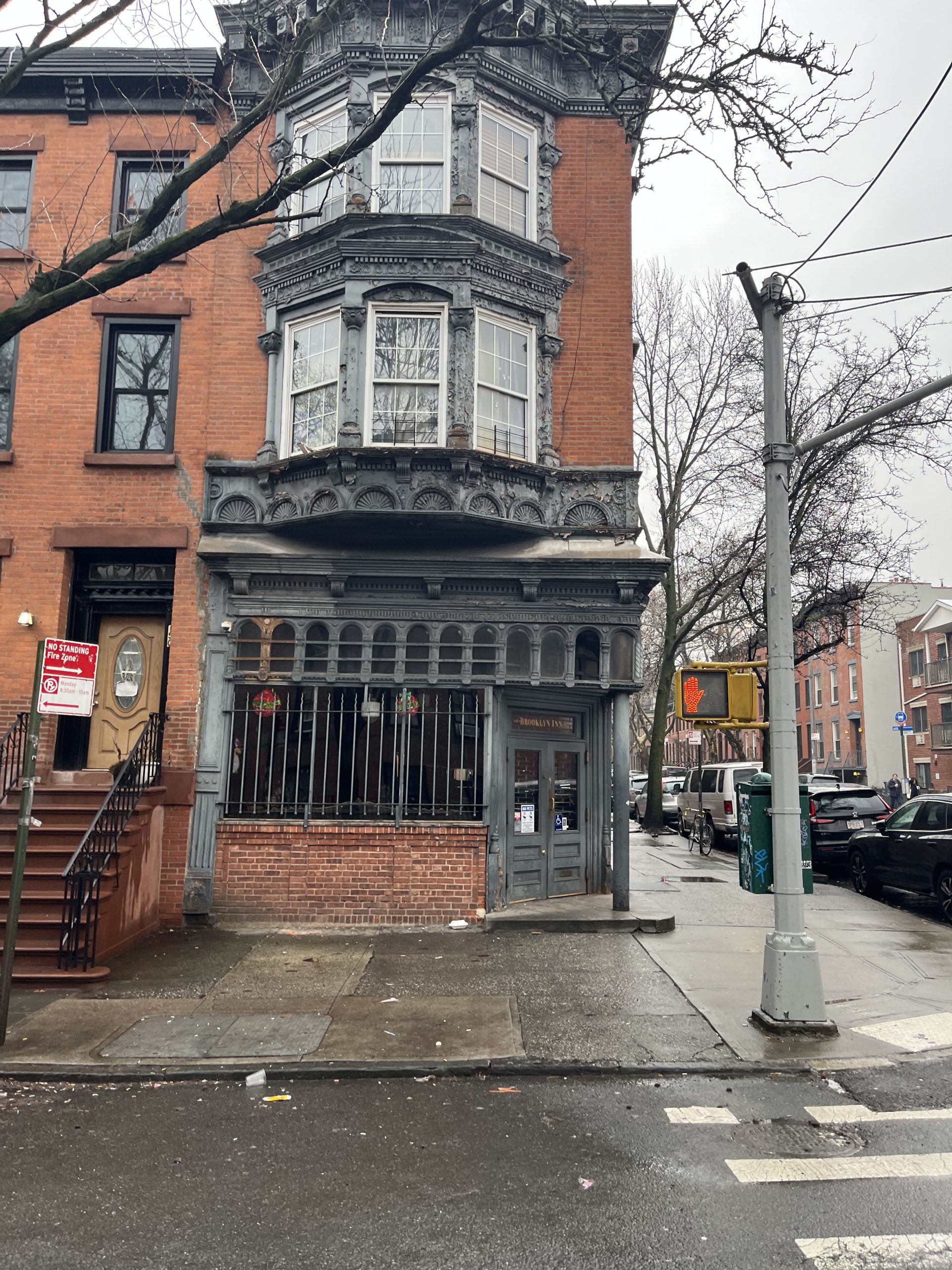
The Brooklyn Inn holds firm, 140 years later.
By COLE SINANIAN
news@queensledger.com
Take a walk down Hoyt Street Street in Boerum Hill, and you’ll bear witness to a breathtaking and sometimes disorienting architectural juxtaposition— looming high above, the Brooklyn Tower’s bronze and steel facade straddles modernity and tradition. At street level, old and elegant brownstones stretch in all directions.
This neighborhood has seen lots of change over the years. Now one of the borough’s ritziest residential districts, Boerum Hill was until the 1960s a nebulous transition zone on the edge of Downtown Brooklyn, known to some as South Brooklyn and to others as North Gowanus.
But at least one street corner hasn’t changed: the corner of Hoyt and Bergren Streets has been the historic home of a bar now called the Brooklyn Inn since before electric light bulbs were commonplace. Though it’s changed owners and names many times since its initial opening in 1885, the Brooklyn Inn has remained both a striking example of 19th-century architecture and an increasingly rare kind of no-frills neighborhood watering hole for more than 140 years.
“What we provide is an extension of peoples’ living room,” said general manager Jason Furlani. “Because it’s New York City, and everyone’s got limited space. So we provide a comfortable, safe space for you to come and enjoy yourself. Maybe have a conversation, maybe read a book.”
The bar’s history has been meticulously documented by local historian and Brooklyn Inn regular Joel Shifflet in his book, Hoyt and Bergen Streets, a copy of which is available on site for patrons to browse. Originally a house, the building was converted into a bar by Anton Zeiner in 1885, who financed the endeavor with the help of the German-American Otto Huber Brewery. Much of the interior woodwork was added in 1892 after Zeiner’s death by his wife, Marie, who sold it to Otto Huber in 1896. Later, another German-American family, the Heissenbuttels, took control and renamed the bar the Exchange Cafe, and ran it through the Prohibition era. Writing in the Lewiston Tribune of Lewiston, Idaho, Martin Heissenbuttel’s great-grandson, Marty Trillhaase, described how the Heissenbuttels served beer, spirits and clam chowder downstairs while they raised their two children on the floor above. Newspaper clippings from the Brooklyn Eagle reveal that the Heissenbuttels kept it open as a speakeasy during prohibition and were subject to a police raid on January 15, 1929, which led to the bar’s eight-month closure.
According to Furlani, all of the facade’s ornate arches, columns and cartouches are original, built by Zeiner in 1885, except for the bars on the windows, which were added later. Inside, a long, darkened drinking den empties into a pool room in the back, with the two rooms separated by bathrooms. High above the bar in the front room are several pieces of backlit stained glass, another of Zeiner’s iconic design flourishes. These were restored in the 2000s, Furlani says, a project that was financed by the earnings from a Gilmore Girls shoot that took place at the bar. Over the years, the building that’s now the Brooklyn Inn has graced both the big and small screens numerous times; parts of Wayne Wang’s classic Brooklyn film Smoke were shot at the Inn, as was a Spike Lee-directed Budweiser commercial and more recently, scenes from the Batman prequel series, Gotham.
In the 1970s and 1980s, the bar was a French restaurant, Furlani said, that utilized a doorbell-like buzzer system to allow patrons to summon their waiters. These buzzers can still be seen along the wall in the bar’s pool room. Modern patrons have a tendency to mess with them, Furlani said, perhaps expecting a tuxedo-clad French waiter to appear.
The current owners — who are real estate investors that Furlani said he’d rather not name — acquired the Brooklyn Inn in 2007 and also operate The Magician on the Lower East Side and Tile Bar in the East Village. When it first opened, there was concern among neighbors that the new owners wouldn’t respect the building’s history and aesthetic integrity. But though Furlani and the new owners made some renovations — namely, expanded seating capacity — they made a deliberate effort to preserve its heritage.
“We’re stewards of the Brooklyn Inn,” Furlani said. “This is our time with it, and we have to do as much as we can to keep it in the spirit that we inherited it in.”
So don’t wander in on a Sunday hoping to catch the game. As part of the owners’ commitment to preserving the bar’s historic charm, the Brooklyn Inn has no TVs. It’s not a cocktail bar (though there is a cocktail menu, it’s classics only), sports bar, dive, nor gastropub. It’s an extension of the streetscape itself, a designated neighborhood third space designed for camaraderie, conversation, and brooding. Nothing more, nothing less.
“It’s amazingly fortunate that it exists,” Furlani said. “It’s like sitting in a snow globe. It’s amazing. It’s got magic. The whole secret is not to kill the magic.”