
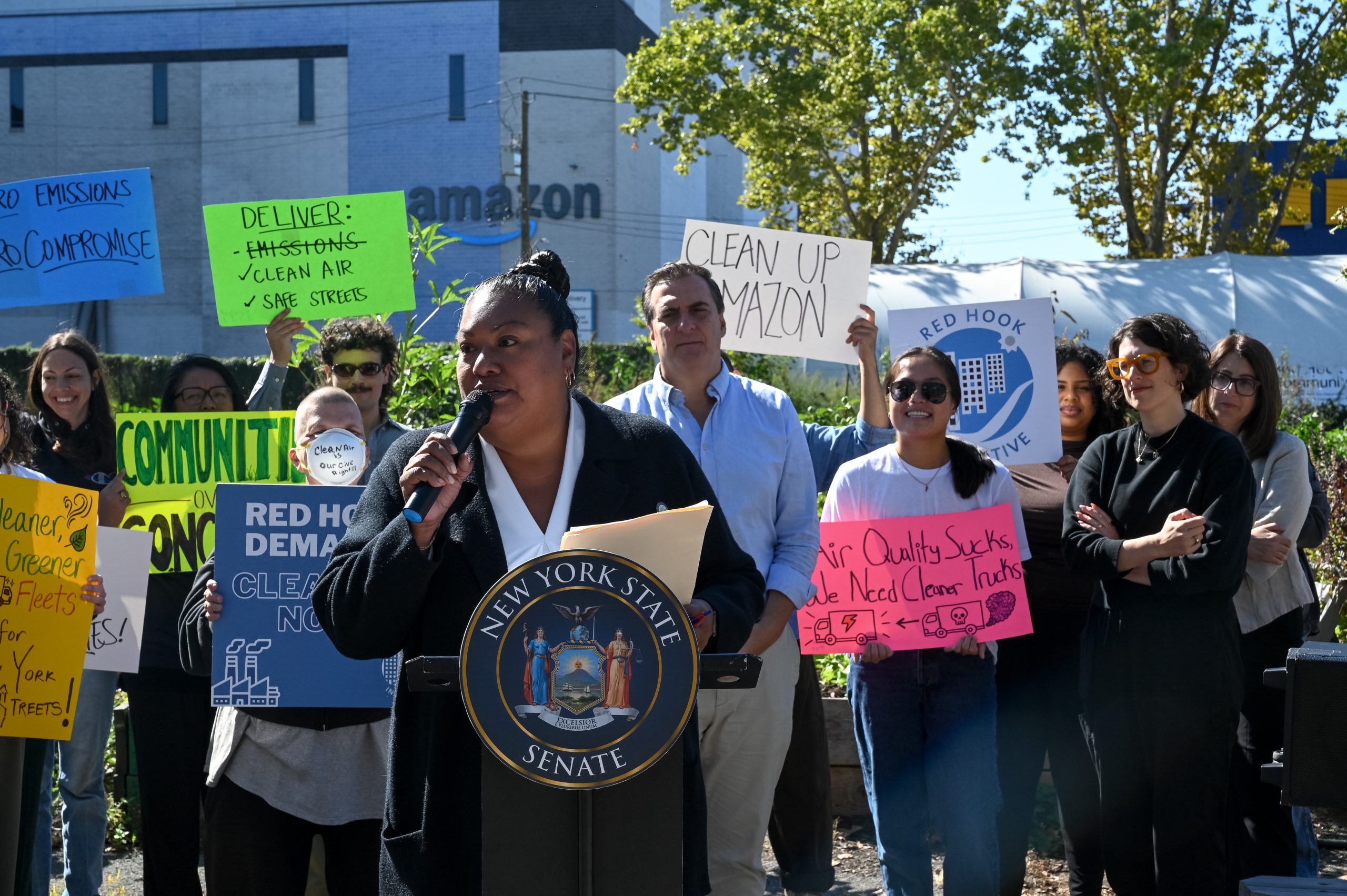
Assembly Member Marcela Mitaynes speaks at the event. Photo: Christian Spencer
By CHRISTIAN SPENCER | news@queensledger.com
Brooklyn officials, transit experts, and environmental advocates are urging Governor Kathy Hochul and the New York State Legislature to pass the Clean Deliveries Act, a bill designed to curb pollution from e-commerce mega-warehouses and their associated diesel truck traffic.
The push comes as federal air and climate protections continue to be rolled back, leaving states to address the health impacts of growing warehouse operations.
Red Hook, a Brooklyn neighborhood heavily affected by the surge in e-commerce warehouses, served as the focal point for the campaign.
On October 1, the ElectrifyNY Coalition led a demonstration at Columbia Street Farm, where lawmakers and community members highlighted the Clean Deliveries Act and the public health threats posed by warehouse traffic.
The walking tour showcased streets, schools, playgrounds, and residential areas adjacent to warehouses, illustrating the constant exposure to diesel emissions.
The Clean Deliveries Act would require mega-warehouses exceeding 50,000 square feet to implement emissions mitigation plans, promote zero-emission vehicles (ZEVs) and on-site renewable energy, and provide enhanced protections for disadvantaged communities and sensitive sites, such as schools.
“We have fought hard to improve our air quality by enacting the nation-leading CLCPA, fighting fossil fuel power plants, and pushing for more electrification, but we cannot allow those achievements to be stymied by the proliferation of e-commerce warehouses,” Senate Deputy Leader Michael Gianaris said. “The Clean Deliveries Act I introduced with Assemblymember Mitaynes will address the proliferation of e-commerce warehouses and the impacts on the health of our communities, as well as make significant strides in our fight to combat climate change and make our communities safer and healthier.”
“I introduced the Clean Deliveries Act because no family should have to sacrifice their health for the convenience of next-day shipping. For too long, working-class communities have been overburdened by pollution. With the federal government rolling back critical air and water standards, it is more urgent than ever that we regulate the operations of last-mile warehouses,” Assemblymember Marcela Mitaynes said. “New York State must step up and defend the right of New Yorkers to breathe clean air.”

Red Hook residents have criticized the air pollution generated by trucks trundling to and from the neighborhood’s Amazon warehouse. Photo: Christian Spencer
Community and environmental advocates emphasized the disproportionate toll warehouse traffic takes on low-income neighborhoods and communities of color, where diesel truck traffic has contributed to rising rates of childhood asthma and pulmonary disease. Kevin Garcia, Senior Transportation Planner at the New York City Environmental Justice Alliance, said, “The unregulated growth of e-commerce warehouses is plaguing low-income communities of color… New York has the opportunity to lead the nation by enacting the first statewide program to cut emissions from e-commerce warehouse operations.”
Jaqi Cohen, Director of Climate Policy and Equity at the Tri-State Transportation Campaign, added, “New York can’t wait any longer—massive corporations and their mega-warehouses are suffocating historically disadvantaged communities with toxic truck pollution… The Clean Deliveries Act must pass this session to hold corporations accountable, protect our lungs, and finally deliver the healthier future every New Yorker deserves.”
Liz Moran, New York Policy Advocate at Earthjustice, emphasized the stakes: “As the Trump Administration guts air quality standards for polluting vehicles, New Yorkers are counting on our Governor and Legislature to step up… The Clean Deliveries Act is the commonsense solution that will allow New York to stand up to the federal government’s attacks on public health.”
Air quality in Red Hook remains a pressing concern. According to the 2023 NYC Department of Transportation Red Hook Traffic and Truck Study, some streets see 10 to 35 trucks per hour, with certain corridors reporting 8 to 20 percent of all vehicles during peak hours being trucks or commercial vans.
Community monitoring and reports, including Gothamist, indicate that daily truck volumes on some streets can reach up to 1,200 trucks, contributing to elevated levels of particulate matter (PM2.5 and PM10) as well as ozone, carbon monoxide, and nitrogen dioxide, often exceeding EPA safety thresholds and posing ongoing risks to residents’ respiratory health.
To underscore the urgency of the situation, some Red Hook streets rival Manhattan’s busiest truck corridors.
Hamilton Avenue sees the highest truck volumes, while Van Brunt Street consistently exceeds citywide averages for truck traffic, with percentages matching or even surpassing Manhattan’s major commercial thoroughfares.