Community Opportunity to Purchase Act Re-enters City Council

Supporters say COPA could help preserve deep affordability by putting distressed housing under community ownership. 

BY COLE SINANIAN

cole@queensledger.com

CITY HALL  — Big, bad landlords beware: large apartment buildings with serious housing code violations could soon come under community control, thanks to a City Council bill that was resurrected Wednesday.

Boosted by a city-wide coalition of legislators, community nonprofits and grassroots tenant activists, the Community Opportunity to Purchase Act (COPA) would help nonprofits and land trusts acquire apartment buildings that meet certain criteria before for-profit real estate companies can.

The goal, supporters say, is to empower trusted local organizations to take control of distressed buildings in their communities instead of real estate speculators headquartered far away that seek to turn a profit at all costs.

Chief sponsor Sandy Nurse reintroduced the bill at Wednesday’s Stated City Council hearing, marking legislators’ second attempt to make COPA law after it passed the Council last year but was vetoed by former mayor Eric Adams on his last day in office. While Adams and a vocal group of critics have decried the bill as an attack on the free housing market, supporters have hailed it as an essential tool for improving tenants’ living conditions in buildings with severe violations and halting the march of gentrification in the city’s most vulnerable neighborhoods.

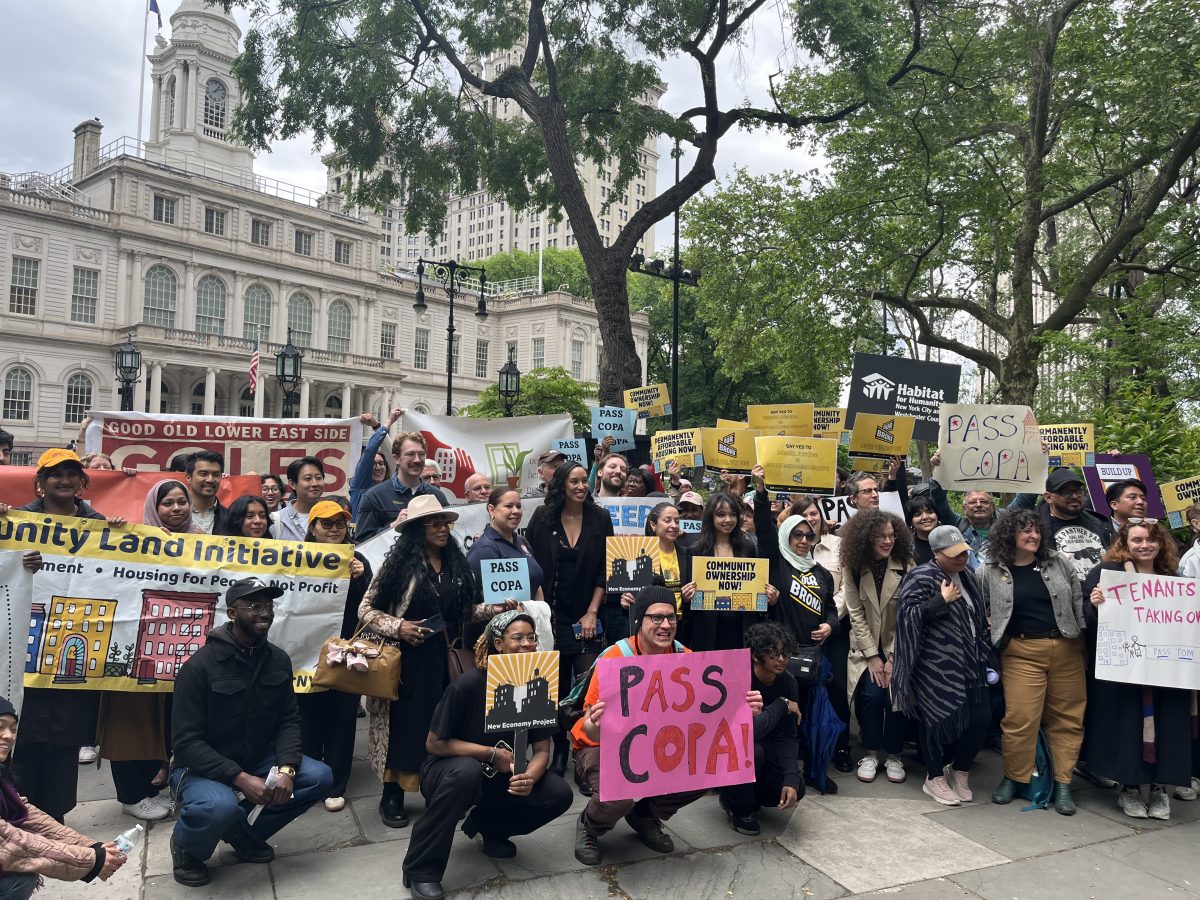
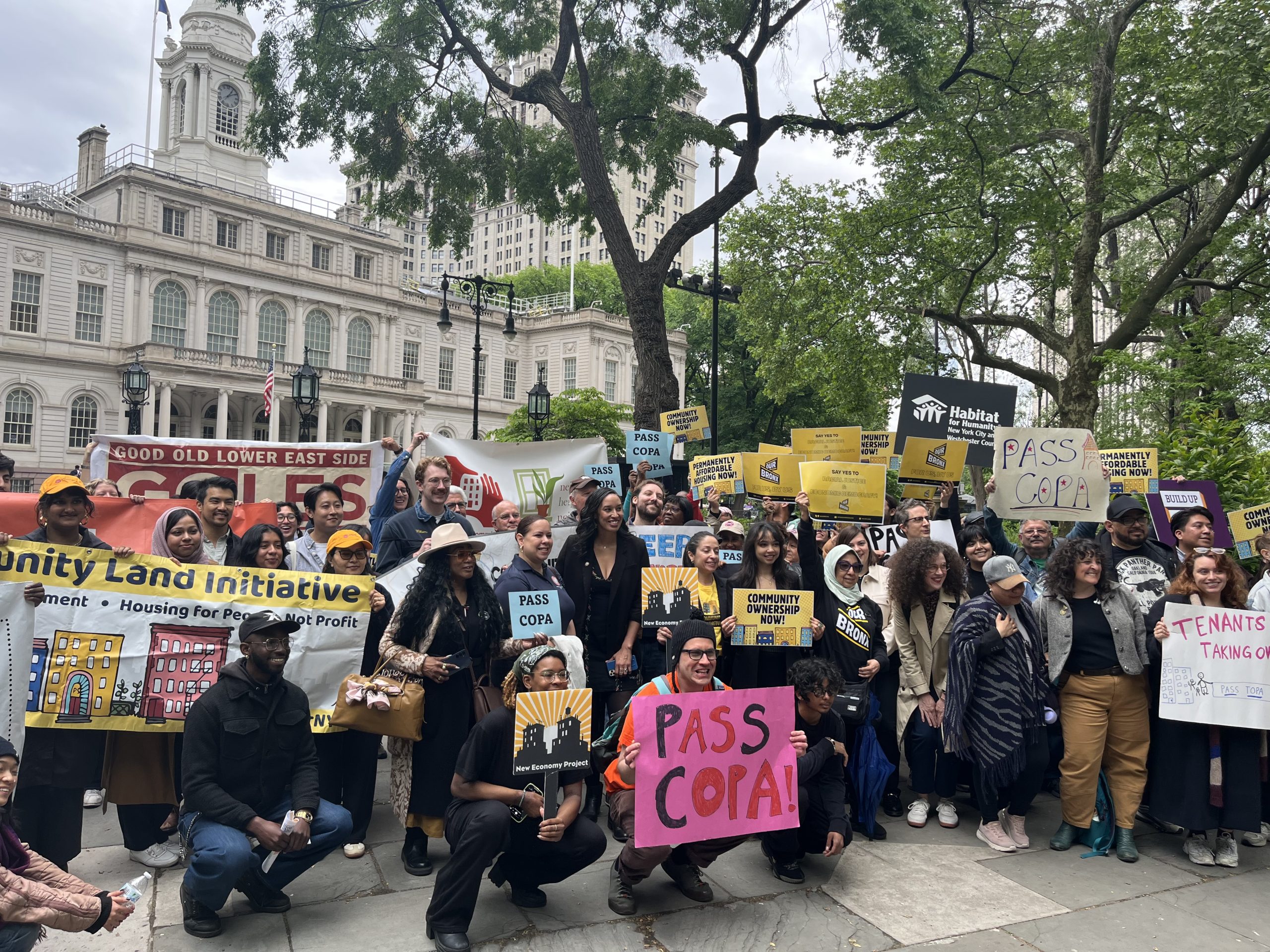
“We have buildings that are in bad condition, where there are many hazardous violations,” said Greenpoint City councilmember Lincoln Restler and COPA co-sponsor at a rally outside City Hall Wednesday afternoon.

“We are simply asking the question— can we bring in nonprofit partners? Can we bring in trusted community-based organizations, who will take over these buildings, and deliver the high quality affordable housing we deserve?”

As currently written, the law would give an approved list of nonproft entities the exclusive right to make an offer on qualifying buildings before they’re made available on the open market. The law would only apply to buildings with four or more apartments, that have an annual daily average of three or more Housing Preservation Department (HPD) violations, and which are declared distressed by the city and subject to HPD enforcement programs, among other conditions. COPA would not apply to buildings with five or fewer units in which the property owner lives.

When they intend to sell their building, an owner would notify the City and all qualified nonprofits, who would then get 20 days to submit a statement of interest. Interested nonprofits would then get an additional 70 days to submit an offer at the seller’s asking price. If no viable offer is made during this 70-day period, the property would enter the open market. However, after this initial time frame has elapsed, the first qualified nonprofit that submitted the offer would maintain the “right of first refusal,”  meaning that when a seller decides to accept an offer from a for-profit entity, that nonprofit would have a 15-day period to submit an offer that matches that of the for-profit company.

Compared to the original, the new version of COPA shortens the amount of time nonprofits would have to make an offer on qualifying properties, clarifies the kinds of properties that would be subject to the law, and enshrines community land trusts into the legislation as an option for ensuring properties acquired under COPA remain deeply affordable.

Though COPA would lengthen the sale process, it would not require owners to settle for less than their property is worth.

“For 20 days, a seller would have an exclusive buyers group that they could present to, and that group will have to entertain the asking price,” said Nurse, who represents Bushwick in the Council. “We’re not under-footing, we’re not devaluing.”

Backed by 25 City councilmembers, COPA is modeled after a similar bill enacted in San Francisco in 2019 and a Tenants Opportunity to Purchase Act (TOPA)  —  which gives tenant associations the first right to purchase certain properties — enacted in the 1980s in Washington DC. While in DC recent funding cuts and amendments have left the policy’s future uncertain, in the years since the passage of San Francisco’s COPA, over 400 homes have been acquired by the San Francisco Community Land Trust — according to nonprofit news organization Next City — preserving affordability for more than 1,000 residents.
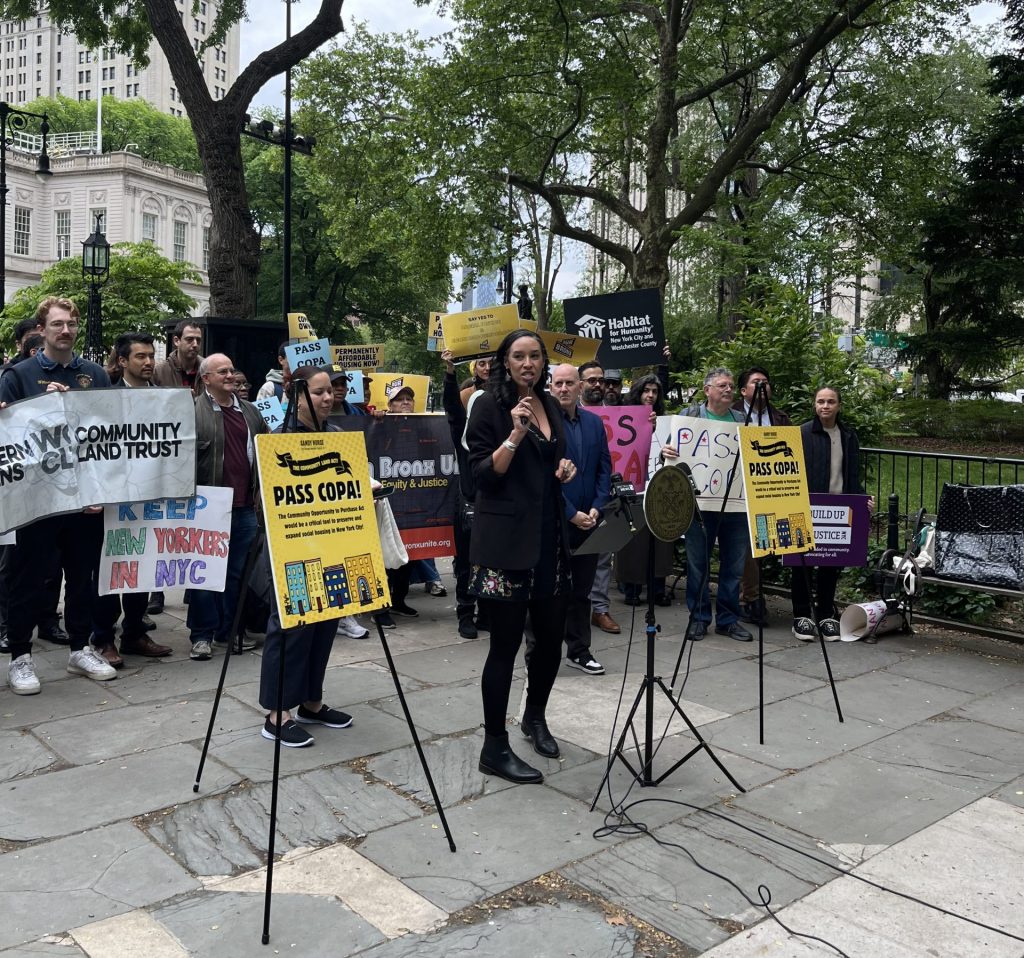
Prime COPA sponsor Sandy Nurse speaks at Thursday’s rally, flanked by City Councilmember Harvey Epstein (right). Photo by Cole Sinanian.

Critics of New York’s COPA, however, have slammed the bill as government overreach, claiming it would further bureaucratize the real estate sale process.

They say it would “present significant operational and administrative challenges for the City agencies involved in administering this law,” as former Mayor Eric Adams wrote in his veto message last December, and lead to “significant costs to the City in assisting nonprofit organizations with renovating and possibly even procuring certain properties.”

Meanwhile, City councilmember Darlene Mealy, who represents parts of Bed-Stuy, Brownsville, Crown Heights and Ocean Hill in Brooklyn, criticized COPA as part of a “radical socialist agenda.”

According to Mealy, the original bill would have “violated private property rights through a likely unconstitutional form of government overreach that would have required property owners to go through HPD in order to sell their homes,” as read a January press statement attributed to the councilmember — who has been noted for having among the worst attendance records in the Council, missing a third of City Council meetings in 2023.

Councilmember Mealy’s office did not respond to the Queens Ledger’s requests for comment.

Still, supporters say the added bureaucracy is necessary to preserve affordability in neighborhoods on the front lines of gentrification, where speculation has caused prices to surge in recent years.  In gentrifying parts of Brooklyn like Bushwick, Bed-Stuy, and East New York, practices like house-flipping — where buyers often use deceptive tactics to acquire homes and quickly resell them at enormous profit margins — have been tied to what some analysts have described as a “mass exodus” of Black and nonwhite residents.

In the East New York neighborhood of Brooklyn, meanwhile, a recent rezoning has led some residents to organize against what they fear is a coming wave of gentrification, in the hopes they can take affordable properties off the market before they can be acquired and flipped by for-profit real estate. COPA, they say, will help them do this.

Schoolteacher Boris Santos grew up in Williamsburg but now lives in East New York. He’s lived in East Brooklyn for the last 15 years, and says it’s this part of town — still relatively untouched by gentrification and its homogenizing tendencies — that feels most like the New York he grew up with.

“Williamsburg, for me, is no longer home,” Santos told the Queens Ledger in an interview. “But rather, it’s East Brooklyn, with that feeling of a Black and Brown community of Latinos, of people playing dominoes outside in the streets, of people bathing in an open hydrant during summertime.”

When he’s not teaching, Santos is president of the East New York Community Land Trust. A kind of nonprofit organization governed by a board of local residents, Community Land Trusts (CLT) acquire land to be managed collectively as a means of preserving long term affordability.

Having witnessed first-hand the gentrification of his native Williamsburg, and now rampant house-flipping in his new home of East New York, Santos described the fight for community ownership as personal. On Arlington Avenue, which runs between Jamaica Avenue to Norwood Avenue, a growing number of modern, newly renovated homes have popped amid the street’s older buildings, which Santos sees as a sign of the neighborhood’s coming upscaling.

“You can literally walk a quarter mile of a couple blocks anywhere in East New York and see a flipped home, he said.

To Santos, a bit more government oversight is a small price to pay for organizations like the ENYCLT to begin democratizing the housing market and putting power into the hands of tenants instead of corporate real estate.

“The two keys to me are fighting displacement — keeping people in their homes — and then people owning their homes and having a democratic say in them,” Santos said. “And to do it with love, right?” he continued. “COPA does that.”
Monitor Point Clears CPC, City Council Vote Set for May 27

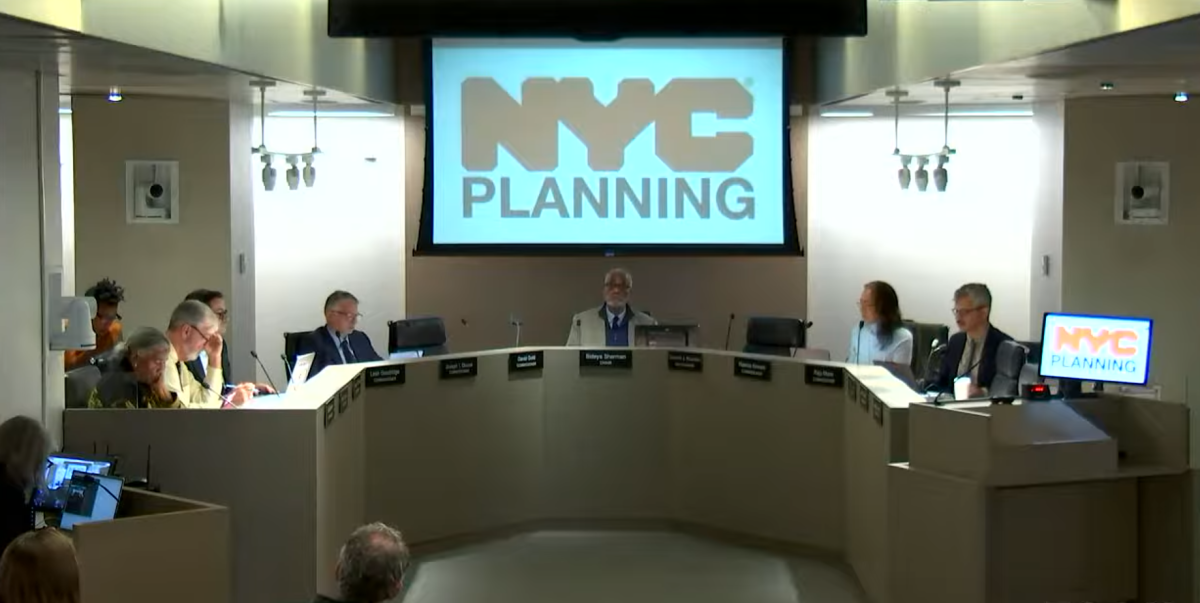
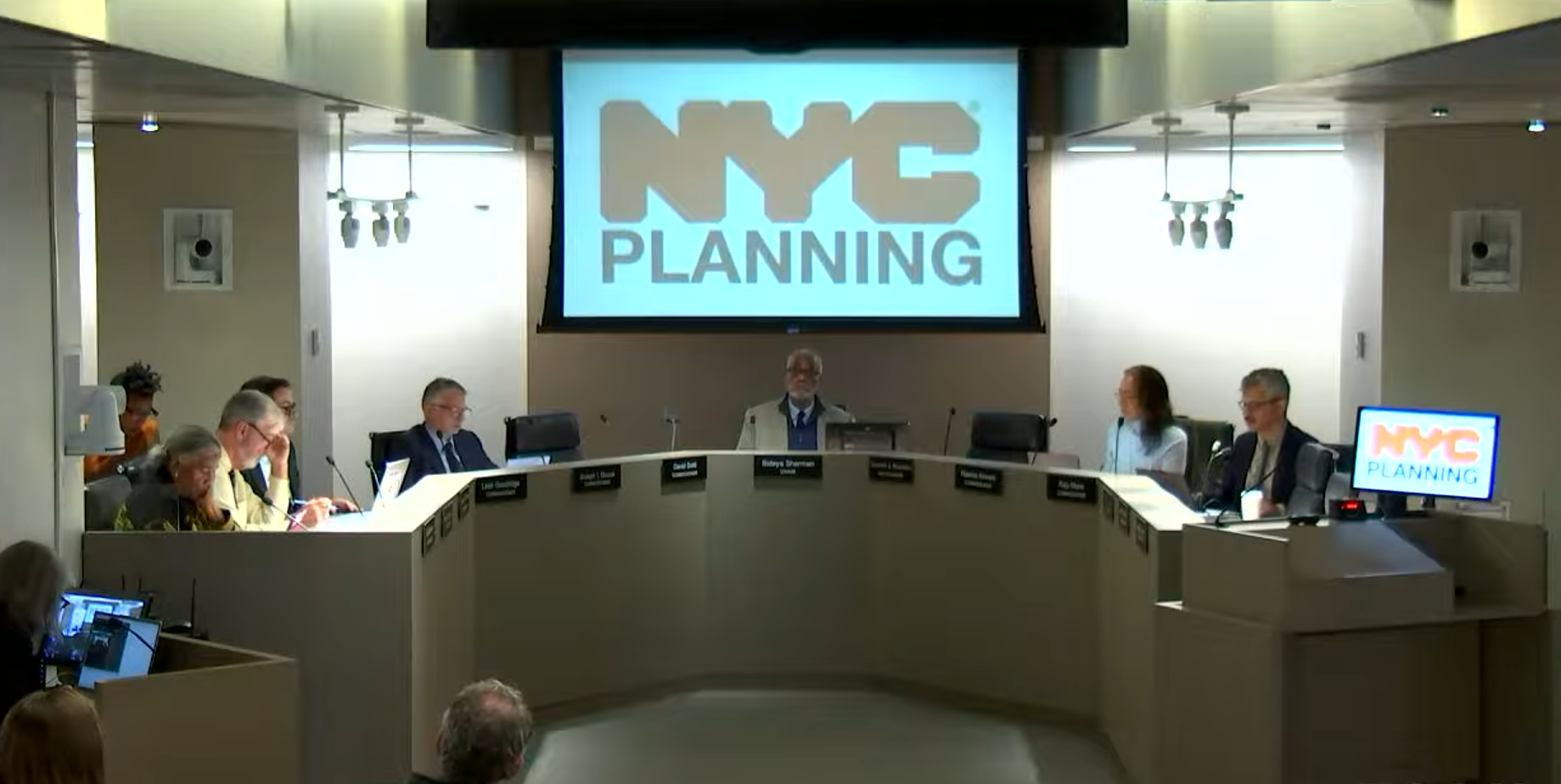
The City Planning Commission at Wednesday’s vote. Photo via NYC City Planning.

GREENPOINT  — The City Planning Commission voted to approve several zoning amendments and one City Map change on the Greenpoint waterfront Wednesday, clearing a path for the approval of the controversial Monitor Point development.

If completed in the 2030s as proposed, the Monitor Point project would see the total transformation of Greenpoint’s last undeveloped waterfront — the small peninsula directly north of Bushwick Inlet Park — with the addition of 862 luxury housing units and 460 affordable housing units across three towers, the tallest of  which would rise more than 600ft. Developed by the Gotham Organization and the MTA, the project — located at 40 and 56 Quay Streets — would also include retail spaces, more than 45,400 square feet of public open space, and a museum dedicated to the historic Monitor Battleship.

The CPC voted to approve five land use actions Wednesday to make way for Monitor Point, including an upzoning to allow for increased housing density, and a demapping, removing the 56 Quay Street property’s park land designation on the City Map. While set aside in the 2005 Williamsburg/Greenpoint rezoning to be acquired by NYC Parks for the eventual development of park land, the City never acquired the property, allowing Gotham to pursue the demapping to facilitate the towers’ construction.

The CPC vote marks the third stage of the project’s Uniform Land Use Review Procedure (ULURP), which began earlier this year and will conclude over the summer. Next is a public hearing before the City Council’s Zoning & Franchises Subcommittee, scheduled for May 27 at 11am at 250 Broadway in Downtown Brooklyn. A binding City Council vote will follow the public hearing, after which the project application will head to the mayor’s desk for final approval.

Traditionally, the City Council votes according to the will of the councilmember whose district encompasses the proposed development. In the case of Monitor Point, this is District 33’s Lincoln Restler, who has opposed the project since the beginning on the grounds that it does not provide enough affordable housing, and that the adjacent and incomplete Bushwick Inlet Park — much of which remains run-down, polluted and littered with debris — should be completed before any luxury developments are built on the site.

Opponents of the project — including councilmember Restler and local group Save the Inlet — have characterized the de-mapping as a land-grab on the behalf of developers. In multiple hearings over the winter and spring, Restler reiterated that he would only support Monitor Point if developers committed to a majority of the housing being affordable housing, and the City committed to completing Bushwick Inlet Park.

“For anything to move forward that I can support, we need to see a healthy majority of any housing that’s built to be truly affordable for our community, and we need a fully funded Bushwick in the park with a clear timeline,” Restler said at a public hearing at Greenpoint’s Polish Slavic Center in January.

Both Brooklyn Community Board 1 and Borough President Antonio Reynoso, however, have recommended the project’s approval, albeit on the condition that developers boost the percentage of affordable housing units and the city commits to fully funding and completing Bushwick Inlet Park.

While developer Gotham has stated in its plans that 40% of housing units will be affordable, Mandatory Inclusionary Housing rules approved by the CPC require just 25% affordable housing, leading critics to question whether Gotham will stick to its word. Save the Inlet will be holding a rally against the development outside City Hall at 9:30am before the May 27 hearing.

Brooklyn Pickleball Team Hosts MLP’s Biggest Stars in NYC

The world’s top professional pickleball players are set to take over New York City later this summer as Major League Pickleball (MLP) heads to SPORTIME Randall’s Island from June 25 through June 28 for one of the league’s premier events of the season.

The multi-day Major League Pickleball Tournament will feature some of the sport’s biggest names — including world No. 1 Anna Leigh Waters — as teams from across the country battle for playoff positioning in front of what organizers expect to be one of the largest pickleball crowds New York has ever seen.

The event will also spotlight New York’s hometown franchise, the Brooklyn Pickleball Team, as the club continues its push toward a coveted berth in the MLP Playoffs. With pickleball’s popularity exploding across New York City in recent years, organizers say the Randall’s Island stop represents a major milestone for the sport locally.

“This is a huge moment not only for the Brooklyn Pickleball Team, but for pickleball culture throughout New York City,” said Adam Behnke, COO of the Brooklyn Pickleball Team. “You’re talking about the best players in the world competing right here in our backyard while thousands of fans experience the energy of Major League Pickleball firsthand. New York has embraced pickleball in an incredible way, and this event is going to show just how passionate this community has become.”

The current Brooklyn Pickleball Team roster includes Rachel Rohrabacher, former D-I tennis star at the University of South Carolina, MLP Champion, and top-five ranked pickleballer; Christian Alshon, multi-MLP Champion and top three-ranked player; Riley Newman, top-ten ranked in pickleball and MLP Champion; Jackie Kawamoto, former D-I tennis standout at the University of Dayton and key player from the 2023 Championship roster; Chris Haworth, top-ranked singles player hailing from OKC; and Hannah Blatt, former pro Canadian squash player and rising pickleball talent.

Beyond the hometown storyline, the event will bring together many of the sport’s most accomplished competitors. Headlining the field is world No. 1 Anna Leigh Waters, widely regarded as the face of professional pickleball and one of the most dominant players in the game. For fans, the event offers a rare opportunity to watch the sport’s biggest stars compete in person on one of pickleball’s largest stages.

Hosted at SPORTIME Randall’s Island, the event will feature four days of professional competition, fan experiences, and amateur opportunities. Alongside the pro matches, organizers will also host a Dink Minor League Pickleball Tournament from June 26-28, giving amateur players a chance to compete in a team-format tournament with significant stakes attached. Winners of the event will earn an automatic bid to Minor League Nationals.

“We want this event to feel accessible to everyone — whether you’re a diehard fan, someone curious about the sport, or a local player who wants to test themselves competitively,” Behnke added. “Having the amateur tournament alongside the pro event creates an environment where the next generation of players can be inspired directly by the best athletes in the game.”

Fans attending the event can also expect a lively Vendor Village experience featuring activations, samples, and sponsor booths from brands connected to both MLP and the Brooklyn Pickleball Team. Vendors currently scheduled to participate include Once Upon a Coconut, Centerline Athletics, Saint James Iced Tea, Yasso Frozen Greek Yogurt, Brooklyn Cider House, Dirty Water Seltzer, KA-EX, Papatui, Luzz, along with local brews, bites, and additional partners expected to be announced in the coming weeks.

42

The Brooklyn Pickleball Team has also partnered with organizers to offer discounted ticket pricing for fans hoping to attend the event. Through May 31, supporters can use promo code “MLP20BKPT” to receive 20% off single-day tickets. After May 31, fans can still receive 15% off using code “MLP15BKPT.”

The New York stop is expected to draw many of pickleball’s most recognizable stars, continuing the sport’s rapid rise nationwide as professional leagues attract larger audiences, sponsorships, and television coverage. For New Yorkers, however, the event also serves as a celebration of the city’s fast-growing pickleball community — one that continues to expand from neighborhood parks and school gyms to professional arenas.

Fans interested in tickets, amateur tournament registration, or additional event details can visit the official MLP New York event page below:

MLP New York Event Tickets & Information

The Brooklyn Pickleball Team has also partnered with 42 Hotel in Williamsburg to give fans an opportunity to experience both world-class pickleball and one of Brooklyn’s premier boutique hotel destinations. Through the collaboration, fans can visit the Instagram accounts of the Brooklyn Pickleball Team and 42 Hotel for a chance to enter a special giveaway featuring two complimentary tickets to the Major League Pickleball New York event at Randall’s Island, along with a free overnight stay at 42 Hotel. Organizers say the promotion is designed to celebrate the growing popularity of pickleball while showcasing some of the best hospitality and entertainment experiences Brooklyn has to offer.

Fill the Form for Events, Advertisement or Business Listing