Bushwick Inlet Opens to Public After 100+ Years

The opening of the newest section of the long-awaited Bushwick Inlet Park  gives Greenpointers direct access to one of the Brooklyn waterfront’s most peaceful corners. But with three residential towers likely to be built next door, for some the inlet’s opening is bittersweet. 

BY COLE SINANIAN

cole@queensledger.com

GREENPOINT — The fences around Bushwick Inlet came down this week, opening the rare and tranquil cove to the public for the first time in more than a century. The Motiva Parcel — as the strip of land around the inlet is known — officially opened on Thursday, April 30 after having been fenced off for months to allow newly planted trees and shrubs to take  root. 

With ample birdwatching opportunities, water access for kayakers and perhaps Greenpoint’s first and only beach, the Motiva Parcel —  located at the north end of 14th St — is the latest section of the incomplete Bushwick Inlet Park to open to the public. It’s one of six NYC Parks-owned parcels that the City set aside as part of the 2005 Williamsburg/Greenpoint rezoning to be developed into a sprawling, 27.8-acre waterfront park, a park that, as of 2026, remains mostly unfinished, with the bulk of the property still in need of major environmental remediation before development can proceed. 

“I’m just really excited for neighbors to be able to access such beauty right in our own community,” said Greenpoint City Councilmember Lincoln Restler in an interview. “And you know, this is something that we celebrate, but with clear recognition that we’ve got a long way to go.”

The section that opened Thursday was acquired by the City in 2014 from a fossil fuel company called Motiva Enterprises for $5 million. It joins two other sections of the park to have already opened — the hilltop gardens at 50 Kent and the soccer fields at 86 Kent — bringing the total park land acreage to 9 out of the eventual 27.8 total.  

Since the 2005 rezoning, tens of thousands of housing units have been built along the Greenpoint and Williamsburg waterfronts, while development of the promised park has stalled. As this area of waterfront land was once populated by fuel storage and the oil and gas refineries of companies like Standard Oil, Motiva Enterprises, Astral Oil Works and Bayside Fuel, expensive remediation measures are needed before the rest of the park can be completed. 

The next section of the park to open will likely be an 8.5-acre parcel acquired by the City from CitiStorage, located east of Kent Avenue between 10th and 11th Streets. Funding has been secured and remediation talks are underway, Restler confirmed, though National Grid — which is responsible for cleaning up the site — has been slow to cooperate. According to Restler, there remains a gap of $75-100 million to fund the park’s completion. 

“There are a lot of moving parts on the cleanup,” Restler said. “Each parcel is different. We’re waiting on some environmental analysis from the State Department of Environmental Conservation. But I think that if there’s a will on the part of the Mamdani team to move this park forward, then we can find a way.”
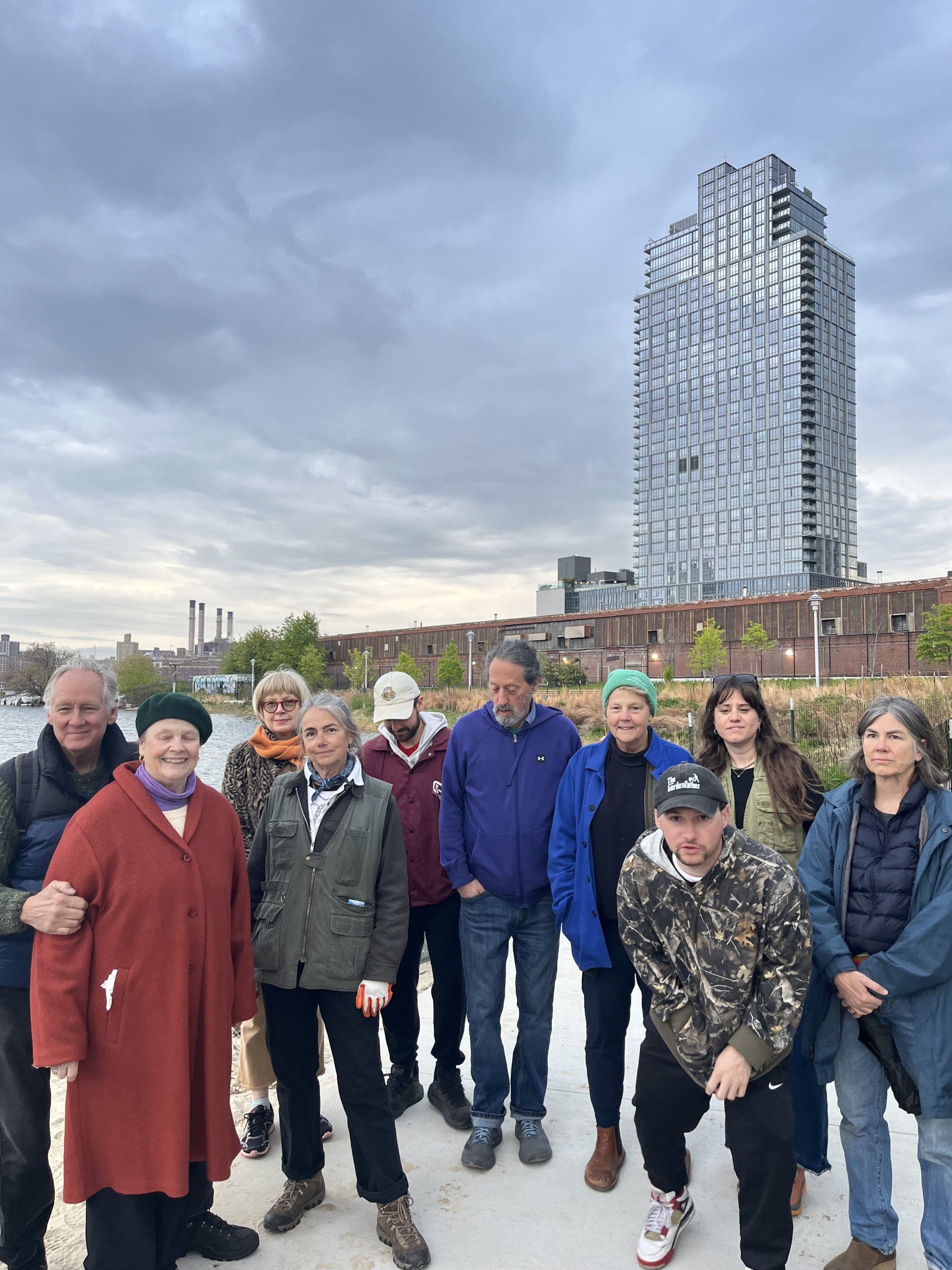
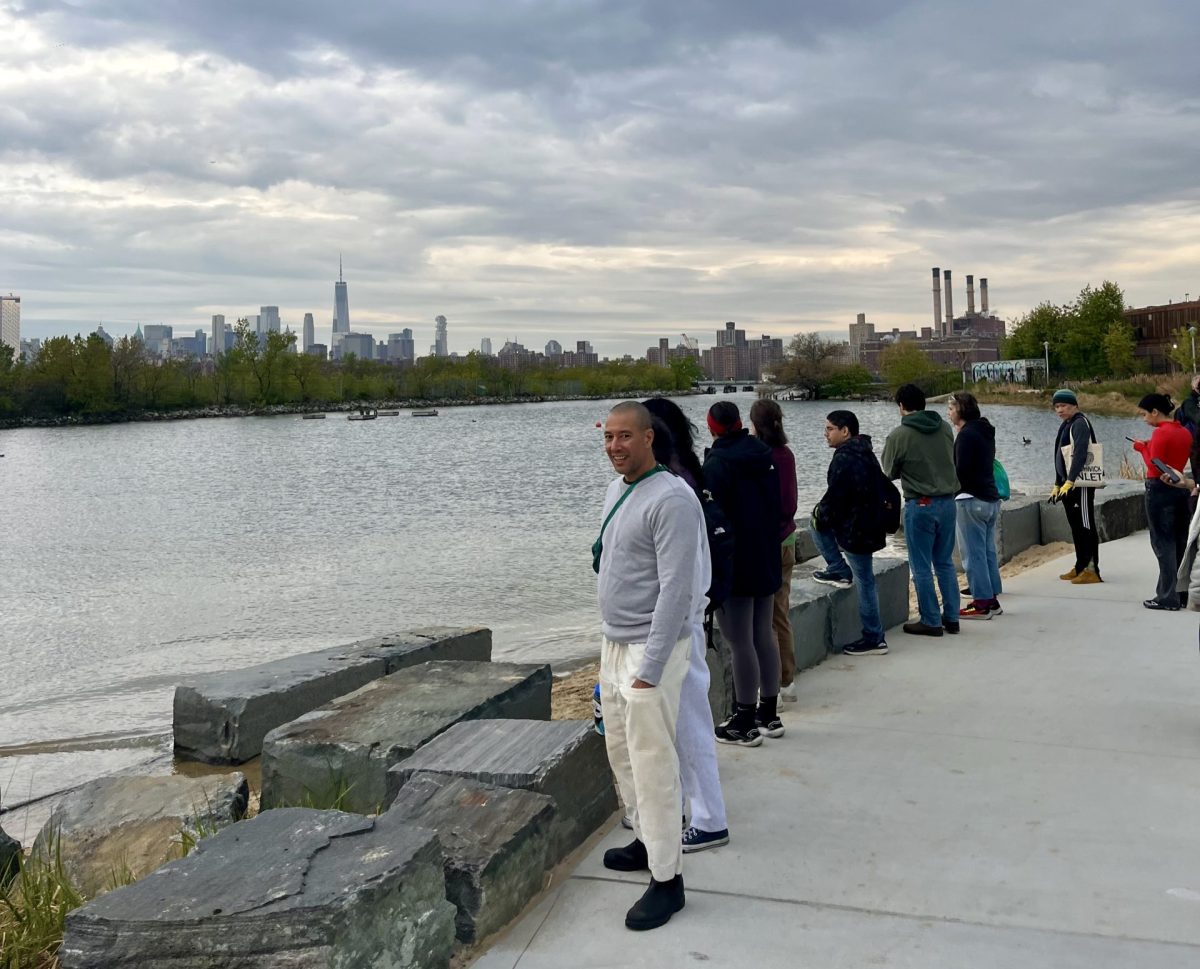
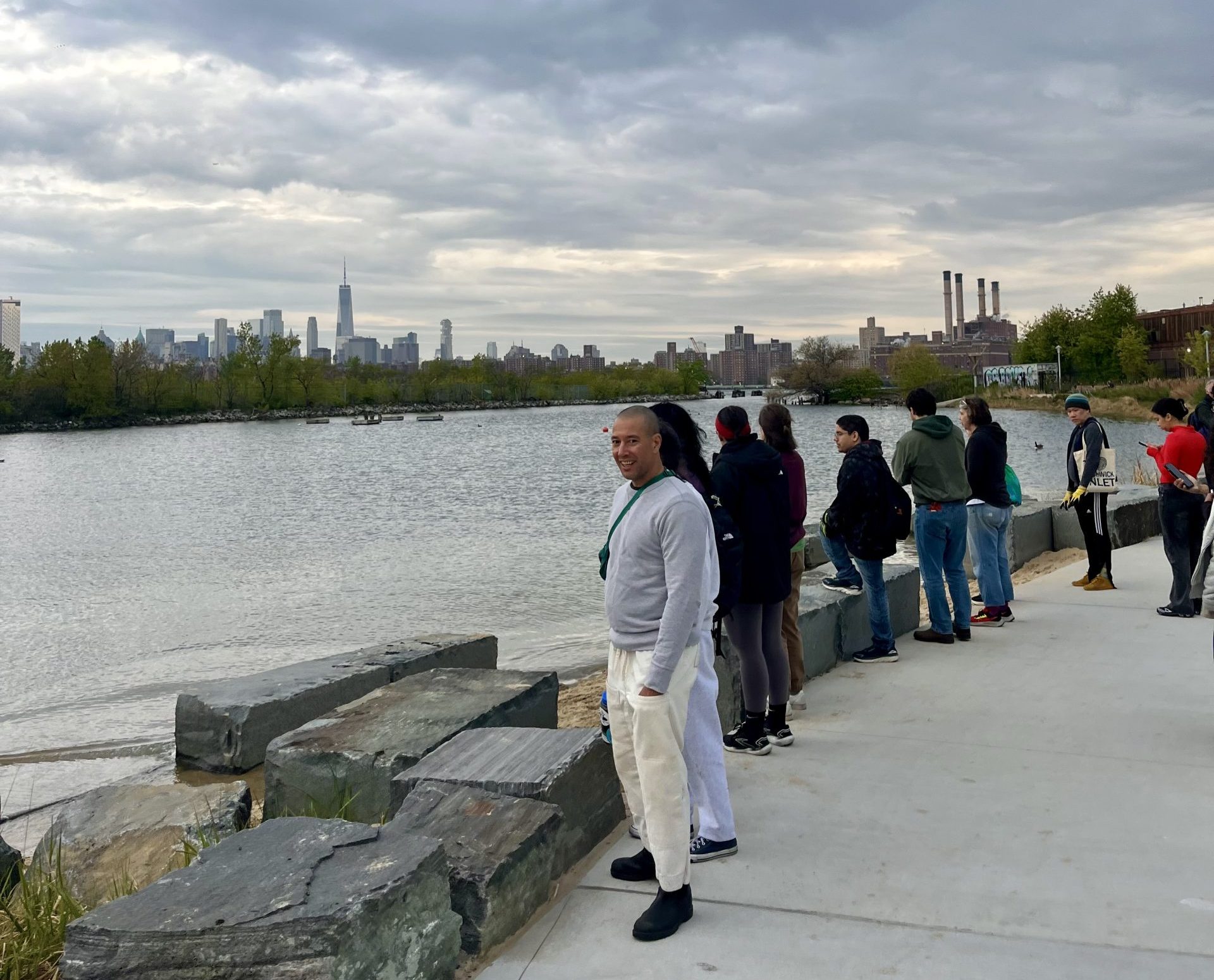
Members of Friends of Bushwick Inlet Park pose in front of Bushwick Inlet on Wednesday, April 29. Photo by Cole Sinanian

But for some locals, the Motiva Parcel’s opening has been overshadowed by what could soon be built next to it — the highly contentious mixed-use mega-development called Monitor Point. Proposed by the Gotham Organization and set to occupy the property immediately north of Bushwick Inlet, the Monitor Point development would see 1,150 housing units built across three high-rise towers, public open space, and a museum to honor the Monitor battleship built next to the inlet. The project is in the midst of a lengthy approval process and has received support from the local community board and Brooklyn Borough President Antonio Reynoso, though both Reynoso and Restler have called for developers to commit to more affordable housing. Currently, Gotham has committed to making 40% of  the towers’ units affordable at 40-80%  Area Median Income (AMI). 

Local activists with the groups Friends of Bushwick Inlet Park and Save the Inlet, meanwhile, have opposed the Monitor Point project since the beginning. A project of such scale would threaten the inlet’s rare and sensitive ecology, they argue, while the high concentration of luxury apartments could effectively privatize the inlet for the towers’ wealthy residents.

As the inlet’s calm waters lapped at the sandy beach Wednesday evening and a family of ducks floated by, a small group of Greenpointers gathered at the water’s edge, many of whom were board members and volunteers for Friends of Bushwick Inlet Park. 

Present at the gathering was 35-year Greenpoint resident Trina McKeever, who raised three now-adult sons in the neighborhood. She explained that while she’s grateful that Bushwick Inlet is finally accessible and the park appears to be moving forward, she also hopes that the public’s interaction with the inlet will help them better appreciate it and understand the threats it is under. 

“It’s definitely bittersweet,” McKeever said. “But what it does is gives everybody the opportunity to actually see where that building is in relation to the park, and hopefully there’ll be even larger groundswell of opposition to Gotham.”

She continued: ““I have three sons that grew up in Greenpoint, and the waterfront was all walled off. “I really feel that this particular site is sacred. It’s next to the inlet, and there just aren’t places like that in Greenpoint.”

Restler agreed. 

“The access to the water, the Zen-like feeling of being on Bushwick inlet, it just really, really got me when I had the chance to be down there,” he said. “People’s mental health will improve as a result of this little parcel.”
Mamdani Creates Deed Theft Office

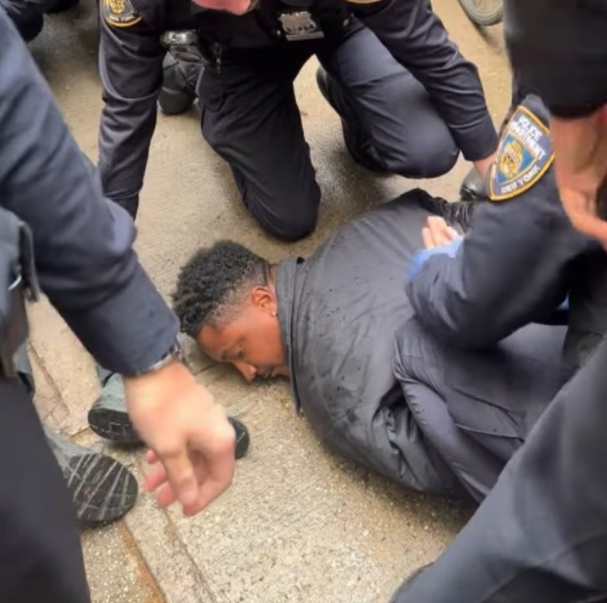
City Council Member Chi Osse was arrested last week at a deed theft protest in Bed-Stuy. (Photo via @chiosse)

Mayor Mamdani this week created a new office to regulate deed theft, after a Brooklyn rep was violently arrested and “slammed on the ground” last Wednesday at a housing protest in Bed-Stuy.

Council Member Chi Ossé, who represents Bed-Stuy and parts of Crown Heights, was one of four people arrested outside the home of Carmella Charrington, a local who is fighting eviction from her Jefferson Ave brownstone.

In footage posted on social media by Ossé’s staff, the 28-year-old — a DSA-affiliated rising star who became the youngest member ever elected to the city council in 2021 — can be seen speaking heatedly with a police officer outside the front gate, before another cop wrenches him face-down against the sidewalk.

Ossé was one of four protesters arrested, and he was released from the local precinct after being charged with two counts of disorderly conduct and one count of obstructing governmental administration. The second-term lawmaker promised to file a misconduct report, noting that he felt “dizzy” and had sustained mild head injuries.

A spokesperson for the NYPD claimed that they had given multiple warnings to clear the area, and that Ossé had resisted arrest. Meanwhile, state Attorney General Letitia James said she was “deeply disturbed” by the video, and North Brooklyn rep Lincoln Restler called the police officers’ conduct “outrageous.”

Deed theft occurs when scammers transfer a property to themselves without the owner’s knowledge or consent, typically through forged signatures or tricks that target older residents. The practice has come under scrutiny in recent years, with state-level complaints skyrocketing by 240% from 2023 to 2025.

Although James’ office determined that Charrington’s case was one of a dispute between heirs, rather than textbook deed theft, Ossé’s arrest has drawn increased attention to scams that often target Black and Brown New Yorkers. The problem is particularly dire in Brooklyn, which accounted for 1,500 of the 3,500 instances of deed theft recorded citywide between 2021 and 2023, making it the most impacted borough by far.

“When my grandmother was sick before she passed, she had a stroke, there were still people knocking on her door in Crown Heights asking her to sell her home,” Ossé told reporters. “We are seeing the displacement day in and day out here in Bed-Stuy — you can see the changing of the neighborhood, and a huge reason for that is because of deed theft.”

Last Friday, only two days after Ossé’s arrest, Mayor Mamdani formally established the first-ever Mayor’s Office of Deed Theft Prevention, and appointed Peter White as its inaugural director.

White, an attorney with Access Justice Brooklyn, has long worked on deed theft and foreclosure cases. The nonprofit’s head hailed him as “a brilliant lawyer and advocate,” and fellow experts largely applauded the appointment.

Scott Kohanowski, the general counsel at the Center for New York City Neighborhoods, singled out a clear priority for the newly-created office: “Just more transparency,” he told the Star. “So many of these scammers and speculators are shielded with our LLC laws, so it’s really hard to identify who the actors are. One thing I’d like to see is this new entity and the AG’s office having access to that information, so they can start connecting the dots.”

SCHWARTZ: I Believe I Have the Perfect Relationship with My Neighbor

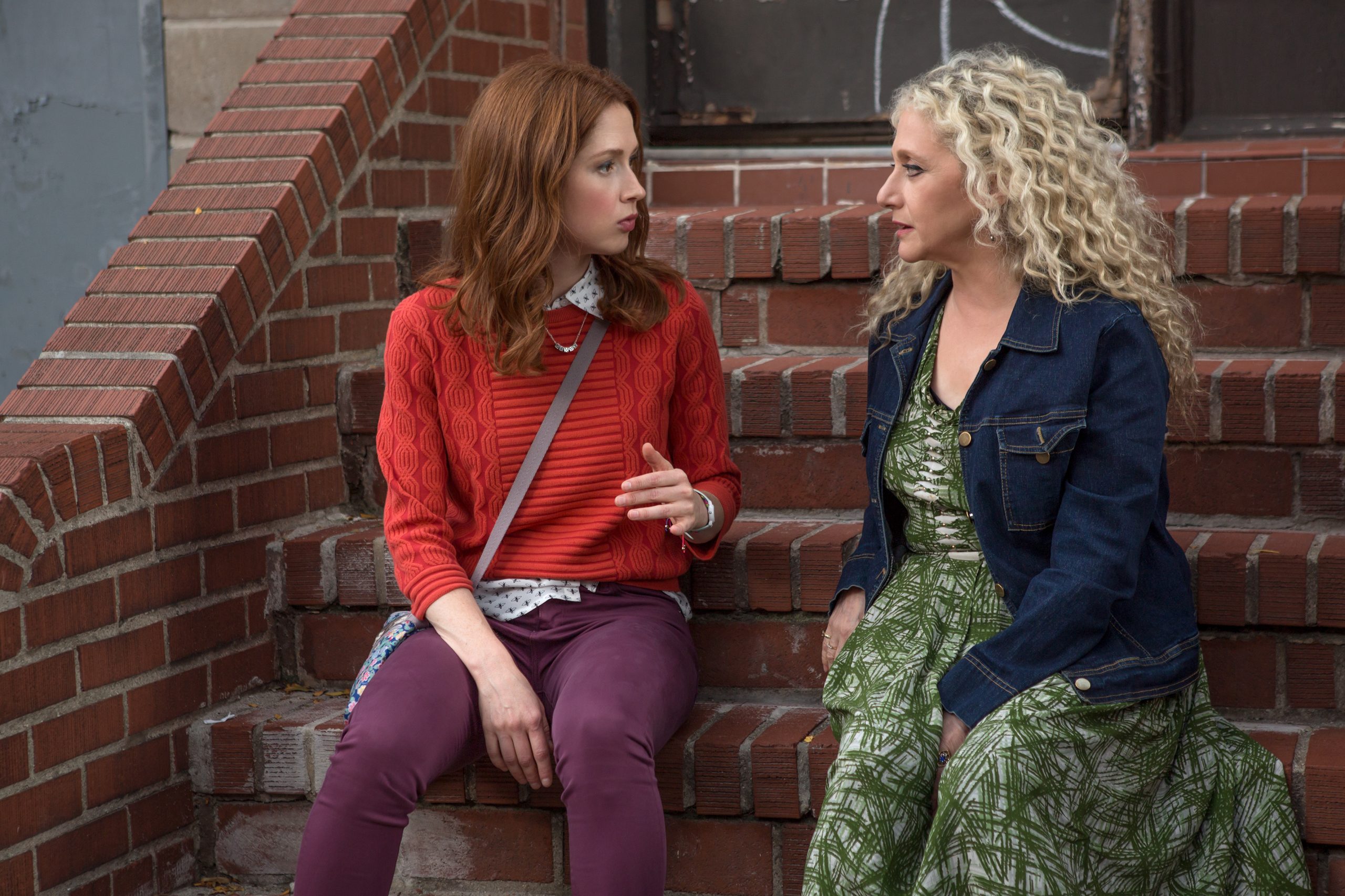
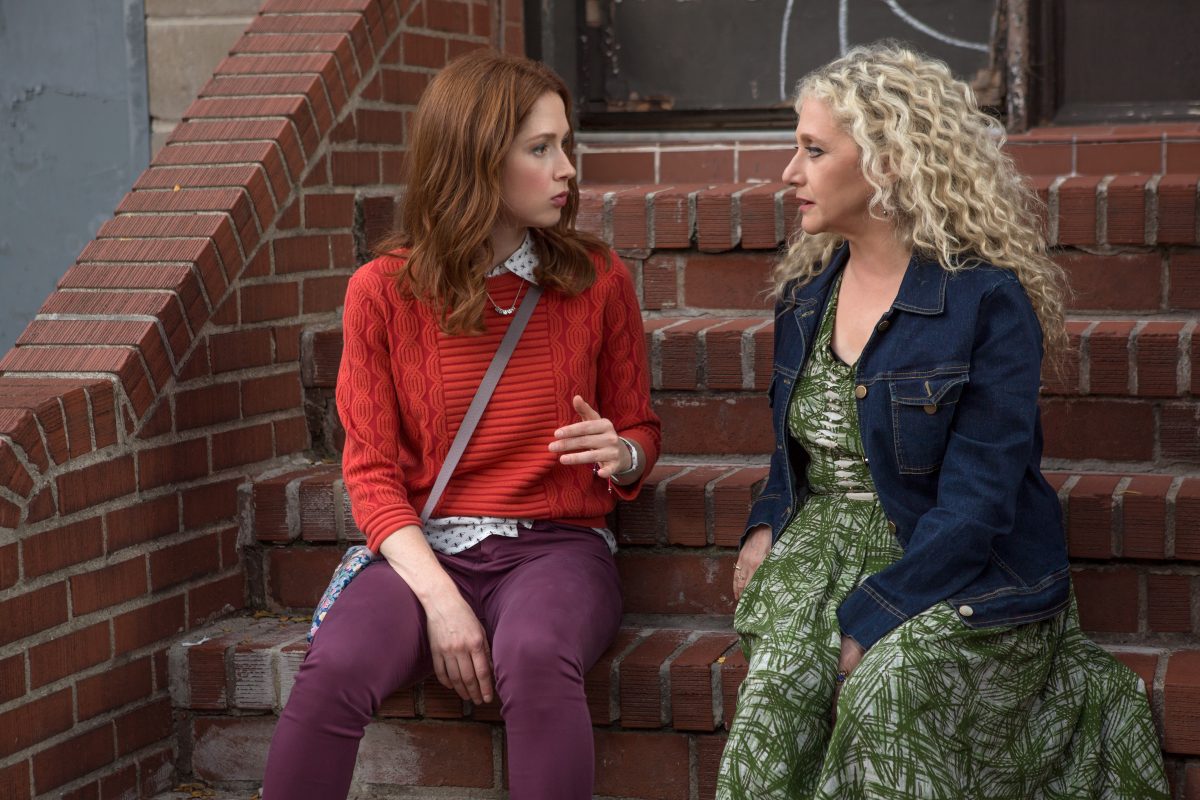
Kimmy and her neighbor-slash-landlady, Lillian, in the show “Unbreakable Kimmy Schmidt.”

By Lana Schwartz | lana.schwartz925@gmail.com

Becoming friends — true friends — with your neighbors in New York City is as elusive as finding a rent stabilized apartment. The fantasy is that you can socialize without leaving your apartment. The reality typically is that, at best, you don’t have anything in common with your neighbors except your address. At worst, you hate them. They’re loud, they have bad taste in music, and usually both at the same time. Worst of all, they could be doing that while simultaneously paying less money in rent than you.

No wall, floor, or ceiling has ever been thick enough for me to consider any direct neighbor as anything but annoying, quite frankly, if I’m considering them at all. Phone numbers have only been offered so I can send pleas to “please turn the music down, it’s 5 a.m.” 

Yet recently I have found a more satisfying relationship with a neighbor, one that I believe is perfect.

I believe the key to this affection for my neighbor is that he lives in the building next to mine, rather than in my building. We have all of the neighborly camaraderie without any of the contempt familiarity can breed.

Our interactions go as follows: When I see him, I say “hi.” He says “hi” back. Though one time he did say that I’m “always walking around places,” which is an accurate summation of what I’m usually doing.

He is an older man, though I have no idea how old and I will probably never find out. How long has he lived in Greenpoint? Does he still like living here? These are all questions I don’t have. The simple, uncomplicated wave of recognition we share is more than enough for me. I even look forward to it. There is no expectation or intimation of small talk. It is a relief to know I can walk by and wave without having to say I’m “good” or talk about what the weather is doing. There are no hopes of deepening our relationship, and by the same token, no disappointments.

Still, I’d be upset if he wasn’t there anymore. I’d like to think he feels the same, and that, if needed, he could provide an accurate description of me to any real-life Law & Order: SVU detectives should I become a victim of an unspeakable crime. But there wouldn’t be an unfillable hole in the other person’s life if one of us was gone; and in New York City, where people are always arriving and leaving, there’s more than enough people with whom you share actual relationships with to miss. I wouldn’t want to add to my neighbor’s burden (whatever that burden may be, but like I said, he is older, so I imagine there are burdens).

Wave to the people who live on your block. You may get lucky and wind up with the kind of relationship like I have with my neighbor, though there are no guarantees. What we have takes no care, no maintenance, and therefore might be impossible to replicate.

COBB: A Paean to Puebla

Generations of migrants to Brooklyn have come from the town of Chinantla in Puebla.(Photo via economia.gob.mx)

Brooklyn’s Mexican community has significant historical ties to its central region, thanks to a chance encounter over 80 years ago.

GEOFFREY COBB | gcobb91839@Aol.com

Author, “Greenpoint Brooklyn’s Forgotten Past

We are again ready to celebrate Cinco de Mayo, a holiday commemorating the Mexican army’s unlikely victory over French forces at the Battle of Puebla on May 5, 1862. Ask most Mexicans living in New York City what part of Mexico they come from, and they will answer Puebla, a region located in central Mexico.

One of Mexico’s smaller states in geographic size, Puebla, though ranks fifth in population with over six million inhabitants. More than one million people from Puebla live in the United States, most of them in New York City neighborhoods including heavy concentrations in Sunset Park, Corona and Elmhurst.

According to estimates from the Pew Research Center and the Mexican Migration Project, approximately 70% of Mexicans in New York have roots in Puebla. Estimates claim that at least 200,000 People from Puebla live in the New York and New Jersey metropolitan area, making Puebla the main state of origin for Mexicans in the Northeastern United States. The migration has been so extensive that it now represents one-sixth of the population of Puebla.

Like most Mexican immigrants, Poblanos are hard working. Many work in restaurants, construction and retail. Many of the Poblanos working in our city send a large portion of their earnings back home. In 2023 alone, migrants from Puebla sent more than $2.4 billion in remittances to their home state, according to data from the Bank of Mexico, and most of that money came from New York.

Many towns in Puebla have a long and deep connection to New York City, perhaps none more than the small town of Chinantla, whose migration started more than eighty years ago, when Pedro Simón and his brother, Fermín, hitched a ride to New York City with an Italian American tourist they met in Mexico City. The man not only took them all the way to Times Square but even put them up in a hotel and got them jobs mopping floors at a restaurant. The day they decided to stay in the city, they left their hotel feeling celebratory, only to be showered by confetti in Times Square. It was V-E Day.

Decades later, the brothers returned to Chinantla, where they built big houses. Since the Simon brothers first arrived here, generations of migrants from Chinantla have come to New York City. Money from the United States has helped revitalize the town. Funds from migrants built the town’s schools and rebuilt its church, financed and designed its potable water system and illuminated its streets. Second and even third-generation New Yorkers keep their connection to the town. Teen-age girls from Brooklyn compete every year in the annual beauty pageant to be Senorita Chinantla, and often win.

Though the Simon brothers might have been the first Poblano migrants to New York City, they certainly were not the last.  In the 1960s there were few economic opportunities in Puebla creating a second wave of Poblanos, many of them from the same small Puebla villages. At the end of the 1960s, when there was a lot of work in manufacturing and in the restaurant industry, the weekly income of the immigrants ranged from U.S.$50 to $80, considerably more than they would earn back home. New York Poblanos encouraged their friends and families in Mexico to migrate and within ten years, there were 6,000 New York Poblanos, and by 1980, 25,000. The 1982 and 1994 economic crises, as well as the 1985 earthquake, sparked a mass migration to New York. Within the United States, tougher anti-immigrant laws in California pushed Poblanos to seek safe haven with friends and family in the northeast.

The Puebla state government has so many of its citizens living in the United States that it created the concept of Casas Puebla in several U.S. cities with large numbers of Poblanos. A Casa Puebla advises Poblanos on immigration policy, consular matters, and customs. In addition, it also tells Poblanos of their rights as residents in the United States and strengthens their bonds with their families in Mexico.  The first Casa Puebla in the United States began helping Poblanos New York City in May 1999.

One of the clearest indicators of the size of the Poblano community in New York City are the many restaurants and food trucks owned by Poblanos. Former New York chef and television host Anthony Bourdain worked with so many Poblanos, including his sous chef Eddie Perez, that he filmed one of his episodes entitled “Where the Cooks are from” in Puebla. One of the best Poblano eateries is Tulcingo del Valle, which is located on tenth Avenue in Manhattan and is famous for its tacos. Another great Poblano spot is Aquí en Bella Puebla on Roosevelt Avenue in Queens, which serves delicious Mole sauces, for which Puebla is famous.

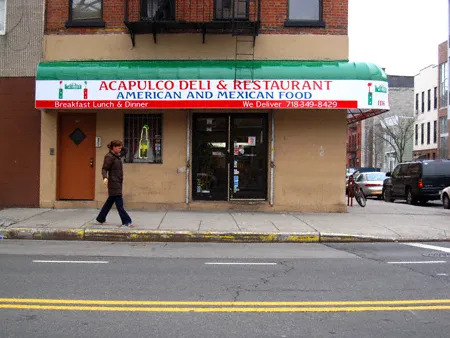
The Zaragosa Deli across from Manhattan’s Stuyvesant town has created an army of devoted fans with its blue-plate daily specials, which might include egg-filled albondigas in Chile sauce, pork ribs and verdólagas (purslane) in salsa verde, smothered chile relleno, or its signature dish potato and chorizo enchiladas. In Greenpoint, a Poblano family owns Acapulco, which has been serving up tasty Poblano dishes for decades.

Poblanos are a huge presence in New York City and Poblano culture is an integral part of the cultural mosaic that is New York City.

Bushwick Bar Hosts NYC’s First ‘LooksMaxxing’ Party

Abby Nazziola (center) used his “looksmaxxing” performance to comment on the fragile nature of performative masculinity. Photos by Carol Chen.

A satirical drag show at Bushwick’s Talon Bar brought a diverse group together to lampoon a bizarre Internet subculture. 

BY CAROL CHEN

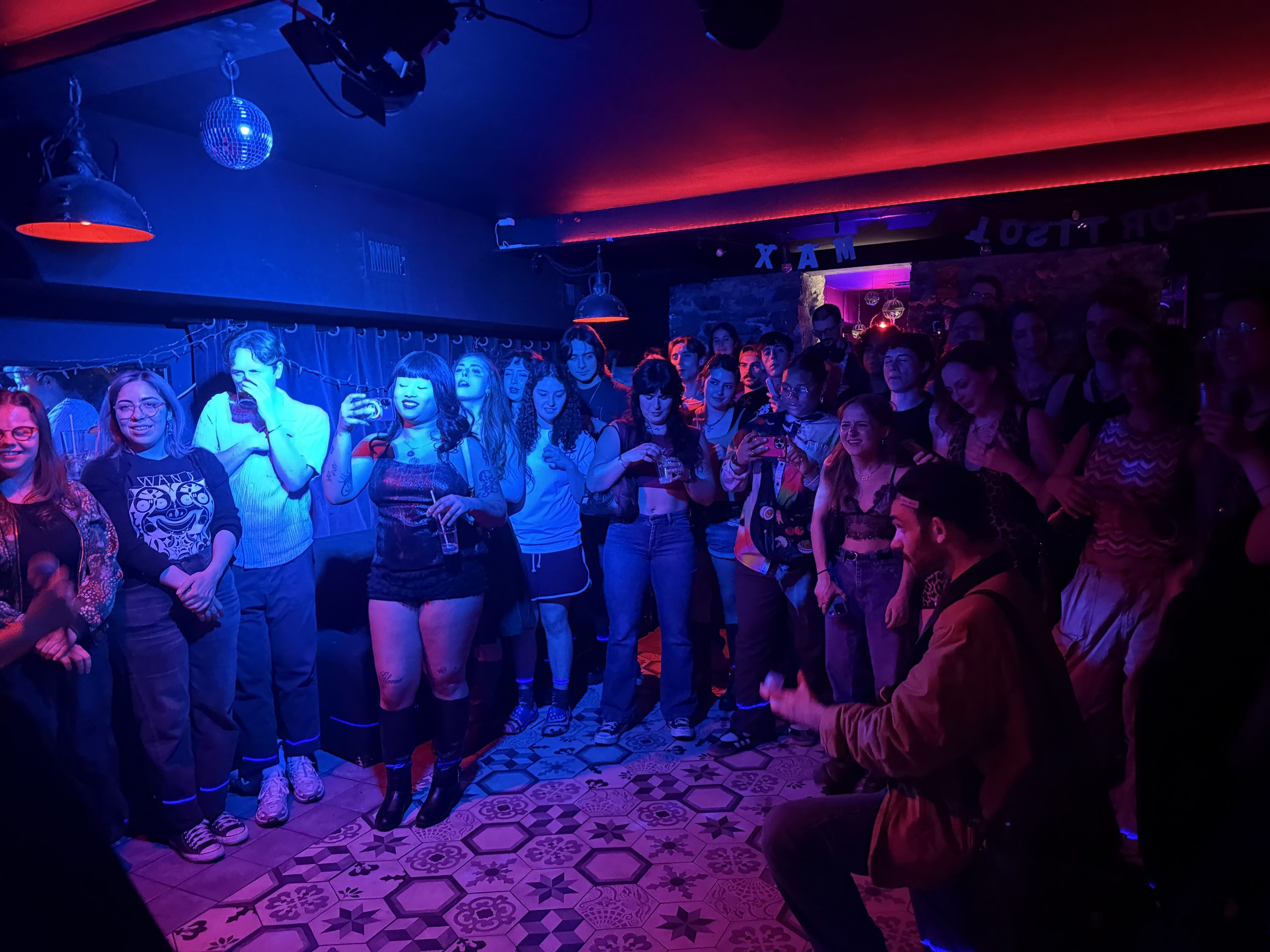
BUSHWICK — The viral Instagram flyer promised New York City’s first — and perhaps last — looksmaxxing drag king contest. Last Friday night, the basement of Talon bar in Bushwick filled up with queer regulars, algorithmically curious strangers, a few attendees who had never been to a drag show, and at least one self-identified looksmaxxer who had driven in from Woodside.

The event was organized by Sarah Rescigno and Emily Herman, a couple whose party-throwing instincts led them toward an unusual subject: the growing online phenomenon of looksmaxxing Popular among young men, looksmmaxxing involves optimizing one’s physical appearance through extreme means, from structured fitness regimens to facial bone reshaping and, in some cases, methamphetamine microdosing for its supposed fat-burning properties.

The catalyst was Clavicular, a 20-year-old content creator who has become the internet’s most visible, and most polarizing, ambassador of the looksmaxxing world. Known for his streams, his controversial statements, and a recent drug overdose that briefly made national news, he has become a kind of funhouse mirror for anxieties about masculinity, body image, and the internet’s influence on young men.

The viral “looksmaxxing” trend was popularized by the controversial 20-year-old content creator, Clavicular. Photos by Carol Chen

Rescigno said the mainstream notoriety of looksmaxxing coupled with its distinctively queer undertones inspired her to put on the event: “My mom knows who Clavicular is now. It still has this niche appeal of  feeling like you’re in an in group, but it’s becoming mainstream. And I thought it was perfect for a gay event — he’s this very flamboyant cisgender heterosexual man. It’s a very interesting thing to examine the gender performance.”

The post announcing the party — including a contest where drag kings compete to out-Clavicular each other — accumulated around 11,000 likes on Instagram and more than 160 RSVPs on Partiful.

The night opened with a performance by drag king Hugh Mann Race,  a Brooklyn-based performer who took the stage in a black shirt and heavy contour, dancing and stripping to the Village People’s “Macho Man” to warm up the crowd. Then the contest itself began: five drag king competitors, each riffing on looksmaxxing culture to varying degrees.

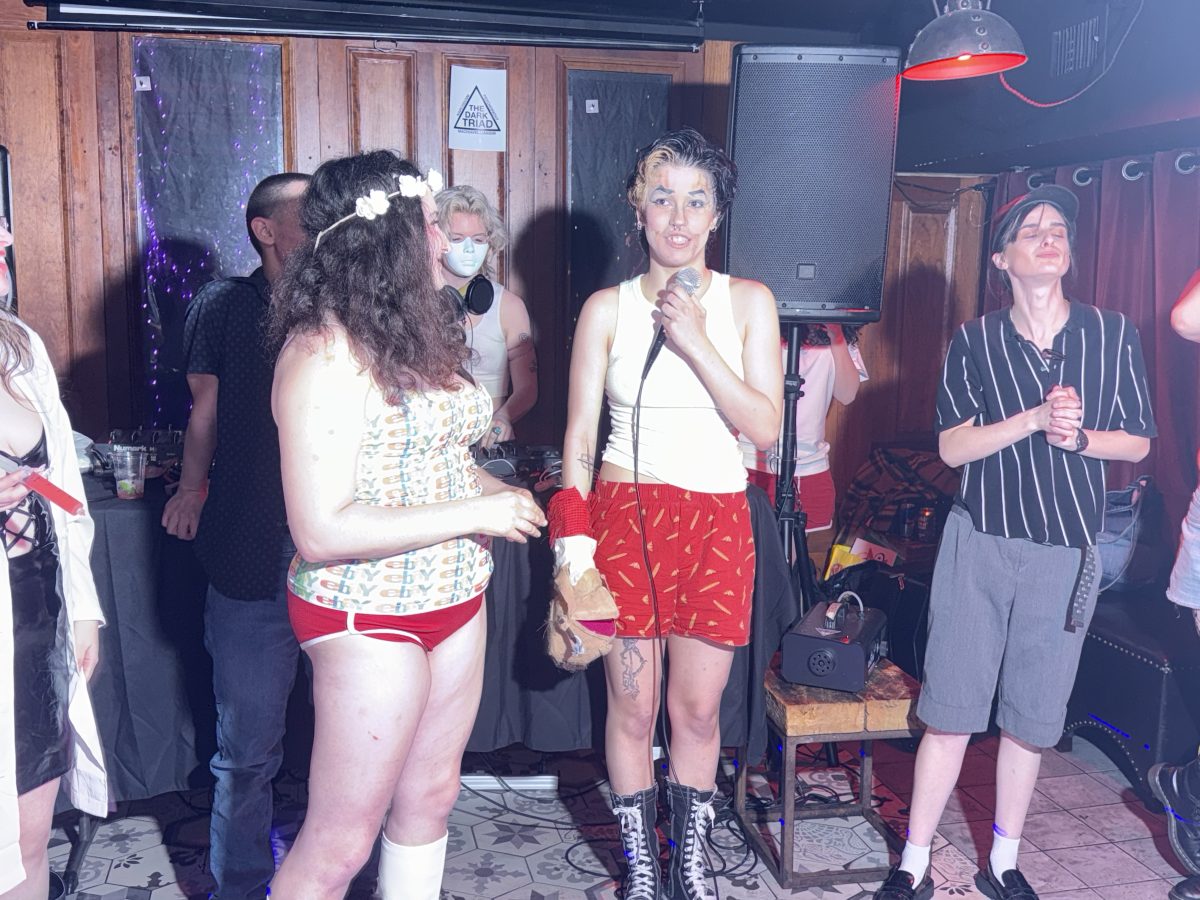
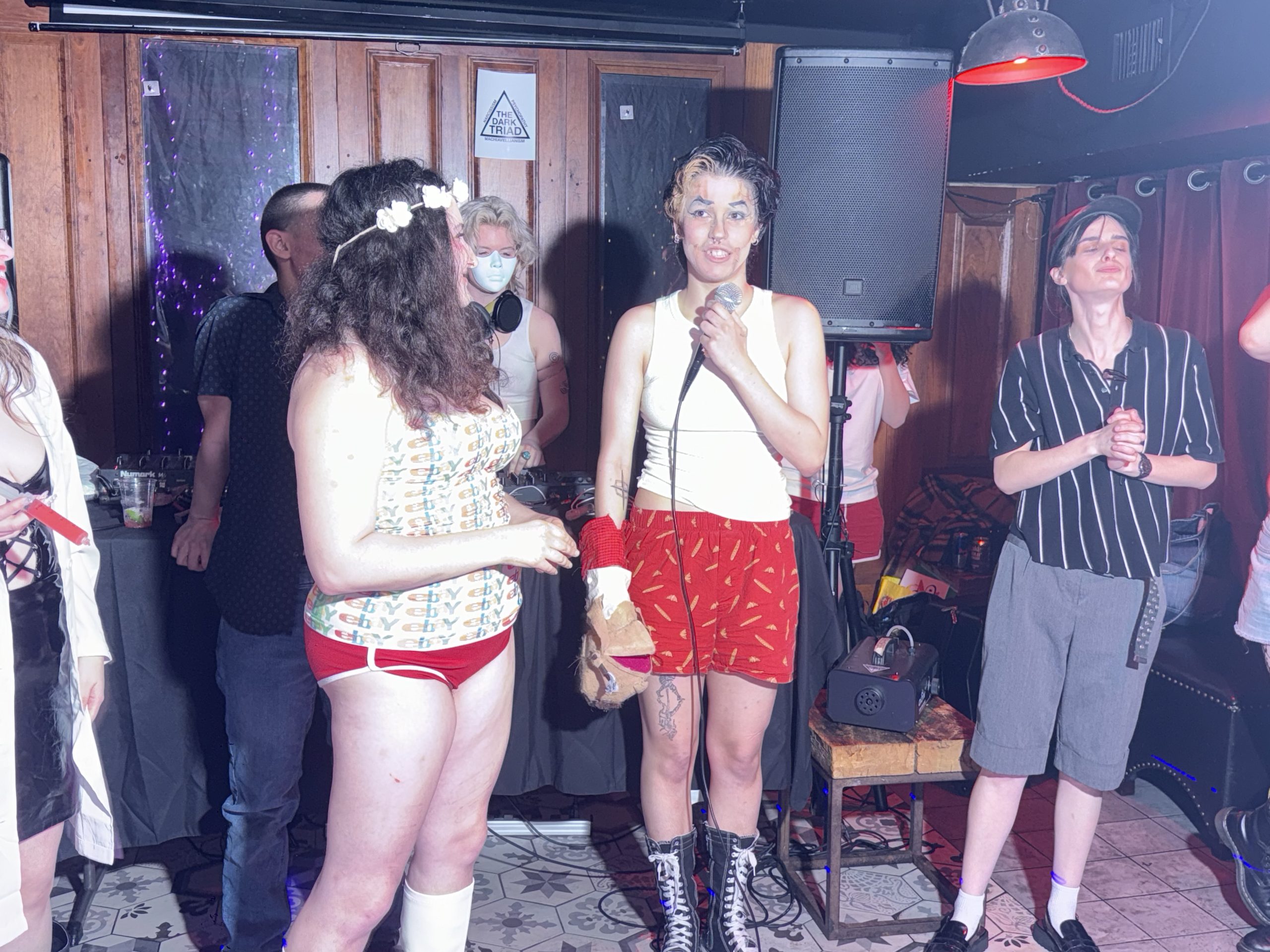
The performance that drew the loudest reaction was that of Abby Nazziola, who wore a white wife-beater, red shorts, and elaborate prosthetic makeup that extended his jawline and accentuated his cheekbones into the chiseled, angular silhouette that looksmaxxers aspire to. He punched himself in the face with a hammer and flexed for the crowd to music, all while holding a muppet in hand.

When asked about the elements of his performance, Nazziola said: “I wanted to show the inherent transness of looksmaxxing. The foundation of it is fear of being ‘not man enough.’ I wanted to show that all of this is hurting more than helping, and how ridiculous these men look and sound.”

To Nazziola, the puppet represents the vulnerable inner child of those who use ultra-masculinity as cover: “I’m sure they see puppets as emasculating and childish, so I know they wouldn’t be happy with this depiction,” Nazziola said.

“There’s no room for being yourself in this sphere,” he added in a text message after the event Nazziola said over text after the event. “If these men really looked inside, they could find self-acceptance elsewhere. I think we as queer people know this very well.”

That parallel between the trans experience and the looksmaxxing community was constantly brought up throughout the night. Hugh Mann Race, who is trans, described watching young men pursue extreme physical transformation as genuinely sad. “I had to struggle to love my body,” he said backstage. “Being trans and being fat are the best things that could have happened to me. It was so sad to watch men hitting their faces with hammers when they don’t need it.”

Kax Petkovich, another contest participant, said that his experience mirrored that of Clavicular: “He’s been taking testosterone since he was 14. So am I.” However, Petkovich, argued that drag king culture offers a different model of masculinity: one arrived at through self-discovery rather than self-punishment. “Most drag kings are trans men or queer women — people who’ve been on the brunt of the worst of men, who then reclaim masculinity for themselves. It’s coming from a place of finding yourself.”

Murray Rosenbaum, 28, a public school teacher who stumbled onto the event while looking for things to do nearby, offered a perspective that hovered between the satirists and Rodrigues. His students, middle schoolers, have picked up looksmaxxing vocabulary and habits. “They would do the ‘mewing’ (during class), dragging their finger down their face to press their jaw in, to tell me they can’t answer a question.”

He said the event helped him make more sense of this cultural trend but also deepened his worry for the kids that he teaches, who are immersed in this culture. “Listening to Clavicular’s statements, it’s clear he struggles with happiness. He’s quoted saying men aren’t meant to be happy. He’s accepted this ideology of ‘I’m meant to suffer”.

At the end of the contest, the crowd voted by applause. Nazziola won. The MC Lauren Corcoran concluded the night with: “We want to make it very clear that we are not here to support Clavicular. We are here, in fact, to make f–ing fun of it.”

Fill the Form for Events, Advertisement or Business Listing