Not-So-Green Point?

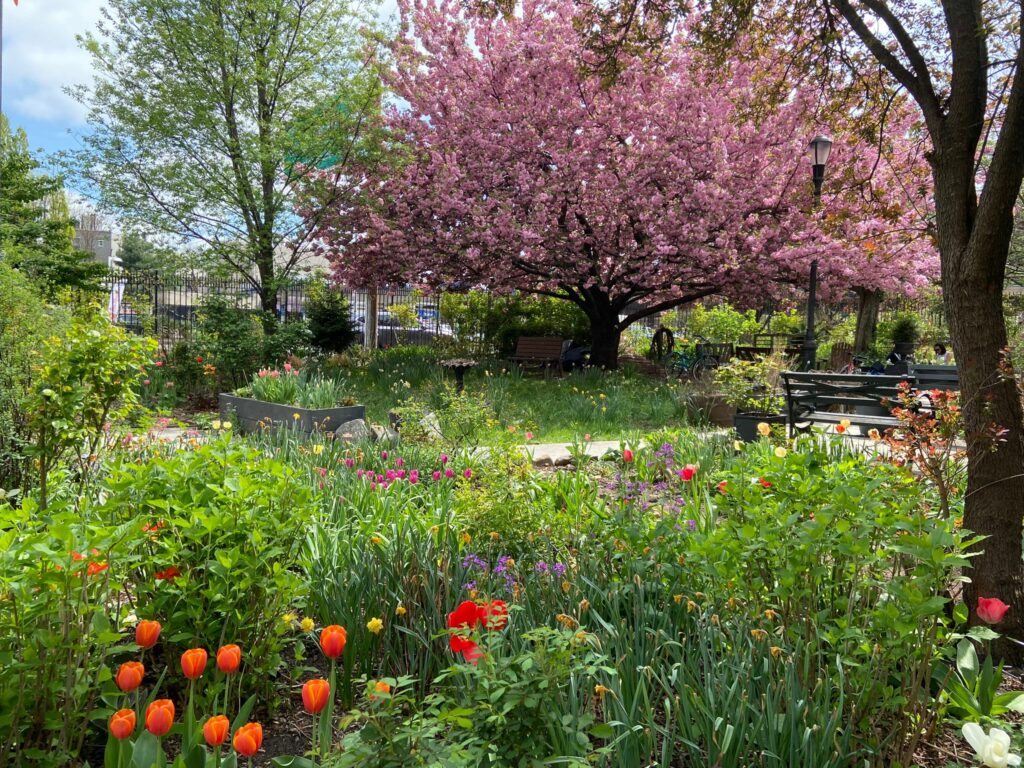
The neighborhood still suffers from low park density, but there are more than enough lush springtime spots for those in the know.
BY GEOFFREY COBB | gcobb91839@Aol.com
Author, “Greenpoint Brooklyn’s Forgotten Past
It is Spring, and my thoughts turn to flowers and gardens.
The enthusiastic, mirthful Peter J. McGuinness would always evoke laughter by referring to industrial Greenpoint as “The garden spot of Brooklyn,” or in one of his more enthusiastic outbursts as “The garden spot of the universe.” For late 19th and 20th century Greenpointers living in crowded tenements ringed by belching factories and foul, polluted air, calling our area “the garden spot” must have seemed like some kind of cruel, snarky joke, but for many years Greenpoint was a real garden spot and today it is still a home to many tiny, gorgeous gardens, often set in the unlikeliest of places.
Greenpoint was once a farming community, and every family had its own garden. There was once a huge hill running around the area of Franklin and Green Streets called Pottery Hill where wildflowers grew. The areas flowers were so pretty that courting couples sailed over from Manhattan to enjoy its beauty. However, the name Garden Spot derives from the Meserole Orchard, which once occupied a huge swath of land around Meserole Avenue. The garden was famous for its apples, and the beautiful apple blossoms each spring, but in what has become a familiar local story the real estate was too valuable and the orchard disappeared as lots were sold off for housing.
Greenpoint still lacks the park space that many other neighborhoods treasure. In 1889 State Senator Winthrop Jones helped secure Winthrop Park, which later became McGolrick Park. In the northwest corner of the park, there is the Paul Clinton garden, dedicated to a park worker. Under his supervision, the parks in this district won numerous awards including the “Greenest District Award.” Patrick McCarren had local streets and factories condemned to create the park that later would bear his name.
During World War I with millions of farmers sent off to fight there were food shortages and McCarren Park was planted as a huge victory garden, tended by local school kids.
After the end of the war, the city wanted to pull the plug on the victory gardens, but McGuinness realized that many kids loved the gardening and he threatened to bring busloads of local school children, rakes in hand, to the City Council to plead for further funding. His ploy worked and the gardens continued in the park for years after. During the sixties and seventies many buildings became abandoned and burned. One of these vacant lots at 61 Franklin Street became a small community garden, lovingly tended by local volunteers.
The Lentol Gardens is also a bucolic oasis on Bayard Street. The land for Lentol Garden was acquired by the city in 1946 during the creation of the Brooklyn-Queens Expressway and became parkland that same year. The Park was named for the father of local Representative Joe Lentol, Edward Lentol who represented the area first in the Assembly and then in the State Senate for decades. In 1992, the park became known as the Lentol Gardens.
Today there is a new frontier for gardens: rooftops. Thanks to Broadway Stages our area has two unique gardens. The Eagle Street Rooftop Farm is an internationally acclaimed greenroof and commercially operated vegetable farm atop a three-story warehouse in Brooklyn, New York. On the shoreline of the East River, with a sweeping view of the Manhattan skyline, Eagle Street Rooftop Farm is a 6,000 square foot green roof organic vegetable farm.
Even More dramatic than the Eagle Street Rooftop garden is Kingsland Wildflowers, an oasis of wildflowers and birds atop a former industrial building in the heart of a zone of very heavy local industry. Opened in 2016, the garden is the conception of Marni Majorelle, founder of Alive Structures. Marni brought together local businesses and nonprofit organizations. The NYC Audubon manages the project and oversees green roof wildlife monitoring through bat and bird microphones and swallow houses installed on the green roof. Newtown Creek Alliance conducts research into land use, policy, and economic factors of green roof installation in industrial areas.
Greenpoint has a new park coming online, Bushwick Inlet Park. The 1.89-acre, waterfront green space, with $7.5 million in mayoral funding, includes smooth paths, a forest grove, an elevated lawn, a water feature, a family gathering area, an overlook and a plaza with sweeping views of the Manhattan skyline.