The Greatest Show on Earth

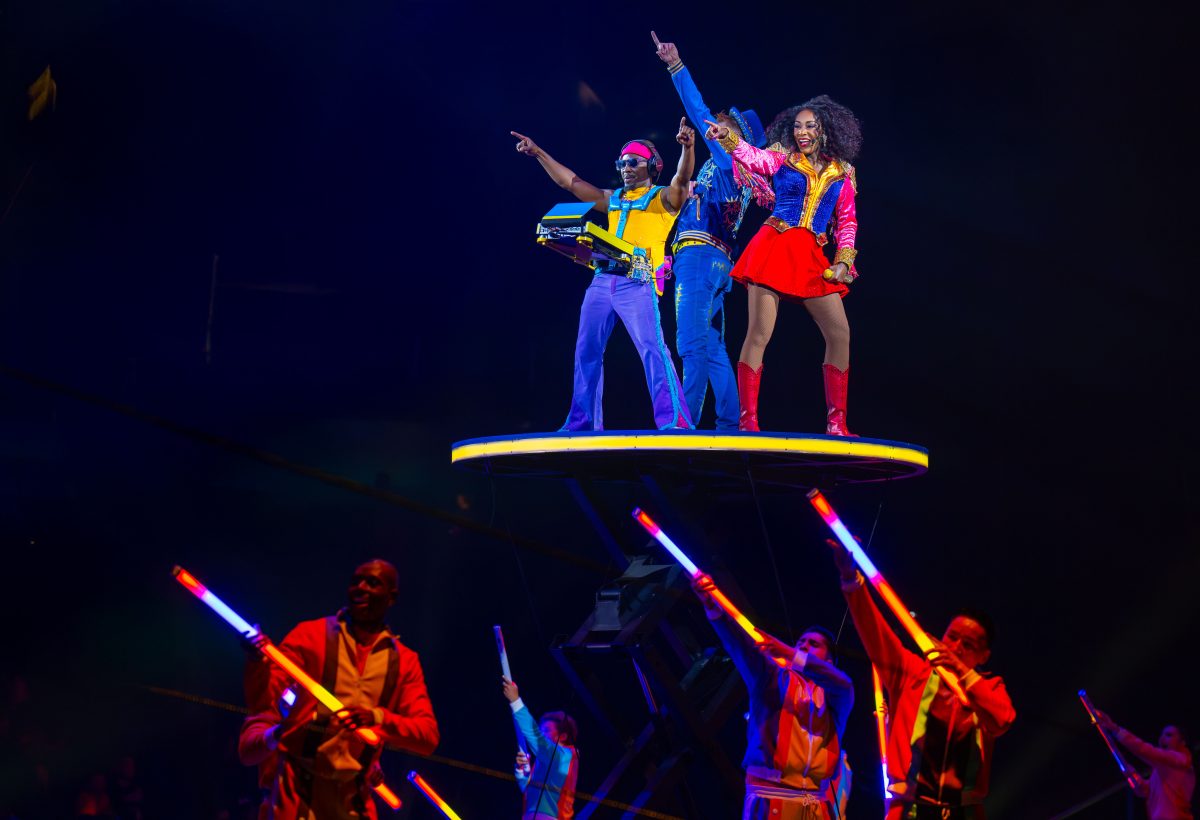
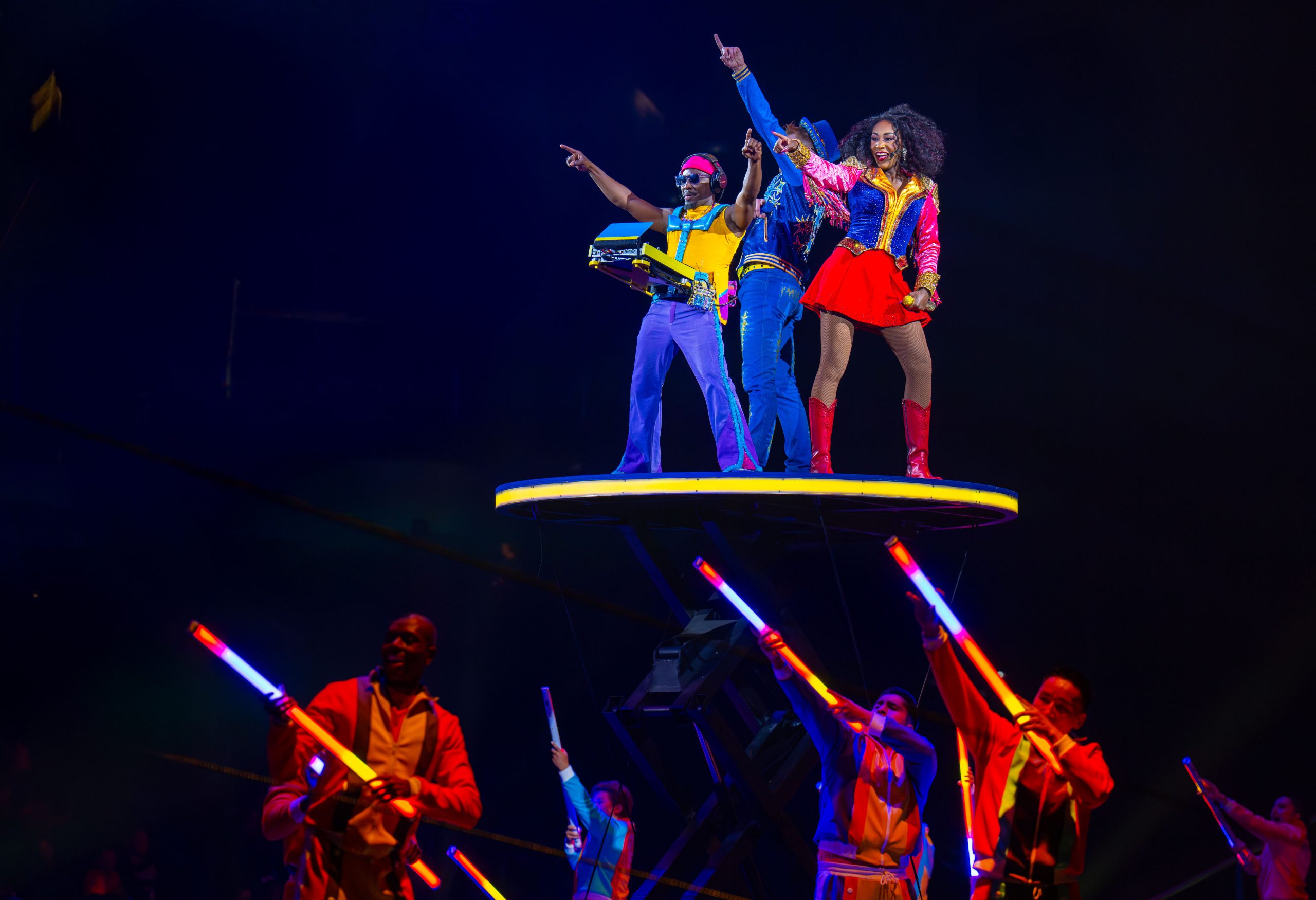
The show’s three ringmasters, DJ Lucky; Cam, played by unicyclist Wesley Williams; and Aria, played by singer and performer Lauren Irving.
At Barclays, a modernized Ringling Bros. and Barnum & Bailey Circus includes a 36ft-tall unicycle, a viral TikTok soundtrack, and a “human rocket.”
By COLE SINANIAN | cole@queensledger.com
DOWNTOWN — Twenty-one elephants and 17 camels marched across the Brooklyn Bridge on the morning of May 17, 1884, in what was both a stress test for the newly completed bridge and an advertisement for legendary showman Phineas Taylor Barnum’s “Grand Traveling Museum, Menagerie, Caravan, and Circus,” also known as “The Greatest Show on Earth.”
The stunt was a success; the animals made it safely across the bridge and the public was smitten, solidifying Barnum’s status among the most popular entertainers of his era. When he opened his circus in Brooklyn in April 1871, its cast included elephants, rhinoceros, gnus, horned horses, lions and Asiatic yaks, as well as human performers like acrobats, bareback riders, and the so-called “French Giant,” “Bearded Child,” and the “California Dwarf.”
More than a century and a half later, “The Greatest Show on Earth” is back in Brooklyn, albeit sans the animals and bearded children. A revived Ringling Bros. and Barnum & Bailey Circus opened at Barclays center last weekend, the show’s latest edition which began touring again in 2023 after a five-year hiatus, this time adapted to 21st century tastes. In a wild, at times disorienting juxtaposition of tradition and contemporary pop culture, a cast of acrobats, dancers and contortionists from 17 different countries, a human cannonball, a pair of circus clowns and a robot dog are led through the roughly 120-minute show by a trio of tech-savvy ringmasters to a soundtrack of viral TikTok songs.
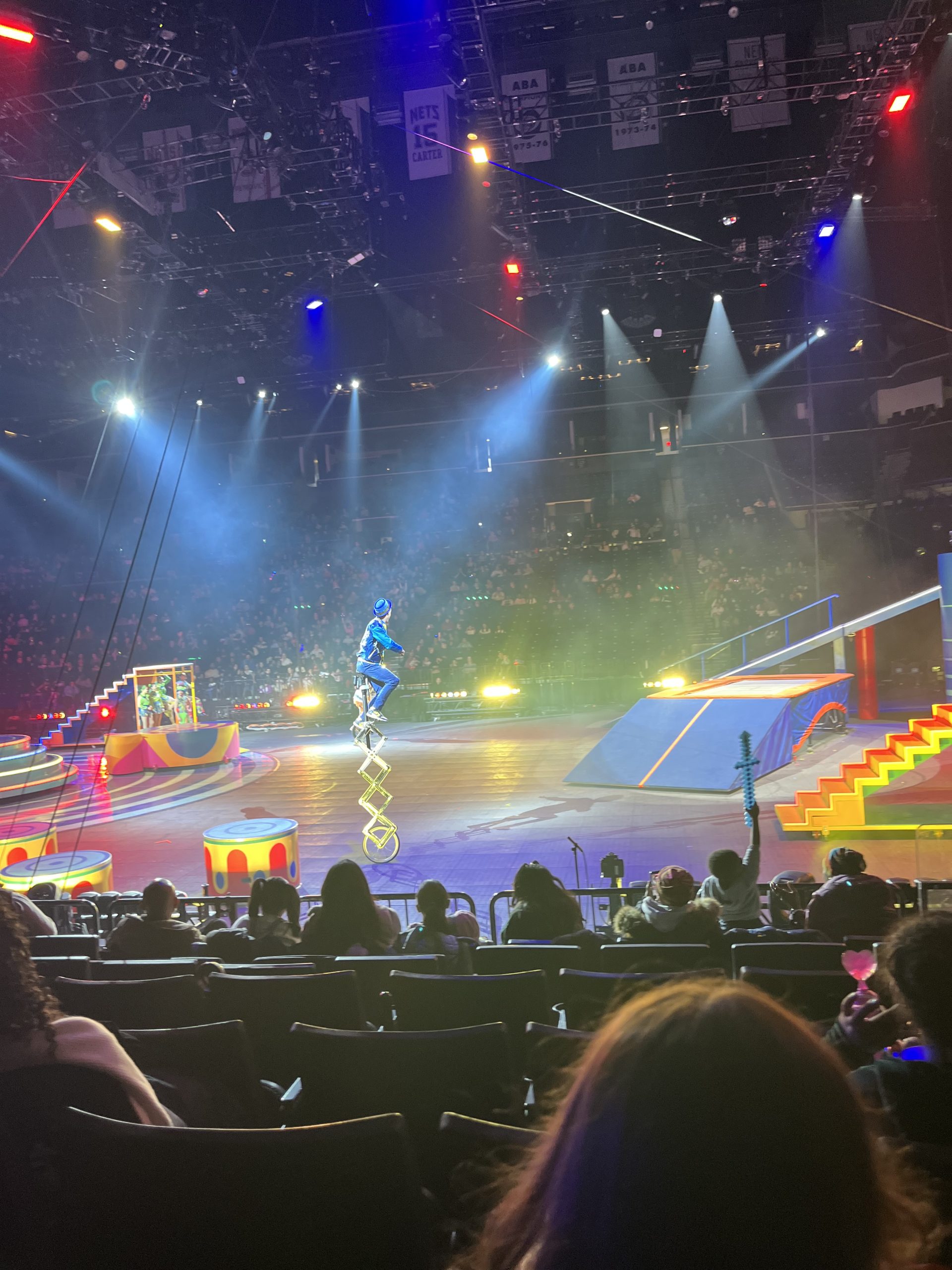
The third ringmaster is Cam, played by Wesley Williams, who also once held the world-record for tallest rideable unicycle. Photo by Cole Sinanian
According to performer Lauren Irving, who plays Aria, one of the show’s ringmasters, the circus’ latest iteration aims to follow in its historic predecessor’s footsteps by showcasing human ability in a family-friendly setting.
“In the past, there was a showcase of what humans and animals could do together,” said Irving in an interview with the Brooklyn Star. “There were also different acts that would happen at the time, with what was the norm then. Now, the focus is on that human ability.”
“The Greatest Show on Earth” stopped at Barclays from February 19 to February 22. The show comes to Elmont, Long Island in March, with shows scheduled at the UBS Arena from March 6 to March 8.
At the evening show on February 20th Barclays was about 50% full, mostly of giddy children, many of whom wore orange dragon hats and struggled to sit still as the show’s DJ, Lucky, jumped from Sir Mix-a-lot to Ariana Grande to U2. Irving, a classically trained vocalist originally from Atlanta, Georgia, plays one of the ringmasters, a character named Aria, who acts as a sort of guide from scene to scene. Catch her flexing her incredible vocal range during her performance of No Doubt’s classic “Just a Girl” during contortionist Jordan McKnight’s grimace-inducing set.
The other ringmaster, Cam, is played by Wesley Williams, and acts as the show’s “content creator.” At various points throughout the show, Williams pulls out his phone to record the acrobats in front of him, which is livestreamed to the jumbotron screen above the stage. Though at times gimmicky, Williams’ livestreaming adds dimension to the spectacle, providing multiple POVs to the acrobats’ performance.
But perhaps most importantly, Williams held the world record for the world’s tallest rideable unicycle until 2024. He showcases this unique ability midway through the show, when he rides a 36ft-tall unicycle of 25 wheels stacked atop one another in a circle around the Barclays Center floor. He is clearly secured by a harness, although the audience can still be heard collectively gasping during his 30-second or so lap.
The show’s most jaw-dropping moment, however, comes with the flying trapeze, just after intermission. Here, a half-dozen acrobats soar over a stress-inducingly thin net, swinging effortlessly between their perches high above the Barclay Center floor. The catchers are strong, and manage to secure their leaping partners by the arms with nearly 100% success. When one of the acrobats loses her grip, a collective gasp rings out. Undeterred, she climbs the ladder back up to her perch to try again, and several shouts of “you got this!” can be heard from the audience. As Irving explained, this particular trapeze configuration is advanced and highly risky.
“Instead of it just going front to back, we have it going front to back and side to side in a crisscross formation,” Irving said. “It’s just incredible to see, because you could literally have a mid-air collision if they’re not in the right time.”
During a bizarre interlude, a BMX unicyclist named Mimo Seedler hops along a tightrope to the music of Maddox Batson, a 16-year-old country singer and social media star, in what’s apparently the result of a paid collaboration. The adults in the audience seem a bit confused, but judging by the reactions of the hundreds of children in the Barclays stands, this is a well-known cultural figure to members of a certain generation.
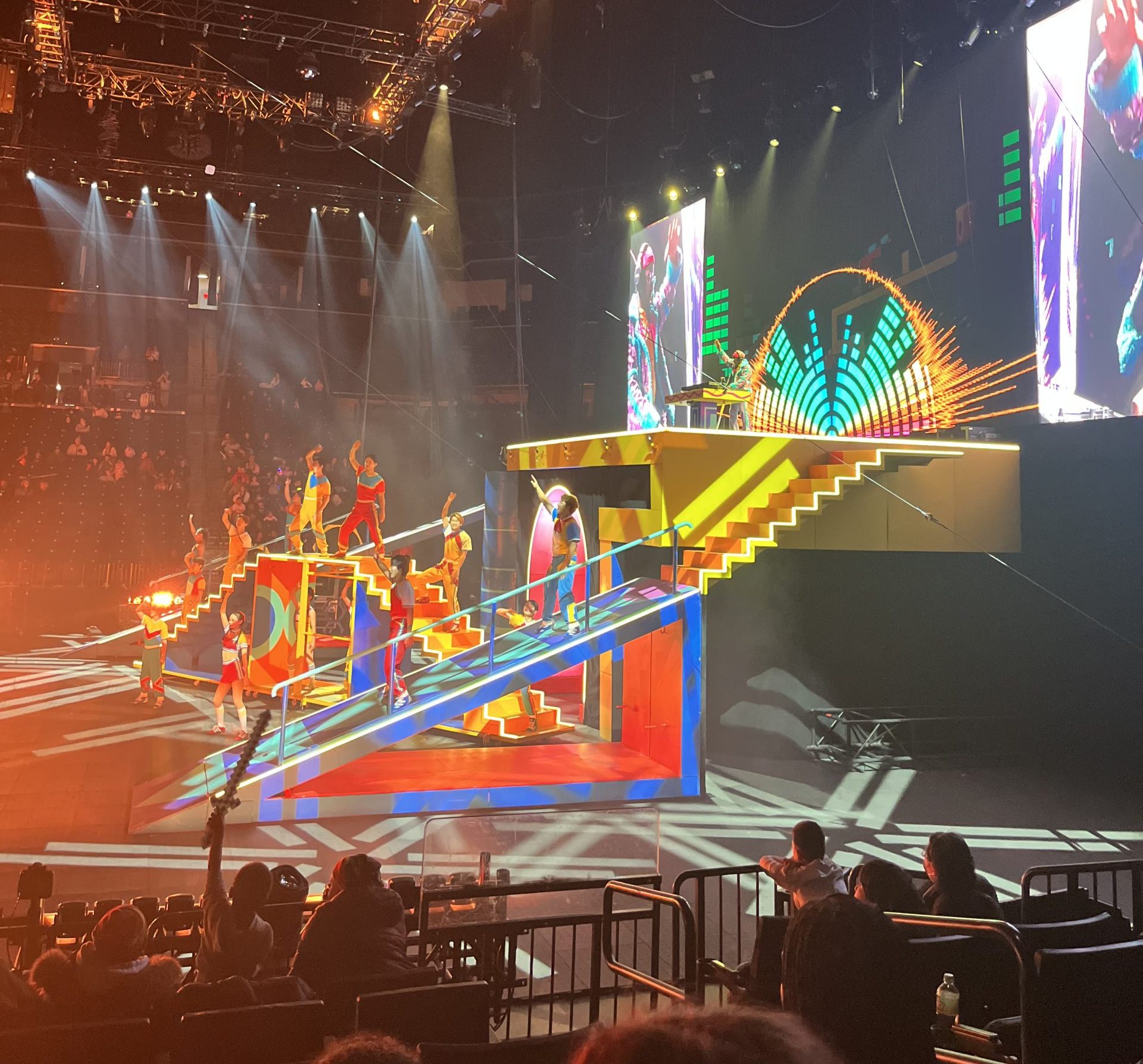
DJ Lucky leads a troupe of dancers. Photo by Cole Sinanian.
For the finale, performers wheel out an enormous, neon-lit cannon as a troupe of drummers beats a hypnotic pulse. The cannon’s ammunition? Skyler Miser, also known as “Rocket Girl.” Perhaps America’s only second-generation working human rocket, Miser’s parents, Brian and Tina, made history in the 2000s as the world’s only double human cannonball couple at the time, touring with a previous edition of the circus, according to the Ringling website. Continuing her family’s legacy, Miser’s portion of the show is short but spectacular— after a countdown, she flies some 110 feet out the cannon’s barrel at 65mph with the grace of an Olympic high-diver, landing in a heap as the dancers and acrobats swarm the stage.
“The soul of what that is, is entertainment for children and all ages,” Irving said. “And that means truly, adults and children come and are inspired and are wowed. That’s the reaction that we strive to give each and every show, these people from all over the world coming together on one stage, in one place, to showcase human ability.”