From the Archives – August 26, 2021: “Former Christ the King Star Jose Alvarado Signs with Pelicans”


Plenty has changed from CTK to Georgia Tech and the Pelicans, but Alvarado’s tough style of play hasn’t. (Photos from D1Scout.com, ramblinwreck.com, & @PelicansNBA)

By Noah Zimmerman

noah@queensledger.com

Five years ago, Jose Alvarado was named CHSAA Player of the Year, turning heads at Christ the King High School in Middle Village. Now the Brooklyn native is on his way to an NBA career, recently signing a two-way contract with the Pelicans.

“When I first met him I thought he was a win at all cost player, the ones I love,” said Christ the King head coach Joe Arbitello. “I knew he would be successful at whatever he chose to do. It’s not a surprise to me he’s in the NBA.”

Alvarado was a four-star recruit out of high school, landing at Georgia Tech under head coach Josh Pastner. In his first year he averaged 12 points, the fourth most by a GT freshman.

By his senior year, Alvarado was averaging 15.2 points and 2.8 steals, a tough player on both sides of the ball. He was named ACC Defensive Player of the Year as Georgia Tech finished 4th in the conference before making a run for the ACC championship.

“Jose is a hard worker, a real hard-nosed individual,” said Pastner. “Coaches love guys like him. He does all the little things to help you win games, fights for every 50/50 ball. That’s what made him Defensive Player of the Year and back-to-back steals leader, the first in the ACC since Chris Paul.”

Up five in the final seconds of the championship game, Alvarado sealed the title with a steal and assist.

“This is why I work my butt off,” said an emotional Alvarado after the game. “A lot of people doubted me. I wasn’t supposed to be in the ACC, but coach took a chance on me,”

Not many players in his situation end up in the NBA, but on draft night, Alvarado knew he had a chance.

“I worked out for 17 different teams and honestly I didn’t know who was going to pick me,” said Alvarado. “I knew the chances of getting drafted were pretty low, but as the process went I started to feel that this might happen, I might get my name called. When I got the phone call it was a dream come true, like a number one pick for me.”

While he didn’t end up picked in the top 60, Alvarado was a part of the Pelicans’ draft day plans. They kept a keen eye on him as they dealt their final pick of the draft, later picking up the Yellow Jackets star.

New Orleans was one of the most comfortable pre-draft workouts for Alvarado, who kept busy in the months leading up to the draft.

“It felt really good,” he said. “They welcomed me with open arms and good energy. It was a good fit, not forced or anything, one of my best workouts easily.”

In the NBA Summer League, Jose took the floor looking to prove he belonged on the roster. In his five games, he did exactly that, leading the team in steals, blocks, and rebounds per game while finishing second in points and assists.

Alvarado’s energy was contagious and he remained confident as ever on the ball. While he has plenty of growth to do, he got valuable experience to learn the speed of the pro game.

With his NBA career on the horizon, Alvarado still looks back to his time hooping in his hometown.

“New York is always gonna be my home, when I go to Christ the King, they’re always gonna be my family. They show so much love because they know my story, they were there with me. My story’s different from a lot of others because not a lot of guys like me get a chance to make it. Where I’m from, that’s never happened.”

Alvarado’s stats may not pop off of the box score, but his effort, dedication, and heart certainly stand out on the court. He knows his role and he plays it well. Whether starting, coming off the bench, or training with the team, the Pelicans are lucky to have Alvarado on board.

“I’m 6-foot on a good day, don’t have the craziest length, I can’t jump up and jam, don’t have the best jump shot, but I give my heart out and I’ll give it my all every time,” he said. “I play like I’m 7-foot and I play like I’m jumping out of the gym.”
This article was originally published on August 26, 2021. Alvarado was traded to the New York Knicks on February 5, 2026.

Mr. Greenpoint: The Life and Times of Pete McGuinness

Peter J. McGuinness in his Sunday best. Photo via Brooklyn Eagle.

Pete McGuinness left an indelible mark on the neighborhood he loved. 

GEOFFREY COBB | gcobb91839@Aol.com

Author, “Greenpoint Brooklyn’s Forgotten Past

Greenpoint, Brooklyn today is an area of luxury high-rise waterfront properties, pricey, Michelin star restaurants and chic boutiques. Its residents are increasingly Ivy League graduates who live an affluent lifestyle, but not long ago, Greenpoint was the heart of industrial, working-class Brooklyn, an area of blue-collar factory workers and longshoremen, and no one personified working class Greenpoint more than its Irish American political boss Peter  J. McGuinness.

A born and raised Greenpointer and former longshoremen, McGuinness represented Greenpoint on the City Council and then ran the area’s political machine from the end of the First World War until his death in 1948, as the last Tammany Hall style ward boss in the Borough’s history. People often said that McGuinness so embodied Greenpoint that it was hard to think of the one without immediately thinking of the other.

On Wednesday, February 25th, I will speak about McGuinness’ local legacy at the Oak and Iron Bar Local History Night, a forum where locals make presentations on aspects of North Brooklyn history. I have presented at the packed bar before and the atmosphere is great because we Greenpointers are really passionate about our community and its long, rich history.

I have written three books on Greenpoint history including, The King of Greenpoint Peter McGuinness: The Amazing Story of Greenpoint’s Most Colorful Character, which I published ten years ago. Though Greenpoint has over three hundred and fifty years of history, no character was as colorful as McGuinness and arguably no one left a greater legacy than Pete whose enduring contributions include playgrounds, the G Train stops, a bridge and the McCarren Park pool, just to name a few.

McGuinness, like the people he represented, grew up facing adversity and working hard. One of eleven children, Pete left school after eighth grade to work in the area’s lumberyards. An amateur boxer and a longshoreman, McGuinness was a powerhouse standing about six feet tall with a barrel chest, huge back and bulging biceps. Though he was a gentleman, he was well able to settle disputes with his fists. Once when six men tried to force him to accept a shipment of rotten lumber, a fistfight ensued, six-on-one. McGuinness knocked three of his opponents out and then lectured the remaining three on business ethics.

Nowadays, American politics is characterized by divisiveness, name calling and acrimony, but McGuinness, a Democrat, displayed a lifelong ability to work with Socialists and Republicans. He defied the Democratic Party and supported his childhood friend Republican John McCrate when he ran for the area’s congressional seat. When Fiorello LaGuardia defeated the Democratic candidate for mayor, McGuinness graciously stated, “The Little Flower is a most splendid gentleman. Under him, we know the poor people of this city will be looked after, irregardless of what may befall. What he done, he done honest and he done good.”

B. Charney Vladeck, a Socialist alderman from the Lower East Side and an enemy of corrupt Democrats was one of McGuinness warmest admirers. “That Irisher!” Vladeck used to say: “Sometimes he makes me wish I was a Democrat.” McGuinness won Vladeck’s friendship by giving Democratic sponsorship to a number of Socialist resolutions. “Many’s the time,” he said, “I used to say, Cheeny, old pal, if you got something you really want to get through this here board, give it to me, and I’ll make it Irish for you. I figured what the hell, if something was good enough for Cheeny, it was good enough for the other aldermen.”

McGuinness had a legendary sense of humor and there are a number of famous yarns about Pete. One of the funniest relates to Governor Franklin Roosevelt’s 1932 visit to Greenpoint as part of his presidential campaign. McGuinness and the future president were touring the area in an open car, and huge crowds lined the streets to greet them. Roosevelt saw Jewish businesses, Polish children dressed in traditional costumes and Italian Americans, but few Irish Americans. Roosevelt inquired about the absence of the Irish and McGuinness somberly told him that most of the area’s Irish were now dead and buried in Calvary Cemetery. A tense silence ensued and Roosevelt thought he said the wrong thing, but suddenly in a loud voice McGuinness retorted, “But don’t you worry Governor Roosevelt, those dead Irish will still turn out for you on election day.”

Though McGuinness had passed away some thirteen years previously, he was still so beloved that when Oakland Street was widened and made into a boulevard, both local Democrats and Republicans agreed it should be named in honor of its legendary political leader. Come out on Wednesday February 25th to hear more about this local legend.

NY Irish Center Calls LIC Home


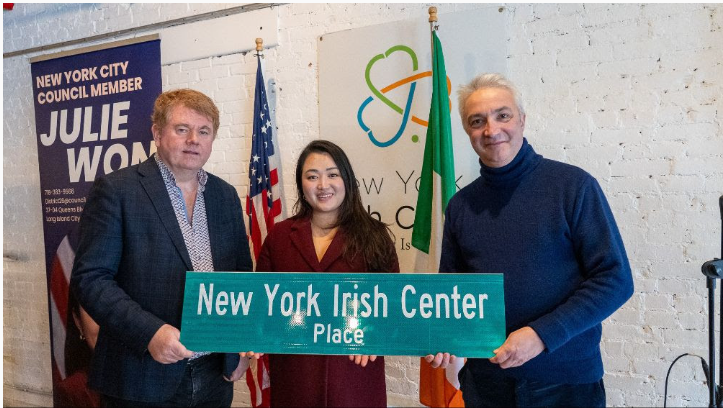
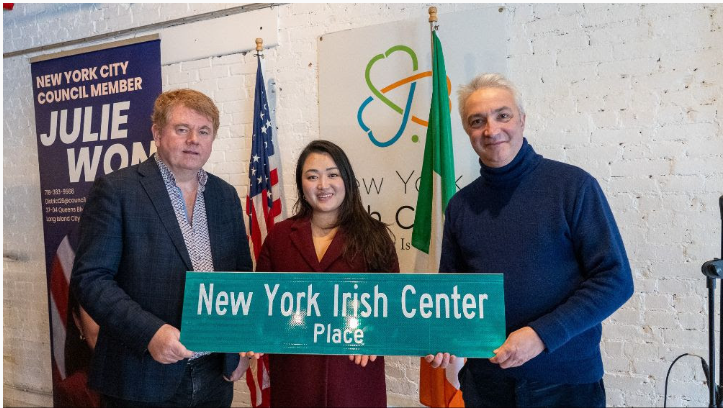
A section of Jackson Avenue was renamed ‘New York Irish Center Way’ in honor of the generations of Irish that have called NYC home. 

GEOFFREY COBB | gcobb91839@Aol.com

Author, “Greenpoint Brooklyn’s Forgotten Past

LONG ISLAND CITY  — It was a bitterly cold day on Saturday February 7th for the celebration of the renaming of the stretch of 1040 Jackson Avenue as New York Irish Center Place, but the Irish are a hardy bunch. About seventy brave souls defied the seven-degree day and subzero wind chill to watch City CouncilmemberJulie Won unveil the new street sign.

Won spoke of how her family, which immigrated from South Korea, was warmly greeted by the Irish community when she arrived in Queens as an eight-year-old. She related how Irish mothers passed on educational advice to Won’s mother and how supportive and welcoming the Irish community was to newcomers to Queens.

“It is important to honor the Irish who have done so much to build our community,” Won told me. Won has helped the center receive over $500,000 in grants. She said that last year alone a mind boggling 25,000 people came to the center, including many outside the Irish community.

The Center hosts three annual programs. In March it stages 40 Shades of Green, a Saint Patrick’s Day cultural marathon celebrating Ireland’s patron saint.  Along with Culture Lab LIC & McManus Irish Dance, the center presents the Queens Irish Heritage Festival as well. A world music series called Crossroads Concerts blends and juxtaposes Irish folk traditions with music from many other cultures.

Forty-three different organizations use the center for programming like Irish dance classes and Gaelic language and literature events, but the center’s outreach also includes non-Irish groups that serve the larger community including suicide prevention services, alcoholic anonymous meetings, immigration counseling and an ever-expanding list of others. The center welcomes people of all races, ethnic backgrounds and faiths. Last year, for example, eighteen Indian American events took place at the center. The center also teamed up with  Councilmember Won to raise more than $14,000 in a Christmas toy drive for underprivileged children.

For Twenty-one years, the Irish Center has served as the beating heart of New York City’s Irish community. The idea for the center was conceived by Belfast native Fr. Colm Campbell who saw a need for a place for the Irish community to gather. Angela Reily, the widow of legendary Irish folk singer Paddy Reilly addressed the audience on Saturday: “My husband would be happy to see how successful the center has become,” she said. The singer was instrumental in raising money for the center and helping to found it. Following a long and hard structural renovation and generous gifts from local Irish building contractors, the Center opened its doors in 2005.

The director and beating heart of the New York Irish center is Limerick-born George Heslin, who has run this multi-purpose community center for five years. Prior to his appointment, Heslin served for 19 years as founding Artistic Director of off-Broadway’s Origin Theatre Company. Warm, personable and capable, Heslin is also a recipient of the Irish Examiner/New York Man of The Year Award.  Though Heslin is modest, he proudly noted, “No other Irish organization does what the New York Irish Center does.”

Heslin says that first and foremost the center is a social service organization. The center radiates a typically Irish ability to welcome people, which Heslin demonstrates in his love for people, especially many of the Irish senior citizens for whom the center is a social lifeline.  He describes his work helping Irish seniors living out their lives overseas as a “privilege,” and said that the center plans to create more programs to cater to the needs of older Irish people including new programs in grief counseling and befriending seniors. Many of these seniors now have no living relatives in Ireland and the center is their only true connection to the land of their birth.  Dozens of these Irish seniors look forward to the lunch the center serves them each Wednesday.

Heslin and his small staff have worked hard to expand the cultural offerings the center stages, including traditional Irish music, dance and theater. Last year the center staged an astounding 160 events, which paid some four hundred artists who performed at them. Stageandcinema.com described the vibe at performances there as “ a bit like stumbling into a well-kept secret; it’s an intimate gathering place and an unassuming, cozy, cultural enclave.” The New York Irish Center is much more than a home to the New York Irish community. It is a home for thousands of New Yorkers, many of whom are not even Irish.  As former Executive Director of the New York Irish Center Paul Finnegan remarked, “It is fitting that this section of Jackson Avenue will now be called the NY Irish Center Place because it is home to an inclusive, caring community in a building built lovingly with the hands of its past and present generations.”

Early Days: Grand Street Opens Third Child Care Center in Sunset Park

The Sunset Park West Child and Family Center aims to address a shortage of child care providers in the neighborhood, with beautiful murals and holistic services to boot.

Kids line up to sing a welcome song at the opening of the Sunset Park West Child and Family Center on Friday.

By Jack Delaney jdelaney@queensledger.com

SUNSET PARK — Above the laundromat on the corner of 52nd Street, the toddlers were settling in for naptime. But for the adults, the celebrations had just begun — there was a ribbon to cut. 

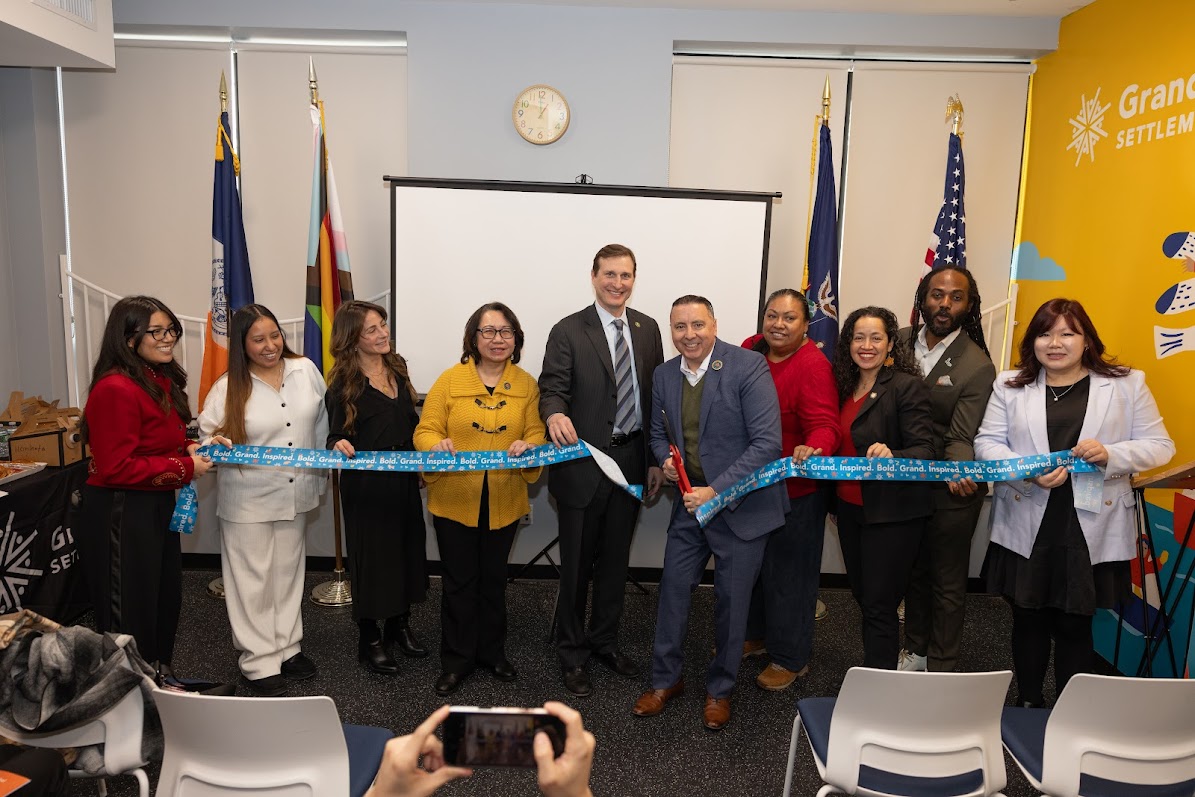
On Friday, February 10, Grand Street Settlement formally opened the Sunset Park West Child and Family Center, its third Head Start program in the neighborhood. The new hub, which began operating in January, provides free early childhood education to almost 100 children, along with initiatives for parents such as career services.

Stephanie Armilla, a lifelong Sunset Parker, said she and her son are already seeing the benefits.

Before the center opened, Armilla had been forced to stop working to take care of her two-year-old son. “I was scared. I was like, there’s no daycare,” she recalled. “That’s not even an option.”

Eventually, Armilla started bringing him to her family’s business on 49th Street and Fifth Avenue. But when two women came by to explain about a new space only a few blocks away with holistic services and an early start date, Armilla was thrilled: “Green flag, green flag,” she remembers thinking.

It’s only been a couple weeks, but Armilla has noticed promising signs. “I feel like his speech is improving — he converses more with me now, and with other people who say ‘Hi’ and ‘Goodbye,’” she said. “I just love my son coming here, honestly.”

Brooklyn reps join Grand Street staff to cut the ribbon, accompanied by local mom Stephanie Armilla (second from left) and Atiba Edwards (second from right) of the Brooklyn Children’s Museum.

Friday’s event kicked off with a brief song from a bashful choir of kids (“Hello to my friends / How are you today?”), before lawmakers, staff, and residents spoke about the importance of this milestone.

“The center is more than a building,” said state Assembly Member Marcela Mitaynes, a former child care provider herself. “It’s a solution in a neighborhood that has long been a child care desert.” 

That might even be an understatement. Policymakers define a desert as an area with at least three children under age five per available child care slot. Yet parts of Sunset Park have 10 kids for every vacancy, according to the Office of Children and Family Services, an especially severe shortage.

“We know that Sunset Park does not have enough center-based options, so that’s what we decided to do,” said Robert Cordero, CEO of Grand Street Settlement, a 110-year-old nonprofit that serves over 1,000 families throughout NYC. 

“I was a Head Start kid. I know that this works,” added Cordero. “This model is our North Star. It’s the most effective program that the federal government has ever done, by any measure.”

Willing Chin-Ma, Grand Street’s COO, highlighted the “hard work, long hours, and late nights” that had made this opening possible. There were landlords Dave and Mike Podolski, two “New York characters” who believed in the mission. There was an expensive renovation during a year that saw federal money dry up. And there was Melanie Ma, the center’s coordinator, who picked up a crucial permit right before Christmas so that the center could launch in January. (“That is commitment,” said Chin-Ma.)

Equally important, Cordero and Chin-Ma noted, was lawmakers’ support. The Brooklyn reps in attendance — City Council Member Alexa Aviles, state Sen. Andrew Goundardes, Rep. Dan Goldman, and Mitaynes — all received “Friendly Heart” awards, inspired by a page from a children’s book that Grand Street published for the occasion. 

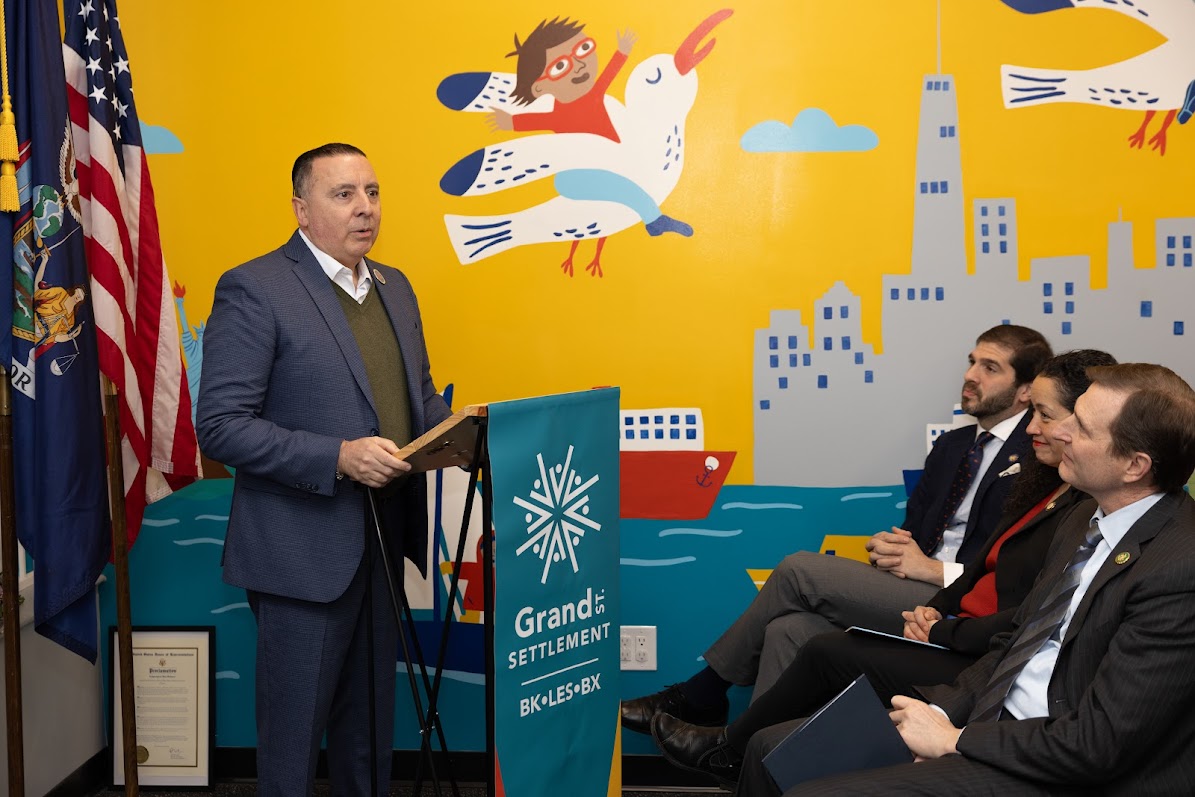
Robert Cordero, CEO of Grand Street Settlement, said that the Head Start program should be the city’s “North Star” as it looks to expand child care coverage.

Weeks after Mayor Mamdani and Governor Hochul announced a major expansion of universal childcare in New York City, Mitaynes in particular argued that raising taxes on the rich to fund health care for all remains vital.

Yet child care centers are pivotal, too. “In today’s context, where there is so much vitriol, and a federal government that is quite frankly fighting against us,” said Aviles, “it is places like this where people will feel safe and dignified.  They know they’re going to be the most precious thing in the world here.”

One element Armilla has appreciated, apart from a staff that “has been nothing but loving,” is the center’s multilingual approach, offering Spanish, English, and Chinese. 

“My son is half Jamaican and half Mexican, so the diversity even in the murals is like — he feels included,” said Armilla. “I feel that my son is seen here. As a child, that’s very important.”

To learn more about enrollment at the Sunset Park West Child and Family Center and other sites throughout Brooklyn, visit grandsettlement.org.

CB1 Votes “Yes” On Monitor Point, Breaking With Land Use Committee

The vote came at the end of a chaotic meeting that pitted local environmentalist against unions and housing advocates over the fate of Greenpoint’s last undeveloped waterfront land. 

By COLE SINANIAN | news@queensledger.com 

GREENPOINT — Brooklyn Community Board 1 voted Tuesday night to recommend the approval of Monitor Point, the proposed mixed-use development immediately north of Bushwick Inlet that’s stirred controversy over its scale and proximity to the half-built Bushwick Inlet Park. 

The proposal — a partnership between the Gotham Organization and the MTA — would add 3,000 new residents in three high-rise residential towers, the tallest of which would stand over 600ft. Most residents would be paying market-rate rent, while Gotham has committed to 40% of the 1,150 units being affordable at 40-80% Area Media Income, an income bracket of about $45,000 to $90,000. Of these 460 affordable units, 200 will be concentrated in the east building, which will be 100% affordable. 

CB1’s recommendation marks the beginning of the project’s Uniform Land Use Review Procedure (ULURP), a standardized process that guides development throughout the city. The recommendation includes conditions, like increasing the amount of parks funding from $300,000 to $600,000 annually, and that a “healthy majority” of the project’s apartments are affordable. 

The board’s vote marks a break from its land use committee, which voted unanimously last week to reject the project unless developers committed to at least 75% affordable housing. Community board recommendations are not binding, but the borough president, to whom the project goes next, is expected to follow the board’s recommendation. 

“The board kind of sets the stage,” said Stephen Chesler, who sits on CB1 and is the Vice President of Friends of Bushwick Inlet Park. “The borough president, and especially our city council member, have to answer to the people.” 

Gotham’s plans for the project —  located at 40 and 56 Quay Street — also include museum, retail, and public waterfront space, and would require a rezoning from medium to high-density. 

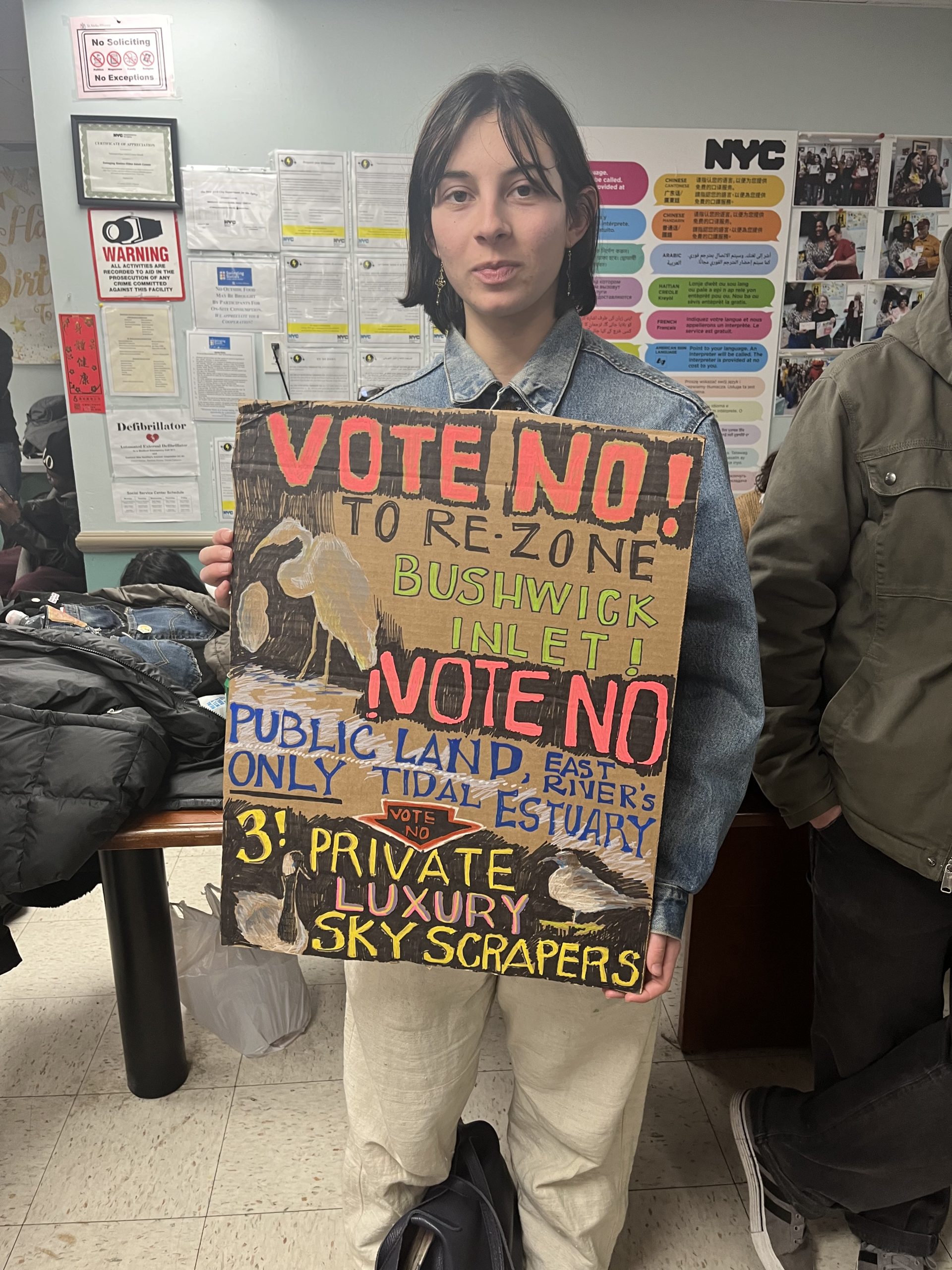
The project has garnered criticism from local environmentalists and open space advocates who’ve argued that the towers would privatize Bushwick Inlet for the buildings’ mostly high-earning residents and wreak environmental havoc on a rare and sensitive ecosystem that’s the last of Brooklyn’s undeveloped waterfront land. Critics have also raised concerns that the population bump could contribute to the area’s ongoing gentrification. 

Labor unions and several housing organizations, however, have supported the project on the grounds that it would bring necessary affordable housing to the neighborhood. 

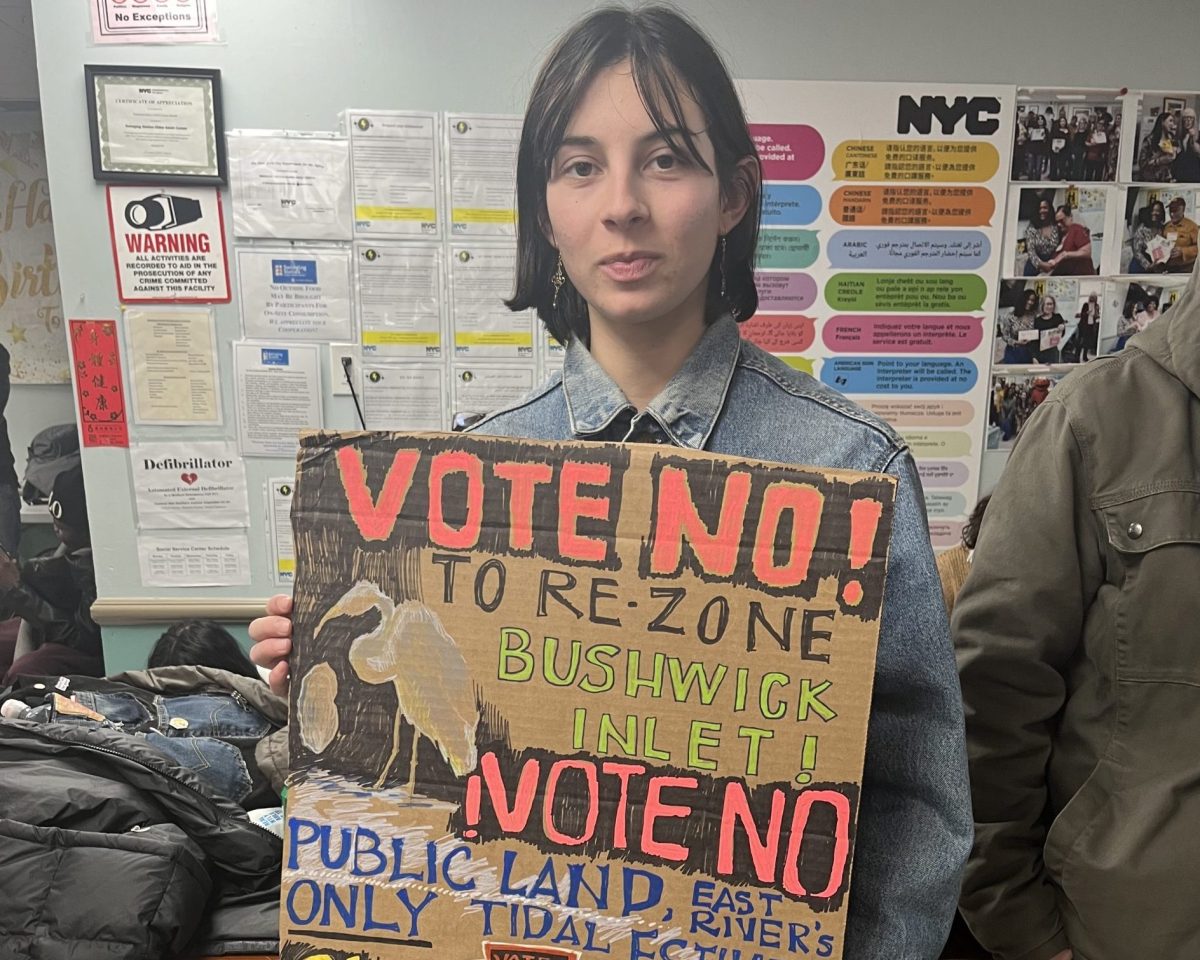
Marissa Bohk holds a sign she made advocating against the Monitor Point development at Tuesday’s meeting.

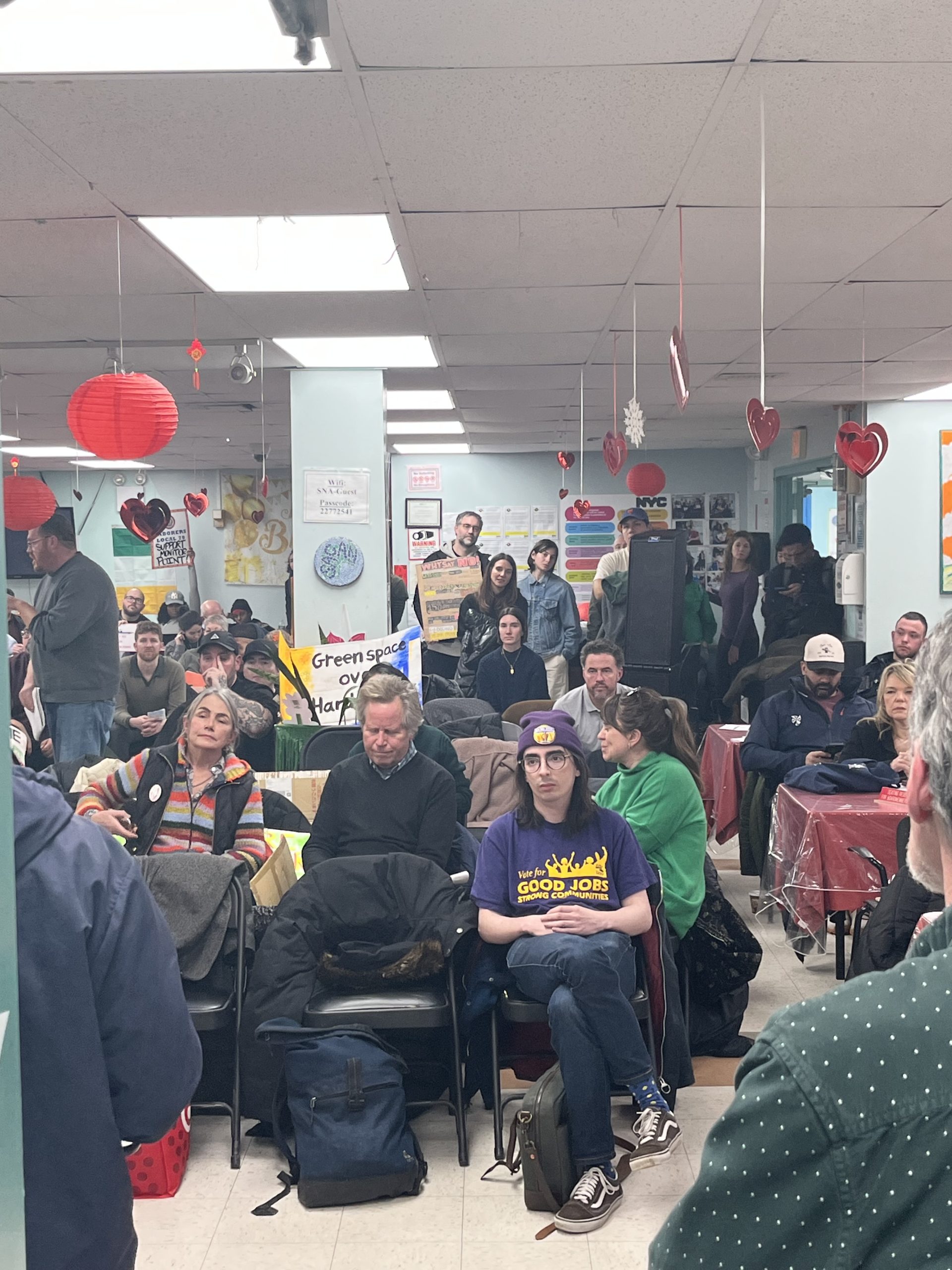
Tuesday’s meeting took place at the Swinging Sixties Center on Ainslie Street. Among the room’s “no”  crowd — many of whom held signs and sat together in the center of the room — rumors circulated that the project’s supporters were not from the neighborhood and had come to stir the pot on Gotham’s behalf. 

During the meeting, City councilmember Lincoln Restler held firm on his opposition to the Monitor Point towers unless developers could guarantee a “healthy majority” of their apartments would be affordable, a position he had previously stated at a January 20 hearing at the Polish Slavic Center. He also urged that Bushwick Inlet Park must be completed before any new towers can be built. 

“I am grateful to the members of our land use community for voting unanimously for more affordable housing, and for getting us on a path to fully funding Bushwick Inlet Park,” Restler said

He continued: “If, if, if this administration is able to actually put us on a pathway to building Bushwick Inlet Park, which has been promised to us for 20 years, then I think we have to have a real conversation. But until then, my position for four years has been that I’m not there on this project.”

Union members from Local 79 and the SEIU 32BJ building maintenance workers union sat together, booing those who spoke against the project, and cheering those who supported it. 

“You don’t build anything union!” yelled a man seated towards the back as Restler spoke. 

Both Local 79 — which represents construction workers — and the SEIU 32BJ building maintenance workers union have partnerships with the Gotham Organization. In a prior written statement to the Brooklyn Star, a Gotham spokesperson clarified that “all Gotham-owned buildings are staffed by 32BJ members.” 

During the meeting’s public testimony portion right before the vote, Local 79 union member and North Brooklyn resident Eddie Burgos said he supported the project for the waterfront access , affordable housing, and jobs it provided.

“Not only is it providing affordable housing, it’s providing union jobs for local residents like myself,” Burgos said. 

At a table in between the union members and environmental activists, several women wearing matching black t-shirts chatted in Spanish before the meeting. They had come with the United Neighbors organization (UNO), a tenant group supported by the housing organization, St. Nick’s Alliance. 

One, an older woman named Luz, explained in Spanish that this was her fourth meeting, and that she supported Monitor Point because the development would bring housing to her and her neighbors. Another woman, who held a bright green sign that read “Support affordable housing! Vote yes on Monitor Point,” said her friends had invited her to the meeting, nodding towards Luz. 

Ronaldo Guzman, the Deputy Director of Community Preservation at St. Nick’s, brought three of the women, including Luz, up to the podium during the public testimony portion of the meeting.  

“For the people of Greenpoint, please meet your neighbors,” Guzman said. “This is one of the few projects that is going to secure 40%, low income housing for our community,” he continued. “What is the use of a park if our community cannot even enjoy it?’

It was close to 9pm by the time the vote took place, by which point Guzman and the group from UNO had already left, as well as many of the Local 79 and SEIU 32BJ members. 

Several members of the public who spoke at the meeting began by stating their connections to the neighborhood. Scot Fraser, a longtime Greenpoint resident who also sits on Friends of Bushwick Inlet Park’s Board of Directors, evoked the displacement brought by the area’s 2005 rezoning in his testimony. 

“At our rallies in the 80s and 90s, we were a community united, locked away from our waterfront by fences, by pollution, by closed factories, by dumps and by parking lots,” Fraser said. “Now, after our rezoning, we are being walled-off by the golden handcuffs of high-rise towers.”

Fill the Form for Events, Advertisement or Business Listing