Red Hook Gallery Highlights “Alternative Visions” for the BMT

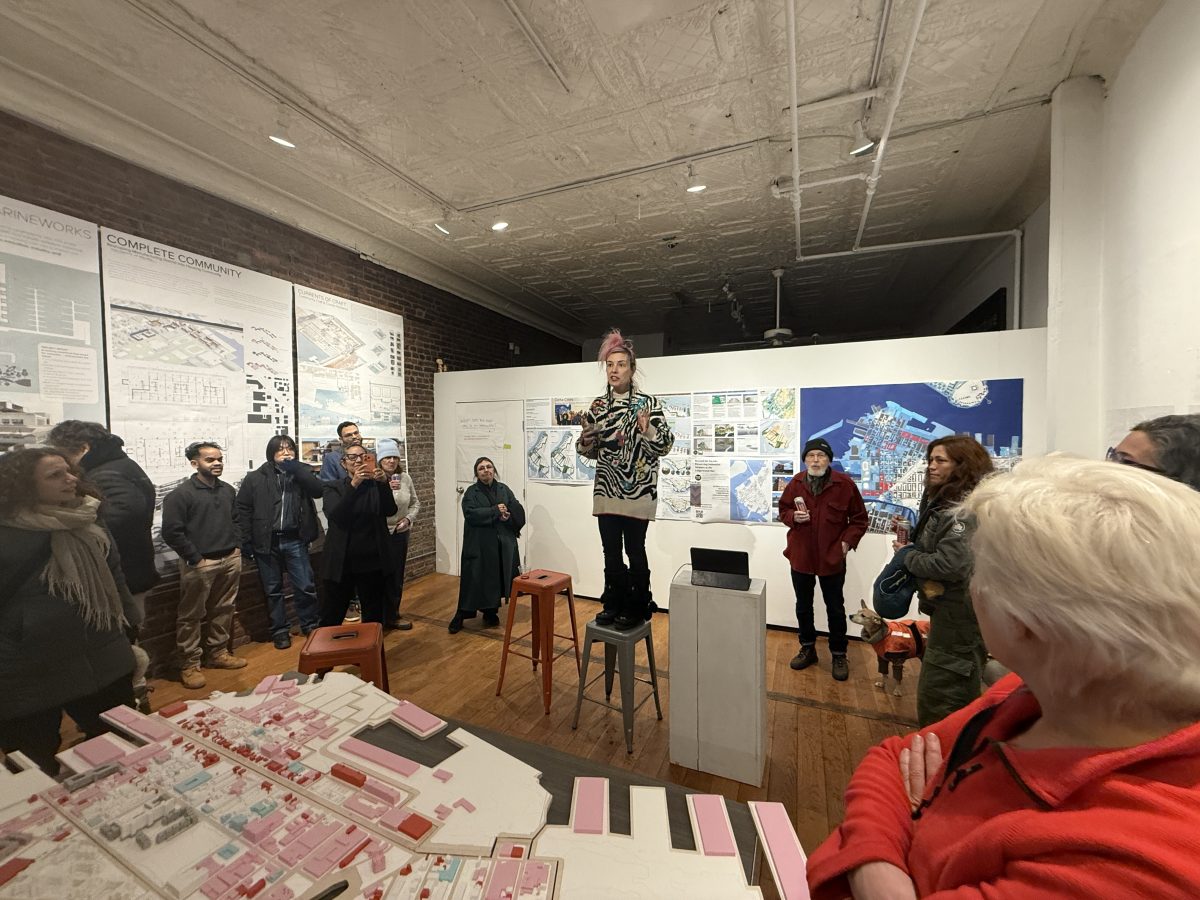
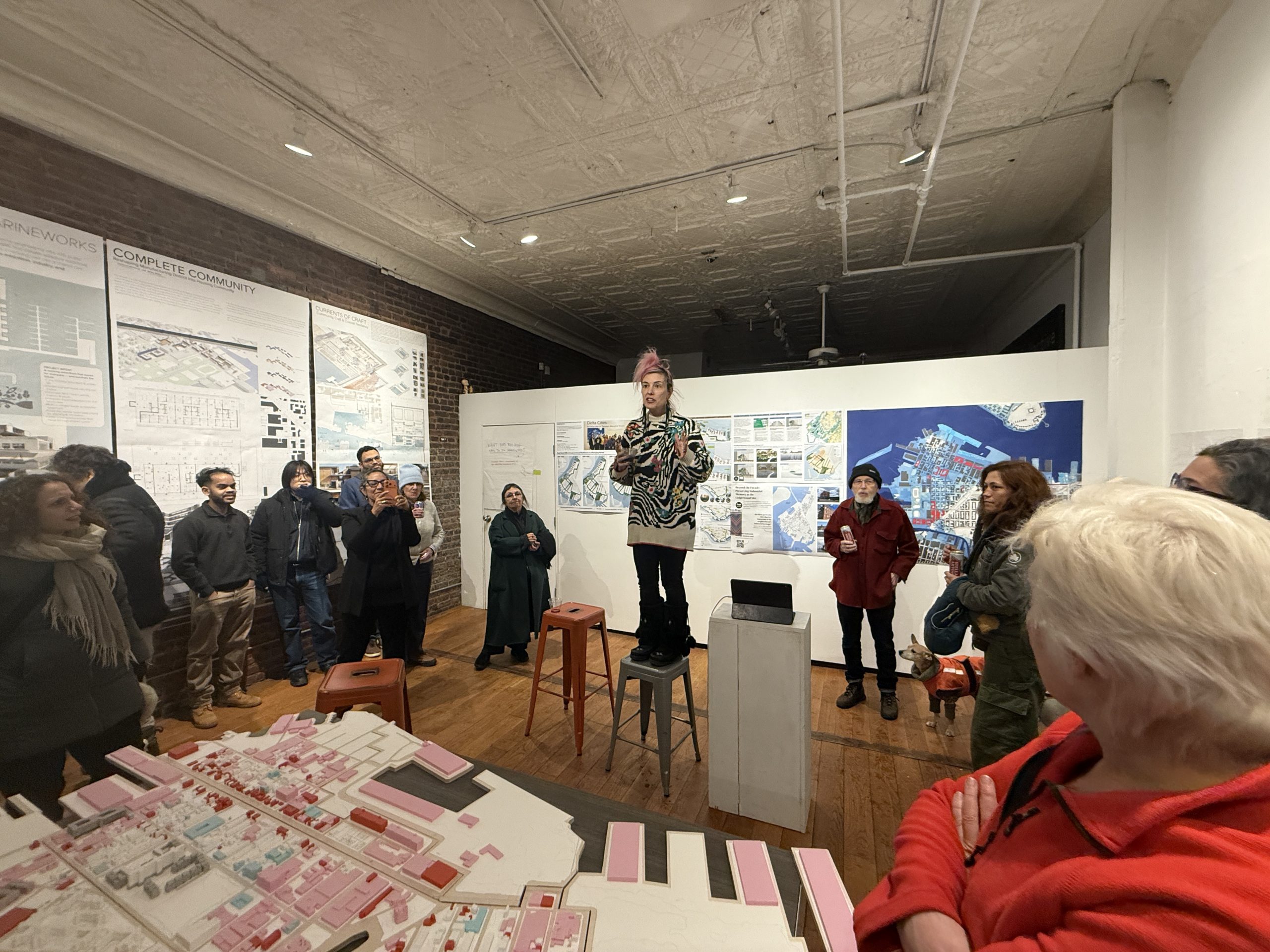
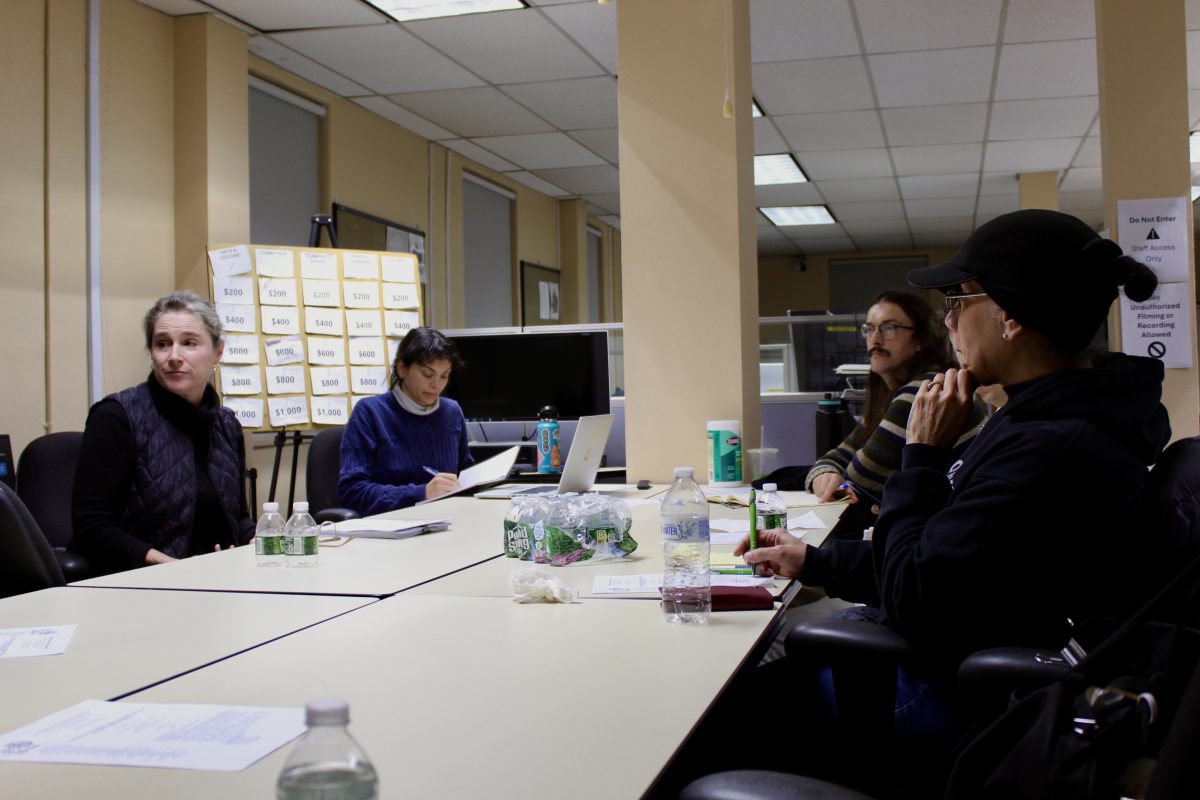
Victoria Alexander, director of Voices of the Waterfront, opens the show at Compere Collective’s gallery on Van Brunt.
By Jack Delaney | jdelaney@queensledger.com
RED HOOK — Last fall, the city pushed ahead with its plan to transform the vast dockyards south of Brooklyn Bridge Park into condos and a modernized port. Now students from Pratt, partnering with local organizations, have come up with their own alternate visions for the site.
Not everyone agrees they’re the right ones.
On Friday, January 30, the Compére Collective’s gallery on Van Brunt St filled with urban designers, architects, and residents eager to see the fruits of their labor.
The “BMT Alternative Visions Exhibit” builds on past collaborations between Resilient Red Hook, a coalition of the neighborhood’s business and nonprofit leaders, and Pratt’s School of Architecture.
The semester-long project was divided across four studios, which settled on three main proposals: creating floating structures that can adapt to rising sea levels; establishing a new agency to handle maritime matters; and integrating community spaces, such as parks, into the port.
In 2024, the city’s real estate arm — New York City Economic Development Corporation (EDC) — took over the Brooklyn Marine Terminal (BMT), a 122-acre site, through a trade with the Port Authority. Throughout 2025, Red Hook residents complained that the outcomes of the public engagement process felt predetermined, arguing that the EDC had already decided upon a plan that includes 6000 units of housing.
The new exhibit offered a foil to that experience. In a nod to the EDC’s workshops, visitors walked in to find a scaled-down model of Red Hook, albeit without the trays of plastic condo towers. Toward the front of the room, a station displayed another community-generated proposal for the BMT from Jim Tampakis of the City Club, who believes the dockyards should be reserved for maritime uses.
“We came to the conclusion very early on that we shouldn’t try to find a better housing solution for the port,” said Deborah Gans, a Pratt professor and the founder of a Red Hook-based architecture firm. “We should not do housing in the port.”
But given the political imperative to add housing across the city, Gans and her class decided to imagine creative ways it could be implemented. “There’s no such thing as just housing. That’s part of New York City’s problem. It’s housing plus community, housing plus resilience, housing plus economy,” said Gans. “So the students each proposed the plus: one has these carbon sequestering devices that take pollution from the port and tunnel and use it for algae farms, to feed people on the second floor.”
Another team tackled Pier 7, on the BMT’s north end. In their design, Christian Zoeller and Kaitlyn Lee envision flood walls surrounding a maritime trade school, with a green roof and workshops for local artists on the second floor. Elsewhere, projects ranging from stormwater drainage to art and industrial spaces stressed the importance of maintaining a “working waterfront.”
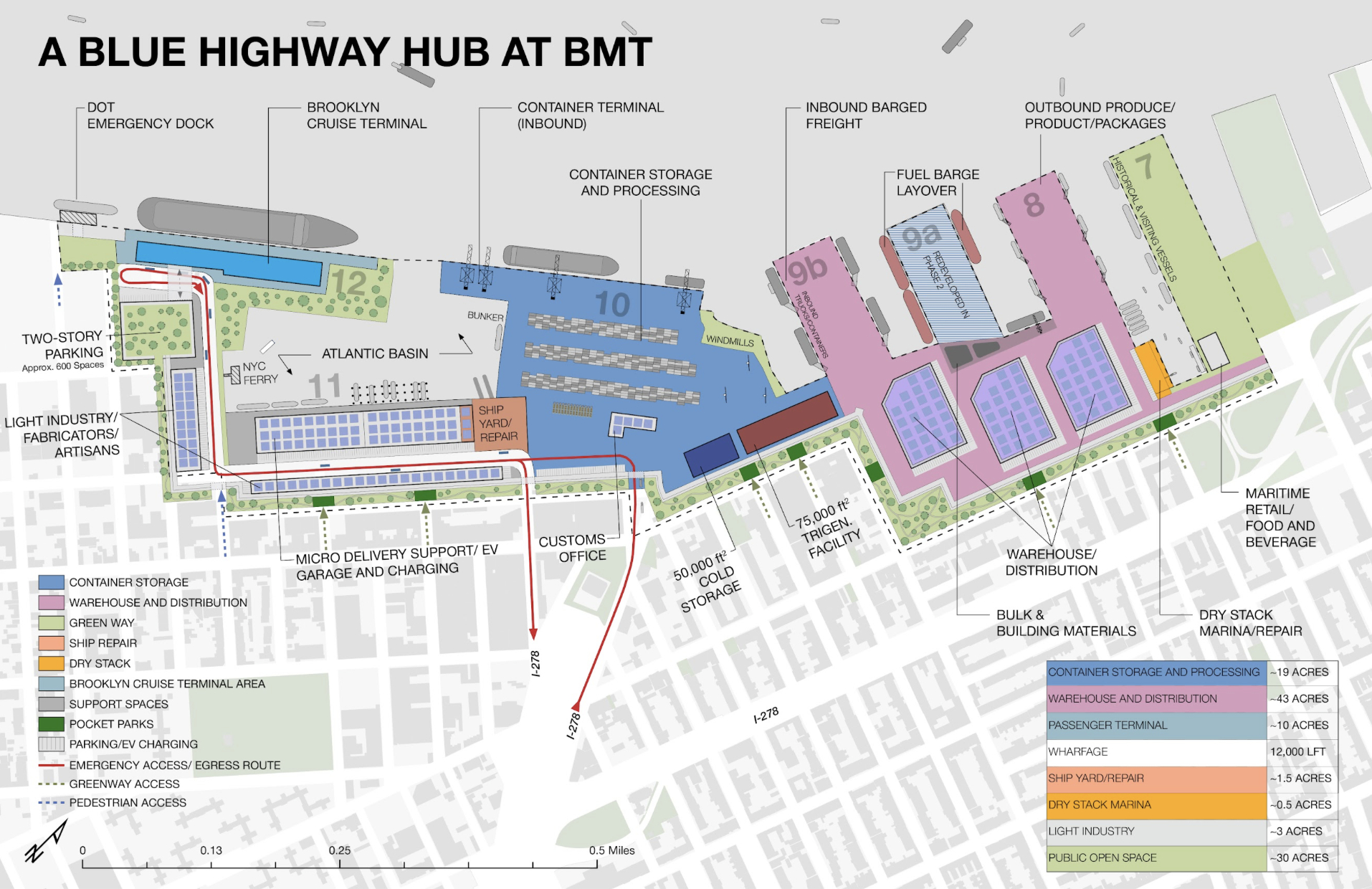
A new proposal from the City Club of NY would go all-in on restoring Red Hook’s port. (Graphic via Resilient Red Hook)
“We thought about what a future workforce would be,” said Professor Bethany Bigham. “We thought about what it would take to actually preserve the built fabric itself, and why it has been allowed to be unprotected for so many decades.”
The event drew an eclectic crowd. Matias Kalwill, part of a group looking to revive the former site of Red Hook’s Revolutionary-era Fort Defiance as a park, made an appearance, as did local power couple Sharon and Randy Gordon. Also present was Joe Leone, an environmental activist in Greenpoint raising money to convert a boat on Newtown Creek into a community hub.
Amid the celebrations, some reactions were mixed. “This is the kind of thing that we’ve been trying to stop urban planners from doing since, like, the 90s,” one resident noted quietly, pointing out a distinct lack of boats in most of the renderings. “These are obviously not maritime people.”
The subtle but palpable disjoint cut both ways. “It’s rare to work on a project like this that’s living and boiling and breathing,” shared one student, who designed modular housing that would use existing warehouses and industrial shops as its base. “It was amazing hearing their perspectives, but it sometimes seemed like they weren’t honest with themselves. Like, is it that you don’t want this specific thing in the neighborhood, or you don’t want development at all?”
Yet John Leyva, a tenants’ rights advocate from the nearby Columbia Street Waterfront District, echoed the sentiments of many residents who were thrilled with the exhibit.
Leyva and two neighbors sued the EDC in December for allegedly violating New York’s Open Meetings Law. In that context, the crowded gallery room — filled with dialogue about the neighborhood’s future — represented progress.
“This is what we were waiting for. [The EDC] was scared that the community would come up with great ideas, with the help of Pratt,” he said. “And we still haven’t given up.”
“BMT Alternative Visions” will be on display at 351 Van Brunt St through February 20.