State Explains No-Fine Call at Third Atlantic Yards Workshop

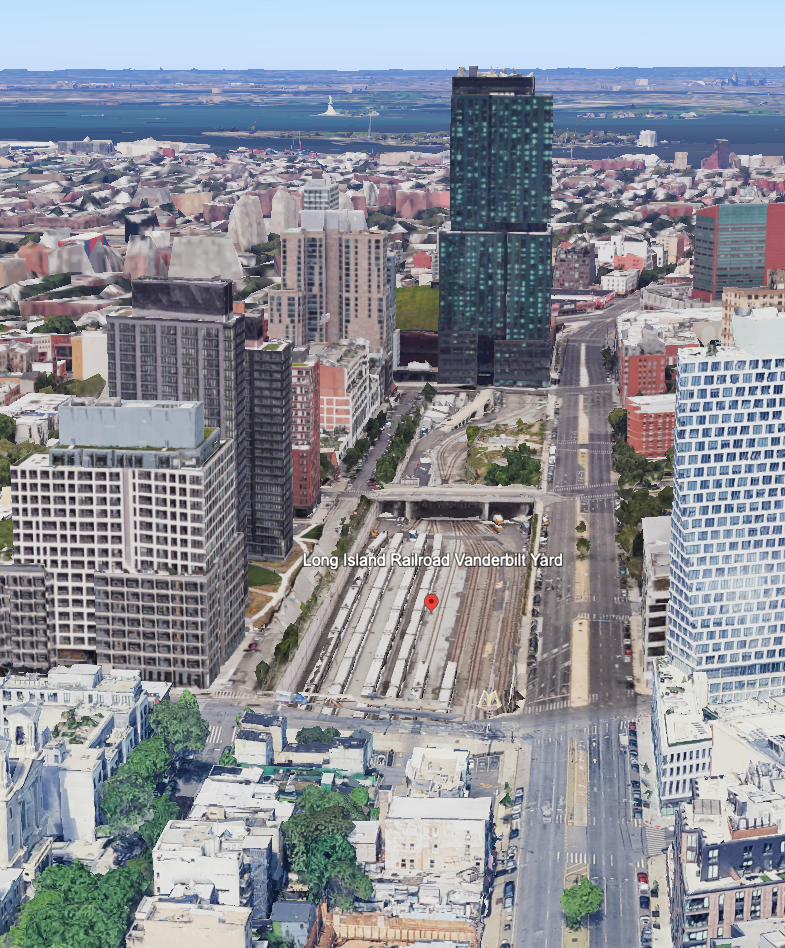
Atlantic Yards — a plan to build housing over the Vanderbilt Railyard, a LIRR storage space behind the Barclays Center — has new developers, as of last year, and the state has held several public forums in recent months as it pushes to realize the project.(Photo: Google Earth)

By Jack Delaney | jdelaney@queensledger.com

DOWNTOWN — If the new developers for Atlantic Yards get their way, the long-stalled effort to build housing behind the Barclays Center will be taller, and denser, than previously expected.

But as the latest round of public engagement winds down, major questions still hang in the air: What subsidies will the latest team, Cirrus and LCOR, need to realize this plan? Just how high are they seeking to build? And perhaps most importantly, for many residents, how will the vague but sweeping promises of affordable housing be enforced given the collapse of past accountability mechanisms?

After months of tiptoeing around this last issue, on Thursday, January 22, Empire State Development (ESD) — the state authority charged with overseeing Atlantic Yards — gave its most direct answer yet at the third of four planned public workshops, held on Zoom.

Under a deal brokered in 2014, the project’s previous developer agreed to pay $2,000 in monthly fines for each affordable housing unit that it had failed to deliver by May 2025. When that deadline arrived, however, only 1,374 of the promised 2,250 affordable units had been built — the same number as when the China-based firm, Greenland USA, had first assumed control.

Instead of levying the fine, which pencils out to nearly $2 million per month, ESD announced last fall that the new team would pay a one-time fee of $12 million, money that would go towards a fund supporting affordable housing in the surrounding community board districts.

At a meeting in October, community leaders criticized that amount as too meager. Michelle de la Uz, a founding member of the local group BrooklynSpeaks who now heads the Fifth Avenue Committee, noted that “we all share the goal of a project that is feasible and that addresses current and future public needs,” which for her included halting the displacement of Black residents. Yet she called the $12 million “insufficient,” echoing other BrooklynSpeaks founders who have characterized the sum as a betrayal of the original agreement.

The state reps see it differently. “That, to us, is part of a win here,” said Joel Kolkmann, a senior vice president at ESD, during Thursday’s Q&A session. “We want to be mindful that there are a lot of costs with this project, and a lot of challenges. There’s the infrastructure and platform costs, the rising costs of construction and uncertainty with tariffs. There’s a more challenging financing market in general.”

“We’re eager to get this moving.” — Joel Kolkmann, ESD

“We know that public resources are going to be needed for this project,” added Kolkmann. “We don’t know how much, currently, but what we do know is that we want to keep this project moving. We’re doing our best to minimize costs that are added to this project so we can make sure that this is a successful, impactful project with a large amount of housing, and affordable housing, which we know is sorely needed here.”

Atlantic Yards faces a unique hurdle, compared to other housing projects of a similar scale: most of the site is a railyard used by the MTA to store LIRR trains, and building over it would require expensive platforms that can bear a skyscraper’s weight.

One significant cost-cutting measure, in Cirrus and LCOR’s framing, is their proposal to build on top of the thin, crescent-like platforms that Greenland installed before it bowed out. That would allow for the creation of more open space, the developers say, and could accelerate the timeline given that the platforms are already in place — but it would mean adding more floors to maintain the quantity of units, which many residents have expressed uneasiness about.

The Cirrus/LCOR plan would be a supercharged version of its predecessors, pushing for 9,000 total units (up from 6,400), a maximum height of 775 feet (up from 620), and shifting from a mix of housing for both lower and upper income brackets to “a focus on middle incomes,” with rents up to 130% of the area median income (AMI).

Empire State Development Corporation’s Joel Kolkmann, left, and Cirrus Partners’ Joseph McDonnell.

What other large real estate projects in New York City have a density comparable to what’s being proposed here, a resident asked, namely 409 apartments per acre? LCOR’s Anthony Tortora replied that his team aims to “ensure our proposed plan is contextual to the surrounding area,” before rattling off a few points of reference: Hunters Point, Jamaica, and Long Island City.

At the second public event, held in the bowels of the Barclays Center back in December, some residents expressed cautious excitement that the project was gaining momentum again. Yet as watchdog reporter Norman Oder has noted, the engagement process has been “carefully managed,” a fact that several veteran community advocates called out at last week’s meeting.

“I would like to encourage more in-person engagement on this,” said state Assembly Member Jo Anne Simon, also a founding member of BrooklynSpeaks. “I know last time when we all met in different groups, there wasn’t a reporting back function, so we don’t know what the other tables discussed. I think that kind of feedback is helpful to people, because they learn from other people’s ideas. I want to encourage us to do more of that going forward.”

Later, a participant argued that the only constant on the project for the past 20 years had been ESD, the state monitor. What would be different this time around?

“Like you, we’re eager to get this moving,” said Kolkmann. “We want to keep on having conversations with you all. We want to keep on hearing what you think should be here, and we want to also keep on discussing how we can prioritize accountability and transparency along the way.”

The next and final workshop will be in February, date and time forthcoming. You can watch the full recording of the latest event at this link.


Cowboys and Capos: Inside Linda Stasi’s Red Hook Epic

Linda Stasi was the longtime co-host of NY1’s “What a Week” and is currently the book critic for CUNY TV’s “Uncensored.” She also teaches novel writing to journalists at the Newswomen’s Club of NY and was once named one of the “Fifty Most Powerful Women in NYC.” (Photo courtesy of Stasi)

By Jack Delaney jdelaney@queensledger.com

RED HOOK — When Linda Stasi decided to take her mother to dinner at Ferdinando’s Focacceria, she didn’t expect the whole restaurant to end up in tears. Nor could she imagine that it would kickstart her new novel, “The Descendant,” out on March 10.

It was 2010, and Stasi’s daughter had been working on the set of a movie being shot in Carroll Gardens. In the process, she befriended Frankie, the owner of the iconic — and sadly now-closed — Red Hook eatery. After she graduated, he offered to rent her the upstairs apartment; she’d declined, but now insisted that her ailing grandmother come by for a meal.

“Where are we?” she asked, as they settled in. But while eating panelles, a traditional Sicilian fritter, something clicked. She called Frankie over. After chatting with him about the place’s history for a few minutes, she put her finger on it: “My mother died here,” she declared.

“Everybody in the restaurant, they only seat 35 people — everybody started crying,” recalled Stasi, in a conversation earlier this month. “There’s truck drivers, people of every race, and they were all hugging my mother. They took down a picture from the wall; it was my grandmother’s apartment, and my mother said, this is where she died.”

That was the night that Stasi, a longtime co-host of NY1’s “What a Week” segment and the current book critic for CUNY TV’s “Uncensored,” felt her latest novel start to percolate. Inspired, she began digging deeper into family stories she had heard scraps of growing up, especially records of Italian immigration to Colorado.

“The Descendant” gently fictionalizes the remarkable lives of Stasi’s mother and grandmother, who was lured from Sicily to America by the false promise of land. After fighting their way from horrific coal mine work to ownership of a ranch, the family became embroiled in the Mafia and resettled in Prohibition-era Red Hook, above Ferdinando’s.

“The day they moved to 151 Union Street, her mother says, ‘Pull down the shades, pull down the shades.’ They said, ‘Why?’ And then they hear — BOOM, BOOM, BOOM,” said Stasi. “Somebody was shot in the vestibule of their building on the very first day they moved there. It was a real scary place at the time.”

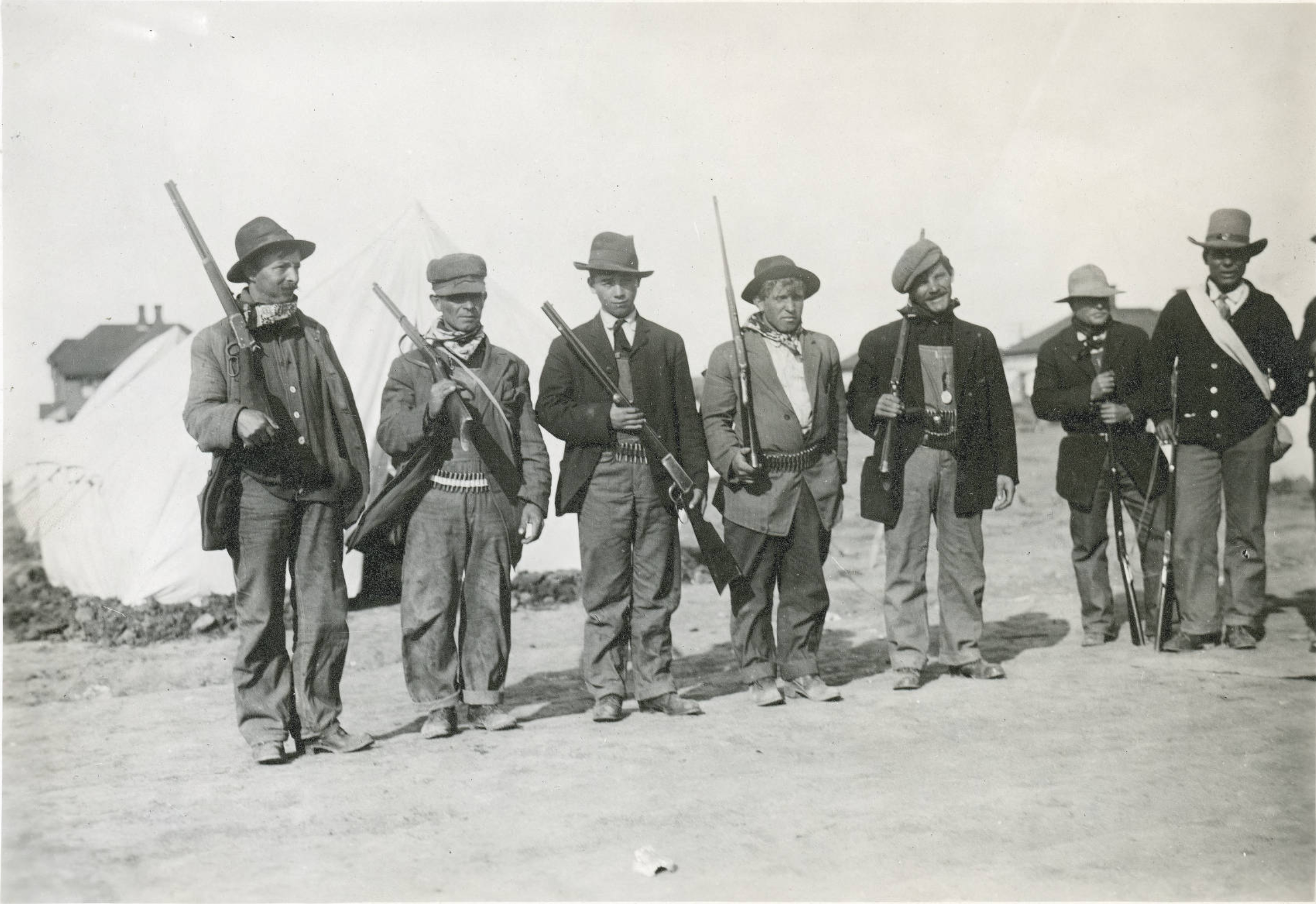
Coal miners strike in Ludlow, CO, in 1914. “The Descendant” follows the La Barbera family from Sicily to Colorado, before they finally land in Red Hook. (Photo: Wikimedia)

During the research process, Stasi came across another book, “Mountain Mafia,” written by her cousin Sam Carlino. Inside, she learned that her aunt had been married to a man named Charlie Carlino, who was killed in the longest gunfight in Colorado history when their daughter was only 10 days old.

The shootout, which took place on the Baxter Street Bridge, shared too many similarities with a scene in “The Godfather” to ignore. Stasi believes that its author, Mario Puzo, based his saga in part on old newspaper clippings about the Carlinos.

But the beating heart of “The Descendant” is the stranger-than-fiction saga of Stasi’s mother and aunts, a gauntlet of near-Biblical trials and tribulations.

First there’s the drought in Sicily, straining Maria La Barbera’s honeymoon. Mount Etna erupts; almost 100,000 people die in the ensuing tsunami.

“She didn’t understand that she couldn’t take a wolf to Brooklyn.” — Linda Stasi, on her mother’s unusual pet

America seems like salvation: higher wages, land of one’s own. But the voyage turns out to be a ruse, engineered by John D. Rockefeller to rustle up indentured labor. Coworkers die in cave-ins, and when a union intervenes, the La Barberas are caught up in one of the bloodiest crackdowns in American labor history: the 1914 Ludlow Massacre, part of the Colorado Coalfield War, which sees the National Guard open fire on women and children.

The family flees to the mountains, where Maria gives birth. Her husband Mariano, who has become abusive since leaving Sicily, threatens to kill the newborn — until a wolf intervenes to save her. (Though it seems improbable, Stasi says her mother really did have a pet wolfdog. “She didn’t understand that she couldn’t take a wolf to Brooklyn,” she explained, “so it was very traumatic for her.”)

Prohibition rescues the La Barberas from the brink. Mariano builds a bootleg empire off sugar beet moonshine, raking in the profits needed to buy a ranch. But tragedy strikes again, this time in the form of the Great Pueblo Flood of 1921, which whisks away the town of Pueblo and all of the family’s holdings.

“The Descendant,” from Regalo Press, is expected to release on March 10.

The blows don’t stop. Just as they’re pulling their life back together, Al Capone comes calling: Mariano has killed the wrong man, and it’s time to leave for Red Hook, also known as the mythical “Brook-a-Land.” Mariano goes ahead, only to gamble away the La Barbera’s savings, leaving them no choice but to cram into the tenement above Ferdinando’s. All that before the devastation of the Great Depression.

Stasi cites the late action writer Nelson DeMille as one of her greatest influences, and the brief, punchy chapters of “The Descendant” — combined with its heaping serving of catastrophe, and side of the supernatural — make for a total page-turner. Yet as Stasi notes, episodes like the Ludlow Massacre rarely feature in high school textbooks, and her rendering of a multicultural West in the 1910s doubles as a crash course in forgotten history à la Howard Zinn.

Northwest Brooklynites will find familiar names, such as Saint Mary Star of the Sea, but the novel is less interested in the local topography than in the effect this new environment has on the outdoorsy La Barberas and their tangled relationships within Red Hook’s Italian American community. (“On Union Street, Mariano was loathed, Maria was loved. He was feared, she was fearless. He took, she gave.”)

This is a restless epic, however, and it doesn’t stay in Red Hook for long. A death sends the narrative back to Colorado, before the story loops around to Brooklyn once more. World War II brings fresh questions of identity — yet the most compelling element is the one with which the book opens: the wolf. What is this guardian spirit, vengeful and wild and watchful, that accompanies Firenze, a stand-in for Stasi’s mother, from rugged hills to a bustling port? More than a thriller, more than an ethnography, “The Descendant” brims with a fierce love — I have your back, it will be alright — that rises above the tide of woe.

Stasi will be holding a book signing at The Corner Bookstore in the Upper East Side on March 10 at 6 p.m.

Fill the Form for Events, Advertisement or Business Listing