Inside Turtles All the Way Down, the Bed-Stuy Dive Hosting Monthly Turtle Races


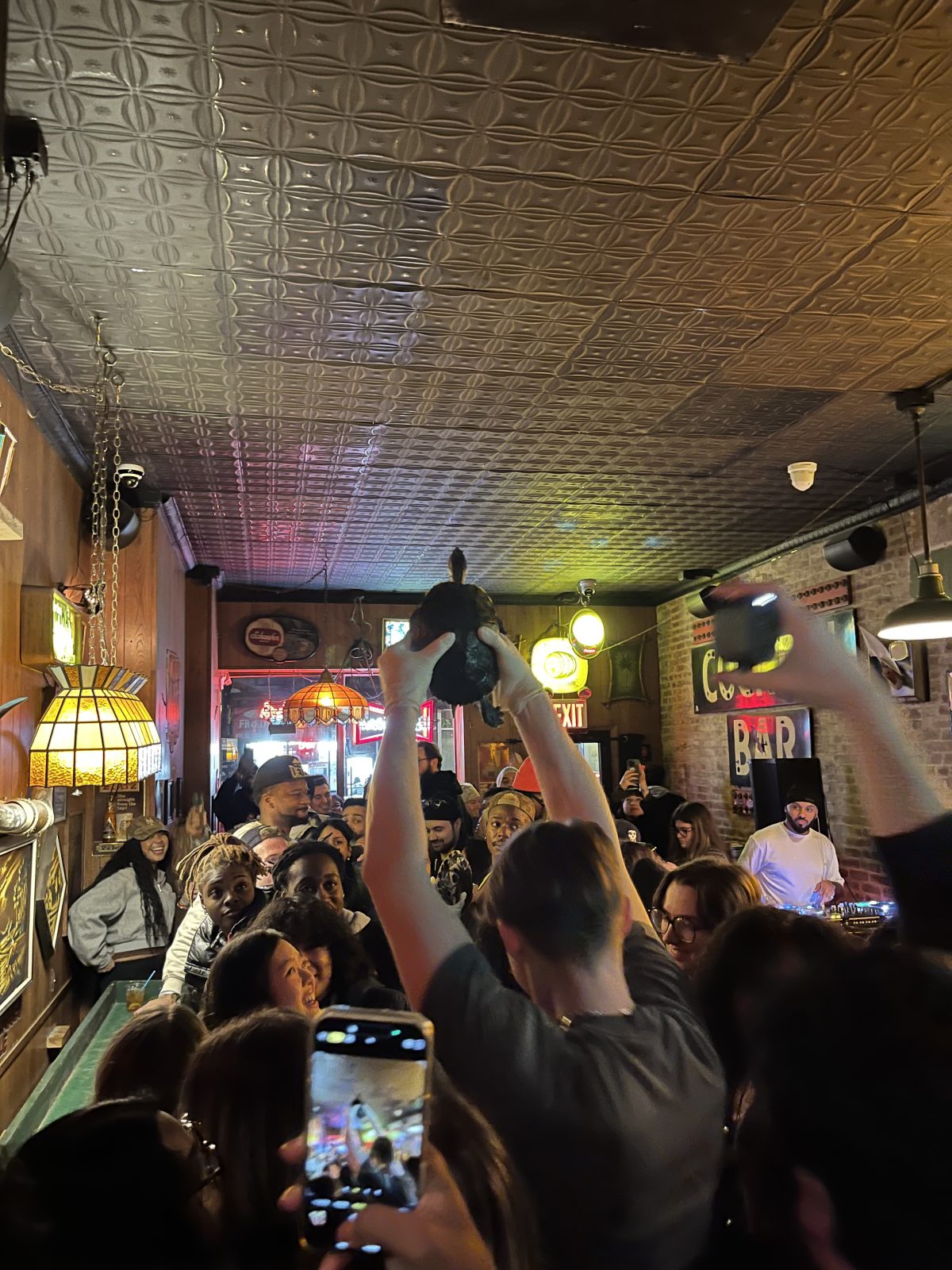
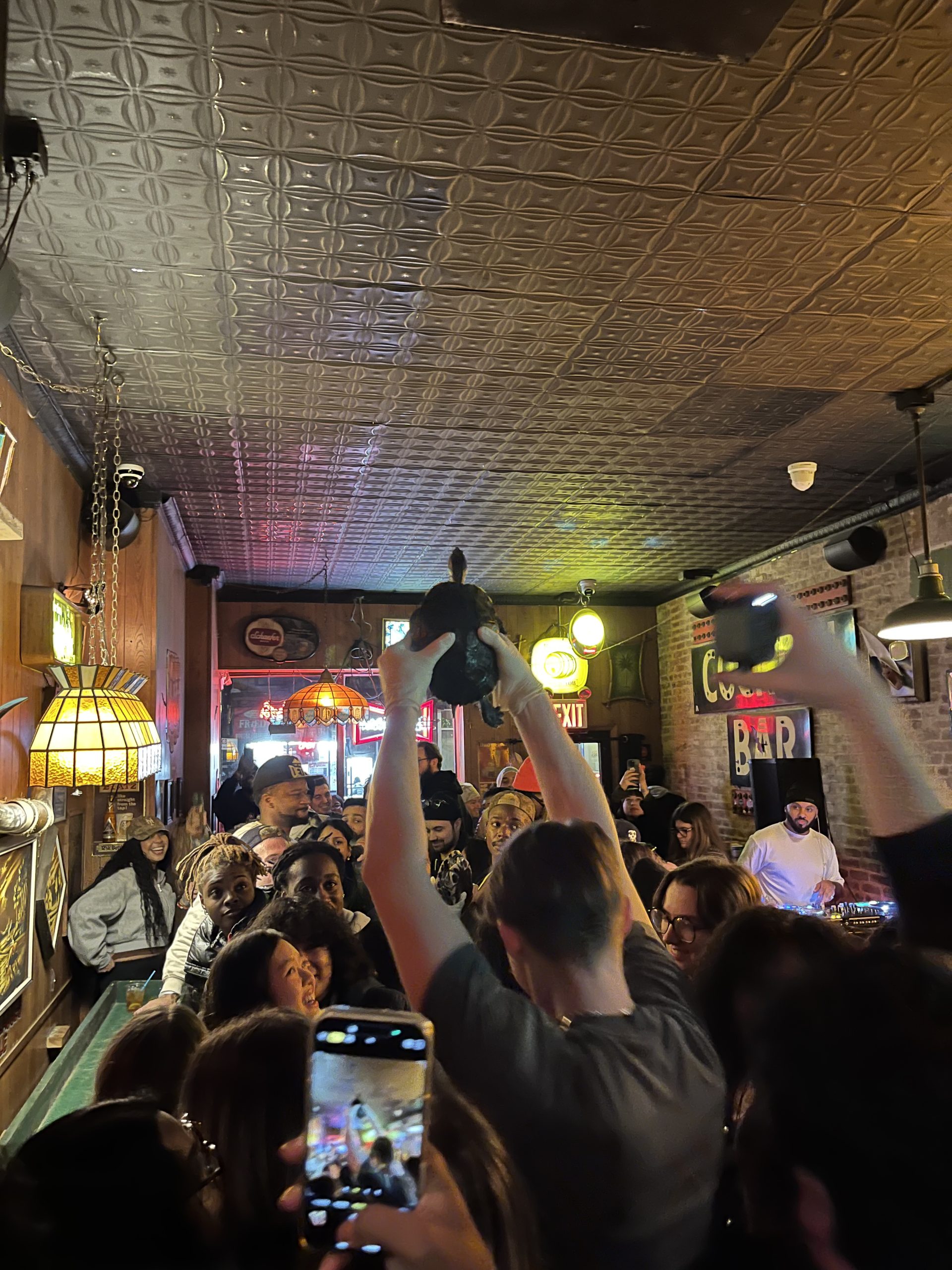
A bartender carries Ja Rule the pond turtle to the race course at Turtles All the Way Down in Bed-Stuy on Sunday.

By COLE SINANIAN | news@queensledger.com

Clad in a pair of white latex gloves, Mimi Martins smiles as she gazes into Ja Rule the pond turtle’s eyes, stroking his tummy and whispering words of tender encouragement. A barback approaches the racecourse with Vita — Ja Rule’s tank partner — held high above the heads of bargoers as they dance to Kendrick Lamar’s “Not Like Us” and shield their drinks from the dripping reptile. 

With dozens of phone cameras trained on the turtles, the race begins. Vita — the younger turtle — pulls her signature move, attempting to climb over the barrier and make her escape mid-race. Martins immediately grabs the turtle and returns her to the course, but not before Ja Rule can secure a comfortable lead. Cheers erupt— a turtle has crossed the finish line. But from behind the hoards of spectators pining for a look at the action, it’s not immediately clear who won the first race. For those stuck in the packed dive bar’s far corner, Martins’ partner, Cole, walks around between races holding up a large QR code that links to a livestream of the race. 

On the first Sunday of the month at Turtles All the Way Down, a popular dive bar on Malcolm X Ave in Bed-Stuy, turtles Ja Rule and Vita are the stars of what has become one of the neighborhood’s strangest and most anticipated Sunday spectacles. Now in its fifth year, the turtle races cost $5 at the door and include a free bet — a colored ticker corresponds to either Ja Rule or Vita. A winning turtle gets patrons a free drink. Before the races, Martins, who acts as emcee, stands on the bar and addresses the room with a microphone: 

“It’s good to see your beautiful faces on this mild, global warming December Sunday. My name is Mimi, I’m the turtle mommy, turtle host…” Martins grins. “I don’t want to say turtle master because that sounds a little colonialist and I don’t like that.” 

The turtle races start at 4pm, and by 4:30, a line has formed out the door. Get here after the second race (there are three) and the bouncer may turn you away. Spectators come from far and wide. During her first pre-race speech, Martins gets a read of the room’s occupants; there’s a group of Londoners, a man from Atlanta. In the past, she said, large groups from Spain and Mexico have attended the races. 

“I need camaraderie! I need kinship!” Martins says into the microphone. “Make new friendships! Hell, kiss somebody you don’t know.” Someone shouts from the crowd: “With consent!” “With consent,” Martins affirms. 
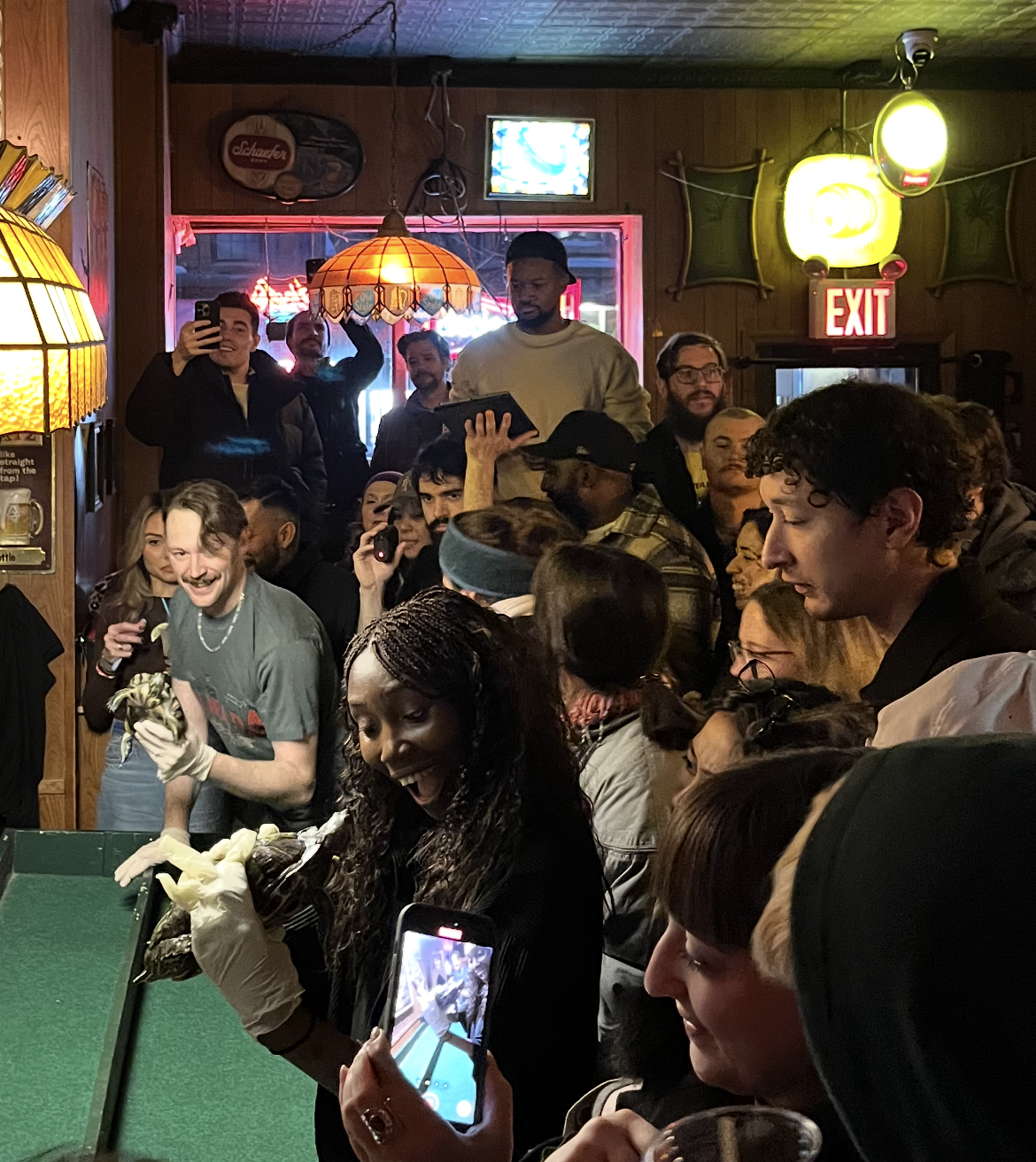
“Turtle mommy” Mimi Martins has a moment with Ja Rule before the race.

The bar’s turtle theme came more or less spontaneously. According to a manager who gave his name as Lean Automatic, the name was the idea of a former manager who had read the John Green book, “Turtles All the Way Down.” 

“They were just kind of throwing stuff around,” Automatic said. In epistemology — the study of knowledge — the phrase refers to the problem of infinite regress, or that any statement and its justification can be infinitely questioned. The phrase also alludes to the “World Turtle” of Hindu and Indigenous American mythology, upon whose back the universe rests. 

Turtles, which opened back in 2017, is one of a dozen bars throughout the city owned by the same company. Some, like Turtles and sister Bed-Stuy bar, Do or Dive, keep a deliberately eclectic, antique-shop-esque interior design. At Turtles, taxidermied fauna adorn the walls, including a hammerhead shark (Automatic says it’s real), an inflated pufferfish, and an elk head pinned above the bar that came from a taxidermist that Automatic insists killed the animal himself. 

“A lot of our bars are dressed with the same kinds of antiques, like vintage stuff,” he said. “We got guys that help us dress our bars. We got connections. So we got guys who do taxidermy, we got a taxidermist. We got a light guy.”

For the first few years, the fish tank held just fish. But after Ja Rule and Vita — named for the iconic New York-area rappers — were gifted to the bar, the owners suggested racing them once a month. Automatic, who was back then a DJ at Turtles, said the staff was initially hesitant. But the event gained popularity, even going viral on TikTok earlier this year, which Automatic and Martins say is why so many foreigners come to the turtle races. It’s all part of a unique aesthetic of liquor-soaked marine mischief, what a former manager once described as “aquarium dancehall,” Automatic said. 

“It’s our little aquarium and place to dance around.”

People have called the bar with animal rights concerns, although Martins said these concerns usually come from ignorance. The turtles’ ears are internal, meant to pick up low-frequency sounds, so the loud noise of the rowdy drinkers is unlikely to disturb them. 

It sounds like a low humming to them,” Martins said. “We did some research and learned all this. Their eyes are very sensitive, they know who I am, they have really amazing vision.” This is why flash photography is strictly prohibited, grounds for removal from the festivities, as Martins made clear in her pre-race speech. 

“I would die for them, straight up,” Martins said. I’m like, ‘oh my God, it’s our fifth anniversary Ja Rule.” 
 

Cobble Hill Pre-K Welcomes Pythons and Porcupines

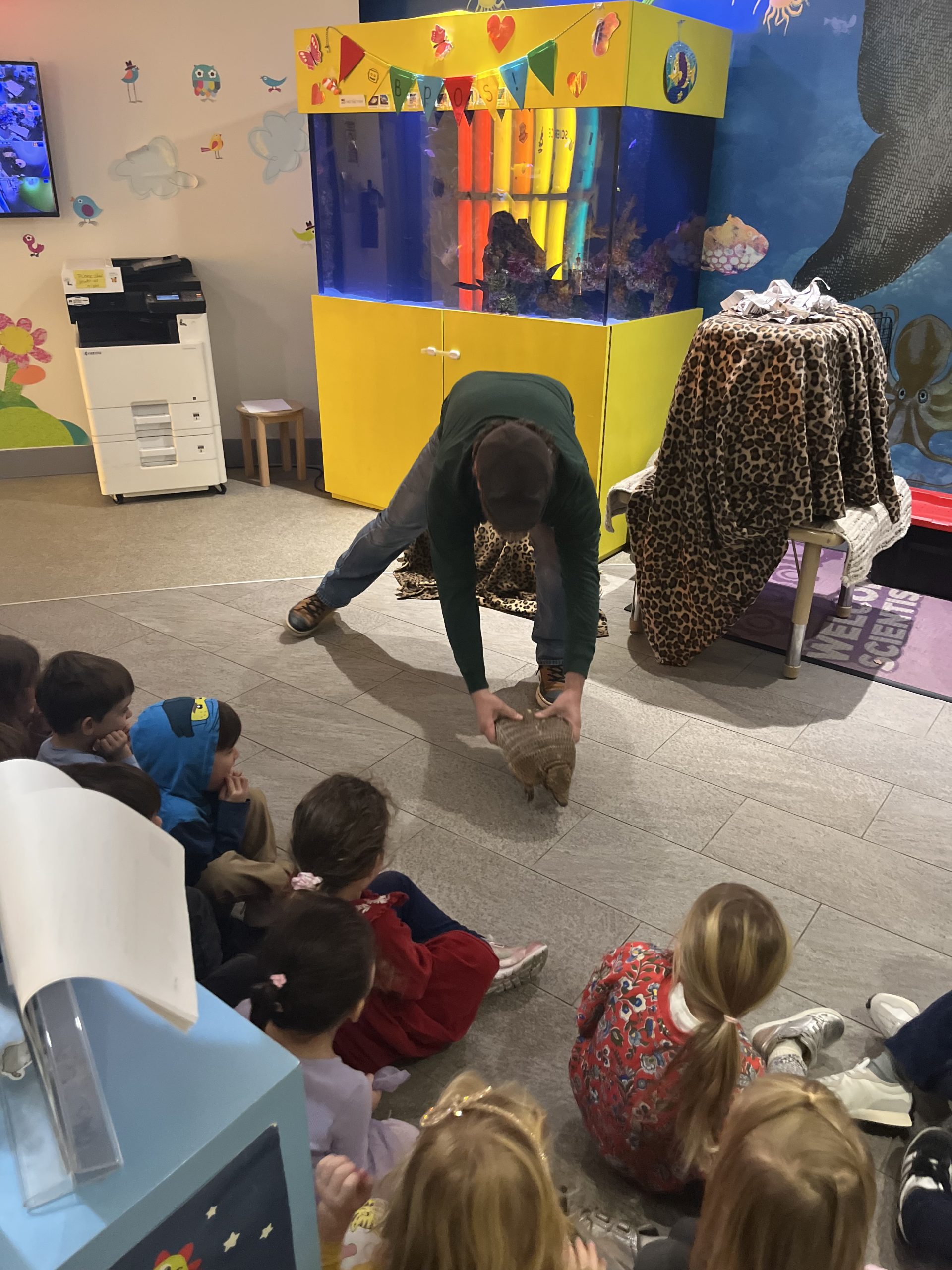
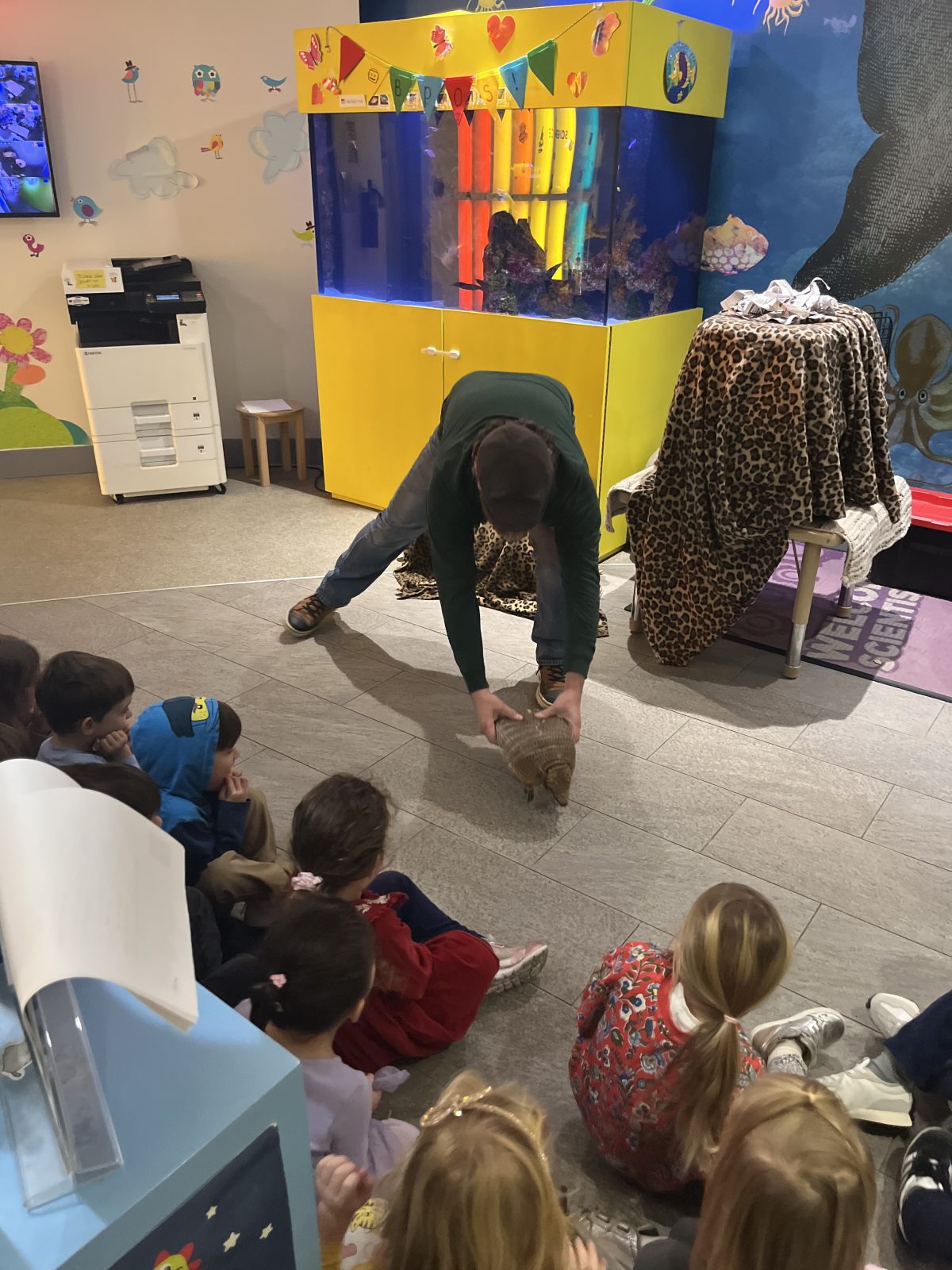
Travis Gale of Eyes of the Wild releases Dillon the Armadillo into a room of screaming pre-schoolers during an exhibition on December 2.

By Cole Sinanian 

news@queensledger.com 

“This is a full-grown elephant.” 

Travis Gale pauses for effect, holding up the back of the leopard-print blanket that covers the cage, its mysterious contents visible only to him. 

“BBRRRRRAAA!” His elephant trill is impressive. The dozen or so four-year-old Brooklyn Preschool of Science students seated criss-cross apple sauce around him scream and giggle in delight. 

Gale pulls out one strip of newspaper, then another, relishing the suspense.

“WE WANT TO SEE THE AMINAL!” shrieks a little blonde boy named Henry. 

Finally, out of the cage comes Dillon the six-banded armadillo. Gale takes care to explain to the children the difference between Dillon and other kinds of armadillos. There’s giant armadillos, nine-banded armadillos, and of course, the pink fairy armadillo of Argentina. Dillon, who Gale rescued from the exotic pet trade, is tortoise-sized with a hard, ridged shell covered in wispy long hairs. 

“Imagine your whole back is covered in toenails,” Gale said. 

“BE CAREFUL WITH THE AMINAL!” responded Henry. 

It’s clear Gale spends much of his time speaking in the register of children. “Good morning, toys and swirls,” he tells the kids before unveiling Dillon. He addresses them as “baby goats,” a kind of animal also known as a “kid.” As founder of Eyes of the Wild — an exotic animal rescue center based on a farm in Hunterdon County, New Jersey — Gale has been coming to Brooklyn Preschool of Science for the past eight years, bringing a different cast of creatures each time. Last year, he brought a wallaby. A few years before he brought a sugar glider, a kind of gliding possum native to southeastern Australia, and launched it at Miranda DeMartin, the school’s educational director. 

“As a science school, we’re always trying to figure out ways to incorporate different kinds of  sciences,” DeMartin said. “And children at this age, they have no fear of worms or snakes or animals.”

A visit from Gale and his furry friends fits nicely into the school’s educational programming. With locations in Cobble Hill, Park Slope, and Boerum Hill, Brooklyn Preschool of Science offers an interactive, activity-based curriculum where children’s innate curiosity is cultivated as a precursor to scientific inquiry. As DeMartin explained, interaction with the natural world is crucial to BPS’ curriculum. Pet guinea pigs, hermit crabs and frogs are kept in classrooms. In the Cobble Hill location’s entrance hallway, where Gale’s presentation took place, a giant sperm whale is painted on the wall. Each year, children hatch a cohort of classroom chickens and care for the young chicks, part of a study of the life cycle. In January, DeMartin says, the school will host a “bubble show” as part of its unit on states of matter. 

New Study Identifies Toxic Feedback Loop Along Newtown Creek

State regulators have homes in on 41 properties along Newtown Creek that may be leaking pollution back into the waterway. 

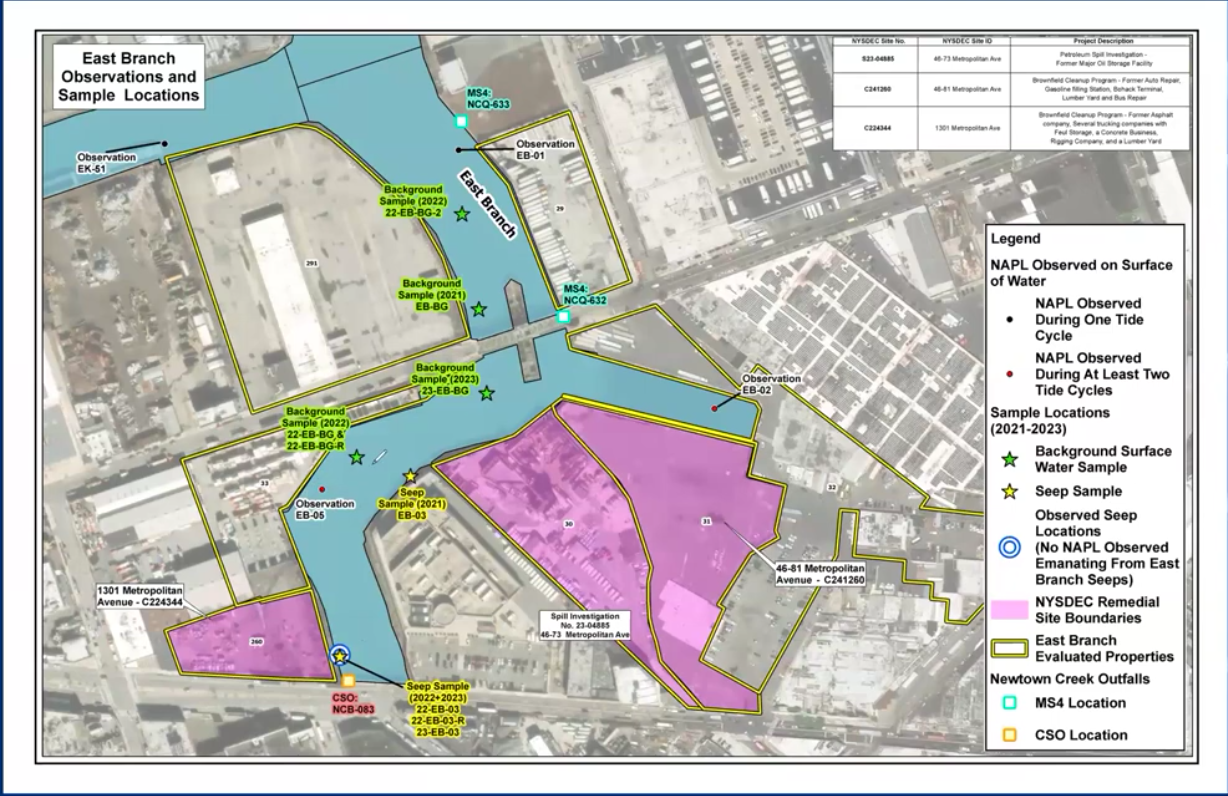
A map showing Newtown Creek’s East Branch, with locations with potential contamination marked.

By COLE SINANIAN | news@queensledger.com

The New York State Department of Environmental Conservation (DEC) has identified 41 sites along Newtown Creek that could be contaminating the waterway with petroleum residue and other chemicals leftover from its long history of industrial use. 

The DEC’s NYC Mega Projects coordinator Heidi-Marie Dudek presented the findings of the agency’s Newtown Creek Upland Study over Zoom at a community meeting in Long Island City on November 19. Between 2021 and 2023, regulators surveyed 155 properties bordering the creek, ultimately concluding that 41 could be potential sources of pollution. 

These sites included the Amtrak yard in Sunnyside, and properties occupied by businesses like Empire Transit Mix, Pebble Lane Associates, and Bayside Fuel Oil Depot, as well as former heavy industrial properties like the Phelps Dodge Refining Corporation and Pratt Oil Works.  

The area around Newtown Creek — which covers much of the current North Brooklyn Industrial Business Zone in Greenpoint and East Williamsburg — was used throughout the 19th and 20th-centuries to house oil storage facilities, manufactured gas plants, foundries, dry-cleaning businesses and oil and chemical refineries, a legacy that’s left it among America’s most polluted waterways. In 1978, a Coast Guard helicopter discovered the Greenpoint oil spill, one of the largest in US history, which would ultimately cause 17 million gallons of oil to seep into  the creek. After a series of lawsuits, ExxonMobil was ordered to pay for its cleanup. 

The Environmental Protection Agency declared Newtown Creek a federal superfund site in 2010, beginning a long remediation process set to finish by 2035. In addition to federal remediation efforts, state regulators at the DEC are conducting a Brownfield cleanup program to remove toxic soil from the area and limit contaminated stormwater runoff. 

The DEC’s Newtown Creek Upland Study aimed to identify potential sources of contamination from a handful of properties bordering the creek that are not already in a remediation program. However, Dudek urged that the results were only preliminary and that further investigation is needed. 

“It means that we need to look at them a little more carefully, maybe adjust some sampling if it’s already within a remedial program or see whether or not they need to be added to a remedial program,” Dudek said. 

Investigators first assessed the creek in 2021, looking for “seeps” — or locations where chemicals appeared to be entering the creek from the ground — and “sheens,” where petroleum residue accumulates along the water’s surface in a polychromatic film. After suspicious sites were identified, officials returned in 2022 and later in 2023 during low tide for subsequent sampling. 

Dudek discussed a few sites from the study in-depth. At 1301 Metropolitan Avenue, investigators found light petroleum contamination and verified that it once held an underground storage tank. Dudek confirmed that it would undergo a Track Four cleanup in 2026, which would remove groundwater contamination and cover toxic substances in the soil to prevent them from migrating to the surface. 

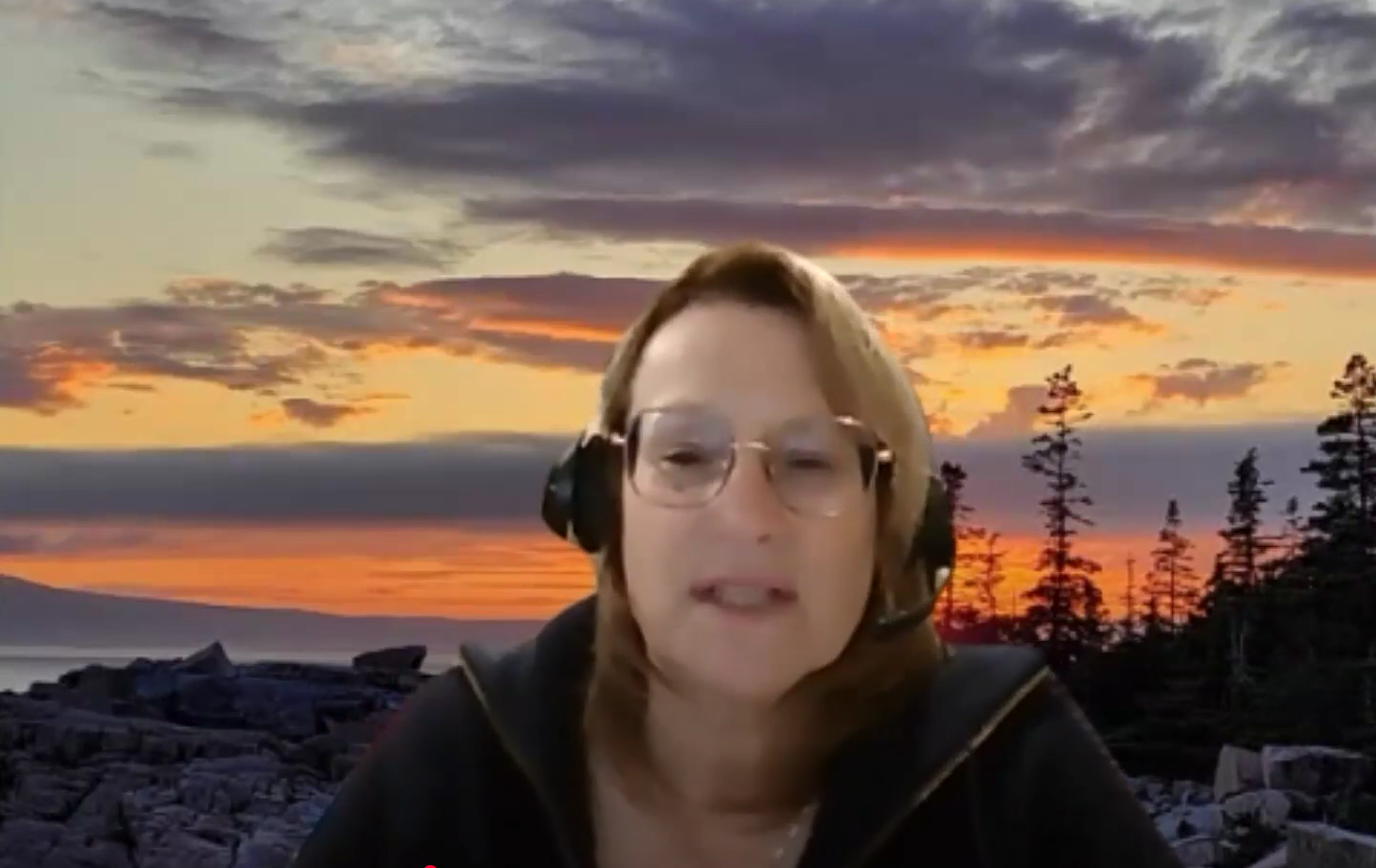
NYC Mega Projects coordinator Heidi-Marie Dudek presents study findings over Zoom at a community meeting on November 19.

At 4681 Metropolitan Avenue, investigators found volatile organic compounds (VOCs), carcinogenic substances that typically contain chlorine and are found in a variety of industrial chemicals. Though DEC investigators couldn’t find a direct source, they did install a soil-vapor-mitigation system to prevent VOCs from entering buildings on the property while a longer-term remediation plan is in the works, Dudek said. 

She assured residents that the DEC is working closely with the EPA to ensure all cleanup measures are coordinated with the EPA to ensure one agency isn’t undoing the other’s work.

“DEC is working in conjunction with EPA,” Dudek said “So we’re not doing this in isolation. We run all of the data and the RAPs (remedial action plan) through EPA to make sure that they concur that what we’re doing is going to be protective of their remedy too.” 

But residents who attended the meeting expressed frustration at the cleanup’s slow progress and concern that the DEC’s and EPA’s independent but sometimes overlapping remedial programs in the area may mean that regulators are underestimating the pollution’s extent. 

“A lot of work has gone into the site,” said Willis Elkins, a Sunnyside resident and Executive Director of the Newtown Creek Alliance. “But we don’t feel like a lot has been accomplished in terms of cleanup goals.” 

Elkins’ organization hosts youth workshops, volunteer cleanups and activities to restore the area’s environmental health and improve local access to Newtown Creek. Recently, the Newtown Creek Alliance held a joint “community share-out” with the Billion Oyster Project focused on restoring the creek’s mussel and oyster habitats. 

Before the arrival of European colonists, Newtown Creek was for many centuries filled with  plentiful fish, oysters, and waterfowl, which the indigenous Mespeatches people (the namesake of modern “Maspeth”) collected for food. Now, it’s hardly accessible to those living on its banks. 

”There are so many different layers of contamination in the area, and some are more of a direct hazard to folks than others are,” Elkins said. ”It’s impacting our ability to safely interact with the waterway.”

Fill the Form for Events, Advertisement or Business Listing