Brooklyn DA Offers AirPods for Guns in East New York

By JACK DELANEYjdelaney@queensledger.com

Could AirPods help reduce the number of gun deaths in Brooklyn? 

The DA’s office thinks so. On Saturday, local District Attorney Eric Gonzalez partnered with St. Paul Community Baptist Church in East New York to host a buyback event where Brooklynites could trade in guns for $500 bank cards — with the first 100 attendees getting AirPods, to boot.

“Brooklyn is about to finish this year with record lows in homicides and shootings — a testament to the comprehensive and holistic approach we have taken to reduce gun violence,” said Gonzalez, adding that gun buybacks are integral to those efforts because “they allow the community to get involved.”

By the time the six-hour event was over, a total of 157 firearms had been collected. Gonzalez’s team offered rewards that differed based on the type of weapon: $500 for operable guns and assault rifles, $200 for 3D-printed or ghost guns, $75 for rifles and shotguns, and $25 for airsoft, imitation, and inoperable guns.

The buyback followed a no-questions-asked policy, preserving the anonymity of participants. However, active or retired law enforcement officers and licensed gun dealers were ineligible.

“As a community-rooted Baptist church serving East New York since 1927, we are committed to promoting safety and wellness for our congregation and our neighbors,” said Rev. Dr. David K. Brawley, the church’s lead pastor. “To that end, we are proud to partner with the Brooklyn DA’s Office on gun safety initiatives that help reduce violence and support a healthier, safer community.”

A spokesperson for the DA’s office emphasized that it holds periodic buybacks throughout Brooklyn, pulling more than 600 guns out of circulation over the past three years.

This weekend’s event comes as the borough experiences a steep drop in gun deaths. Though shootings rose slightly in November, Brooklyn saw 29% fewer homicides in the first half of 2025 compared to the same period last year. Meanwhile, the city as a whole is on pace to post the lowest yearly tally of shooting incidents and victims in its history.

This Week in North Brooklyn: 11/28-12/4

★ The last public comment session for the environmental review of the 122-acre Brooklyn Marine Terminal proposal took place on Monday, but the deadline for written comments was pushed back to March.

★ Several small businesses on West St and Greenpoint Ave were given a 90-day extension after being told to vacate by November 30.

★ The embattled Atlantic Yards project in Downtown Brooklyn is moving forward after a two-year delay, with a public workshop on December 8.

★ Smith Street Maternelle, a bilingual daycare in Brooklyn Heights, is hosting a book fair on December 6 that’s open to the community.

★ The bougie “Williamsburg Winter Village,” set to open Dec. 5, is facing blowback for charging a $12 entry fee. 

★ Serial dine-and-dasher Pei Chung is now in jail at Rikers Island — and is getting evicted from herWilliamsburg high-rise by her landlord, who bizarrely enough is former NY governor Eliot Spitzer.

★ The F and M trains will permanently switch routes between Manhattan and Queens on December 8 to eliminate a merge at Queens Plaza. 

★ Grim: 38-year-old Timothy Taylor was sentenced to 22-years in prison for fatally stabbing his pregnant wife in their Williamsburg apartment in October.

“Red Cup Rebellion” Comes to Gowanus

By COLE SINANIAN | news@queensledger.com

Starbucks workers protesting against unfair labor practices in Gowanus on Monday, December 1, received a welcome show of solidarity when Mayor-Elect Zohran Mamdani and Senator Bernie Sanders showed up to address the crowd. 

The protesters, members of the union Starbucks Workers United, had been striking around the country since November 13 in the longest unfair labor practices (ULP) strike in Starbucks history. Workers  are on strike for a union contract that would boost staffing levels and to draw attention to the ULP charges the union has filed related to the Starbuck’s union-busting activities. The strike has been called the “Red Cup Rebellion,” and has affected some 95 Starbucks stores in 65 cities. 

The protest comes as Starbucks, which pulled in $37 billion this year, is being fined $35.5 million by the City’s Department of Consumer and Worker Protection for violating NYC’s Fair Workweek Law. 

Among the protesters was City Council Member and fellow Democratic Socialist Tiffany Caban.

Mamdani addressed the crowd amid signs with slogans like “What’s Disgusting? Union Busting!” and “No Contract, No Starbucks!”

“I’ve said this to many of the unions that are here today, many of the rank and file, which is that we want to build an administration that is characterized by being there for workers every single step of the way, “ he said. 

Sanders’s speech stuck to his typical themes of  America’s high wealth disparity and the increasingly powerful oligarchic class: “We are living in an economy where the people on top have never, ever had it so good,” he said. “You have one man owning more wealth than the bottom 52% of American households. The CEOs made unbelievable salaries, 60% of our people in Vermont, in New York City, all over this country are living paycheck to paycheck, struggling to pay the rent, struggling to pay for health care, struggling to put food on the table.”

South Slope Street Co-Named After Donna Maxil

By JACK DELANEY jdelaney@queensledger.com

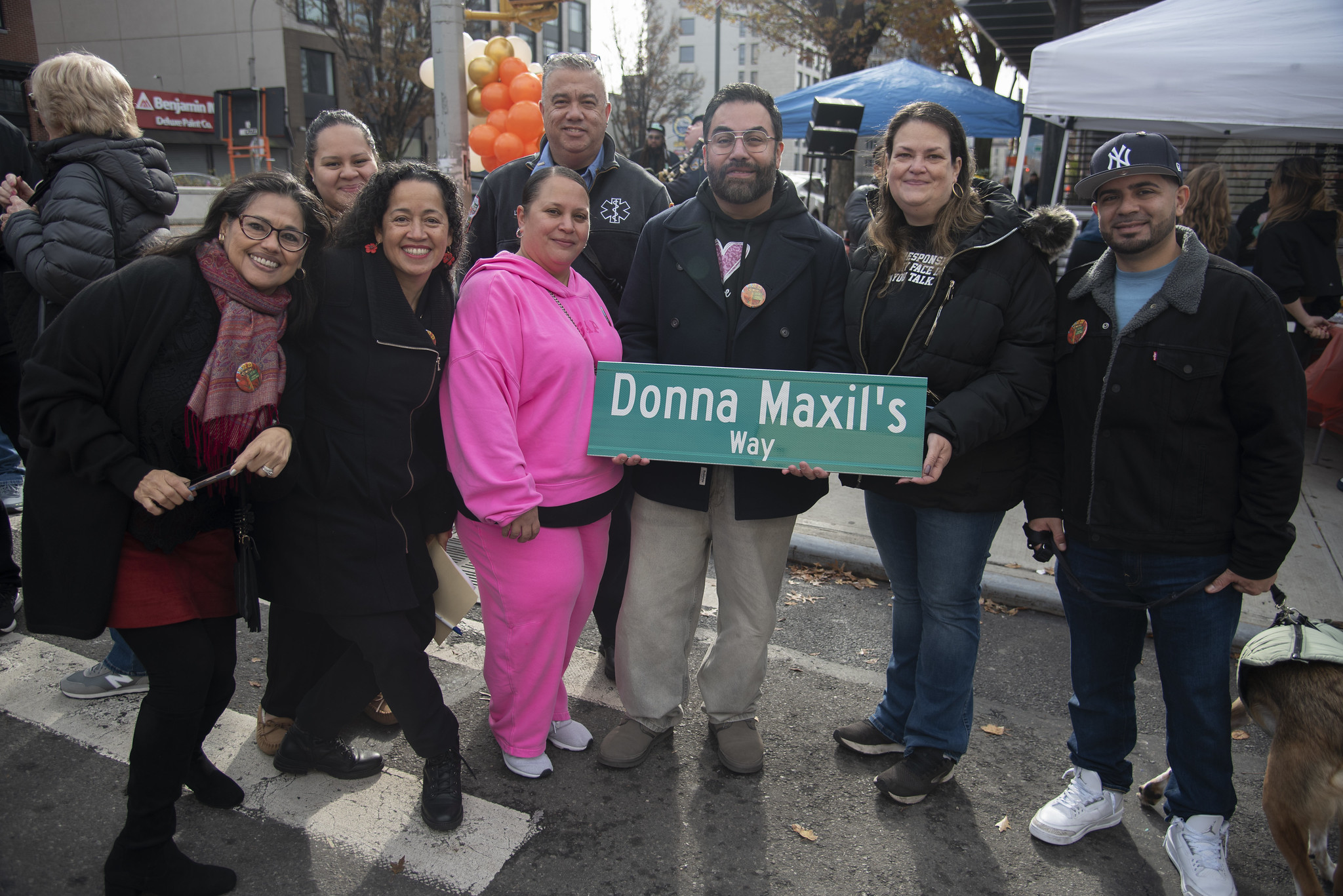
Late last month, a new street sign was affixed to a pole in South Slope, on 17th Street between 3rd and 4th Avenues, christening “Donna Maxil’s Way.”

Even if this co-naming hadn’t come to fruition, however, this small patch of Brooklyn would have been Maxil’s. “[Donna] was the perfect example of how if you take care of your family and neighbors, you can start to change the world,” wrote Anthony Almojera, one of several dozen community members who attended the ceremony on November 22, describing her as “a truly wonderful human being.”

Maxil was born and raised on the block, and continued to shape the neighborhood throughout her life. After battling cancer, she founded the 17th Street Cancer Crusade in 2005 to raise money for researching a cure. Though it started small, the block party fundraiser — featuring face paint booths, raffle prizes, and a flea market — eventually became a local staple that would draw friends and relatives from across the country. 

Maxil passed away in 2021, but the Cancer Crusade has continued under the auspices of her daughter Melissa. (Both Donna and Melissa were recognized by the Brooklyn DA’s office in 2013 as part of a 33-person cohort of “Brooklyn’s Extraordinary Women.”)

“Over the years, [Donna’s] name became synonymous with 17th Street,” said City Council Member Alexa Aviles, who represents the area, adding that she was “deeply beloved and respected by her family and community.”

Having once attended local elementary school PS 124, Maxil would later give back as a long-time PTA member, then paraprofessional, and finally parent coordinator. As news of the co-naming spread, tributes from former students poured in online.

“I am lost for words,” said Rob Aurelius. “[She] was such an amazing school aid, and she always made sure I kept out of trouble. Even in my adult life, Donna and I always kept in touch and hugged every time we saw each other. Thank you, Donna, for being a positive influence in my life.”

Fellow PS 124 alum Mercy Figueroa echoed Aurelius’ sentiments. “I will always remember how she brought homemade goodies for us in school like chocolate lollipops,” said Figueroa, writing shortly after Maxil’s death. “She had a beautiful and kind smile.”

Maxil also served as the president of the 72nd Precinct Council, working to connect local law enforcement with her neighbors. Officers joined residents at the co-naming celebration, and the precinct’s post about the event summed the prevailing feeling up concisely: “May this new name stand as a lasting tribute to her life, legacy, and impact on our community.”

Menin Declares Victory, Extending Brooklyn’s City Council Speaker Drought

By JACK DELANEY jdelaney@queensledger.com

The race to become the second most powerful official in New York City had scarcely started before it was over.

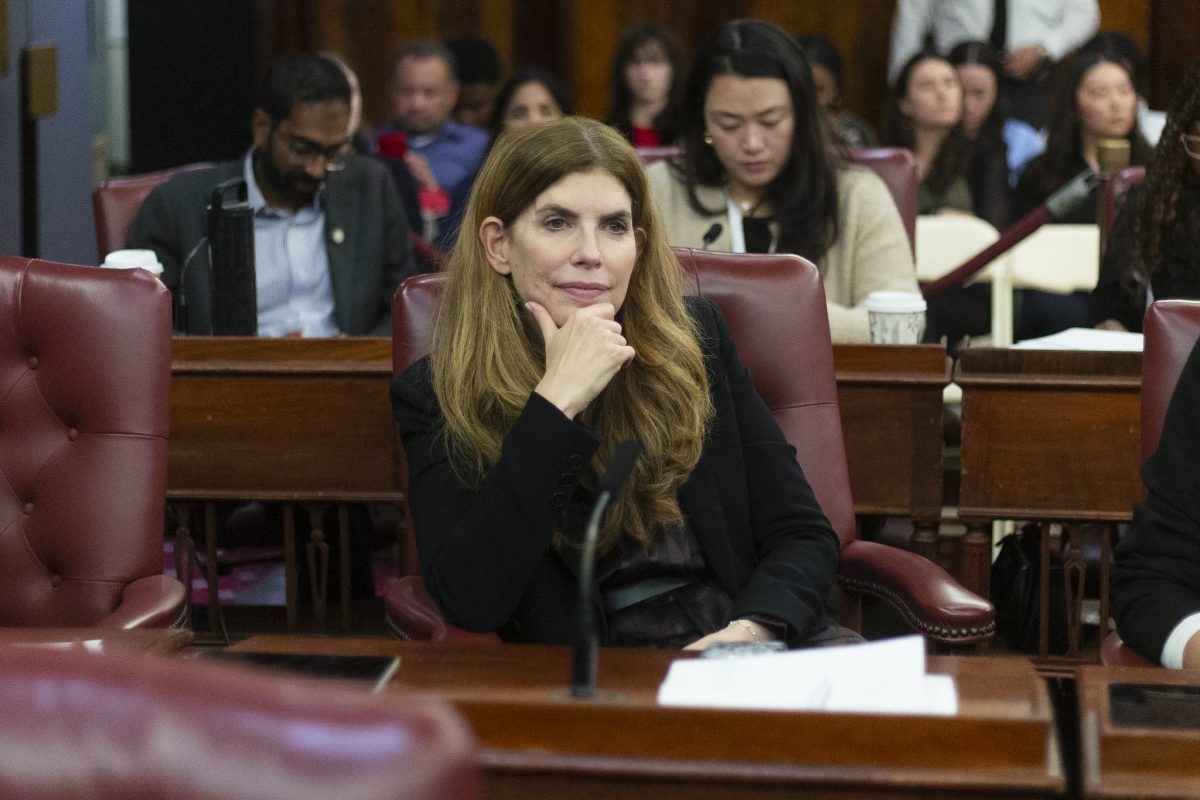
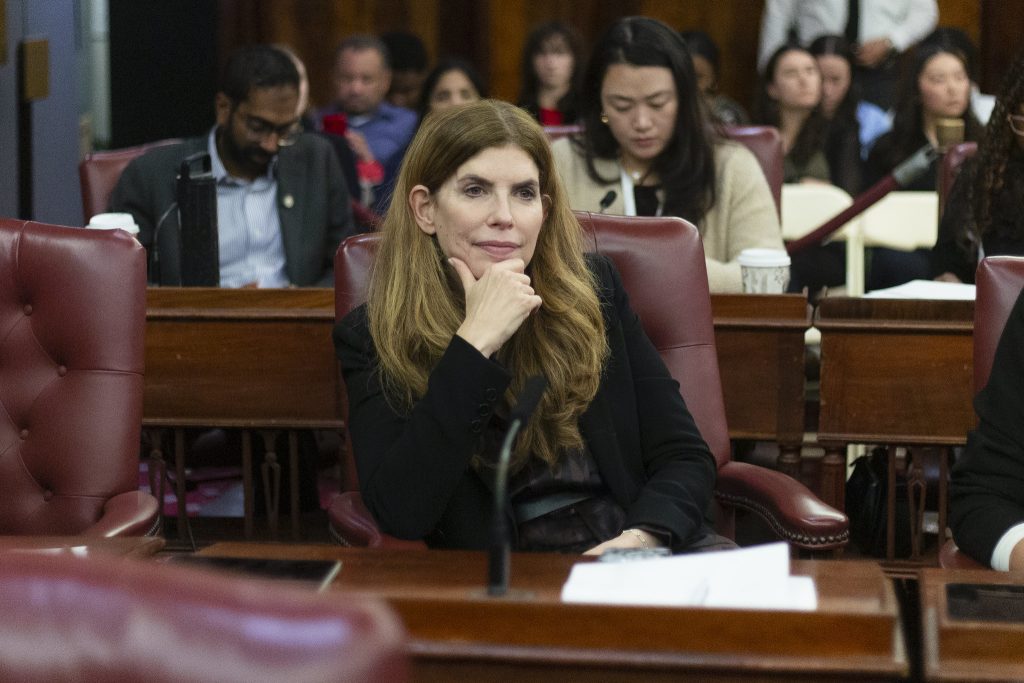
Last Wednesday, November 26, City Council Member Julie Menin announced that she has secured endorsements from 36 of the legislative body’s 51 members, giving her a commanding supermajority that all but guarantees she will be the next speaker.

In the wake of Zohran Mamdani’s mayoral win, five council members had emerged as candidates for the speakership: Crystal Hudson of Brooklyn, Selvena Brooks-Powers of Queens, Amanda Farías of the Bronx, and Menin and Christopher Marte of Manhattan. 

Menin, 58, and Hudson, 42, were seen as the strongest contenders in a secretive campaign that’s often compared to a popularity contest. But within weeks, Menin rallied both moderate Democrats and Republicans, who view her as a check on the mayor-elect, alongside a smattering of progressives to effectively clinch the race— the swiftest result since the speaker’s position was introduced.

Hudson conceded shortly after Menin’s announcement. “I have always said this should be a member driven process; and today, my colleagues have made their choice clear,” the Downtown Brooklyn rep said in a statement. “I am optimistic and excited for the future of [NYC] and look forward to continuing to deliver for the city that we all love.”

So who is Menin, and what will her tenure as speaker mean for New Yorkers?

A Varied Resume

Menin’s long career has included stints in business, government, law, and foundation work, a varied resume that many of her boosters highlighted in their endorsements.

“She’s been a business owner, a nonprofit leader, a Commissioner, and a Councilmember,” said Minority Leader Joanne Ariola. “At every step she’s shown that she can cut through the red tape of city bureaucracy and produce real results.”

Menin was born in 1967 to a painter and a radiologist, and grew up in Washington, D.C., where she would also begin her professional journey as a regulatory attorney in 1992 — two years before her soon-to-be post as city council speaker was officially established.

Corporate law eventually brought Menin to NYC, and in 1999 she pivoted to the food sector, opening a restaurant in lower Manhattan called Vine. When the eatery was damaged during the 9/11 attacks, she launched a new organization: Wall Street Rising, a nonprofit dedicated to rebuilding businesses in the financial district that grew to 30,000 members. (One of its early actions was partnering with Robert DeNiro to pull together the first Tribeca Film Festival in 2002; Bill de Blasio would later name Menin as the city’s “film czar.”)

Menin’s next act was in local government. In 2005, she was elected as the chair of Manhattan’s Community Board 1, a role she kept for seven years. The most significant test of her leadership came when a mosque was proposed near the World Trade Center in 2010, sparking Islamophobic backlash; with Menin at the helm, the board voted 29-1 in favor of the mosque, but pushed for the inclusion of an interfaith community center.

City officials took notice. Following a failed bid to become Manhattan Borough President in 2013, Menin was tapped to run the Department of Consumer Affairs, where she carried out the recently-created paid sick leave law, spearheaded a tax credit for low-income residents, and worked to reduce fines against small businesses. 

But Menin wasn’t one to be restricted to a single niche. Drawing on her time at Wall Street Rising, Menin pivoted again in 2016 to head the Mayor’s Office of Media and Entertainment, brokering a deal to bring the Grammys back to NYC after a 15 year hiatus. Then, as De Blasio’s term came to close, she oversaw the implementation of the 2020 census and won a Supreme Court case to block the Trump administration from including a question about citizenship status.

Menin was elected to the City Council in 2022, representing the Upper East Side and parts of Harlem and Midtown. As with her career, the legislation she’s introduced and sponsored has been varied, with an emphasis on small businesses: bills passed this session ranged from requiring licensing for self-storage warehouses to providing legal services for low-income domestic violence survivors. 

Much of the buzz around Menin’s bid for speaker has cast her as a potential foe to Mamdani, highlighting her Jewish identity and her marriage to a real estate developer. Meanwhile, stalwarts of the City Council’s Progressive Caucus like Brooklyn Council Member Shahana Hanif expressed disappointment that Hudson was snubbed, worrying that Menin would hinder the mayor-elect’s agenda.

But early indicators suggest otherwise. Menin and Mamdani met recently, as reported by Politico, and in an interview last week she stressed their common goals — including “fast and free” buses and creating a Department of Community Safety to shift mental health calls away from the NYPD. 

Menin also reiterated her commitment to building affordable housing on empty lots and above some public libraries, and to expanding NYC Kids Rise, a college savings program she launched while serving under De Blasio.

“With this broad five-borough coalition, we stand ready to partner with mayor-elect Mamdani’s administration and deliver on a shared agenda that makes New York more affordable through universal childcare, lowers rent and healthcare costs, and ensures that families across the city can do more than just get by,” Menin said in Wednesday’s announcement.

What powers will she have as speaker to accomplish those aims?

The Speaker’s Curse

The speaker represents the council as its figurehead, both publicly and in negotiations with the mayor. 

But much of their day-to-day is spent wrangling the chamber, determining its legislative priorities and steering the timeline for hearings and votes. As speaker, Menin will be tasked with hand-picking the heads of committees, and will set the budgets for each council member’s office.

In the past, speakers have also acted as checks on the mayor. Menin will lead talks with Mamdani over the city’s $200 billion annual budget, and has hinted that she could revive the council’s ability to issue subpoenas, a rarely-used tool that was most recently activated in 2021 when the NYPD refused to disclose information about its “Digidog” contract for surveillance robots.

As the second rung of NYC politics, the speaker’s seat has been seen as a stepping stone — with a major caveat. Menin has reportedly said that she has no desire to run for mayor, per the New York Times. If she has a change of heart later into her speakership, however, she’ll face a curse that has dogged her predecessors: of the six previous speakers, five have run for mayor, most recently Adrienne Adams. Few have made a splash, and all have ultimately failed in their bids. 

With Wednesday’s announcement, Menin joins a storied line of Upper East Side politicians who have played starring roles in the speaker race. That list includes Gifford Miller, who presided over a wave of rezonings in the early aughts, but it reaches back even further, to the position’s origins.

In 1985, the retirement of Majority Leader Thomas Cuite triggered a chaotic scramble for succession. Despite some bad blood, council members from Manhattan and Brooklyn formed an alliance to elect Samuel Horowitz, who represented South Brooklyn, as the council’s joint majority leader and speaker. 

Horwitz seemed destined for a coronation. But party leaders in the Bronx and Queens went on their own offensive, ultimately pulling off the unthinkable — in an infamous twist known as the “Dreyfoos Betrayal,” the Upper East Side rep Robert Dryfoos defected from the Manhattan bloc to support the campaign of Peter Vallone, Sr., a council member from Queens. 

Vallone would go on to hold court for 11 years, holding court in the new era after the Board of Estimate was eliminated in 1989 and the speakership was formalized in 1993. Decades later, a Brooklyn council member has yet to become the speaker — and with Menin’s victory over Hudson last month, the drought continues.


GPS Artist Uses Brooklyn As Her Canvas

By JACK DELANEY | jdelaney@queensledger.com

They walk and bike among us, making strange loops in the park and cycling the wrong direction up one-way streets. You may have even honked at them — lost in thought, leaning over their handlebars to check their phones in traffic. 

But for GPS artists like Janine Strong, who recently trekked 93 miles across Brooklyn in a single day, there’s a method to the madness. To them, the objective of exercise isn’t just posting a new PR or burning calories: it’s illustrating on a massive scale.

Strong, a native of Vancouver, CA, has made over 75 drawings since she started cycling seriously in 2019, using the satellite tracker built into the popular fitness app Strava as if it were an Etch-a-Sketch.

Sometimes, Strong picks a site with an idea already in mind — like when she drew a 40-mile-long “Big Apple” that stretched from Midtown to Forest Hills.

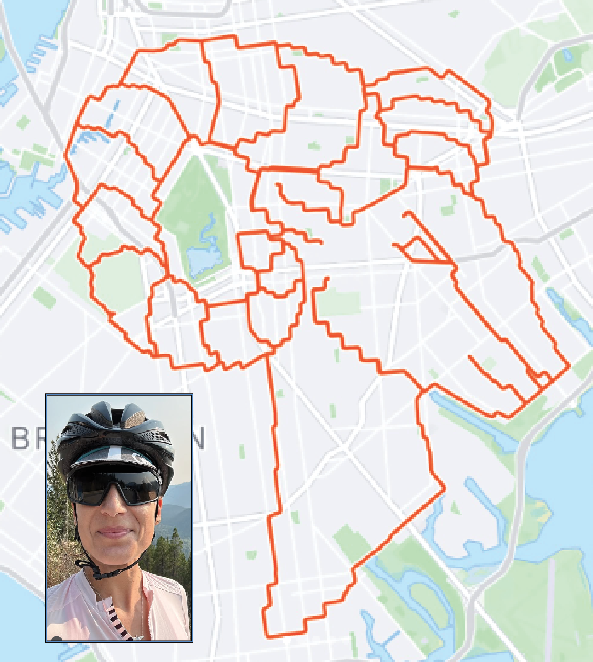
But for her latest creation in Brooklyn, Strong looked for shapes hidden in the map and spotted the makings of a ram. 

“I got so much joy out of feeling like I found something in the streets that has essentially always been there, but has never been revealed before,” she told the Star.

After setting off from Flatbush, Strong quickly fashioned an ear. By the time she left East New York, the head was mostly formed. Fittingly, the neck involved a trip down to Sheepshead Bay. One horn curled around Prospect Park; she had to dismount in Greenwood Cemetery, which she called a “special place,” and stopped to chat with some fellow bikers. Next came the zigzag up to Downtown Brooklyn, before the horn continued its arc through Bed-Stuy and arrived at its base once more in Flatbush.

The sun had long since set: the whole trip took 13 hours and involved a cumulative 2,000 feet of elevation gained.

But this isn’t Strong’s first creative foray in Brooklyn — in fact, it’s not even the first farm animal she’s designed here.

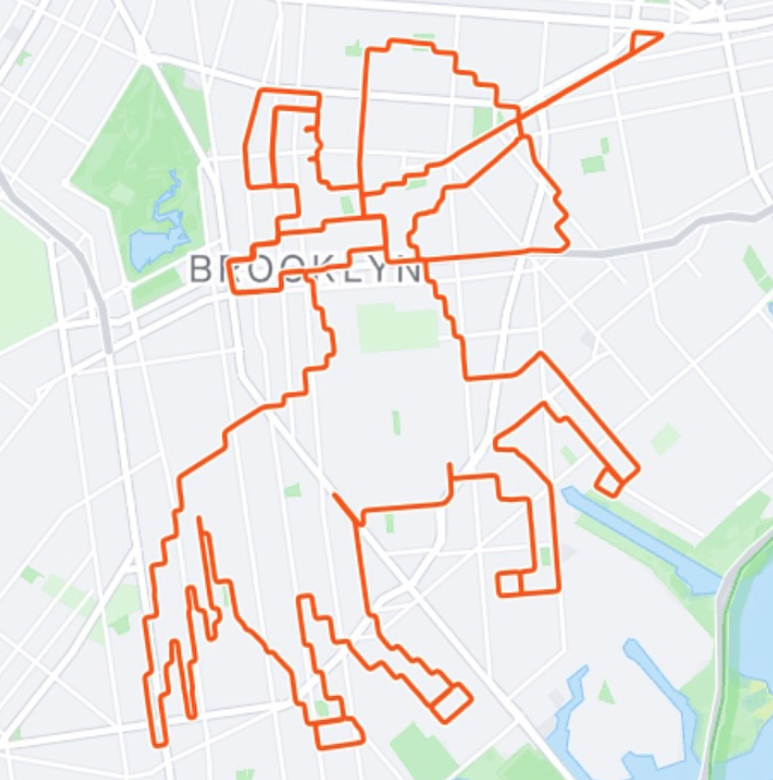
Last year, Strong embarked on a month-long project of drawing the zodiac signs while staying in the borough. In short order, Strong’s bike painted a scorpion, a centaur, the scales of justice, and yes, a goat, on the canvas of Southern Brooklyn.

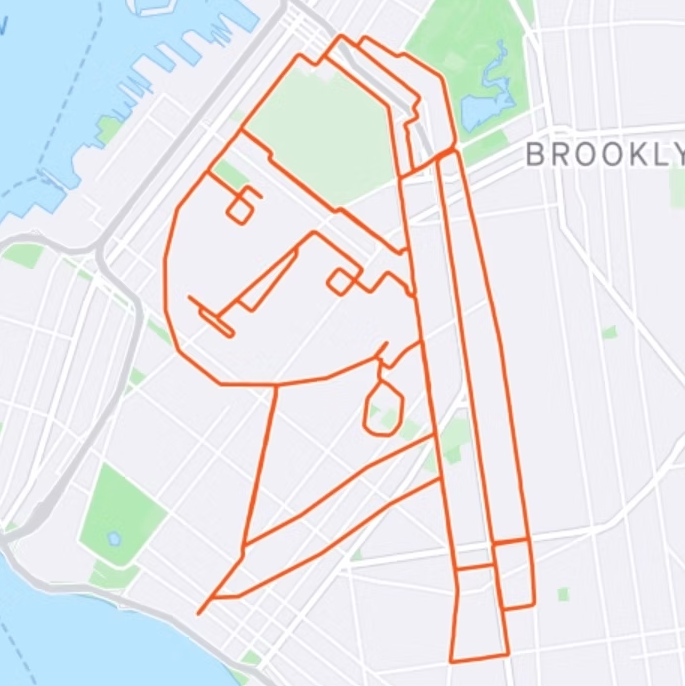
Other local projects have included a rendition of Vermeer’s classic “Girl with the Pearl Earring,” and a replica of another, more dubious masterpiece: “Comedian,” the banana duct-taped to a museum wall by Italian artist Maurizio Cattelan that sold for $6 million in 2019.

“If I’m going to the East Coast, I’ll definitely be spending time in Brooklyn,” said Strong. “It’s one of my favorite places to do GPS art.”

Strong, whose artistic practice also encompasses traditional drawing and photography, sees the constraints of the medium as part of its appeal. “[When I was younger] I would always draw straight with ink on paper, never with pencil,” she said. “Similarly, with GPS art you can’t erase anything. I loved the permanence of having to work with what happens and not change it.”

The community — equal parts obsessive, eclectic, and welcoming — is a deal sweetener. One of the earliest examples of GPS artists was Reid Stowe, who in 1999 undertook a 5,000-mile circumnavigation of the Atlantic Ocean in his sailboat, lasting 194 days without touching land as he slowly drew an enormous sea turtle with data recorded in his logbook. The next year, the US military opened its satellite signals to the public, and a digital iteration of the discipline took off. 

With the advent of fitness apps, a new renaissance is now underway. “We support each other online,” explained Strong. “They’re all over the world, and we all have quite different approaches to things.” One man traces intricate drawing among sand dunes in Brazil; an Australian artist makes all his drawings in the same park, running free-form. In 2022, channeling Stowe, an Anglo-Italian couple brought their dog along as they traveled 4,500 miles to imprint a bicycle across Europe as a protest against fossil fuels.

For those interested in trying GPS art themselves, Strong has some practical advice.

While not essential, gear can make the long, erratic treks less daunting. “One thing that really increased my level of safety and comfort was getting this pair of glasses where there’s a little mirror in the left lens,” she shared. “So with a very short movement of my eye and my head, I can see exactly what’s happening behind me without having to turn my whole head.”

To create curves and diagonal lines, GPS artists often have to work on large scales — much like how pixel artists have to increase the resolution to draw smoothly. But Strong sometimes makes use of a workaround in Strava: if you pause your session and move to a new location before pressing play again, the program will draw a straight line between the two points. (She executed one project, a star upstate in Ithaca, through this method exclusively.)

Strong designs all of her works digitally in the app, but you can also try websites like routedoodle.com and gpsartify.com that allow you to randomly generate ideas. 

If you’re stumped, expand your horizons. “Some of the European cities have amazing canvases,” said Strong. “That’s part of what I love about it: every place is a totally new canvas, and you can’t draw the same thing in a different place.”

Fill the Form for Events, Advertisement or Business Listing