
Soccer Schedule Shift Coming to MLS in 2027

Major League Soccer will join other top leagues playing from Summer to Spring

Noah Zimmerman

noah@queensledger.com

Last Thursday, Major League Soccer’s Board of Governors voted to align the season schedule with that of most top professional leagues worldwide. In 2027, following an abbreviated transition season, MLS will hold matches between late Summer and Spring, with a sizable winter break.

“The calendar shift is one of the most important decisions in our history,” claimed Don Garber, the Commissioner of Major League Soccer. “Aligning our schedule with the world’s top leagues will strengthen our clubs’ global competitiveness, create better opportunities in the transfer market, and ensure our Audi MLS Cup Playoffs take center stage without interruption. It marks the start of a new era for our league and for soccer in North America.”

The move was expected after two years of deliberation, and it’s not one that had unanimous support by teams and fans. Even with the winter break there are concerns regarding harsh weather in cold markets and the loss of some summer matchdays. There’s also the possibility that MLS finds it more difficult to compete with other major sports leagues for attention, both domestically and abroad.

Still, this is a move that primes the league for a new era of continued growth. By lining up with other leagues, MLS can take full advantage of player purchases and sales in the Summer transfer window. It also lets the league avoid conflicts with mid-Summer tournaments like the Gold Cup, though the schedule shift won’t come in time for the 2026 World Cup hosted in the US, Mexico, and Canada.

Between February and May of 2027 the league will hold a shortened 14-game season with playoffs and a MLS Cup Final. Then in mid-July the league will kick off its first season with the new format, playing until the Winter break in mid-December. Matches will resume in early February of 2028, with the regular season terminating in April and the 2027-28 playoffs in May.

What’s the benefit to the league?

First and foremost, Major League Soccer will see a drastic change in their ability to maximise both the summer and winter transfer windows. In most seasons MLS clubs have faced difficulty not only signing top talent but integrating them into their lineups. Additionally, it’s often been difficult for clubs to sell their promising young talents to bigger clubs without derailing their season. 

With the summer transfer window (usually running from June/July until early September) directly in the middle of the MLS season, it’s difficult for new signings to find their feet and mesh with their new clubs.

Now new Summer signings can participate in preseason training and Winter signees won’t need to wait months for matches to begin after leaving their clubs in the middle of an active season.

Playing from the Summer through the Spring is not out of the question and it’s something done by plenty of local soccer leagues. In the New York Metro area the American Premier Soccer League (APSL) and Cosmopolitan Soccer League (CSL) have both played along similar schedules for years, with a Fall season running from September to December and the Spring season taking place between March and June.

Despite the frigid winters, play is still possible with only a handful of postponements due to inclement weather and snow-covered fields. Some leagues even hold cup tournaments in late January and February, two months that will be avoided during the MLS season’s Winter break.

Are there any major drawbacks?

Of course the Winter weather will always be a concern, as matches are already played on snow-covered fields and sometimes in subzero temperatures. Just earlier this year, Sporting Kansas City hosted Inter Miami CF in a CONCACAF Champions Cup match in late February with temperatures under 4 degrees.

Fans of teams like Toronto, Montreal, New York/NYC, New England, and Colorado will be bracing for the effects of the schedule shift. Many of those clubs face sparse attendance in the colder parts of the current season structure and rely on Summer games to make up for the lost revenue. Now without many of those warmer weather games (especially for clubs who miss the postseason) it may lead to even worse attendance issues.

This also brings into question if the new schedule will provide an unfair advantage to teams in big southern markets such as Los Angeles, Miami, and Atlanta. It’s unclear if the league will schedule more home games for those clubs during the colder months to help avoid cancellations and sparse attendance, but if they do it could lead to some clubs going months without a single home game.

Another possible negative impact is in regards to media share and attention. With MLS competing with the NBA, NFL, NHL, and other major soccer leagues, it may limit the league’s ability to draw and keep eyes on their product. Many clubs play in markets with popular basketball, hockey, and football teams, meaning that fan focus may not fall on the soccer pitch during a majority of the season. 

For many of those fans, it’s easier to mix soccer in with a baseball season featuring well over 100 games rather than miss more pivotal matchups in other sports. How they’ll react once the schedule is updated remains to be seen, but it doesn’t bode well given MLS.

What does this mean for New York City FC?

With the schedule change coming the same year as the grand opening of Etihad Park in Queens, questions are already flying regarding what that means for the new stadium. Will there be extra efforts to provide heating? Will there be new efforts to weather-proof the facility? Will the stadium be available for the 2027 transition season or will it wait to open doors until the 2027-28 campaign later in the year?

So far the club has remained tight-lipped about the impacts to their new stadium. Still, the front office has voiced clear support of the schedule shift, noting its benefits especially in major soccer markets.

“Soccer is already seeing incredible levels of growth in North America, and aligning the League’s schedule to follow the international calendar provides us with the best opportunity to continue building off this momentum,” said New York City FC CEO Brad Sims following the league’s announcement. “Especially with the much-anticipated FIFA World Cup 26 coming next summer, followed shortly by the opening of our future home in Etihad Park, this decision could not come at a better time.”

New York City FC alluded that an official update on their new stadium’s availability for 2027 will come in the future, but it’s not likely they’d pass up an opportunity to finish completing the stadium for a full season rather than rush the finishing touches in time for an abbreviated one.

Apple TV deal drops paywall

Another piece of MLS news this past week was that Apple TV will no longer charge for the MLS season pass, dropping a paywall that limited the league’s reach during a valuable period of growth. Fans will still need an Apple TV subscription to enjoy matches, but without the extra $80 ($100 for those not subscribed to Apple TV) per year, the league will be far more accessible across the country and beyond.

This is a move that should do well to combat the competition with more popular sports throughout the MLS season, but the requirement still does limit the league’s reach beyond Apple TV subscribers. Apple has done relatively well to broadcast all Major League Soccer contests, but it’s difficult to ignore a lack of MLS presence outside of their platform. 

Hopefully with the calendar adjustment and lack of additional paywall Major League Soccer can pick up some new momentum, especially with the World Cup kicking off in 2026.
Green Asphalt to Pause Operations After Complaints in Greenpoint, LIC

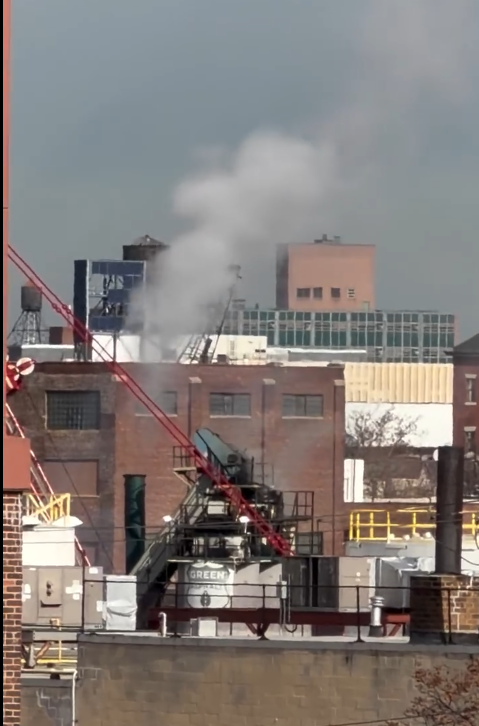
Green Asphalt’s low smokestack. Photo via @shut_down_green_asphalt_lic on Instagram.

After years of polluting Greenpoint, a plant billed as climate-friendly is closing temporarily for safety modifications. What took so long?

By COLE SINANIAN

news@queensledger.com

Green Asphalt, an asphalt recycling plant in Long Island City that’s caused noxious air pollution in Greenpoint and Blissville for years, will likely cease operations on December 11 until it completes an extension of its smokestack. 

Green Asphalt CEO Michael Capasso committed to closing the facility in a phone call with state regulators and local elected officials earlier this month. The news came after the New York Department of Environmental Conservation (DEC) had fined the company $124,000 for years of spewing foul-smelling fumes from its low smokestack into the surrounding neighborhoods, and for failing to submit emissions monitoring reports between 2019 and 2023. State regulators say doubling the smokestack from its current 45ft to 90ft will help reduce pollution at street level. 

“Raising the stack height will improve dispersion of air emissions that historically have contributed to odor complaints in the surrounding community and will ensure that emissions meet stringent environmental standards,” wrote DEC communications specialist Adanna Roberts in an email statement. 

A real headache 

According to City councilmember Lincoln Restler, the company has yet to submit construction plans to the Department of Buildings. In a series of text messages, Capasso confirmed that construction of the smokestack had yet to start as of November 16, and it is unlikely that the smokestack would be complete by the December 11 deadline. 

“It hasn’t started and it doesn’t look like it will be ready to be raised by Dec 11,”  Capasso wrote. “Unfortunately there will be numerous employees laid off and will be out of work.” 

But to Greenpoint and Blissville residents, who’ve submitted hundreds of complaints to the DEC and repeatedly called Green Asphalt to no avail, the news is a welcome development after years of tar smell choking their streets and wafting through their windows. 

“It smells like burning tires,” says Thomas Mituzas, a lifelong Blissville resident with deep family roots in the neighborhood. “When you’re outside, it gets in your throat, your eyes, you taste it on your tongue, on the back of your throat.” 

Mituzas lives with his 96-year-old great aunt in a house that’s belonged to his family since 1907. Blissville and neighboring Greenpoint are industrial areas full of heavy industry, so Mituzas is no stranger to weird smells in his neighborhood. 

But since Green Asphalt first opened in 2011 at 37-98 Railroad Ave, he says the smell coming from the plant has gotten worse. When the wind blows in the right direction the clouds wafting from the low smokestack cause poor air quality and health issues at street level, Mituzas said.

It has a particular effect on his elderly aunt, who likes to enjoy her time outdoors. 

“She has to sit down,” Mituzas said. “She’s 96.  She’s a very active woman so she likes to go outside. And if the wind is blowing the right way, she can’t go outside. She can’t breathe.” 

Jens Rasmussen lives less than a mile from the plant with his wife and toddler, on the other side of Newtown Creek. A 30-year Greenpointer, Rasmussen said the smell is especially bad over the summer, and that while there are numerous air quality issues in Greenpoint, Green Asphalt’s contribution is particularly egregious. 

“It’s overpowering, like someone is pouring asphalt in your house,” Rasmussen said. 

Between Green Asphalt and DKN Ready Mix, a nearby concrete supplier that’s also made the news for its pollution, Rasmussen says the air quality in Greenpoint is among the worst it’s been since he’s lived in the neighborhood. 

“These companies are not good neighbors,” he said. “They’re happy to externalize their pollution and their costs to the community instead of taking reasonable and appropriate actions to make their facilities safe for the people nearby.” 

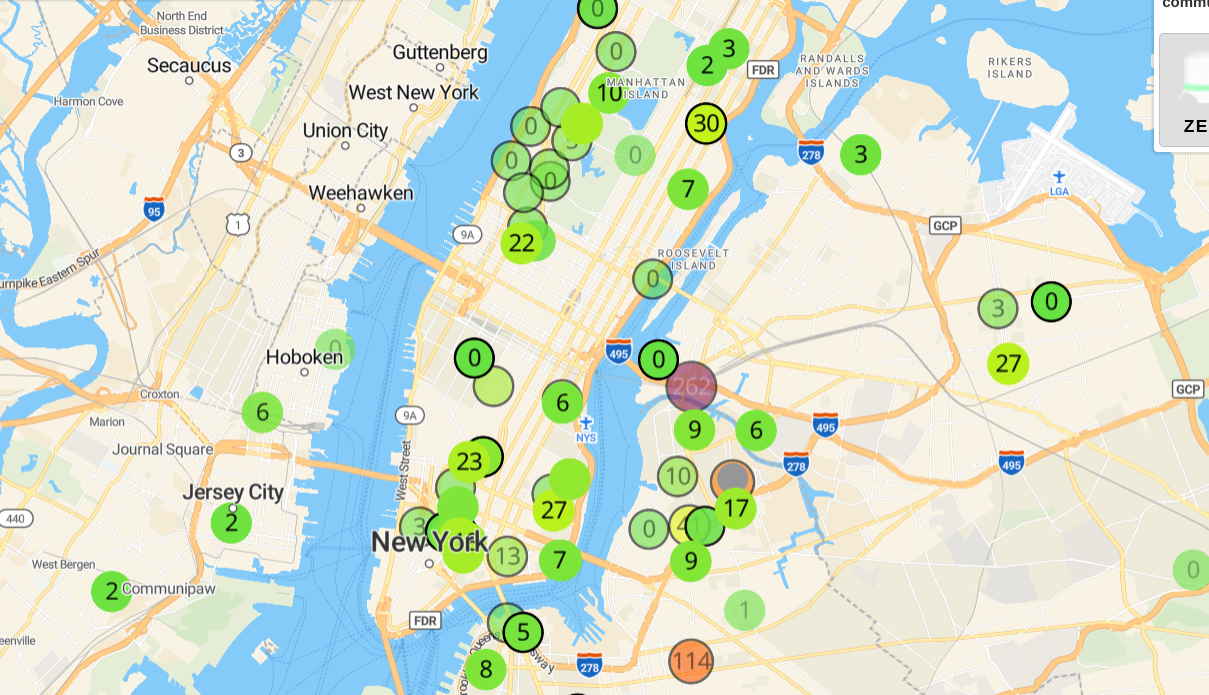
Green Asphalt’s official operating hours are 6am-2:30pm, but neighbors say the plant will often operate in the evenings as well. The evening of Wednesday, October 29, Mituzas, said, was particularly bad. A website built to track Greenpoint air quality complaints submitted to the DEC shows an enormous spike on October 29, with a total of 110 complaints submitted in a single day, 60 of which were first-time reporters. 

In meetings with residents and elected officials, Green Asphalt management has denied that the plant is the source of the smell. But residents say it’s obvious, as its emissions are perfectly visible. An Instagram page called shut_down_green_asphalt_lic documents the plant’s fumes almost daily. 

Online air quality monitor purpleair.com shows Greenpoint as having some of the worst air quality in the city.

Recycled Pavement

The Green Asphalt plant in LIC has been operational since 2011, and was originally built to produce 100% reclaimed asphalt pavement, or RAP, a kind of paving substance composed only of recycled materials. According to Green Asphalt, the plant is the first of its kind in the country. 

Since its opening, Green Asphalt has worked closely with City and State agencies to help maintain roads and ensure sustainability goals are met. In 2013, the company was awarded a pothole repair contract by the NYC Department of Transportation (DOT), filling potholes throughout the five boroughs with its recycled asphalt. Later that year, the company participated in a DOT pilot project testing the efficacy of fully recycled asphalt in paving roadways. The DOT owns and operates two asphalt plants— one on Northern Boulevard in Queens, and another on Hamilton Avenue in South Brooklyn. Combined, these city-owned plants produce 75% of the asphalt used by the City. The rest of the City’s asphalt is supplied by a handful of private producers, like Green Asphalt.

Green Asphalt has played a major role in the City’s road maintenance and sustainability operations. Per its website, the company has provided two million tons of recycled asphalt to the New York City Metro, producing approximately 100,000 tons of asphalt per year and turning a $10 million annual profit. 

“We’re just looking for an opportunity to provide that benefit to the City of New York while reducing carbon footprint emissions all at the same time,” CEO and owner Michael Capasso at a January 2025 meeting of the City Council’s Committee on Transportation and Infrastructure. 

Capasso is well-connected at both the local and national level. In 2022 , he was appointed to Mayor Eric Adams’ Capital Process Reform Task Force. And this past summer, he was appointed to the US Department of Transportation’s 12-member Advisory Board by Transportation Secretary Sean P. Duffy. 

Five years too late

Despite the enormous volume of complaints submitted to the DEC, it took years for state regulators to pursue enforcement against Green Asphalt, filing a consent order only after State assemblymember Emily Gallagher’s office collected and submitted her constituents’ complaints to the DEC. Gallagher organized a town hall about the Green Asphalt plant at Greenpoint’s Polish Slavic Center on September 16, the same day that the DEC issued its consent order. Along with Gallagher and Capasso, DEC reps attended the meeting, as well as councilmember Restler and State Senator Kristen Gonzalez, in addition to 150 members of the public. 

Mituzas, who also attended the town hall, said Capasso personally called him the night before the meeting in an attempt to assuage his concerns about the company’s activity. Mituzas, having previously spent years sending emails and calling Green Asphalt to no response, was unimpressed. 

“What I said to him was, ‘you’re about five years too late, my friend,’” Mituzas said. 

According to Restler, the company had previously committed to extending its smokestack earlier this year. 

“They have been telling us for the better part of a year that they were going to imminently submit plans to the Department of Buildings to double the height of the smokestack and address this issue,” Restler said. “I’ll believe it when it happens, and not a moment before.” 

Once plans have been submitted to the Department of Buildings, Restler said, construction on the smokestack should take only a few weeks. But in an email statement to the Star, Green Asphalt Chief Marketing Officer Kerianne Melillo called the smokestack extension a “complicated construction endeavor.”  

“We are working with engineers to finalize a design that complies with local statues and achieves the desired result,” Melillo wrote. 

Once the smokestack  is complete, Green Asphalt must begin to submit DEC-approved emissions testing to ensure no toxic contaminants are released into the community. In her email statement, Roberts clarified that a complete assessment of the facility and the health threats it may pose to the community will be conducted after the new stack  is complete. 

“By collecting measurements from the stack and locations of potential fugitive releases, DEC will gain a more complete picture of the operations at the facility to address the community’s concerns,” she wrote. 

Roberts added that Green Asphalt conducted an odor-sampling assessment in 2024 and found “reduced sulfur compounds,” which are known for their smell, and that a more rigorous assessment was needed and would be conducted in January 2026. 

In his text messages to the Star, Capasso insisted that his company had already submitted test results to elected officials. But according to Restler, the data that Capasso provided via email was unsatisfactory. 

“I don’t put a ton of faith in that dataset,” Restler said. “It was conducted by ownership without any independent health experts advising on the methodology and rigor.” 

Restler said his office is currently working with the Newtown Creek Alliance, a local environmental group, and an NYU professor to conduct an independent test of Green Asphalt’s emissions in the coming weeks.  

“The most important thing at this stage in the process is that Green Asphalt is shutting down in less than four weeks,” Restler said. “And I am optimistic that their fix will address the issues that have caused such concern in our community.” 

Fill the Form for Events, Advertisement or Business Listing