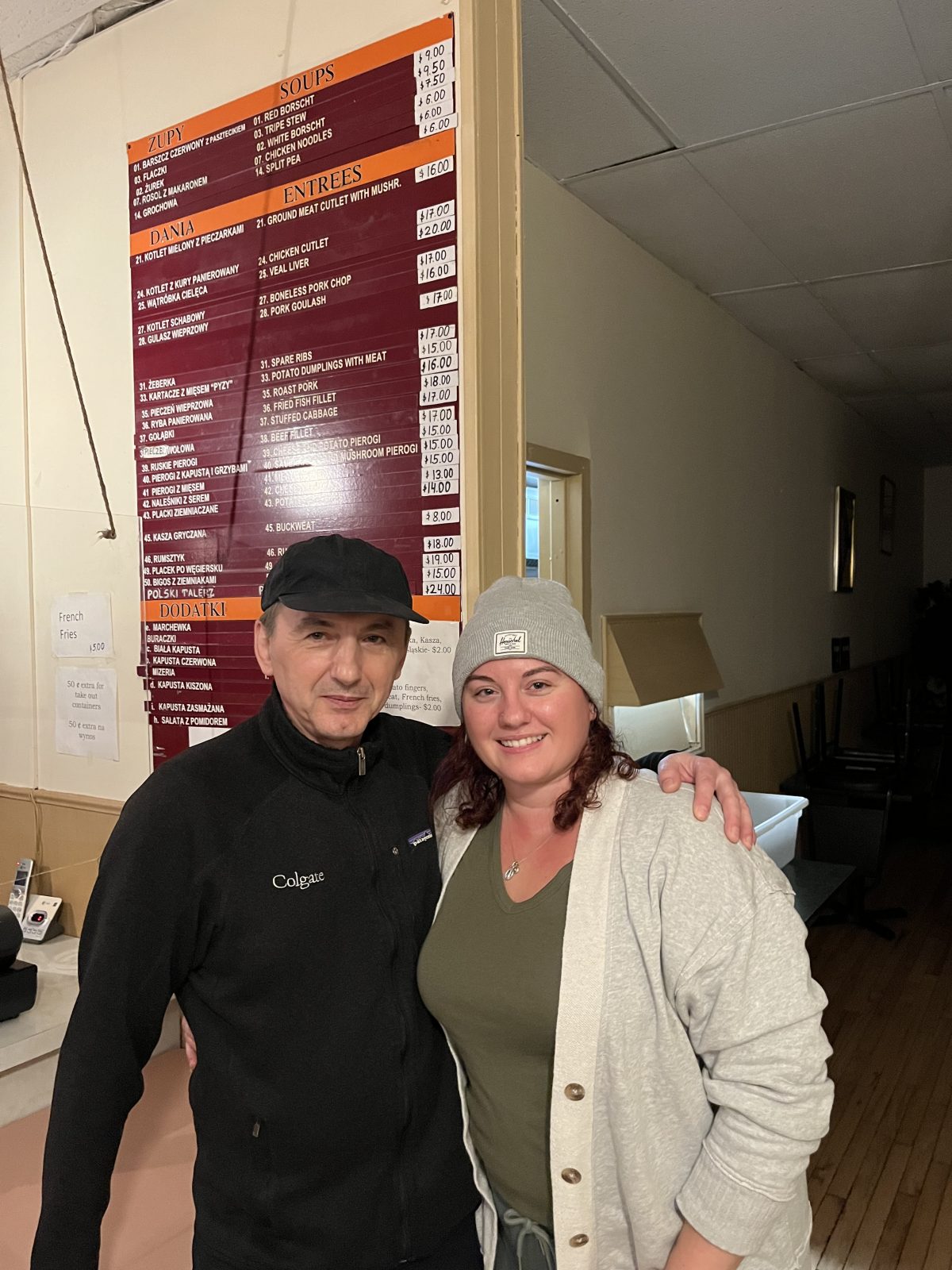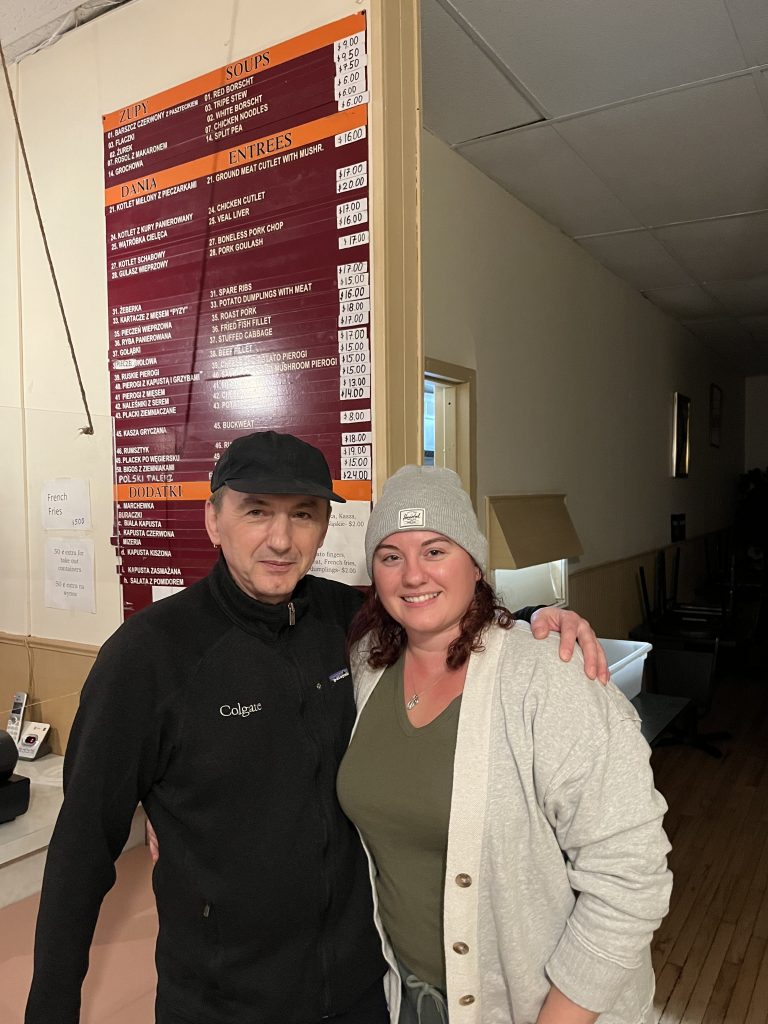
Izabella Prusaczyk and her father, Marek Prusaczyk. Marek came to Greenpoint from a small town in the north of Poland in the early 90s. He opened Pyza, a Greenpoint staple serving traditional Polish food, in 1993.
Greenpointers trace a beloved enclave’s colorful past and uncertain future.
By COLE SINANIAN
news@queensledger.com
Izabella Prusaczyk remembers the Pulaski Day parade of her youth. Everyone was out on the street in Greenpoint speaking Polish, the red and white of the Polish flag painting their faces and hanging from the cars that did donuts in gas station parking lots. Poles would crowd the delis, subway cars and street corners on Greenpoint, Nassau and Manhattan Avenues, out to show pride for their homeland in what was then America’s preeminent Polish enclave. When her father, Marek, arrived from Poland in the early 1990s, he spoke no English, but had no trouble finding his way in Greenpoint, where he now operates a restaurant called Pyza, named for its specialty in pyzy, a kind of Polish dumpling.
“It really felt like the city was ours,” Prusaczyk said.
Polish-American NYU student Sebastian Staskiewicz was born in Greenpoint and spent his early childhood on Diamond Street. The Polish community here back then was tight-knit. He recalls grocery shopping with his Polish grandma, who spoke no English but had no trouble communicating with her neighbors and shopkeepers in the majority Polish-speaking community. Polish flags hung from storefronts and almost every corner was a Polish-owned bakery, deli or butcher shop.
“It was a very friendly community,” he said. “She would push me on a stroller and every block or so we had some sort of friend or relative that we could wave ‘hi’ to at the local deli. For her it was much easier in that sense because she could still use Polish to navigate and live within the US.”
Alain Beugoms, current principal of PS 34 on Norman Ave, was just beginning his teaching career in 2002, and remembers the Greenpoint of this era as one of New York’s most vibrant ethnic enclaves.
“It was almost like a Chinatown kind of experience,” he said. “Many people on the street speaking Polish, many stores and little restaurants and little shops, bookstores in Polish, all serving the Polish community.”
In 2025, Greenpoint’s Polish heritage is not so easy to spot. Nowadays, English is more commonly heard than Polish, and many Polish businesses have disappeared, replaced by American chains, cafes and now, cannabis dispensaries. Beloved Polish butcher shops and specialty supermarkets peddling smokey kielbasa, blood sausages and other Polish delicacies have closed their doors as corporate supermarket chains have moved in. Meanwhile, an influx of wealthy professionals who began moving to Williamsburg in the 2000s has spilled over into Greenpoint, while higher housing costs and luxury residential towers have followed, forever altering the neighborhood’s once working-class, predominantly immigrant character.
“I always saw someone I knew at the store I’d go to to get deli meats,” Prusaczyk said. “Now it’s a weed dispensary. We’re really on the decline here.”
“Everything is so expensive now,” continued Prusaczyk, who works with her father and her mother, Grazyna, at Pyza. “People get mad at us for our prices being so high, but I’m like, do you know where you are? There’s avocado toast for $18 down the block.”
But although many members of Greenpoint’s original Polish community have left — often moving either to the suburbs or back to Poland, where economic conditions have improved drastically since the fall of the Soviet Union — others stayed to raise families with children now growing up as Polish Americans, whose presence continues to influence neighborhood life through their cuisine, customs, and language.
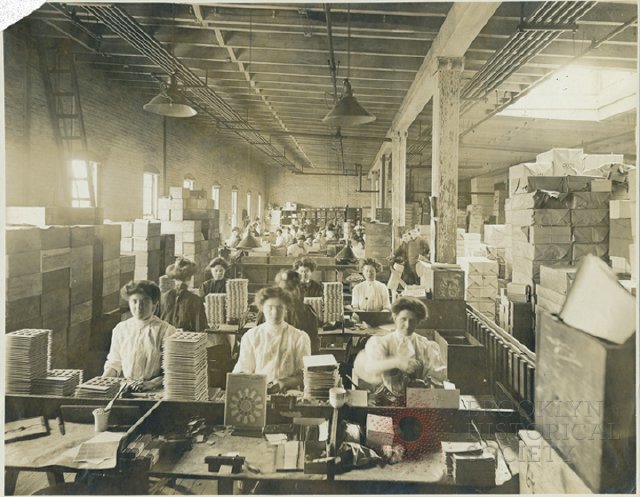
A view inside the Eberhard Faber pencil factory on Kent Street in 1915, after the first peak of Polish migration to Brooklyn in the 1890s. Courtesy of the Brooklyn Historical Society.
Poles in America
Polish immigration to America reached its peak in the 1890s. By the 1920s, more than 2 million Poles had immigrated to the US, according to the Library of Congress. Many of these early arrivals were economic migrants and political refugees, working as steelworkers, miners, meatpackers and autoworkers and congregating in enclaves in America’s industrial centers.
Later, a subsequent wave of Polish immigrants arrived after the fall of the Soviet Union in the 1980s and 1990s. A New York Times report from 1984 counted 50,000 people of Polish descent living in Greenpoint. These were economic migrants as well, mostly younger, educated people who took low-paying, working class jobs with intentions of saving money and eventually returning to their country once conditions there improved.
“Our 80s in Poland in the 20th century were truly devastating,” said Mateusz Sakowicz, the Polish Consul General in New York. “There were no products on the shelves and you could barely make ends meet. People had to line up to buy diapers.”
According to Sakowicz, Greenpoint’s “Little Poland” era peaked in the early-mid 2000s. In addition to gentrification and rising housing costs, Sakowicz partially attributes Little Poland’s decline to Poland’s 2004 entry into the European Union, which brought the country unprecedented economic growth and facilitated easy immigration to other European nations. Since 2004, Polish immigration to the US has slowed to a trickle.
“Finally my country has much more to offer, and it’s actually a preferable place to be, in particular if you’re of Polish origin,” Sakowicz said. “And if they were deciding to emigrate, people were choosing different states, closer to home,” he continued.
Partly as a result of Poland’s economic growth — with the country’s GDP having grown by 300% between 1989 and 2024, according to a report from Wrocław University in Poland — more people of Polish origin are returning to Poland than are leaving the country.
Meanwhile, many of the Polish economic migrants to Greenpoint of the 1980s have since moved on, having kids in Greenpoint, then purchasing homes outside the city. This is precisely what Staskiewicz’ family did, moving to Linden, New Jersey while Staskiewicz was in elementary school. Other family members moved to Long Island and Pennsylvania, Staskiewicz said, chasing better affordability and a higher quality of life to raise their families. Many of Prusaczyk’s childhood friends moved to Masbeth, Middle Village, or further out on Long Island.
Little Poland lives on
Like much of Central and Eastern Europe, Poland is a deeply Catholic country. St. Stanislaus Kostka Church on Humboldt Street, founded in 1896, remains a community hub. Staskiewicz attended Sunday mass here with his family as a kid, while Prusaczyk, now in her 30s, regularly goes to mass conducted in Polish by Pastor Grzegorz Markulak. On December 7 at 5:30pm, the church will host a screening of Triumph of the Heart, a Polish language film that tells the story of Maximilian Kolbe, a priest who was killed at the Auschwitz concentration camp.
Given Poland’s deep Catholicism, it should be unsurprising that Greenpoint’s Polish community is most visible around Christmas and Easter.
In Polish culture, Christmas is traditionally celebrated on December 24, not December 25. And the Christmas Eve meal contains no meat. The holidays are a busy time at Pyza, Prusaczyk says, with Polish and Polish Americans coming from all over the tri-state area to pick up their special orders. Many are loyal customers who’ve since moved out of Greenpoint, usually to Masbeth or further out on Long Island. One Polish woman named Eva was once a Pyza regular but now lives in Connecticut. Still, she comes without fail every Christmas Eve to order Polish Christmas specialties like krokiety (croquettes), saurkraut, kapusta (cabbage) and mountains of pierogies. Some years, Pyza sells more than 3,000 pierogies over Christmas.
On Easter, baskets are packed with food and gifts, and local Poles line up outside St. Stanislaus’s to have them blessed by a priest, part of a tradition called Święconka that dates back to the 7th century. This confuses many tourists and non-Polish Greenpoint residents, Izabella says, who raise their eyebrows at the long line of people carrying their baskets outside the church.
For Sakowicz, the Polish General Consul, it is the long queues that form around the holidays outside bakeries like Syrena, Cafe Riviera, and others serving Polish bread and pastries, that most remind him of Poland.
“Maybe they expect communism a little bit,” he said. “Because in communism, there was scarcity of products and oftentimes they’d have to line up for a day and a half.”
Sakowicz, who’s lived in America since 2011, currently resides on the Upper West Side, although he commutes to Greenpoint regularly to get his haircut at his favorite Polish salon. During the warmer months, he says you’re most likely to hear Polish spoken in Greenpoint during the evening, as the sun is setting over the Manhattan skyline and most people are doing their shopping.
“You have many Poles that would leave Greenpoint, but still go there every now and then to do a routine,” Sakowicz says. “You have your favorite hairdresser, you want to go and gossip.”
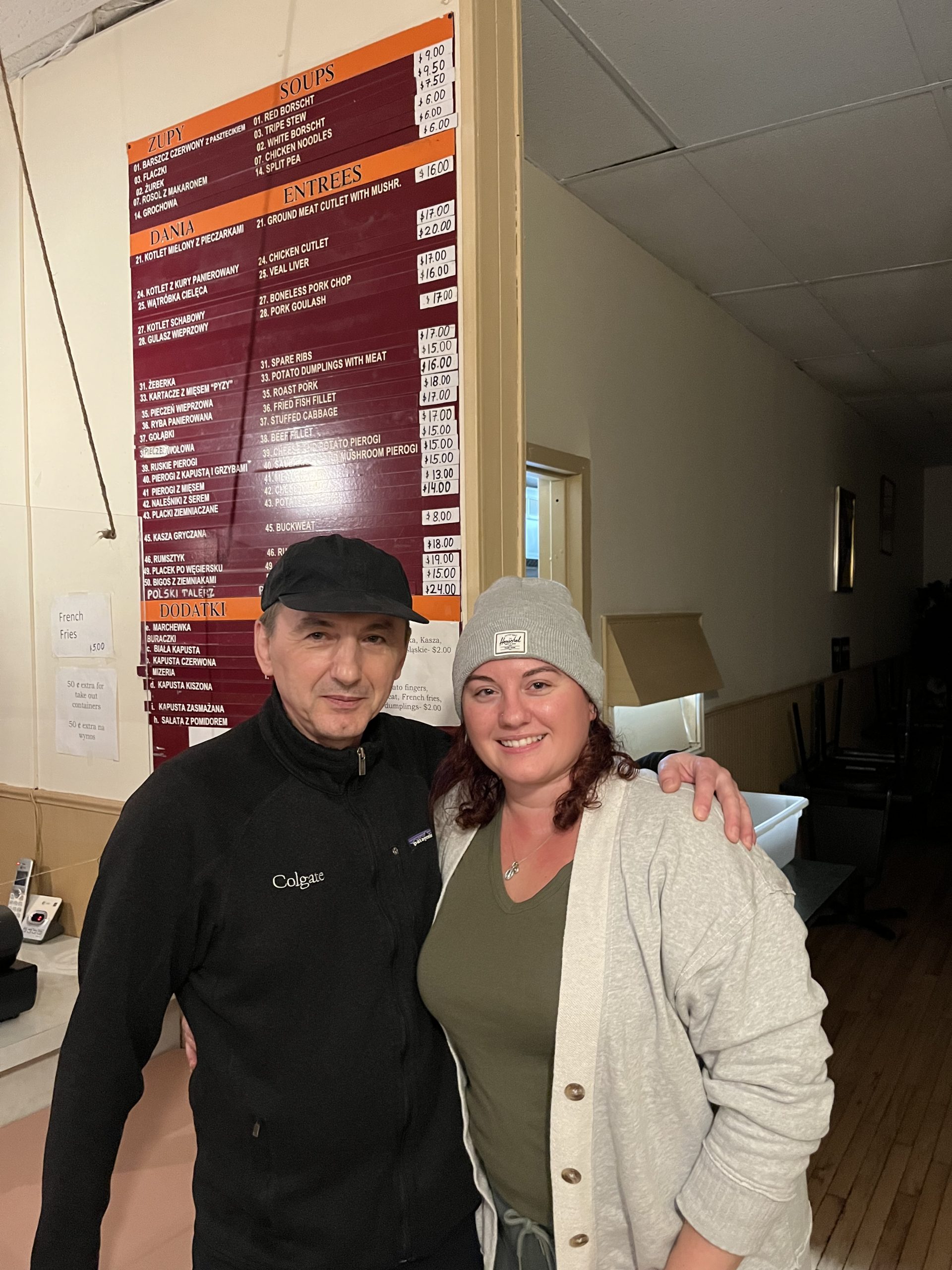
Izabella Prusaczyk and her father, Marek Prusaczyk. Marek came to Greenpoint from a small town in the north of Poland in the early 90s. He opened Pyza, a Greenpoint staple serving traditional Polish food, in 1993.
New Opportunities
Back in the 1980s and 1990s, many of the Polish immigrants to Greenpoint took blue collar jobs below their education levels, in fields like construction, manufacturing and caretaking that allowed them to work without English fluency. But nowadays, the comparatively few Polish people coming to New York are of a different class entirely, Sakowicz says.
“It’s not a blue collar migration,” he said. “These people that decide to pursue their careers in the US these days are highly qualified, skilled and educated people. We’re talking Wall Street, IT, AI, arts, these kinds of fields of work.”
And conversely, the Polish government finances internships and visa programs to Americans of Polish origin, offering them the chance to work, live for a while and perhaps emigrate for good to the country of their heritage. This is, of course, much easier if you speak the Polish language.
Along with Staskiewicz, Polish student Max Miniewicz runs the Polish and Eastern European Society at NYU. Originally from Warsaw, Miniewicz came to New York three years ago to study, now getting his Master’s in Economics. The first time he visited Greenpoint, he saw traces of Poland, but did not initially see it as the vibrant Polish enclave he had heard about.
But as he explored the neighborhood more, its Polish soul started to reveal itself. He recalls a time he took a Polish classmate on a tour around Greenpoint. They got coffee, pastries, and went to a few bookstores, speaking to each other in Polish the whole time. In each of these places, Miniewicz said, as soon as the cashier heard them speaking Polish, they’d start speaking Polish too. This was the case even in American chain restaurants and seemingly non-Polish establishments, suggesting to Miniewicz that much of the Polish community from the golden era of Little Poland remained, but their businesses had been swallowed and absorbed by American establishments.
“We spent a few hours walking around, and we were shocked by how many places were like this,” Miniewicz said. “I think a lot of those Polish people are still there, but they’re just like kind of hidden and working for American businesses.”
For Beugoms, the principal at PS 34, language is a key to unlocking the community’s Polish heritage. In 2015, under former principal Carmen Asselta, the school launched its Polish-English dual language program. Now in its eleventh year, about a quarter of the student body is enrolled in the program, Beugoms says. Students progress from kindergarten to fifth grade in a mirrored classroom, with everything written in Polish on one side and English on the other. The bilingual teachers in the program guide students through math, science, social studies and literature in both Polish and English, paying special attention to Polish historical figures like Marie Curie and Copernicus. And every student, Beugoms says, Polish or otherwise, knows what a pierogi or a pączki (donut) is.
“It unlocks a door to culture,” he said. “Language might appear to be a barrier from someone accessing a new culture, but when you learn, even in small increments, you start to unlock things.”
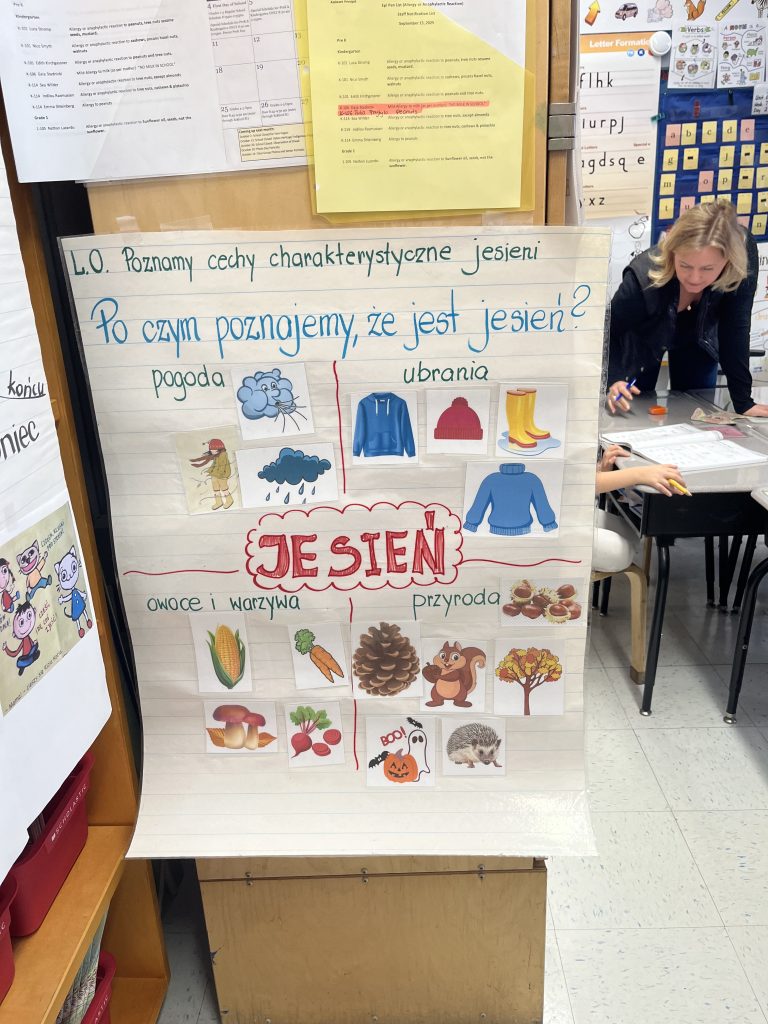
Inside PS 34’s Polish-English dual language classrooms, students learn literature, science, math and social studies in both Polish and English, with a special focus on Polish culture.
For some Polish-American parents who’ve lost touch with their heritage, the program provides a new motivation to learn (or re-learn) the language of their family through their children. Beugoms recalls one parent of Polish descent who didn’t grow up speaking Polish. But both of her children are in PS 34’s dual-language program, and for a parent-student read-aloud the school hosted one year, she came ready with a Polish book in-hand.
“The Polish that she heard as a kid from her grandparents was coming back to her,” Beugoms said. “So she came with a book and said ‘don’t judge me.’”
Although the program is mostly made up of Polish heritage students, many of whom speak Polish at home, others aren’t Polish at all. The school holds a celebration for Polish children’s day on June 1st. One year, a non-Polish fifth grade student who’d been in the program since kindergarten, gave a presentation on Copernicus, in near-fluent Polish, to a room full of stunned Polish parents.
And with more Poles returning to Poland than ever, the program has another purpose: preparing Polish students for life in Poland, should they decide to return.
“I’ve had students from this program move to Poland, and then the parents write me an email stating how the school in Warsaw was impressed,” Beugoms said. “There’s a lot of opportunity in Poland nowadays, so it’s attracting a lot of folks back.”